Description
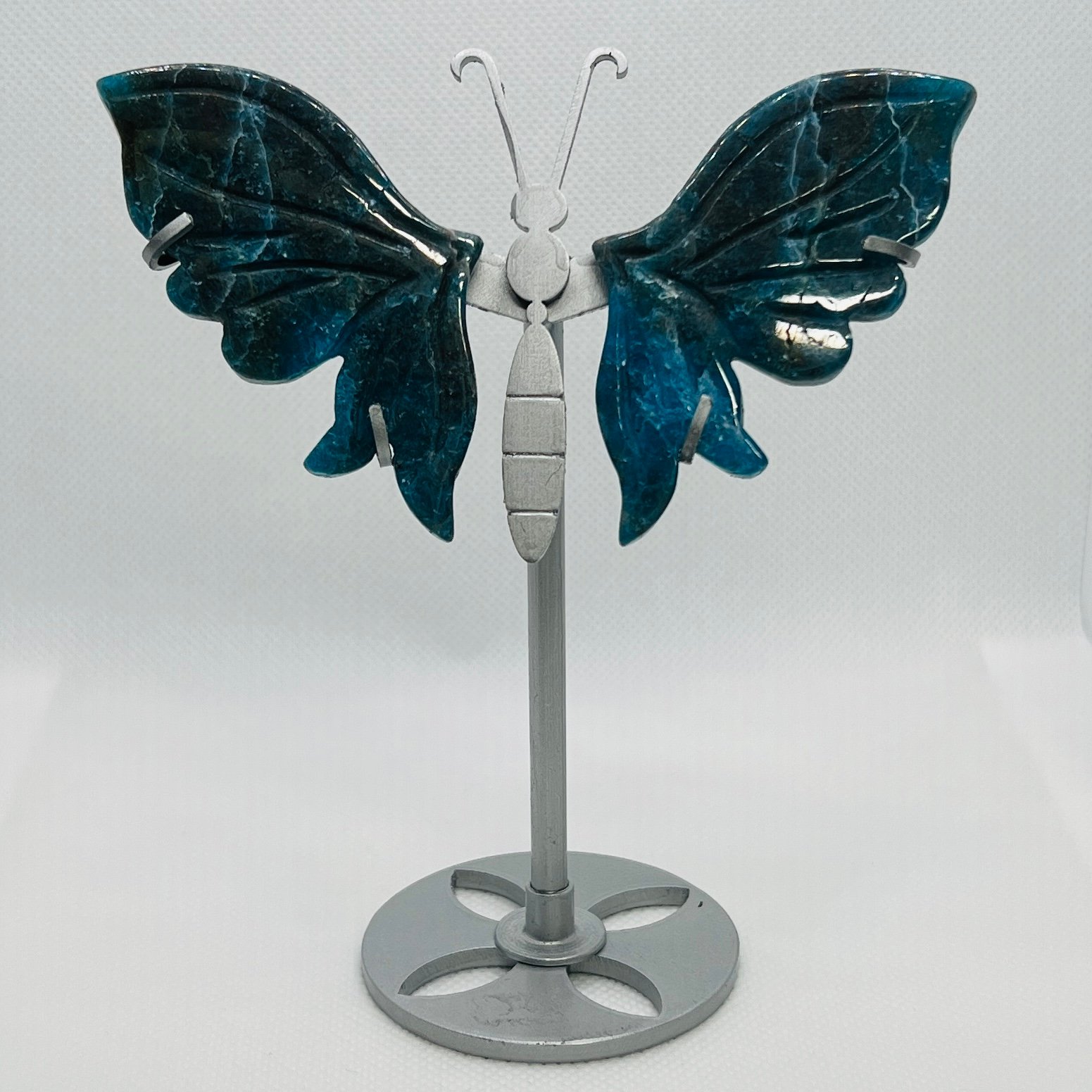
Blue apatite butterfly wings, carved and polished, set on a slim silver toned metal stand worked into a butterfly body with fine curled antennae. The wingspan measures 12cm across the pair.
Apatite takes a high polish and this pair has been worked to a glassy finish, so the surface throws light back rather than sitting flat. The wing veins are cut in as fine raised lines and the outer edges are scalloped, following the shape of a real wing down through the lower lobes.
What you can see in the blue apatite butterfly wings
The colour is deep teal rather than bright, closer to petrol than to sky. The upper section of each wing runs dark, almost black in places, and opens out into a brighter denim blue through the lower lobes.
Fine pale veining runs across both wings in a web, which is characteristic of this material and not a crack. There is a bright reflective patch on the right wing where the polish has caught a harder section of the stone.
The two wings are a matched pair but not identical. Look at the images rather than the description for the pattern, because that is the part no wording gets right.
About this piece
Every crystal carving in the Grove is photographed on its own, and the piece in the photograph is the piece that arrives. Nothing is swapped for something similar.
These blue apatite butterfly wings sit in small clips on the stand arms rather than being fixed in place, so each wing lifts out and can be held. The stand has a circular cut out base and stands on its own without needing a shelf edge or a prop.
Traditional correspondences
Apatite takes its name from the Greek word for deceive, because the mineral was so often mistaken for beryl or other stones before it was properly described. That history sits oddly well with how blue apatite is worked with in traditional practice, which is with clear speaking and with saying the thing plainly rather than around the edges.
The associations are with the throat rather than the heart, and with motivation and appetite for work rather than with rest.
The butterfly form carries its own association, with change that has already happened rather than change being asked for.
Correspondences are traditional and are offered as part of a practice, not as a substitute for medical or professional advice.
Caring for blue apatite
This is a soft stone. Apatite sits at 5 on the Mohs scale, which is softer than window glass and well below quartz. A house key will scratch it. Do not store this piece touching other crystals, and do not wipe it with anything gritty.
Apatite is also brittle and has a definite cleavage direction, which means it chips rather than scuffs when knocked. The thin scalloped edges of the carve are the vulnerable part.
Keep it away from heat and away from prolonged strong sunlight, and never put it through an ultrasonic cleaner or steam. Blue apatite owes its colour to trace elements that heat can disturb.
To cleanse, use sound, breath or moonlight. Water is not needed here and salt water in particular should be avoided.
What you receive
The blue apatite butterfly wings shown in the photographs, the metal stand, and nothing else. Wrapped and posted from Shropshire by Royal Mail Tracked.
Browse the rest of the crystal carvings, or see everything currently in stock in apatite.
For the mineralogy behind the stone, Mindat holds the reference data on fluorapatite.