
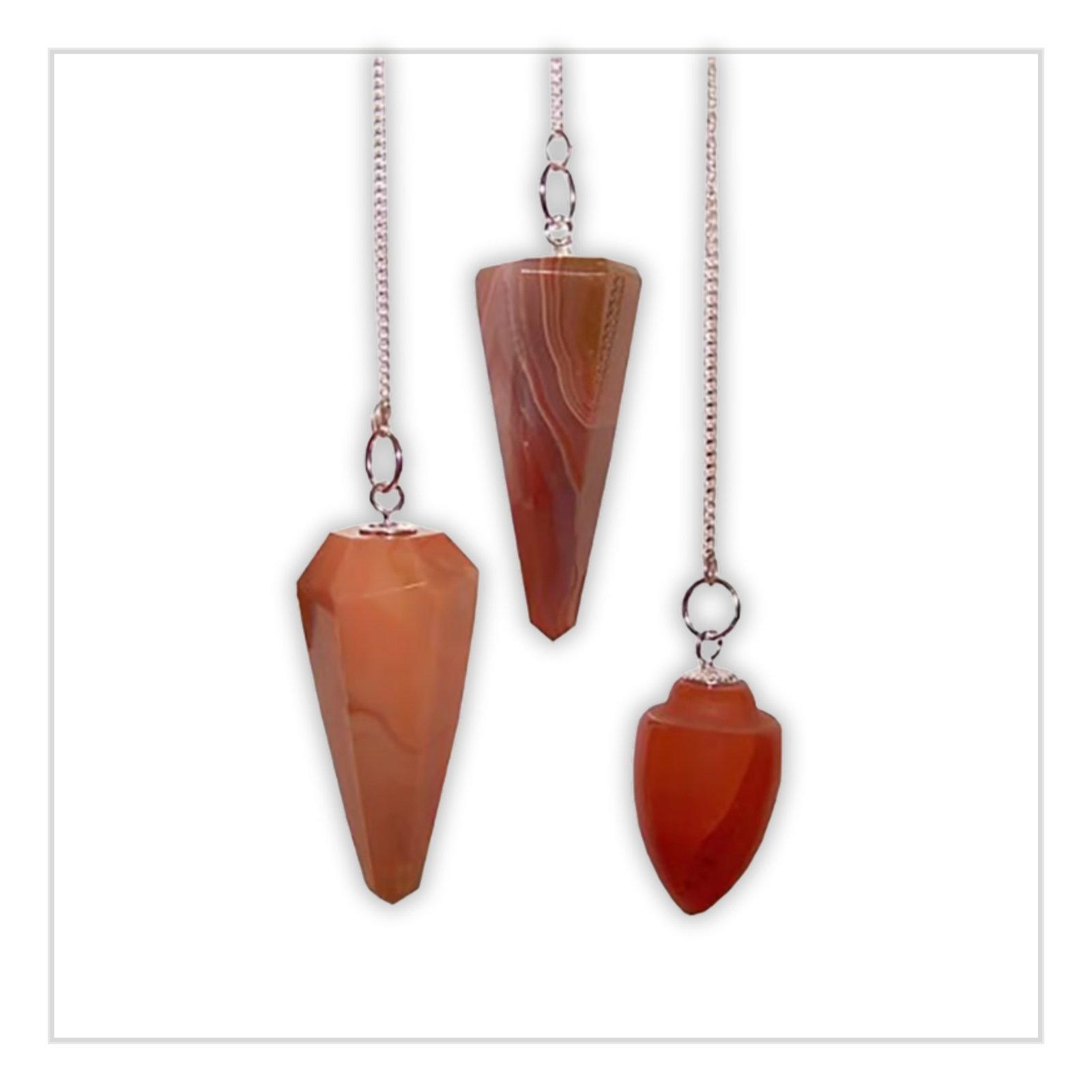
Choosing the stone, setting your yes, and asking a question that can actually be answered
Most guides on how to use a pendulum tell you how to hold it and stop there. The holding is the easy part. What nobody explains is which stone to pick, what the shapes are for, and what to do on the evening it simply will not answer.
What a pendulum is
A weight on a chain. That is the whole of it. The weight hangs still, you ask something, and it begins to move.
The movement comes from you. Tiny shifts in the muscles of your hand, far too small to notice, travel down the chain and become a swing you can see. This is not a secret and it is not a problem. It is the mechanism, and knowing it does not spoil anything, because the interesting question was never whether the chain moves on its own. It is why your hand knows something before the rest of you has caught up.
A pendulum does not tell you anything you do not already know. It makes what you know large enough to see.
Where the practice comes from
Older and more practical than most people expect. The first printed description of dowsing rods used to find minerals underground appears in De Re Metallica, published by Georgius Agricola in 1556, describing the miners of Germany. It was contested even then, which is worth saying plainly rather than pretending the whole thing arrived unchallenged.
One detail from Agricola is the reason this guide exists. According to his account, dowsers used different kinds of wood to search for different metals. Four and a half centuries ago the practice already held that the material in your hand should suit the thing you were looking for. That idea did not start with crystal shops. We have simply carried on with stone instead of hazel.
Choosing your stone
This is the part that gets skipped, and it is the part people actually stand in front of a shelf wondering about.
First, the thing that needs saying before any list. Most people have one pendulum and use it for everything. That is normal, and it is not a lesser way of working. A pendulum is not a set of spanners where you reach for a different size each time. The one you settle with learns your hand, and you learn its movement, and that familiarity is worth more than matching a stone to a subject.
So read what follows as what each stone has traditionally been associated with, not as a filing system for your questions. It is there to help you choose the one, not to suggest you need ten.
If this is your first one
Clear quartz is the usual starting point and deserves to be. It is not tied to any one subject, so it will not lean your question in a direction before you have asked it. It is the plain notebook of pendulums. If you have no idea yet what you will use it for, start here.
Amethyst is the other common first choice, traditionally carried for dreamwork and the quieter kind of knowing. People who come to a pendulum through meditation rather than through decisions tend to reach for this one.
Rose quartz for anything to do with people. Relationships, family, whether to make the call. It is a softer stone to work with and it suits softer questions.
What the others are associated with
- Labradorite is associated with thresholds and change. It is also simply lovely in the hand, shifting from grey to blue as it turns.
- Tiger’s eye for practical decisions with money or work in them. The least dreamy stone in the range.
- Moonstone for timing. When the question is not whether but when.
- Sodalite and lapis lazuli for questions about speaking, writing or being understood.
- Green aventurine for chance and opportunity, the should I try it questions.
- Smoky quartz for when you are rattled and want something steadying before you begin.
- Carnelian and red jasper for courage, and for decisions you have been circling for weeks.
- Fluorite for untangling something complicated into its parts.
Two honest notes. The first is that weight matters more than people expect. A heavier stone swings slower and reads more clearly, which is why a beginner often gets on better with a solid point than with something delicate. The second is that if you are drawn to one for no reason you can explain, take that one. That is the practice working before you have started.
Chakra pendulums
Seven stones set in a row, one for each centre, used where somebody wants the whole spread rather than a single stone. They are popular as a first pendulum for the same reason a tumblestone set is popular as a first set of crystals: you are not committing to one thing. Worth knowing they are busier to work with, since there is a lot going on at the end of the chain.
They are also much newer than they look, and since we sell them it seems only right to say so.
The chakras themselves are old and Indian, set out in tantric and yogic texts and brought into English scholarship by Sir John Woodroffe, writing as Arthur Avalon, in The Serpent Power in 1919. Those texts do describe colour. What they do not describe is a rainbow. As Kurt Leland puts it in his history of the Western system, the chakras have colors, but there is no rainbow
.
The spectrum we all recognise came later and came from the West. Colour healers began assigning one colour per centre in spectrum order in the 1930s. The familiar package, rainbow colours set alongside the endocrine glands and a list of psychological qualities, did not appear together in print until 1977, in Ken Dychtwald’s Bodymind. Leland’s account traces the whole Western chakra system back only about forty years, built up through Theosophy, clairvoyant writers such as C.W. Leadbeater in 1927, colour therapy and the human potential movement.
Pairing particular crystals to those centres is more recent still. Scott Cunningham’s Encyclopedia of Crystal, Gem and Metal Magic, published in 1988 and still one of the most used references in the craft, files each stone by its energy, planet, element, magical uses, substitutes and zodiac sign. There is no chakra column. The crystal and chakra pairing most shops now treat as standard belongs to the reference books that followed, Melody’s Love Is in the Earth among them from 1991.
Which is not a reason to avoid them. A practice being recent does not make it empty. Tarot as most people read it is younger than people think, and so is a good deal of modern witchcraft. What matters is knowing which part is ancient and which part was assembled in the twentieth century, so you can decide for yourself what you are working with.
Traditionally, a dowser chose by material rather than by colour. Agricola’s miners used different woods for different metals. The idea that the thing in your hand should suit what you are seeking is genuinely old. The particular seven colour sequence is not.
If you end up with more than one
Plenty of people do, and it is worth being honest about why. It is rarely because one pendulum could not answer the question. It is because they liked another stone, or were given one, or wanted something heavier for sitting with and something quicker for a run of yes and no.
That is collecting, and there is no harm in it. But nobody needs a shelf of them to work properly, and if anyone tells you a particular stone is required for a particular subject, they are selling rather than teaching.
Shape, and what it changes
Shape changes how a pendulum behaves far more than people are told. A heavy geometric form and a light faceted sphere do not swing the same way, and if you have struggled with one it is worth knowing the other exists.
The classic dowsing point
A faceted cone drawn down to a tip. The tip gives you a clear line to read against, which is why this is the shape most people picture and the one to buy if you are unsure. It starts quickly and stops quickly, so it suits rapid back and forth work.
Merkaba
A star formed from two interlocking tetrahedrons. Heavier and slower, with a long settle. Once it starts a circle it holds it beautifully, which people either love or find maddening. Good for sitting with one question. Poor for a quick run of twenty.
Chamber
Hollow, with a lid that unscrews. You can put something inside: a pinch of dried herb, a written word, a small piece of another stone, a fragment of something belonging to the question. This is the one for people who work with intention rather than yes and no, and it is the least understood shape in the range.
Angel and faceted spheres
Rounder, lighter, swinging more loosely without a definite point. They suit people who find a sharp tip too final, and they are easier to wear or carry as an object rather than a tool.
Floating settings
A cage or frame holding stones that are not fixed solid. There is a little movement inside the pendulum itself, which makes the swing softer and slower to settle.
The two stone pendulums, and how to read them
Seventeen of the pendulums here carry more than one stone, and the naming can be confusing until you know what you are looking at. There are three arrangements and they do different jobs.
A bead at the top
Written as with gemstone sphere or with ring. That second stone sits at the end of the chain where your fingers rest. It is not doing the answering. It gives you something to hold and a little weight at the top so the chain hangs true, and it is why some pendulums feel steadier than others of the same size.
If you have ever found a pendulum skittish, a bead at the top is often the fix.
A different stone at the point
Written as with aventurine point or with labradorite point. This is two working stones, a body and a tip, and the pairing is the character of the piece rather than an instruction for using it.
Rose quartz with an aventurine point is warmer and more open. Amethyst with a labradorite point is quieter and stranger. Pick the pairing you like the feel of, the same way you would pick a single stone. It does not narrow what you can ask.
Seven stones on the chain
The chakra pendulums carry a main stone with the seven set in a row above. The chain becomes part of the tool rather than just a way to hold it. These suit people working through the centres in order, and they are busier to use than a plain stone, so they are not the easiest first pendulum despite often being sold as one.
Stone with metal
A copper spinning star, a silver plated chamber. Metal has been in this practice far longer than crystal has, going back to the rods, so there is nothing modern about the combination. Copper in particular adds weight low down and a slower, heavier swing.
Picking between two you like. Hold each one still and ask the same question you already know the answer to. The one that gives you a clear, unhurried movement you can read without squinting is your pendulum. Weight, length of chain and how definite the tip is matter more here than which stone is prettier.
If you are buying for somebody else and cannot test it, a faceted point in clear quartz with a bead at the top is the safest thing you can choose.
Setting your yes and your no
Do this before you ask anything, and do it again whenever you pick up a different pendulum. Yes and no are not fixed in the stone. They are an agreement between you and this particular object.
Rest your elbow on a table. Hold the chain between thumb and forefinger with roughly a hand’s width hanging, and let the weight come to a complete stop. Then say, out loud if you can, show me yes. Wait. It may take a while the first time. Whatever it does, backwards and forwards, side to side, a circle one way, that is your yes. Then ask it to show you no, and then ask it to show you I do not know, which is the one everybody forgets and the most useful of the three.
Test it on something you can verify. Ask it your own name, then a name that is not yours. If the answers come back the wrong way round, swap them. It does not matter which movement means what, only that you know which is which.
Asking a question that can be answered
Most disappointing sessions are a question problem, not a pendulum problem.
A pendulum answers yes, no and sometimes I do not know. That is the whole vocabulary. So what should I do about my job gets you nothing, because there is no yes in it. Break it down. Is it right to stay where I am past March. Is there something I have not considered. Those can be answered.
Keep it to one thing at a time. Should I take the job and move is two questions wearing one coat, and you will get a muddle back. Ask about the job. Then ask about the move.
Avoid questions where you already badly want one answer. You will get the answer you want, because your hand is making the movement, and on those nights the pendulum is simply an expensive way of agreeing with yourself. Better to notice that and put it down.
The part most shops leave out. The swing comes from very small movements in your own hand. That is the honest mechanism and it is not a reason to stop. It means a pendulum is a way of asking yourself something in a form slow enough to watch.
Which is also why you cannot use one to answer a question about someone else’s health, or anything that should go to a professional. It will give you an answer. The answer will be yours, not theirs.
When it will not answer
Four common ones, and only the last is about the pendulum.
It barely moves. Usually the question. Try a yes and no you already know the answer to and see whether the movement comes back.
It swings wildly and changes its mind. Usually you. Put it down, come back later. This is reliably what happens when you ask something you are frightened of.
It gives a different answer to the same question. Ask what has changed instead. Often the honest reading is that the situation genuinely has not settled yet.
The chain breaks or the stone chips. People read a great deal into this and traditionally it has been taken as a working ending rather than an omen. The duller truth is that these are small stones on fine chains and they get dropped on hard floors. If it has broken, it has broken. Keep the stone if you like it, in a pocket or by the bed, and begin again with another.
Looking after it
Rinse the stone and dry it properly if it has been handled a great deal, but keep water away from any metal fitting, since that is where a chain will go first. Overnight on a windowsill is the traditional reset. Store it hanging or loose in a pouch rather than coiled tight, which is what puts a kink in the chain and shortens its life.
If you share your pendulum, reset your yes and no each time it comes back to you.
These are traditional practices, offered as part of a practice rather than as advice. A pendulum is not a substitute for proper guidance on anything that matters medically, legally or financially.
Where to check any of this
None of the history above should be taken on our word, so here is where it comes from.
- The dowsing record, including the Agricola account, is set out in the Society for Psychical Research’s Psi Encyclopedia entry on dowsing.
- The history of the Western chakra system is Kurt Leland’s work, summarised by the Theosophical Society in America in The Rainbow Body: How the Western Chakra System Came to Be, drawn from his book Rainbow Body: A History of the Western Chakra System from Blavatsky to Brennan.
- For the mineralogy rather than the practice, labradorite on Mindat explains why that stone shifts colour as it turns.
Find your pendulum
Clear quartz, amethyst, rose quartz, labradorite, tiger’s eye, moonstone and more, in points, merkabas, chambers and chakra sets, from £3.




Leave a Reply