Crystal Shop UK · Rooted in intention, curated with care

Tag: Chakras

  • Blue Crystals: A Grounded Guide to Throat Chakra Stones

    Blue Crystals: A Grounded Guide to Throat Chakra Stones

    Sodalite, blue kyanite, lapis lazuli and how to choose the right blue stone for you

    A friendly guide to the most loved blue crystals in UK practice. What each one is called, what it means, and how to choose the right blue stone for you.

    Blue kyanite freeform, bladed structure with pale to mid blue colouring

    Blue is one of the most searched colours in UK crystal shopping, and it is not hard to see why. Blue stones are calming to look at, gentle to work with, and connected to the throat chakra, the part of the body associated with communication, honesty, and finding your voice. Whether you are buying your first crystal, choosing a gift, or adding to a collection, the blue range has something for almost every reason a person looks for a crystal in the first place.

    This guide covers the eight blue crystals you are most likely to find in a UK shop, including their names, their meanings, and how to choose between them. By the end you will know which stone fits what you are looking for, whether that is calm communication, clearer thinking, deeper meditation, or simply a beautiful piece for the home.

    What Blue Crystals Are Called

    Before going further, it is worth knowing the names you will come across. The blue crystal family is wider than people often realise, and the same stone sometimes goes by more than one name in different shops. The eight stones below are the ones you will find most often in UK crystal shops.

    • Sodalite
    • Blue Kyanite
    • Lapis Lazuli
    • Blue Lace Agate
    • Celestite (sometimes spelled Celestine)
    • Blue Calcite
    • Blue Apatite
    • Blue Onyx

    You may also see aquamarine, blue topaz, sapphire, and angelite in jewellery and gem shops, though these are less common in everyday crystal practice. The eight above are the working crystals, the ones most often used for meaning, healing, and altar work rather than for jewellery alone.

    What Blue Crystals Mean

    In crystal practice, colour carries meaning. Blue is the colour of the throat chakra, the energy centre at the base of the neck. The throat chakra is associated with communication, with self expression, with telling the truth, and with the kind of calm that lets you say what needs to be said. This is why blue crystals are often chosen by people going through a season of life that asks for clearer communication, whether that is a career change, a difficult conversation, or simply a desire to feel more grounded in how you speak to yourself and others.

    Blue stones are also associated with calm and with easing anxiety. Pale blues like blue lace agate and blue calcite carry a soft soothing energy, useful for stress or for a quieter mind. Deep blues like lapis lazuli and sodalite carry a more grounded clarifying energy, useful when you need to think more clearly or find the right words. Every blue stone shares the general family of meaning, but each one has its own particular tone.

    Why Crystals Are Blue in the First Place

    The blue in most crystals comes from tiny amounts of copper and iron sitting inside the stone. These trace elements scatter light in a way that makes the crystal read blue rather than clear or white. The depth of blue varies naturally, and a paler blue is not a lower quality stone, just a different one.

    Some blue stones get their colour in unusual ways. Lapis lazuli is technically a rock rather than a single mineral, made up of three things mixed together: lazurite (the deep blue), white calcite, and golden flecks of pyrite. The combination is what makes lapis instantly recognisable, with her deep blue body and golden sparkle. Sodalite gets her colour from a different source, chloride ions sitting in the mineral structure, which is why her blue reads as a deep navy rather than the royal blue of lapis.

    The Eight Blue Crystals

    The eight crystals below are ordered from the most familiar and accessible to the more unusual. Each one carries a different tone of blue energy.

    Sodalite

    Sodalite is the most accessible blue crystal in UK shopping. Deep navy blue with thin white veins running through her, she is sold widely as tumbled stones, bracelets, wands, and pendulums. She is associated with intuition, with clear thinking, and with finding the right words. A good first blue crystal for anyone who works with words for a living, anyone going through a phase that asks for clearer communication, or anyone simply drawn to the calming depth of dark blue.

    The Sodalite Wand is one of the most popular formats in the UK because the elongated shape feels good in the hand. The Sodalite Pendulum is a beautiful piece for anyone interested in dowsing or simple yes and no divination. The Sodalite Bracelet keeps her near the body through a working day, and the Sodalite Tumblestone is the simplest entry point for anyone meeting her for the first time.

    Sodalite wand, deep navy blue with white veining

    Blue Kyanite

    Blue kyanite looks like no other crystal. She has a flat bladed structure, almost like layers of glass stacked together, with pale to mid blue colouring that catches the light in ribbons. Most blue kyanite is sold as natural freeform pieces, where you can see the blade structure clearly. She is associated with throat chakra opening and with feeling aligned in yourself.

    One quiet detail worth knowing: kyanite is one of the only crystals that does not need cleansing. The structure does not hold onto negative energy, so she can sit alongside your other crystals without needing the usual moonlight or selenite reset. The Blue Kyanite Freeform is the format she comes in most often.

    Lapis Lazuli

    Lapis lazuli is the royal blue of the crystal world. Deep blue with golden flecks of pyrite running through her, lapis has been treasured for over six thousand years. The ancient Egyptians used her in the burial mask of Tutankhamun. Renaissance painters ground her to make ultramarine, the most precious blue pigment in medieval Europe. She is the stone of wisdom and inner truth, and there is something quietly powerful about owning a piece of a tradition that runs so deep.

    If you are buying lapis, look for visible variation in the blue and real golden specks (pyrite is metallic, not painted glitter). Uniform bright blue with no inclusions is often dyed howlite or sodalite sold as lapis. The Lapis Lazuli Tumblestone shows the natural pattern clearly, and the Lapis Lazuli Bracelet is a beautiful way to wear her every day.

    Lapis lazuli tumblestones, deep blue with golden pyrite flecks

    Blue stones are calming to look at, gentle to work with, and connected to the throat chakra. They are stones for clearer thinking and finding your voice.

    Light Blue Crystals

    Within the blue family, the pale stones have a softer feel than the deeper blues. If you are drawn to lighter shades, or if you find the deeper navy blues a bit too intense, these are the three to look at.

    Blue Lace Agate

    Blue lace agate is the gentlest blue crystal. Pale sky blue with delicate white banding running in soft waves through each piece, she is associated with calm communication and with easing anxiety. Where sodalite is sharp and clarifying, blue lace agate is soft and soothing. A lovely choice for anyone whose throat tightens before difficult conversations, anyone going through a stressful period, or anyone simply drawn to the prettiest of the blue stones.

    The Blue Lace Agate Tumbles come in approximately 50g pouches, so you get a small handful of pieces in one purchase, perfect for sharing or for placing around the home.

    Celestite

    Celestite (sometimes spelled Celestine) is pale sky blue, formed in clusters of tiny crystal points that catch the light like frost. She is associated with peace, with meditation, and with a sense of calm that settles into a room when she is present. A favourite among people who meditate regularly, and a beautiful piece for anyone who wants a more delicate blue stone for the bedroom or altar.

    One thing to know: celestite is fragile and sensitive to sunlight. Direct light fades her colour over time, so keep her in a shaded spot rather than a sunny windowsill. The Celestite Cluster is the form she comes in most often.

    Blue Calcite

    Blue calcite is softer than the other blues, often translucent, with a pale watery colour like a piece of frozen sea. She is associated with mental clarity and with recovery from stress, particularly the kind of mental tiredness that comes from too much screen time or too many demands. The Blue Calcite Egg is a lovely piece for a desk or workspace, and the egg shape sits well in the hand.

    The Bolder Blues

    Blue Apatite

    Blue apatite is the brightest of the blue family. Vibrant teal blue, sometimes with hints of green, she is associated with motivation, with focus, and with the kind of energy that helps you finish what you started. Less common in the UK than sodalite or lapis, which makes the sphere a striking piece for anyone collecting the rarer blues. The Blue Apatite Sphere is a real statement piece.

    Blue Onyx

    Blue onyx is deep blue, often reading almost black, with subtle banding through each piece. She is associated with grounding and stability, the rare blue stone that combines throat energy with a more rooted, settled feel. Useful for anyone who wants to feel both clearer in how they speak and more steady in themselves. The Blue Onyx Sphere is a beautiful altar piece, and the Blue Onyx Rune Set is a distinctive divination tool for anyone interested in the old Norse runes.

    Raw Blue Crystals or Polished?

    A question that comes up often when shopping for blue crystals is whether to choose raw natural pieces or polished smooth ones. There is no wrong answer, just a difference in feel.

    Raw crystals are pieces that have not been shaped or polished after being mined. They show the natural form of the stone, often with rough edges and visible texture. Many people prefer raw pieces because they feel more connected to the earth, and they often cost less because they need less work to prepare. The Rough Sodalite is a good example of a raw blue crystal at an accessible price.

    Polished pieces have been shaped and smoothed, sometimes into specific forms like spheres, towers, or palm stones, sometimes simply tumbled smooth. They are more comfortable to hold for long periods, which is why they are popular for carrying or for jewellery. Most of the products linked in this guide are polished, with rough or raw versions available where they exist.

    Start with whichever appeals to your eye. There is no advantage to one over the other in terms of meaning or energy. It is genuinely a matter of preference.

    How to Choose Between Them

    If you are buying a blue crystal for a specific reason, here is a simple shortcut:

    • For calmer communication: sodalite or blue lace agate
    • For meditation or peaceful sleep: celestite or blue calcite
    • For motivation and focus: blue apatite
    • For wisdom and depth: lapis lazuli
    • For feeling aligned and clear: blue kyanite
    • For grounded stability: blue onyx
    • For a beautiful gift: any of the above, depending on the person

    If you are buying without a specific reason, choose the one you keep coming back to in the photos. The right stone tends to be the one you notice. Trust that.

    Three Ways to Work With Blue Crystals at Home

    Blue crystals do not need a complicated practice to be useful. These three approaches are the most common and the easiest to fit into ordinary life.

    Keep One With You

    Slip a small tumble into a pocket or handbag in the morning. Hold it for a few breaths during quiet moments through the day, especially before a difficult conversation or after a stressful one. Many people find that simply knowing the stone is there has a calming effect.

    Place One Near Your Desk

    A blue crystal on the desk or near the screen helps with the kind of mental clutter that builds up during long work days. Blue calcite and blue apatite are particularly suited to this, but any of the blue stones will do the work. Notice the shift in how the space feels after a week.

    Use One in a Calm Corner

    Build a small calm corner with a blue crystal, a candle, and something living like a small plant or a flower. Place it somewhere you pass naturally, the windowsill above the kitchen sink, the corner of a desk, the top of a chest of drawers. The point is not to do anything elaborate, just to have a small spot in the home that quietly belongs to peace.

    Pairing Blue Crystals With Other Colours

    Blue crystals look and feel beautiful alongside other colours, and a few combinations work particularly well together.

    Blue with white is the cleanest pairing. Sodalite with selenite, or blue kyanite with clear quartz, gives you the calm of blue with the brightness of white. The white stones cleanse and amplify whatever sits beside them.

    Blue with pink is the bridge from throat to heart. Blue lace agate with rose quartz supports emotional honesty, particularly when you want to say something kind but truthful. Read more in our guide to pink crystals.

    Blue with gold or yellow is a powerful combination. Lapis lazuli already does this within a single stone, with her natural golden pyrite balancing the deep blue. For a more visible version, pair sodalite with citrine.

    Looking After Your Blue Crystals

    Most blue crystals are easy to look after. Sodalite, blue lace agate, blue calcite, blue apatite, and blue onyx can all be rinsed briefly under running water and patted dry. Lapis lazuli and blue kyanite are better cleaned with a dry cloth, because the iron in lapis can oxidise in water and the layered structure of kyanite can absorb moisture. Celestite should never go in water, and she should be kept out of direct sunlight to protect her colour.

    For energetic clearing, place your blue crystals on a selenite plate overnight, or leave them on a windowsill in the moonlight. Both methods are gentle and effective. Blue kyanite is the exception, as mentioned above, and does not need clearing at all.

    Every blue crystal at Mystic Grove is hand selected before she leaves the bench, dispatched in protective packaging from Mystic Grove HQ.

    Explore the complete crystal collection for everything you need to deepen your blue crystal practice.

    Continue Your Journey: Read about heart energy stones in our guide to pink crystals, or explore seasonal ritual in How to Build a Beltane Altar 2026.

  • Pink Crystals: A Grounded Guide to Heart Energy Stones

    Pink Crystals: A Grounded Guide to Heart Energy Stones

    Rose quartz, pink amethyst, rhodonite and how to work with them gently

    A practical guide to the most loved pink crystals in UK practice. What each one is, how to choose between them, and how to bring them gently into a working life.

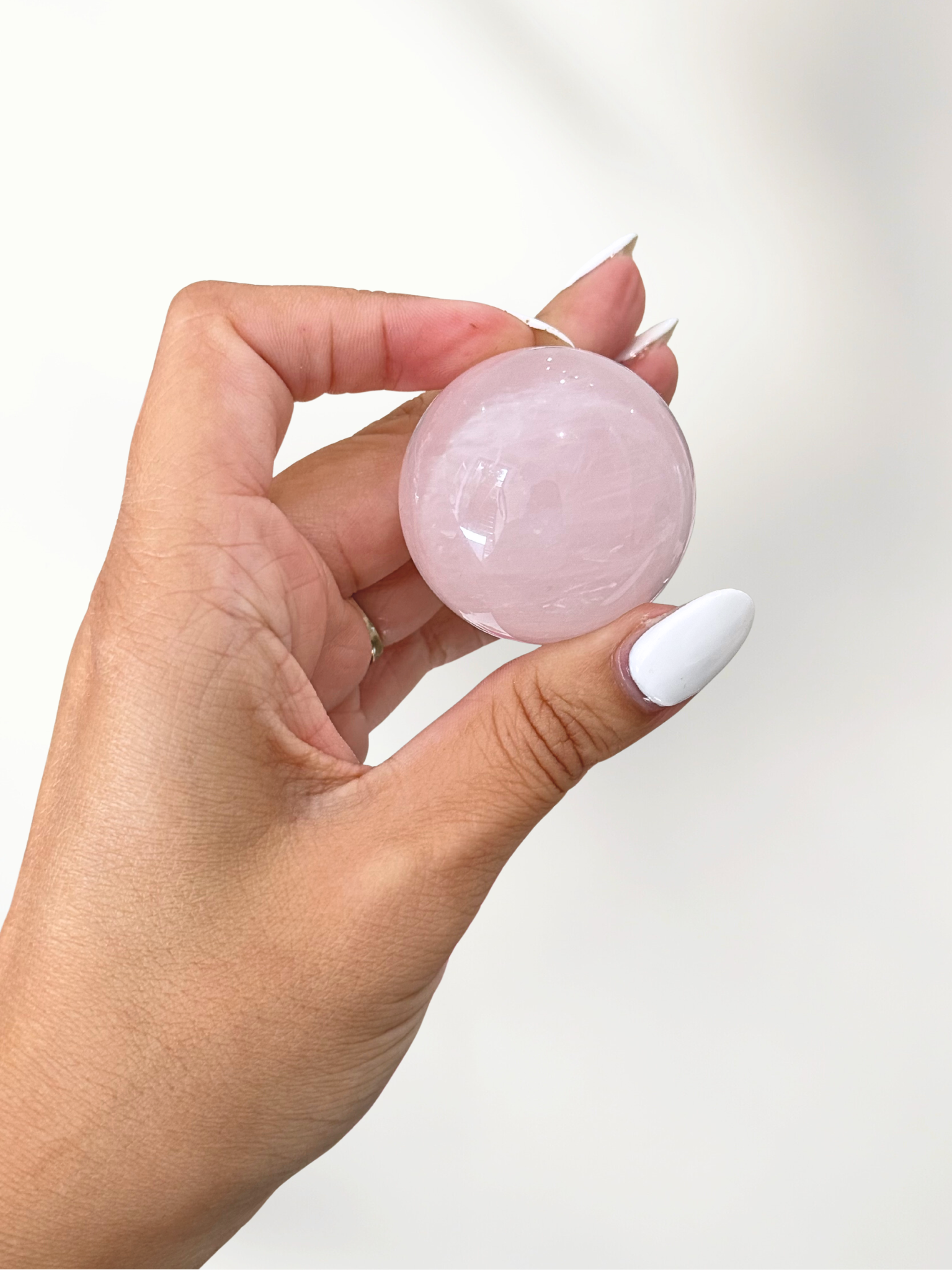
    Polished pink rose quartz sphere on bone background, hand selected for heart chakra work

    Pink is the colour of the heart. In crystal practice, pink stones have long carried associations with the heart chakra, with self love, with relationships and emotional softening. The connection is not arbitrary. Pink in crystal form usually comes from trace minerals layered into a clear or white base, which gives these stones their soft luminous quality. Working with pink crystals tends to feel gentle rather than activating, supportive rather than challenging. They are stones for quiet days and tender ones.

    This guide walks through the most accessible pink crystals to start with, what each one is associated with, how to choose between them, and three simple practices for bringing them into daily life. Whether you are buying your first crystal or extending an existing collection, the pink range has something to offer at any level of practice.

    The Science of Pink

    The pink in most crystals comes from trace mineral inclusions. In rose quartz, microscopic fibres of titanium and traces of manganese sit inside an otherwise clear quartz body, scattering light in a way that reads as soft pink to the eye. Pink amethyst takes its colour from manganese sitting inside the same quartz family, but in a crystalline geode form rather than a solid body. Rhodonite carries manganese silicate at its core, which gives it the depth of pink and the characteristic black veining at the same time.

    The depth of pink varies naturally and is not a marker of quality. A pale rose quartz is not lesser, only different. What matters more is even colour through the piece, and clarity that reads warm rather than chalky. If you see fractures or cloudy patches inside a polished piece, those are part of the natural form. Avoid pieces that look uniformly bright pink with no variation at all, as those have sometimes been dyed.

    Most of the pink crystals on the world market come from Brazil, Madagascar, Namibia, and parts of South Africa. Pink amethyst comes almost exclusively from Patagonia, in southern Argentina, where the geological conditions for its formation are unusually concentrated. Rhodonite turns up in Brazil, Russia, and Australia. The named provenance matters because it tells you something about the history of the stone in your hand.

    The Crystals

    The five pink crystals below are the ones most worth knowing. They are ordered by accessibility, working from the most familiar to the more niche. Each carries a different tone of pink energy, and the right one for any given person depends on what they are reaching for.

    Rose Quartz

    Rose quartz is the crystal most people meet first. It turns up in gift shops and on bathroom shelves, on bedside tables and in jewellery boxes. It is associated with the heart chakra, with self love, with emotional softening, and with softening the field after grief or rupture. The poetic phrase that has followed it for years is “the stone of unconditional love”, and like most poetic phrases it is partly accurate and partly marketing.

    What is observably true is that rose quartz carries a gentle field. People who do not feel much from harder stones often report a soft warmth from it, the kind that does not announce itself but tends to be missed when it is not in the room. She is not activating like carnelian, not protective like black tourmaline, not amplifying like clear quartz. She is, more than anything, present.

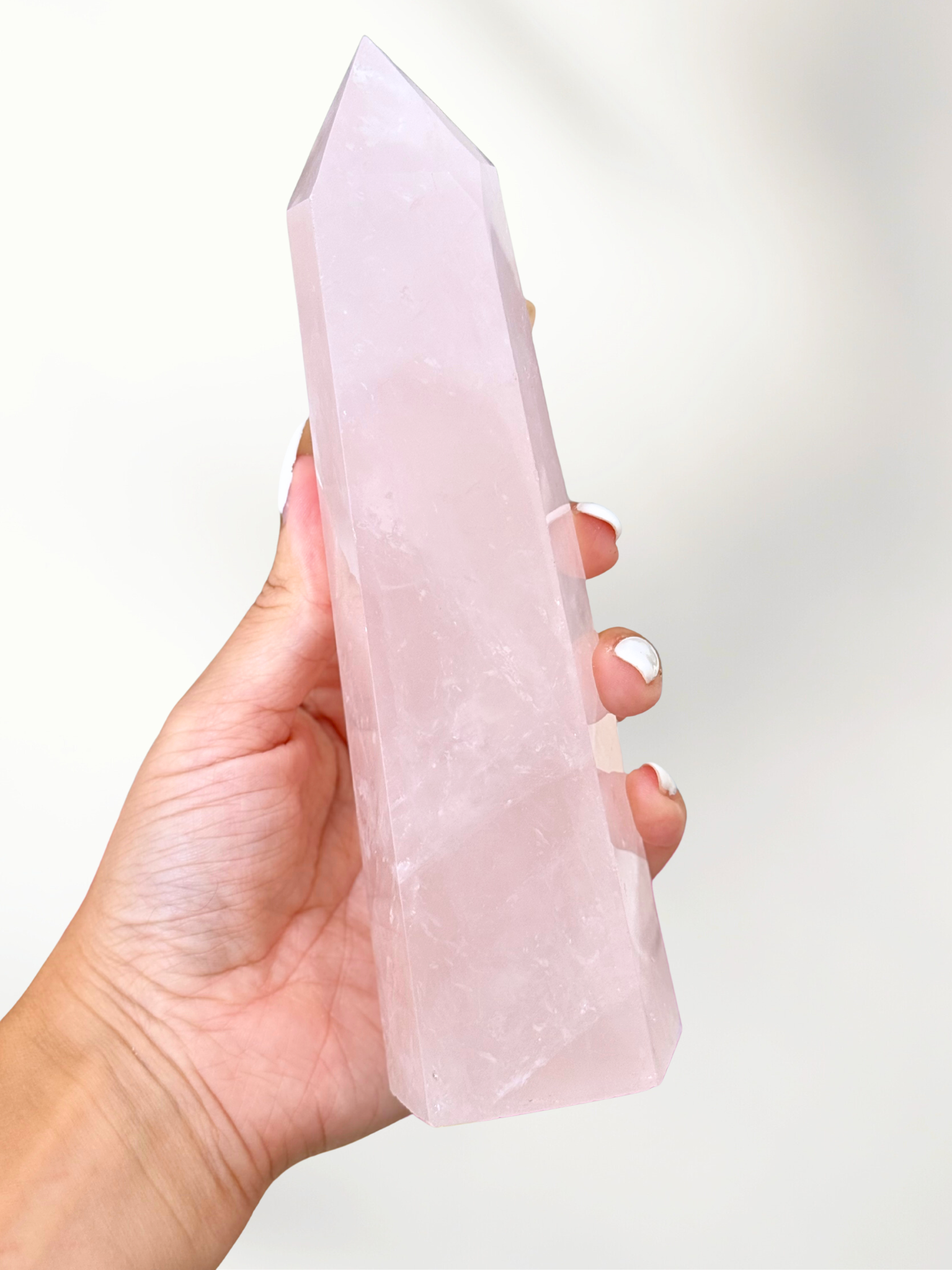
    Rose quartz forms in solid bodies rather than crystalline points, which is why she is most often sold as polished pieces. The Rose Quartz Tower is the statement piece for an altar or a bedside table. The Rose Quartz Sphere radiates evenly in all directions and is a good place to start for anyone building a heart altar. The Rose Quartz Bracelet keeps her energy near the body through a working day. The Rose Quartz Palm Stone is the right shape for quiet practice, for holding during difficult conversations, or for slipping into a coat pocket on a hard morning.

    Hand selected pink rose quartz tower, soft pink colour with even clarity

    The energy she carries is gentle rather than activating. She is a quiet stone for quiet days, and a steady one for harder ones.

    Pink Amethyst

    Pink amethyst is rarer than rose quartz and reads as a different kind of stone. Where rose quartz forms in solid bodies, pink amethyst forms in crystalline geodes and clusters, with each tiny crystal point catching the light separately. The effect is brighter and more sparkling, and the energy follows the form. Pink amethyst is associated with emotional clarity rather than emotional comfort, and with the kind of heart work that asks you to look honestly rather than be soothed.

    She comes almost exclusively from Patagonia and is a step up in price from rose quartz at equivalent size. For the practitioner ready to invest in a hero piece, the Pink Amethyst Sphere is a striking altar stone. For something more dramatic, the Pink Amethyst Slab on Stand shows the crystalline structure in cross section, and the Pink Amethyst Bowl doubles as a charging station for smaller crystals.

    Rhodonite

    Rhodonite is the pink stone for harder seasons. She is deeper in colour than rose quartz, with characteristic black veining of manganese running through her, and she carries a different tone of heart energy. Where rose quartz is associated with self love and gentleness, rhodonite is associated with emotional resilience, with rebuilding after rupture, and with the quiet work of recovery. She is the stone people reach for when they have moved past the soft early grief and into the slower work of putting things back together.

    The Rhodonite Bracelet is the simplest way to keep her near the body, and the Rhodonite Tumblestone is small enough to carry in a pocket through a difficult week.

    Rhodonite tumblestones, deep pink with characteristic black manganese veining

    Pink Calcite

    Pink calcite is softer than rose quartz, more translucent, and less common in the UK market. She is associated with gentleness and emotional openness, with the kind of slow tenderness that allows feelings to surface without forcing them. Calcite as a mineral family carries an undertone of clearing, and pink calcite brings that clearing to the heart space rather than the mind. The Pink Calcite Slab is a quietly distinctive piece for an altar, and a useful counterpoint to rose quartz in a wider heart practice.

    Strawberry Quartz

    Strawberry quartz is the most playful of the pink range. She is clear or pale pink quartz with red iron oxide inclusions that look like seeds in a strawberry, and she carries a lighter tone than the other pink stones. She is associated with joy, with lightness, and with the recovery of pleasure after a long stretch of seriousness. A softer entry point for anyone whose heart work has been heavy lately. The Strawberry Quartz Tumblestone is the format she comes in most often, and a good gift for anyone in need of a lighter touch.

    How to Choose Between Them

    The honest answer is by feel, and the practical answer is by what you are reaching for. Both matter.

    For self love, gentleness, and the soft work of self acceptance, start with rose quartz. She is the most accessible of the pink stones and asks the least of the practitioner. For emotional clarity, for honest looking at relationships, or for a step up in altar work, pink amethyst is worth the investment. For resilience, recovery, and the slower seasons of rebuilding, rhodonite holds up where rose quartz can feel too soft. For tenderness without sweetness, pink calcite is the choice. For joy and lightness, strawberry quartz.

    By form, the question is what you are going to do with the stone. A small tumble or a polished palm stone is the right shape if you want to carry her with you, slip her into a pocket, or hold her for a few quiet minutes at the end of the day. A sphere or a tower belongs on an altar or a bedside table where she anchors a space rather than travels through it. A bracelet keeps her at the wrist through a working day. A slab or a bowl is for the practitioner already running an established practice and ready for a hero piece.

    By feel, the rule is to notice which piece pulls. If you are shopping in person, hold two or three options and see which one settles in the hand. If you are shopping online, the photographs and the descriptions usually do enough of the work, and the right one tends to be the one you keep returning to. There is no special skill needed. The body knows.

    Three Ways to Work With Them at Home

    Pink crystals do not need a complicated practice to be useful. The three approaches below are the ones that come up most often, and they cover most of what people are looking for when they bring a heart stone home.

    Carrying

    Slip a tumble or a palm stone into a pocket in the morning. That is the entire practice. Hold the stone for a few breaths during quiet moments through the day, particularly before a difficult conversation or after a hard one. The point is not to do anything with her. The point is to have her there. Many people find the simple awareness of a stone in the pocket settles the body more than they expect. Rose quartz works well for this. So does the smaller rhodonite tumble for harder weeks.

    Sleep Work

    Place a piece on the bedside table or beneath the pillow before sleep. Pink crystals are associated with calm rest and softer dreams, and this practice is one of the gentlest ways to test how the field affects you. Notice how mornings feel after a week of having her there. The shift, when it comes, is usually subtle and almost always supportive rather than disruptive.

    Altar Work

    Build a simple heart altar with one pink piece, one white piece for cleansing such as selenite or clear quartz, and a candle. Place the altar somewhere you pass naturally, the windowsill above the kitchen sink, the corner of a desk, the top of a chest of drawers. Light the candle for a few minutes when you arrive home or before bed. The practice is not religious. It is the small ritual of marking the heart as something worth honouring in your own house.

    Pairings With Other Colours

    Pink crystals work alongside almost every other colour, and a few combinations are worth knowing.

    Pink with white is the foundational pairing. Selenite cleanses and amplifies whatever sits beside her, and clear quartz extends the energy of the stone she is paired with. The classic gentle altar setup is rose quartz alongside selenite, which keeps the heart stone clear without any extra work from the practitioner.

    Pink with green is the full heart chakra pairing. Aventurine, malachite, and prehnite all sit naturally alongside rose quartz in heart work. Pink and green together is one of the oldest pairings in crystal practice and the colours balance each other on the visible spectrum as well as the energetic one.

    Pink with blue is the heart to throat bridge. Rose quartz and blue lace agate together support the practice of emotional honesty, particularly the work of saying out loud what the heart already knows. Useful when a difficult conversation is coming and you want to be steady rather than reactive.

    How to Look After Pink Crystals

    Most pink crystals are safe to clean briefly with running water, and a gentle wash followed by a pat dry is enough for most polished pieces. Rose quartz, rhodonite, pink amethyst, and pink calcite all hold up to brief contact with water. Avoid soaking any of them for long periods, and avoid prolonged sunlight, which can fade the pink in some pieces over time.

    For energetic clearing, a night on a selenite plate or in moonlight is the most reliable method. Selenite does not require recharging herself and can sit alongside other crystals indefinitely. Moonlight on a windowsill works for any of the pink stones and pairs particularly well with the lunar half of crystal practice.

    The Mystic Grove range includes the Ancient Witch Love Bath Potion with Rose Quartz Amulet for anyone wanting to fold rose quartz into a bath ritual, and the Twisted Silver Healing Wand for altar work that asks for a directional tool.

    Every pink crystal at Mystic Grove is hand selected before she leaves the bench, dispatched in protective packaging from Mystic Grove HQ.

    Explore the complete crystal collection for everything you need to deepen your heart practice.

    Continue Your Journey: Read more about working with stones in our guide Best Crystals for Beltane 2026, or learn how to set up a sacred space in How to Build a Beltane Altar 2026.

  • Meditating with Crystals

    Meditating with Crystals

    How to meditate with crystals, from sitting quietly with one stone to a full chakra layout

    / / / Meditating with Crystals Moonology & Rituals | 9 Minute Read

    We often hear people say, “I tried meditation, but I just can’t do it. My brain won’t switch off.”

    If this sounds like you, you are not alone. The modern mind is designed to be busy. Asking it to suddenly sit in silence is like trying to stop a speeding train instantly; there is going to be some screeching.

    This is where crystals become your secret weapon.

    Meditating with a crystal gives your “monkey mind” a job to do. Instead of trying to think of nothing, you focus your attention on the physical weight, texture, and energy of the stone in your hand. It acts as a physical anchor, keeping you tethered to the present moment while your spirit explores.

    Here is how to deepen your mindfulness practice using the power of stone.

    The Left Hand vs The Right Hand

    Before you begin, you need to decide which hand to hold your crystal in. In energy work, your hands have different polarities. Understanding this flow is the first step to a successful practice.

    The Left Hand (Receiving)

    Your left hand is your Yin side. It is connected to your internal world and your subconscious.

    When to use it: Hold the crystal in your left hand if you want to receive its energy. For example, if you are anxious and want to absorb the calm of Amethyst, or if you are tired and want to absorb the vitality of Carnelian, use the left.

    The Right Hand (Sending)

    Your right hand is your Yang side. It is connected to the external world and action.

    When to use it: Hold the crystal in your right hand if you want to release energy. For example, if you want to let go of stress using Smoky Quartz, or if you want to send healing intentions to someone else, use the right.

    Step by Step: The “Sitting with Stone” Technique

    You do not need to be a Zen master to do this. You just need five minutes and a quiet corner.

    Step 1: Choose Your Ally
    Go to your collection or your altar. Do not overthink it. Close your eyes, hover your hand over your stones, and pick the one that feels “stickiest” or warmest. Trust that your intuition knows what you need today.

    Step 2: Find Your Seat
    Sit comfortably. You can sit cross legged on the floor or upright in a chair. The only rule is to keep your spine straight to allow energy to flow up and down your chakras.

    Step 3: The Tactile Connection
    Hold the crystal in your chosen hand (or cup it in both). Close your eyes. Before you try to get “spiritual,” just get physical.

    • Feel the temperature: Is the stone cool to the touch? Is it warming up?
    • Feel the texture: Is it smooth and polished, or rough and raw?
    • Feel the weight: Notice the gravity of the stone pressing into your palm.

    Focusing entirely on these physical sensations is a form of mindfulness. It brings you out of your head and into your body.

    Step 4: The Energy Breath
    Now, visualise the energy of the stone. As you inhale, imagine you are breathing the colour of the stone up through your arm and into your heart (e.g., breathe in pink light from Rose Quartz). As you exhale, imagine you are breathing out grey smoke (your stress or worry) back into the stone to be transmuted. Repeat this cycle for five to ten minutes.

    Laying on of Stones: The Full Chakra Guide

    If you prefer to lie down, you can place crystals directly onto your body. This is excellent for balancing the Chakras (energy centres). Here is a guide to the seven main points and the best stones for each.

    1. Root Chakra (Base of Spine)

    This is your foundation, governing safety and grounding. Use Red Jasper, Black Tourmaline, or Hematite here to feel secure.

    2. Sacral Chakra (Lower Abdomen)

    The centre of creativity, passion, and pleasure. Use Carnelian or Honey Calcite here to reignite your spark.

    3. Solar Plexus (Stomach)

    The seat of your personal power and confidence. Use Citrine, Tiger’s Eye, or Pyrite here to boost willpower.

    4. Heart Chakra (Centre of Chest)

    The bridge between the physical and spiritual, governing love. Use Rose Quartz, Green Aventurine, or Malachite here to open your heart.

    5. Throat Chakra (Throat)

    Governs communication and speaking your truth. Use Sodalite or Blue Lace Agate here to find your voice.

    6. Third Eye (Forehead)

    The centre of intuition and foresight. Use Lapis Lazuli or Amethyst here to awaken inner stillness.

    7. Crown Chakra (Top of Head)

    Your connection to the divine and the universe. Use Clear Quartz, Selenite, or Moonstone just above your head to invite white light.

    Closing Your Practice

    When you are ready to finish, do not just jump up and check your phone. You need to close the circuit to integrate the healing.

    Wiggle your fingers and toes to wake up the body. Take a deep breath and open your eyes. Place your crystal back on the altar or in your pocket. Finally, ground yourself. Eat a piece of chocolate, drink a glass of water, or simply place your bare feet on the floor. This brings your awareness back to the physical world.