The Great Queen of Irish myth: her three forms, the crow on the battlefield, her meeting with the Dagda at Samhain, and a quiet way to honour her as the dark half of the year begins
Every October, as the nights draw in, the Morrígan seems to come closer. She is the crow on the battlefield, the woman washing armour at the river, the voice that speaks prophecy when the fighting is over. She can seem frightening at first. Spend a little time with her stories, though, and a different picture appears: a goddess of fate, of the land, and of seeing clearly what is coming. Here is who she is, where her stories come from, and a simple offering you can make at Samhain.
The Morrígan at a Glance
- Who: an Irish goddess of fate, prophecy, sovereignty, war and death, one of the Tuatha Dé Danann
- How to say it: MOR·ree·gan, with the stress on the first part; often written Morrigan, without the accent
- Her name: usually read as “Great Queen” or “Phantom Queen”
- Her forms: the Morrígan herself, Badb and Macha; some tellings name Nemain
- Known for: foretelling the outcome of battle, washing at the ford, her union with the Dagda at Samhain, testing the hero Cú Chulainn
- Symbols: the crow and raven, the river ford, a red cloak, a grey spear, the chariot
- Colours: black, red and white
- Her festival: Samhain, Saturday 31 October 2026
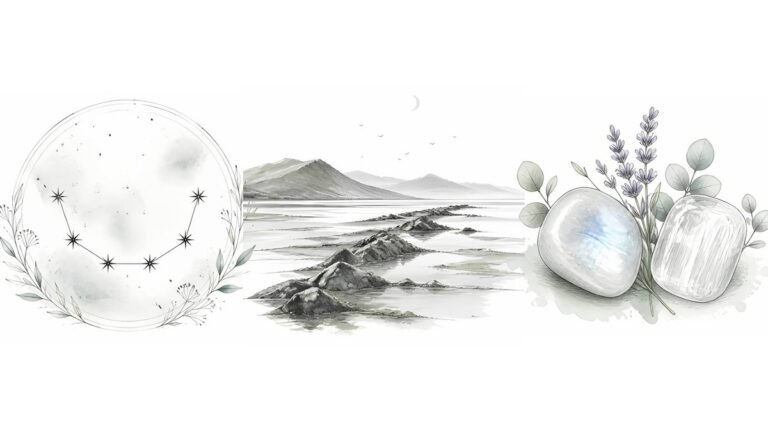
- Stones often linked with her: black obsidian, Whitby jet, bloodstone
Who Is the Morrígan?
The Morrígan belongs to the Tuatha Dé Danann, the divine people of Irish myth who were said to have ruled Ireland in the age before mortal kings. She is one of their greatest powers, and her loyalty in the old stories lies with them and with the land they held.
She is often called a war goddess, but that is only half the story. She rarely fights the way a hero fights. Her power is over the outcome: she knows who will live and who will fall, and she speaks the prophecies that follow when the battle is done. She is less a goddess of fighting than a goddess of fate.
Her Three Forms: Morrígan, Badb and Macha
Like many Irish goddesses, the Morrígan is both one and three. The old texts speak of a group of sisters who share her work, and the names in that group shift from story to story. The best known trio is the Morrígan herself, Badb and Macha. Some tellings name Nemain instead.
| Name | How to say it | What she is known for |
|---|---|---|
| The Morrígan | MOR·ree·gan | The Great Queen herself: fate, prophecy, sovereignty and the shape shifter of the Táin |
| Badb | BAHV | The battle crow; her name is linked with the hooded crow, and she is often the one who washes at the ford |
| Macha | MAH·kha | A queen of the land and the horse, remembered at Emain Macha in Ulster and in the curse she laid on the men of Ulster |
| Nemain | NEV·in | Battle frenzy and panic; named in some lists in place of one of the others |
Macha has her own famous tale. Forced to race against the king’s horses while heavily pregnant, she won the race, gave birth to twins at the finishing line, and cursed the men of Ulster to suffer the pains of labour at the very moment they most needed their strength. The great royal site of Emain Macha, near Armagh, carries her name, and Armagh itself is Ard Mhacha, Macha’s height. Her story ties the Morrígan’s family firmly to sovereignty: dishonour the goddess of the land, and the land will make you pay.
Many people today link her three forms with the waxing, full and waning moon, a tradition many keep in their own practice, and it is a lovely way to sit with her through a lunar month.
The Crow and the Washer at the Ford
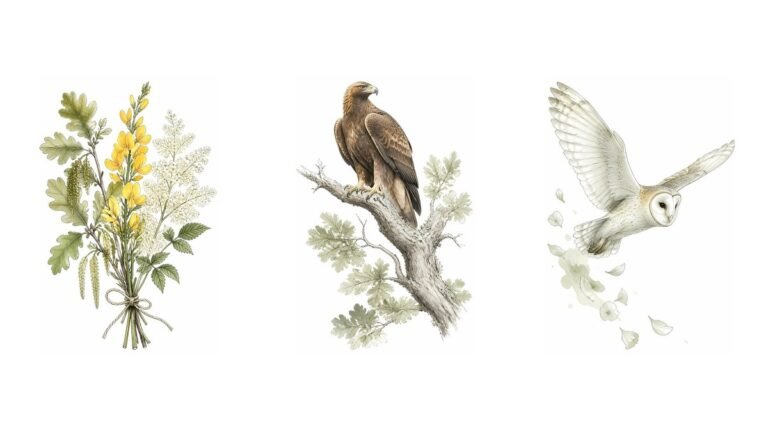
The crow is the Morrígan’s best known form. In the old tales the hooded crow or raven gathers over a battlefield, and a crow settling near a warrior is a sign that his fate is close. To this day, many people who feel drawn to her first notice it through crows and ravens: a bird that keeps turning up, landing close, calling at odd moments.
Her other great image is the washer at the ford. A woman stands in a river, washing clothes or armour stained with blood, and whoever sees her is seeing their own fate. The washer appears across Gaelic folklore, and in the Scottish Highlands she lived on for centuries as the bean nighe, the washing woman of the streams. It is a stark picture, but the ford is also a crossing place, where one thing ends and the next begins.
The Morrígan and the Dagda at Samhain
One of the oldest and most important stories about her comes from the tale of the Second Battle of Mag Tuired, when the Tuatha Dé Danann faced their great enemies, the Fomorians.
Shortly before the battle, at Samhain, the Dagda, the great father god of the Tuatha Dé Danann, went to a river in Connacht, the Unshin (written Unius in older spellings). There he found the Morrígan washing, with one foot on each bank of the river and her hair loosened. They came together there, and the place was afterwards known as the Bed of the Couple. She then told him where the Fomorians would land, and promised to take the strength from their king.
This is not a romance in the modern sense but a joining of two great powers, abundance and fate, on the night the year turns. The old teaching held that their union at Samhain helped secure a good year to come for the fields, the herds and the people. Some traditions say a son, Aengus, the god of love and youth, was born of their meeting.
When the battle was won, the Morrígan spoke two prophecies: a song of peace reaching up to the sky and plenty across the land, and a darker vision of a far future when summers would have no flowers and cattle no milk. She sees the good and the bad, and says both aloud. You can read more about the wider festival in our guide to the meaning of Samhain, and more about her partner in our post on the Dagda.
The Morrígan and Cú Chulainn
The Morrígan’s most famous human encounter is with Cú Chulainn, the young champion of Ulster, in the great Irish epic the Táin Bó Cúailnge, the Cattle Raid of Cooley.
Medb, queen of Connacht, marches her army out to seize the Brown Bull of Cooley. The men of Ulster are laid low by Macha’s curse, and Cú Chulainn must hold back the invading army almost alone, fighting one champion after another at the fords. The Morrígan watches him closely. She comes to him as a young woman and offers him her love and her help. He turns her away, and she warns him that she will come against him when he is fighting.
She keeps her word. During a hard fight at the ford she comes as an eel that wraps around his legs, as a grey wolf that drives cattle at him, and as a heifer leading a stampede. He wounds her in each form. Afterwards she appears as an old woman milking a cow, and offers him milk. With each drink he blesses her, and the wounds between them are healed. In other moments she comes as a crow and perches on his shoulder, bringing him omens and warnings of what lies ahead.
In a later tale, the dying Cú Chulainn ties himself to a standing stone so he can face his enemies on his feet, and they only dare come near when a crow settles on his shoulder. Read together, the stories show the Morrígan as a tester of heroes, the one who keeps the appointment with fate.
Sovereignty: The Queen and the Land
In early Irish thought, the right to rule was a relationship with the land, and the land was understood as a goddess. A good king was, in a sense, married to her. If he ruled well, the land was fruitful; if badly, the crops failed.
The Morrígan carries this idea in her very name. She is the Great Queen, fierce in defence of the land and those who belong to it, which is why she can be both terrifying and protective. For many people today, that is exactly her appeal.
Samhain, the Moon and the Season of the Crow
The Morrígan’s festival is Samhain, the old Celtic new year, kept on 31 October by people of many paths. The bright half of the year closes here and the start of the dark, a time when the veil between the worlds was said to be thin. In 2026 it falls on Saturday 31 October.
The sky fits her well this year. The Sun is in Scorpio at Samhain, the sign of depth, endings and what lies beneath the surface. The Hunter’s Moon is full in Taurus early on Monday 26 October, so by Samhain the moon is waning, the phase traditionally used for letting go and clearing away. It is a fitting time to ask her what needs to end in your own life before winter.
The Honest History
Everything we know about the Morrígan comes from Irish stories that were written down by Christian monks, mostly from around the eleventh and twelfth centuries, in great manuscript collections such as the Book of the Dun Cow, the Book of Leinster and the Yellow Book of Lecan. Some of the material in them is clearly much older, carried in oral tradition for generations before anyone wrote it down. But the monks were not writing as worshippers, and we cannot be sure how much they changed, softened or left out.
We have no temples or carved inscriptions that name her, and we do not know exactly how she was honoured before Christianity reached Ireland. What we have are her stories.
The Morrígan as many people meet her today, a goddess of personal power, boundaries and empowerment, especially for women, is a modern understanding. It grew from the twentieth century onwards as people came back to the old tales and found something in her that spoke to their own lives. That does not make it false. It simply means it is new, built with care on old foundations, and it is worth knowing the difference.
Crystals for the Morrígan
These stones are often chosen for her altar or to carry when working with her:
- Black obsidian: a dark, glassy stone of protection and honest reflection, long linked with her
- Whitby jet: a traditional stone of mourning and remembrance, fitting for Samhain and her care for the dead
- Bloodstone: deep green flecked with red, a warrior’s stone traditionally linked with courage
- Snowflake obsidian: black with soft grey marks, a gentle companion for facing endings with a clear head
- Red jasper: grounding and steady, in one of her three sacred colours
Trees and plants traditionally linked with her include rowan, willow and yew.
A Simple Samhain Offering to the Morrígan
This is a gentle, traditional style offering for Samhain night, Saturday 31 October 2026, or any evening in the waning days around it.
- Prepare a small space. Lay a black or red cloth on a shelf or table. Place a black or red candle in the centre; a white candle can stand in for any colour. Add your stones, a dish for the offering, and a crow or raven image if you have one, or a feather you have found naturally on a walk.
- Choose your offering. Offerings often given to her today include a small dish of red beans, a piece of meat from your Samhain meal, a little red wine, milk, or bread.
- Light the candle and speak to her. Breathe slowly for a moment, then say aloud, in your own words or these: “Great Queen, Morrígan, I honour you on this night of turning. I bring this gift with respect. Help me see clearly what is ending and what is worth defending.”
- Sit with her. Close your eyes and picture a river ford at dusk, with a crow on a branch above the water. Notice what comes: a sound, a feeling, a word. If nothing comes, that is fine too. Simply sit for a few minutes in the quiet.
- Write it down. In a journal, answer two questions: What in my life has run its course? What am I willing to stand up for in the year ahead?
- Close with thanks. Thank her, then snuff the candle rather than blowing it out.
- Return the offering. The next morning, pour any liquid onto the earth and place food outside on soil or in the garden, away from paths, if it is safe for wildlife. Otherwise, bury it or compost it with thanks.
If you are drawn to honour the dead as well, our Samhain guide includes a simple ancestor practice that sits beautifully alongside this one.
Signs the Morrígan May Be Calling You
People who feel drawn to her often describe a few of the same things:
- Crows or ravens turning up again and again, landing close or calling at you
- Dreams of rivers, fords, battles or a tall woman in red or black
- A strong pull towards her name or image, especially in autumn
- A season of life where you need to find your courage, speak up or protect something you love
- A growing interest in prophecy, divination and seeing things as they really are
You do not need a sign to begin learning about her. If you are not sure which goddess is reaching for you, our gentle guide Which Goddess Is Calling You? may help.
Questions People Ask
What is the Morrígan the goddess of?
She is an Irish goddess of fate, prophecy, sovereignty, war and death. In the old stories she decides the outcome of battles rather than fighting in them, and she is closely tied to the land and the right to rule it.
Is the Morrígan evil?
No. She can be fierce and frightening in the stories, but she is not evil. She protects her people and her land, she tests heroes, and she speaks the truth about what is coming, whether it is welcome or not.
Is the Morrígan a crow or a raven?
Both appear in the tradition. Her sister Badb is closely linked with the hooded crow, and the Morrígan herself takes crow form in the Táin. Many people today honour her through ravens and crows alike.
What is the Morrígan’s connection to Samhain?
In the tale of the Second Battle of Mag Tuired, she meets the Dagda at a river on Samhain, before the battle against the Fomorians. Their union at the turning of the year was traditionally linked with the fertility of the land. You can read more in our post on the Dagda.
How is the Morrígan different from Hecate?
Both are goddesses many people turn to as the nights draw in. Hecate is Greek, a goddess of crossroads, keys and the dark moon, while the Morrígan is Irish and tied to fate, sovereignty and the land. Our post on Hecate tells her story.
The Morrígan is said to take the form of a wolf in the old tales, and many people keep a crystal wolf head carving on their altar for her. A black obsidian mini goddess body carving is another fitting focus for this goddess of the darker half of the year.
Keep reading: The Dagda, the Good God of Ireland · The Cailleach, the Celtic Winter Goddess · Samhain Meaning · Which Goddess Is Calling You? · Hecate, Goddess of the Crossroads
Leave a Reply