The great father of the Tuatha Dé Danann: what his name means, the stories of his club, his cauldron of plenty and his harp of three musics, and a simple hearth offering for an abundant winter
Of all the old gods of Ireland, the Dagda is perhaps the easiest to like. He is huge, hungry, clever and kind, a god who carries a club that can take life and give it back, a cauldron that never runs empty, and a harp that can make a whole hall weep, laugh or fall asleep. As autumn turns to winter and thoughts go to warm kitchens and full tables, he is a lovely god to get to know. Here is who he is, where his stories come from, and a simple hearth offering for the season.
The Dagda at a Glance
- Who: the great father god of the Tuatha Dé Danann in Irish myth
- How to say it: DAG·da in everyday English; closer to DAHG·dah in Irish
- What the name means: “the good god”, good in the sense of good at everything
- Other names: Eochaid Ollathair, “father of all”, and Ruad Rofhessa, “the red one of great knowledge”
- Known for: strength, wisdom, abundance, druid magic, music and his huge appetite
- His three great possessions: a club, the cauldron called the Undry, and the harp Uaithne
- Family: son of Danu in the traditional teaching; father of Brigid and of Aengus Óg
- Festival: Samhain, when he meets the Morrígan by the river
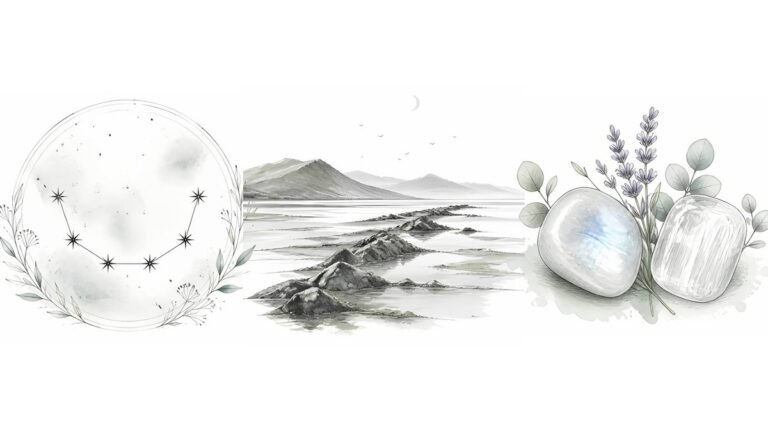
- Symbols: club, cauldron, harp, torc, oak
- Colours: white and red
Who Is the Dagda?
The Dagda is the chief father figure of the Tuatha Dé Danann, the divine people who, in Irish myth, ruled Ireland before the arrival of mortal kings. The traditional teaching names his mother as Danu, the great mother goddess from whom the Tuatha Dé Danann take their name.
He is a warrior, a druid, a harper, a builder and a wise leader all at once. He is strong enough to turn a battle, clever enough to outwit his enemies and skilled enough to play music that changes how people feel. He is linked with fertility, the harvest, the weather and the good things of the earth.
He is also, unlike the graceful gods of Greece and Rome, wonderfully earthy. The old stories describe him as a huge man with a great belly, wearing a short rough tunic and dragging his club behind him so that it ploughed a track along the ground. He eats enormously and laughs easily. That roughness is part of his charm, and part of his meaning. He is a god of the body, the hearth and the land, and he does not pretend to be anything grander.
What Does Dagda Mean?
Dagda means “the good god”. This does not mean good in the moral sense, gentle or well behaved. It means good at things. In one story, when the Tuatha Dé Danann are preparing for battle and each of them lists what they can do, the Dagda says he will do all the things they have promised, by himself. Everyone agrees: he is the good god.
His other names fill in the picture. Eochaid Ollathair means “father of all”, a title of the great protector and provider. Ruad Rofhessa means “the red one of great knowledge”, pointing to his wisdom and his skill in druid magic.
The Club, the Cauldron and the Harp
The Dagda owns three famous magical possessions. Together they tell you almost everything about him.
The club
His great club, called the Lorg Mór in the traditional teaching, is so heavy it takes several men to carry it. One end can kill nine men with a single blow. The other end, the handle, can touch the dead and bring them back to life. It is the power over life and death held in one hand, and it is the weapon he used to help win victory for his people at the Battle of Mag Tuired.
The cauldron of plenty
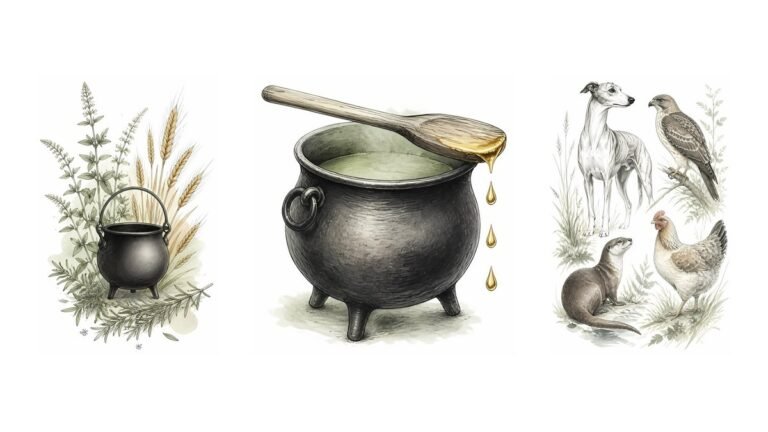
His cauldron, the Undry, is a cauldron of endless plenty. No company ever went away from it hungry, and no one ever left the Dagda’s presence unsatisfied. In the old tales it was one of four marvels the Tuatha Dé Danann brought with them to Ireland from the four great cities of their homeland, alongside the Stone of Fál, the spear of Lugh and the sword of Nuada. The cauldron is abundance and generosity in its simplest form: there is enough, and it is shared.
Cauldrons are central to Celtic myth more widely, from the Irish cauldron of plenty to the Welsh cauldrons of rebirth and inspiration, and the Dagda’s cauldron is one of the earliest and best loved.
The harp of three musics
His harp, called Uaithne in the traditional teaching, is made of oak and carved with great skill. It answers only to him. It is said to set the seasons in their proper order, and it can play three kinds of music: the music of sorrow, which makes all who hear it weep; the music of joy, which makes them laugh; and the music of sleep, which sends them into a deep slumber.
After the Second Battle of Mag Tuired, the Fomorians stole the harp and carried it off to their hall. The Dagda went after it with Lugh and Ogma. When he called out to it, the harp leapt from the wall into his hands. He played the music of sorrow, and the Fomorians wept. He played the music of joy, and they laughed. Then he played the music of sleep, and while the whole hall slept, the three gods walked out unharmed with the harp.
The club, the cauldron and the harp: the power over life and death, the abundance that feeds everyone, and the art that moves the heart.
The Dagda and the Battle of Mag Tuired
The Dagda’s greatest stories come from the tale of the Second Battle of Mag Tuired, when the Tuatha Dé Danann fought the Fomorians, a race of powerful beings linked with chaos and the deep, for control of Ireland.
Before the battle, the Dagda was sent to the Fomorian camp to ask for a truce. The Fomorians, knowing his love of porridge, set a test. They filled a pit in the ground with a vast meal of porridge, milk, meat and fat, and told him he must eat all of it or die. The Dagda took up a ladle big enough to hold a man and a woman, ate every last scrap, scraped the bottom of the pit with his finger, and then lay down for a well earned sleep. It is one of the funniest stories in Irish myth, and it shows his good humour as much as his appetite.
The Dagda and the Morrígan at Samhain
At Samhain, shortly before the battle, the Dagda went to the river Unshin in Connacht (written Unius in older spellings). There he found the Morrígan, the Great Queen, washing in the river with one foot on each bank. They came together there, and in return she told him where the Fomorians would land and promised to help the Tuatha Dé Danann win.
The traditional teaching says that the Dagda and the Morrígan consummate their union on Samhain so that crops, cattle and people would thrive in the year ahead. It is a meeting of two great powers: his abundance and her power over fate and death, coming together on the night the old year ends and the new one begins. In 2026, Samhain falls on Saturday 31 October. Our guide to the meaning of Samhain tells more of the festival.
His Family: Brigid and Aengus
The Dagda is the father of Brigid, the beloved goddess of poetry, healing and smithcraft, whose festival is Imbolc on 1 February. In some of the old sources she is three sisters, all named Brigid, each keeping one of the three sacred fires.
He is also the father of Aengus Óg, the young god of love and beauty. In a tradition many keep, Aengus was born of the Dagda’s meeting with the Morrígan by the river; other tellings name Boann, goddess of the River Boyne, as his mother. Aengus later won the Dagda’s great home at Brú na Bóinne, the ancient passage tombs by the Boyne that include Newgrange, by a clever trick. He asked to live there for a day and a night, and then pointed out that all of time is made of days and nights, so the house was his forever.
The Honest History
Everything we know about the Dagda comes from Irish stories written down by Christian monks, mostly from around the eleventh and twelfth centuries, although much of the material is older. The tale of the Second Battle of Mag Tuired, his most important story, survives in a single manuscript copied in the sixteenth century, while the text itself is centuries older.
The monks were not writing as worshippers, and some scholars think the comic picture of the Dagda, the huge belly, the short tunic and the porridge pit, may partly reflect their own humour at the expense of an old god. Others see it as true to a very old idea of the father god as earthy, generous and close to the land. Both may be true.
We have no inscriptions or temples naming him. Some scholars compare him with the Gaulish god Sucellus, the “good striker”, who carries a mallet and a pot, but that link is a suggestion, not a certainty. The way many people honour him today, as a god of abundance, the hearth and generosity, is a modern devotional practice built on the old stories, and a warm and fitting one.
Crystals for the Dagda
Earthy, warm stones suit his altar:
- Red jasper: grounding and steady, the stone most often linked with him, in his colour of red
- Tiger’s eye: golden brown and warm, traditionally kept for strength, confidence and good fortune
- Goldstone: glittering copper brown, a cheerful stone often kept for abundance and generosity
- Mahogany jasper: deep red brown like an oak hearth, a stone of stability and steady effort
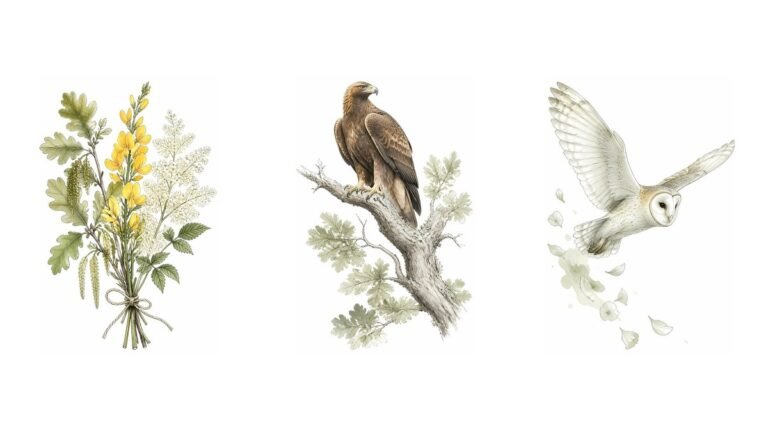
Plants traditionally linked with him include oak, clover and aspen. Oak is especially fitting, as his harp was made of it.
A Simple Hearth and Abundance Offering to the Dagda
The offerings traditionally given to the Dagda are simple, everyday things: oats, grain, bread and music. This hearth practice suits Samhain night, Saturday 31 October 2026, or any evening as the moon grows towards the full Beaver Moon in late November, a waxing time traditionally used for growth and plenty.
- Prepare the hearth. Choose a kitchen table, hearth or altar. Place a red or white candle there; a white candle can stand in for any colour. Set a small cauldron or bowl beside it, with your crystals around it.
- Fill the cauldron. Add a handful of oats or grain, or a piece of fresh bread. If you are cooking a meal or a pot of porridge, set aside a spoonful for him.
- Light the candle and call to him. Speak aloud: “Dagda, good god, father of all, keeper of the cauldron that never empties, I honour you at this hearth. May there always be enough here, and enough to share.”
- Offer music. Play a piece of music you love, sing, hum or play an instrument if you have one. Music was one of his great gifts, and it is one of the best offerings for him.
- Sit with the image of plenty. Close your eyes and picture a great cauldron over a fire, steaming and full, with people gathered round it. Notice the warmth and the sense of enough.
- Write a list of plenty. In your journal, note the things you already have enough of, and one way you could share your abundance this winter.
- Close with thanks. Thank him and snuff the candle.
- Share the plenty. The next day, scatter the oats or bread outside for the birds, and if you can, give something to a food bank or a cause that cares for the land, an offering in his generous spirit.
Signs the Dagda May Be Calling You
- A pull towards cooking, feeding people and gathering friends round a table
- A growing interest in music, especially the harp or traditional Irish music
- Noticing oak trees, acorns and cauldrons everywhere you look
- A season of life where you need to provide for others or step into a leadership role
- A wish to feel more grounded, generous and at home in your own body
If you are drawn to the wider family of the old gods, our guide to Celtic gods and goddesses introduces them all.
Questions People Ask
What is the Dagda the god of?
The Dagda is an Irish father god linked with abundance, fertility, strength, wisdom, druid magic and music. He is the chief father figure of the Tuatha Dé Danann.
What does the name Dagda mean?
Dagda means “the good god”. The word good here means good at everything rather than morally good: he is warrior, druid, harper and leader all in one.
What magical items does the Dagda own?
He owns a great club that can kill with one end and bring the dead back to life with the other, the Undry, a cauldron that never runs empty, and the harp Uaithne, which plays the music of sorrow, joy and sleep.
Who is the Dagda’s partner?
His best known union is with the Morrígan, the Great Queen, whom he meets by the river at Samhain before the Second Battle of Mag Tuired. Some stories also pair him with Boann, goddess of the River Boyne. You can read more in our post on the Morrígan.
Is the Dagda like Zeus or Odin?
He is a father of the gods, and his name Eochaid Ollathair, “father of all”, is often compared with Odin’s title All Father. But he is much earthier than either, with a great appetite, a rough tunic and a strong sense of humour.
How do you pronounce Dagda?
Most English speakers say DAG·da. In Irish it is closer to DAHG·dah, and the modern Irish spelling is Daghda.
Keep reading: The Morrígan, Celtic Goddess of Prophecy · Brigid, Goddess of Fire and Spring · Celtic Gods and Goddesses · Samhain Meaning
Leave a Reply