
Who Brigid is, the three fires she keeps, how the goddess and Saint Brigid of Kildare became so closely woven together, and how to make a Brigid’s cross for St Brigid’s Day
Few figures in Irish tradition are loved as much as Brigid. As a goddess she keeps the fires of poetry, the forge and healing. As a saint she founded a great church at Kildare and gave her name to wells, crosses and a spring festival still kept on 1 February. Here is her story, her symbols, her honest history, and a few gentle ways to honour her at home.
Brigid at a Glance
- Who: an Irish goddess of fire, poetry, smithcraft and healing, and Saint Brigid of Kildare, one of the patron saints of Ireland
- How to say it: BRIJ·id in English; in Irish, Bríd is said BREED. You will also see Brighid, Brigit and Bride
- Name meaning: “the high one” or “the exalted one”
- Family: daughter of the Dagda; mother of Ruadán
- Known for: the three fires, the perpetual flame at Kildare, holy wells, the protection of cattle and the home
- Symbols: Brigid’s cross, the eternal flame, sacred wells, bells, doorways, arrows
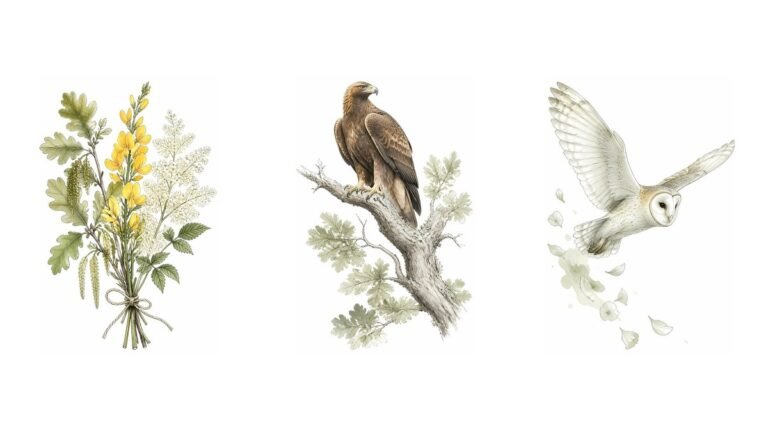
- Animals: cows, bees, owls and serpents
- Festival: Imbolc and St Brigid’s Day, 1 February. Next: Monday 1 February 2027
- Colours: white, green and red
Who Is the Goddess Brigid?
In Irish mythology Brigid belongs to the Tuatha Dé Danann, the family of gods who ruled Ireland in the old stories. She is a daughter of the Dagda, the great father god whose cauldron never runs empty. Her name comes from an old Celtic word meaning “the high one” or “the exalted one”, and that sense of brightness and height runs through everything told about her.
The story of her birth is pure fire. Brigid was born at the break of dawn, and as she came into the world a tower of flame rose above her head. The light spread across the land. Cattle thrived, crops grew and people rejoiced. From that first morning she was a goddess of fire and inspiration.
She is also a healer. It is said that wherever she walked, springs of fresh water welled up from the earth, and she became the guardian of healers and midwives. Poets and craftspeople looked to her too, for she was the patron of bards and the one who sparked new verse and new work.
Brigid, Bres and Ruadán
Not all her stories are bright. To make peace between the gods and the Fomorians, Brigid was married to Bres, son of a Fomorian king. Their son Ruadán fought on the Fomorian side in the great battle of Mag Tuired and was killed. Brigid came to the battlefield and grieved for him so loudly that, in the old telling, it was the first keening ever heard in Ireland. It is a reminder that the goddess of the hearth also knows loss.
One old tradition says that one side of Brigid’s face is beautiful and the other is not. Many see this as a sign that she holds both sides of life, the warm and the hard, in the same gaze.
The Three Brigids and the Three Fires
Brigid often appears as three sisters, all called Brigid. Cormac’s Glossary, written in Ireland around the year 900, describes Brigid the poet, with her sisters Brigid the healer and Brigid the smith. Each keeps a different fire:
- The fire of inspiration: poetry, music, words and new ideas
- The fire of the forge: smithcraft, metalwork and making things with your hands
- The fire of healing: warmth, care and the tending of others
These are not three separate goddesses so much as three sides of one creative power. Three is a pattern you meet again and again in Celtic tradition, with three Morrígans and three mothers as well as three Brigids. To know one face only is to know her in part.
Brigantia and the High One
The same old root word that gives us Brigid also gives us Brigantia, the goddess of the Brigantes, a large tribal confederation in northern Britain whose lands ran from what is now Yorkshire to the Scottish border. Carved stones from the Roman period name her. Whether Brigid and Brigantia are the same goddess known in two places, or two goddesses who share a name, is not something the tradition settles, and it is fine to leave the question open. What they share is the sense of height, of sovereignty, and of a protective power watching over the land and its people.
Saint Brigid of Kildare
Saint Brigid lived in the fifth and early sixth centuries and founded a monastery at Kildare, from the Irish Cill Dara, “the church of the oak”. Her feast day is 1 February, the same day as Imbolc. The stories told of her are full of generosity: giving away her father’s goods to the poor, turning water into ale for visitors, and a favourite legend in which a king offered her as much land as her cloak would cover, only to watch the cloak spread across the plain.
The saint carries so many of the goddess’s gifts, fire, healing, wells, cattle and poetry, that a tradition many keep sees them as one beloved figure who simply changed her clothes when Christianity arrived. The Irish loved Brigid too much to let her go. Historians still talk over the details, and both the goddess and the saint can be honoured in their own right.
The perpetual flame at Kildare
At Kildare a fire was kept burning in Brigid’s honour. In the twelfth century Gerald of Wales wrote that nineteen nuns took turns to tend it, and on the twentieth night the fire was left to Brigid herself, and still it did not go out. The flame burned from the fifth century until 1220, when the Archbishop of Dublin ordered it put out. In 1993 the Brigidine Sisters relit it in Kildare, and it has been tended there since.
Holy wells
Brigid’s wells are found all over Ireland, and in parts of Britain too. Two of the best known are at Kildare and at Liscannor in County Clare. People still visit them around her feast day, walking around the well, saying prayers and tying ribbons or strips of cloth to nearby trees. It is one of the clearest places where you can feel how close the goddess of healing springs and the saint of the wells still stand.
St Brigid’s Day today
Since 2023 Ireland has marked a public holiday for St Brigid’s Day, the first named after a woman. It falls on the first Monday of February, or on 1 February itself when that day is a Friday. In 2027 the holiday and the feast day fall together on Monday 1 February. Brigid is also at the heart of Imbolc, the festival of the first light of spring.
Brigid’s Symbols
- Brigid’s cross: the woven rush cross hung over doors for protection
- The eternal flame: her fire at Kildare, and any candle lit in her honour
- Wells and springs: the healing waters that rose where she walked
- Cows and milk: she was said to have a white cow, and she protects cattle and dairy
- Bells and doorways: thresholds, welcome and the turning from winter to spring
- Snowdrops and crocus: the first flowers of her season
- The rowan tree: sacred to Brigid in Celtic herb lore
Brigid and the Cailleach
In Scottish and Irish lore, Brigid meets the Cailleach, the old woman of winter, each year at the turning of the seasons. The Cailleach strikes the ground with her staff to freeze it. Brigid brings the thaw. In some tellings they struggle for the land, and in others the Cailleach rules from Samhain to Beltane and Brigid rules the bright half, so the year passes between them. You can read more in our posts on the Cailleach and her father the Dagda.
How to Make a Brigid’s Cross
Making a Brigid’s cross is the most loved Brigid tradition of all. Rushes were pulled by hand on the eve of her feast, and the cross was made by the fire that evening. If you cannot find rushes, long stems of dried grass, wheat straw or even paper straws work well.
You will need: about 16 rushes or straws, soaked for an hour if they are dry, and four short pieces of thread or small elastic bands.
- Start with one. Hold one rush upright between your finger and thumb.
- Fold the second. Fold a second rush in half around the middle of the first, so its two ends point to the right.
- Turn. Hold the centre firmly and turn the whole piece a quarter turn anticlockwise, so the folded rush now points upwards.
- Add the third. Fold a third rush in half over both strands of the upright one, so it points to the right again.
- Turn and repeat. Turn a quarter anticlockwise again, fold the next rush over the strands pointing upwards, and keep going. Hold the centre tightly as you work.
- Watch the square grow. After a few rounds you will see a woven square form in the middle, with four arms reaching out.
- Tie the arms. When the centre is as large as you like, usually after 12 to 16 rushes, tie the end of each arm with thread.
- Trim. Cut the ends of the arms so they are even.
Hang your cross above the front door or over the hearth. Traditionally the old cross from the year before is taken down and burned or returned to the earth when the new one goes up.
Crystals for Brigid
The old correspondences link Brigid with amethyst, jasper, agate and warm metals such as copper and gold. A few stones that suit her well:
- Red jasper: a warm, earthy stone for the fire of the hearth and the forge
- Chevron amethyst: amethyst is one of her traditional stones, and its bands of purple and white suit clear, calm inspiration
- Goldstone: made in fire and flecked with copper, a fitting stone for the smith goddess
- Lapis lazuli: long associated with words, wisdom and the voice, for the poet in her
- Howlite: white like milk and snowdrops, for her season
A Simple Candle Practice for Brigid
This short practice can be done on Imbolc, on a Friday, the day of Venus, her traditional planet, or whenever you would like to ask for inspiration, healing or a fresh start. You will need a white candle, a small bowl of water, and a poem or a few lines of your own writing.
- Prepare. Tidy your space and set the candle and the bowl of water side by side, fire and well together.
- Breathe. Take a few slow breaths and let the day settle.
- Light the flame. Light the candle and say, “Brigid of the three fires, I light this flame in your honour.”
- Bring her to mind. Many people like to close their eyes and picture her flame rising, or simply sit with the warmth and the quiet sound of the room.
- Offer your words. Read a poem aloud, or speak a few lines you have written. Poetry and spoken word are her traditional offerings.
- Ask. Name one thing you would like her help with: a creative project, care for someone you love, or the courage to begin.
- Bless the water. Dip your fingers in the bowl and touch your forehead, as people do at her wells.
- Close. Thank her, then snuff the candle. Pour the water onto the earth or onto a plant the next day.
If you would like to see which other goddesses may be close to you, try our gentle guide, Which Goddess Is Calling You?
Signs Brigid May Be Calling You
- You feel a strong pull to write, make or create, especially in the dark weeks of winter
- Candles, fire and the hearth have started to feel important to you
- You keep noticing wells, springs, snowdrops or Brigid’s crosses
- You find yourself caring for others and want to do it with more warmth
- February has always felt like a turning point in your year
- Her name keeps coming up, in books, places or conversations
Questions People Ask
What is Brigid the goddess of?
Brigid is the Irish goddess of fire, poetry, smithcraft and healing, often described as keeping three fires. She is also linked with wells, cattle, the home and the coming of spring at Imbolc.
Is St Brigid the same as the goddess Brigid?
They share a name, a feast day and many symbols, including fire, wells and cattle. A tradition many keep sees the saint as the goddess carried into the Christian age, while historians still discuss how much passed from one to the other. You can honour either, or both.
What is St Brigid’s Day?
St Brigid’s Day is 1 February, the feast of Saint Brigid of Kildare and the same day as Imbolc. In Ireland it is now a public holiday, held on the first Monday of February or on 1 February when it falls on a Friday.
What does a Brigid’s cross mean?
A Brigid’s cross is a woven rush cross made on the eve of her feast and hung over the door or hearth. It was believed to protect the house and everyone in it, and a new one was made each year.
Where do you hang a Brigid’s cross?
Traditionally it goes above the front door, over the hearth or in the rafters. Many people today hang it in the kitchen, near the heart of the home.
What offerings does Brigid like?
Her traditional offerings are poetry and the spoken word. Many people also offer milk, bread, a lit candle or water from a spring, and tend a small flame in her honour on 1 February.
A mini goddess body carving in grey calcite or labradorite makes a gentle focal point for a Brigid altar beside a candle and a Brigid’s cross. For a larger piece, see our goddess body crystal carving collection.
Keep reading: Imbolc Meaning and Traditions · The Dagda, the Good God · The Cailleach · Which Goddess Is Calling You?
Leave a Reply