
The antlered god of the Celts: who Cernunnos was, how to say his name, his torc and serpent, the honest history behind the Horned God, and a quiet way to honour him in the woods
Cernunnos is the antlered god who sits cross legged among the animals, a torc in one hand and a serpent in the other. He is one of the most searched for figures in Celtic myth, and one of the most mysterious, because no story about him survives from the ancient world. What we have are carvings, a single inscription and a great deal of modern love. Here is what is truly old, what is newer, and how people honour him today.
Cernunnos is one of the deities in our guide to Celtic gods and goddesses, which sits within our wider guide to gods and goddesses of myth and magic.
Cernunnos at a Glance
- Who: an antlered Celtic god of the wild, of animals, of plenty and of the forest
- How to say it: ker·NUN·os
- Name means: usually read as “the horned one”
- Where he comes from: continental Europe, especially Gaul (roughly modern France)
- Best known image: the seated, antlered figure on the Gundestrup Cauldron
- Where his name appears: once only, on the Pillar of the Boatmen from Paris
- Symbols: antlers, the torc, the ram horned serpent, the stag, oak and acorns
- Season: honoured by many at Yule and Beltane; one tradition gives him the month of December
- Stones often linked with him: Whitby jet, serpentine, tiger’s eye, unakite, dalmatian jasper
Who Is Cernunnos?
Cernunnos is the name we give to a horned god who appears again and again in the art of the ancient Celts. He is shown as a man with the antlers of a stag growing from his head. He usually sits on the ground with his legs folded, calm and still, with wild animals gathered around him. He does not rule them from a throne; he sits among them.
More than thirty ancient images of an antlered god like this have been found across the Celtic world, so he clearly mattered to many people. In the tradition many keep today, he is a lord of nature, of animals and of abundance, and also a lord of the underworld and of souls: the one who watches over the turning of life into death and back into life again.
His name is usually explained as “the horned one”, from an old root word, ker, connected with horns and with growing large and strong.
The god with no surviving story
Here is the part that surprises people. Unlike Brigid, the Dagda or the Morrígan, Cernunnos has no ancient myth that has come down to us. The Irish and Welsh tales were written down by medieval monks, and he does not appear in them. Everything we know of him comes from stone, metal and one carved word. The stories told about him now, of a forest lord who drives back the darkness, are modern tales inspired by those images, and lovely to enjoy as exactly that.
The Gundestrup Cauldron
The most famous picture of Cernunnos is on the Gundestrup Cauldron, a great silver bowl found in a peat bog in Denmark in 1891. It is around two thousand years old, and it is covered inside and out with panels of gods, animals and strange scenes.
On one inner panel sits the antlered figure. His legs are crossed beneath him. Around his neck he wears a torc, and in his right hand he holds up a second torc. In his left hand he grips a serpent with the horns of a ram. Beside him stands a stag whose antlers match his own, and around him gathers a crowd of wild creatures. It is a scene of complete stillness in the middle of the wild.
Nobody knows exactly where the cauldron was made. What matters is the picture: a god rooted to the earth, holding power in one hand and the coiled life of the land in the other.
The Pillar of the Boatmen: The Only Place His Name Appears
So where does the name Cernunnos come from? From one carved stone in Paris.
In the early 1700s, workmen digging beneath the cathedral of Notre Dame found the blocks of a tall Roman era monument. It had been raised by the boatmen of the river Seine in the time of the emperor Tiberius, nearly two thousand years ago, and it is known as the Pillar of the Boatmen. Its sides show Roman gods and Celtic gods side by side. On one block is a bearded god with antlers, and from each antler hangs a torc. Above him, carved into the stone, is his name. The first letter has worn away, so it reads ERNUNNOS, and the missing C has been filled in ever since.
That is the only time the name is written anywhere in the surviving record. Other antlered gods in other places may well have been called by other names. We use Cernunnos as a convenience, a name that fits the images well, rather than as a certainty. The pillar is now kept in the Musée de Cluny in Paris.
His Symbols and What They Mean
The antlers
The antlers link him to the stag, the greatest wild animal of the old northern forests. A stag sheds its antlers in late winter and grows them again each year, and many read this as the cycle of the year itself.
The torc
A torc is a heavy neck ring of twisted metal, often gold, worn by Celtic leaders and gods as a sign of honour and authority. Cernunnos wears one and holds another, as if he has power to wear and power to give.
The ram horned serpent
A snake with the curled horns of a ram is one of the most unusual creatures in Celtic art, and it often appears with Cernunnos. A serpent lives close to the earth and sheds its skin, so it speaks of the land, of renewal and of hidden places. The ram’s horns add strength and fertility. Together they make a creature of the earth’s own life force.
The stag and the animals
The stag is his closest companion, and in the tradition many keep, bulls, dogs and even rats belong to him too. He is a god of all creatures, not only the noble ones. Oak, ivy, mistletoe and juniper are the plants most linked with him, with acorns as a favourite offering.
Honest History: What Is Old and What Is New
What is ancient. An antlered god was honoured across continental Europe in the Iron Age and Roman era. He is shown seated, with a torc and often a ram horned serpent, and surrounded by animals. One carved stone gives his name as Cernunnos. All of this is real and old.
What is uncertain. We do not know his stories, his festivals or exactly how he was worshipped. He is a continental figure, preserved in art rather than in writing, and he does not appear in the Irish or Welsh tales. Almost everything said about him beyond what the images show is interpretation.
What is modern. In the twentieth century, Cernunnos became the best known face of the Horned God of modern witchcraft and Paganism: the partner of the Goddess, born at Yule, in his strength at Beltane, and returning to the earth at the end of the harvest. This picture is much loved and deeply meaningful to many people, and it goes well beyond the ancient evidence. It is a modern construction built on an old image, and it is fine to hold it that way.
Herne the Hunter and Gwyn ap Nudd
Britain has its own wild figures often linked with Cernunnos.
Herne the Hunter belongs to English folklore. He is a ghostly huntsman with antlers on his head who is said to haunt Windsor Great Park, near an old tree known as Herne’s Oak. The earliest written mention of him is in Shakespeare’s play The Merry Wives of Windsor, from around 1600. Some feel he carries an old British memory of the horned god; others see a local ghost story.
Gwyn ap Nudd comes from Welsh tradition. He is a king of Annwn, the Welsh otherworld, and a king of the fair folk, remembered as a great hunter who rides out with his hounds. He is not antlered, but he shares the same theme: a figure who stands at the edge of the wild, between the world of people and the world beyond.
Neither is the same being as Cernunnos, and no ancient text joins them. What they share is an idea that runs deep in these islands: the lord of the forest who wears the wild as a crown.
How to Pronounce Cernunnos
Most people in Britain say it ker·NUN·os, with a hard K at the start, as in “kernel”, and the weight on the middle syllable. You will also hear ser·NUN·os, with a soft S, and both are widely used. The hard K is closest to how it was likely said, and speaking his name slowly, with care, is a simple act of respect.
Cernunnos and the Wheel of the Year
No festival of his survives, so people honour him at the points of the Wheel of the Year, kept by people of many paths, that feel most like him.
Yule, around the winter solstice on 21 December, is when many honour the horned god as the returning light in the darkest days, the stag sleeping in the frozen forest and waiting for spring.
Beltane, on 1 May, is when many honour him in his full strength: green, fertile and alive, the wild partner of the blossoming earth. Our guide to crystals for Beltane pairs well with this.
A god for December
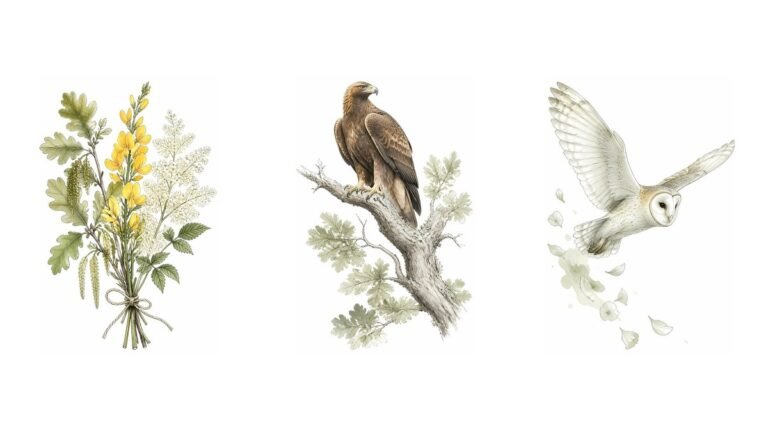
There is a gentle tradition that gives each month of the year its own deity, drawn from the many cultures that shaped the northern world. In that calendar, December belongs to Odin or Cernunnos, a figure of magic, wisdom and prophecy, celebrated on 31 December, New Year’s Eve, a night for fortune telling and looking ahead. The trees of that month are elder and birch, its animals the owl and the goose, and its flower the narcissus. It is a tradition many keep, and a lovely reason to light a candle for the antlered one as the old year ends.
Crystals for Cernunnos
Earthy, rooted stones suit a god of forest and field.
- Whitby jet: a stone traditionally linked with Cernunnos, made from ancient fossilised wood, so it carries the old forest in it.
- Serpentine: green and smooth, its name and markings echo the ram horned serpent he holds.
- Tiger’s eye: warm and golden like the torc, a stone traditionally associated with steady strength and courage.
- Unakite: a mix of moss green and soft pink, often chosen for growth, patience and the slow cycles of nature.
- Dalmatian jasper: spotted like the coat of a young deer, a playful, grounding stone for honouring the animals in his care.
Green, gold and silver are the colours most linked with him, so a green, gold or white candle suits any of these. A white candle can always stand in for any colour.
A Simple Woodland Offering to Cernunnos
This is a quiet, traditional way to honour him, outdoors if you can, or at a window that looks out on trees if you cannot.
- Gather your offering. Choose something natural and kind to the land: a handful of acorns, a few oak leaves, some oats or grain, or a piece of fruit. These are the offerings traditionally given to him.
- Find your place. Walk into woodland, a park or your garden, and find a tree that feels welcoming, ideally an oak. At home, set a small altar with a green or white candle, your chosen stone and a sprig of ivy or evergreen.
- Settle yourself. Stand or sit still. Take a few slow breaths and listen to the sounds around you: wind in the branches, birds, your own breathing. Many people like to picture the antlered god seated among the animals, as he sits on the cauldron.
- Speak to him. Say his name three times, slowly. Then speak simply and from the heart, for example: “Cernunnos, horned one, lord of the wild, I bring this gift with thanks for the forest, the creatures and the turning year.”
- Give the offering. Place your acorns, grain or fruit at the foot of the tree, or on a plate on your altar. Leave nothing outdoors that could harm wildlife, such as plastic, salt or ribbon.
- Listen. Sit for a few minutes. Notice what you feel and anything that catches your attention. Write it in your journal afterwards.
- Close gently. Thank him. If you lit a candle, snuff it rather than blowing it out, and return any indoor offering to the earth the next day.
Signs Cernunnos May Be Calling You
- You feel a strong pull towards woodland, and time among trees feels like coming home.
- Deer, stags or antlers keep appearing, on walks, in dreams, in pictures or in conversation.
- You notice oak trees and acorns everywhere you go.
- You feel moved to care for wild animals and wild places.
None of these is proof on its own. If you are wondering whether a deity is reaching out to you, our gentle guide to knowing which deity is calling you walks through it step by step.
Questions People Ask
Who is Cernunnos?
Cernunnos is an antlered Celtic god of nature, animals and plenty, shown in ancient art seated among wild animals with a torc and a ram horned serpent. He was honoured in Gaul around two thousand years ago and is widely honoured today as the Horned God.
How do you pronounce Cernunnos?
The most common pronunciation is ker·NUN·os, with a hard K and the stress on the middle syllable. Some people say ser·NUN·os with a soft S. Both are widely heard, but the hard K is closer to how the name was likely spoken.
Is Cernunnos Irish?
No. Cernunnos is a continental Celtic god, known from carvings and metalwork in places such as France, and he does not appear in the Irish or Welsh myths. Ireland’s great father god is the Dagda, and Britain has its own wild figures such as Herne the Hunter and Gwyn ap Nudd.
What is the symbol of Cernunnos?
His main symbols are stag’s antlers, the torc, a twisted neck ring standing for honour and authority, and the ram horned serpent. The stag, the oak tree and acorns are also strongly linked with him.
Is Cernunnos the same as Herne the Hunter?
Not exactly. Herne is an antlered ghost of English folklore tied to Windsor, first written about around 1600, while Cernunnos is a much older continental god. Many people feel the two share the same spirit of the wild, but there is no ancient source that makes them one.
When is Cernunnos celebrated?
No ancient festival for him survives, so people honour him today at Yule and Beltane, and one tradition gives him the month of December and New Year’s Eve. Our guide to Celtic gods and goddesses shows how he fits among the other deities.
Keep reading: Celtic Gods and Goddesses · The Dagda, the Good God of Ireland · Gods and Goddesses: A Guide to the Deities of Myth and Magic · Celtic Circles and Ancient Crystal Magic
Leave a Reply