
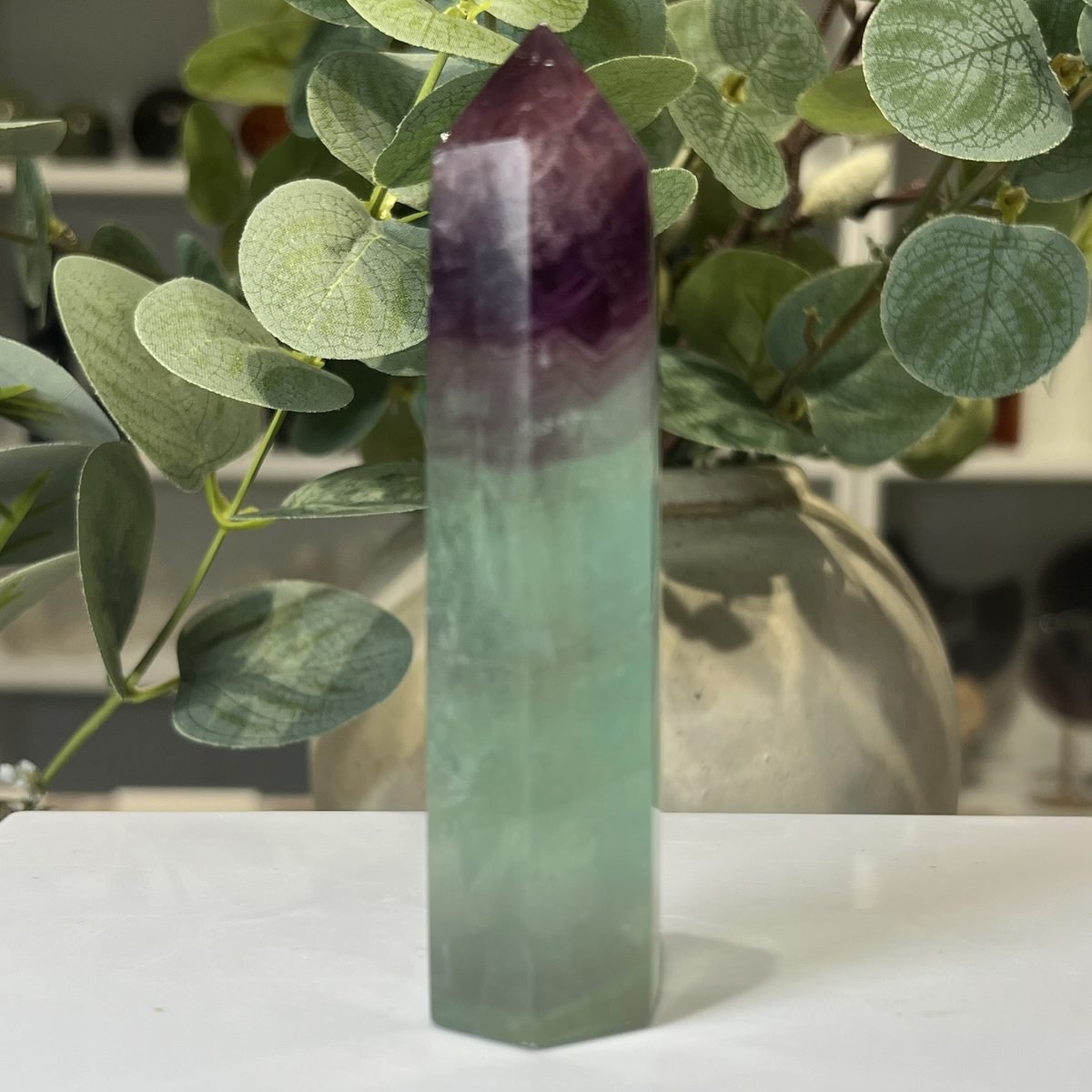
Soft enough to scratch with a blade, banded, often dyed, and how to keep a tower in one piece
Fluorite meaning is given as focus and clear thinking, and that is a fair summary of what the stone has traditionally been used for. Fluorite is also the stone with the best British story of any crystal in the shop, because one variety of it is found in exactly one place on earth and that place is in Derbyshire. This guide covers what fluorite is, why it comes in every colour, Blue John, whether it can go in water, and why fluorite chips so easily.
Fluorite meaning and what the stone is
Fluorite is calcium fluoride, and it grows in cubes and octahedra, which is unusual enough to be a recognition feature on its own. A natural fluorite cube with sharp square faces is one of the most satisfying mineral shapes there is.
It is soft, 4 on the Mohs scale, which is about the hardness of a copper coin and well below quartz. It also has perfect cleavage in four directions, meaning it will split cleanly along any of four planes. Those two facts together explain almost everything about handling fluorite.
The word fluorescence is named after this mineral, because fluorite was the stone the effect was first described in. Many pieces glow blue or violet under ultraviolet light. Mindat’s fluorite entry has the crystallography.
Why fluorite comes in every colour
Pure calcium fluoride is colourless. Everything you see in a piece of fluorite comes from trace elements and from defects in the crystal structure where an electron sits in a gap and absorbs part of the light passing through.
That is why fluorite ranges from green through purple, blue, yellow, pink and clear, often several of them banded through a single piece. Rainbow fluorite is not a trade name for something treated. It is one crystal that changed its chemistry as it grew, and the bands are the record of that.
Green and purple are the most common. Yellow and pink are less so. Clear fluorite is used to make lenses, because it bends light unusually evenly.
Blue John, the Derbyshire fluorite
Blue John is a banded blue, purple and yellow fluorite found in two caverns at Castleton in Derbyshire and nowhere else in the world. It has been worked since at least the eighteenth century into bowls, urns and small ornaments, and the Romans may have had it before that.
Very little is mined now, a few hundred kilograms a year, and the workings are protected. Anything sold as Blue John should come with provenance, and most of what is offered online as Blue John is dyed fluorite from elsewhere. If you want the real thing, buy it in Derbyshire.
Is fluorite receptive or projective
Projective, which surprises people who think of fluorite as a calm study stone.
Cunningham lists fluorite as projective and gives its traditional use as mental powers, without naming a planet or element. Where a source is silent it is better to say so than to fill the gap. Kynes places fluorite with both Earth and Water in her element tables.
Projective means sending outward and acting, and for fluorite that reads as directed thinking rather than drifting. It is traditionally the stone for study, for concentration, for sorting out a problem, and for the kind of mental work that has a target. That is a different thing from the quiet receptive clarity of amethyst, and the two are often used together for exactly that reason.
As a projective stone it belongs on your dominant wrist. Our guide to which hand to wear a crystal bracelet explains the framework, though fluorite at hardness 4 is a poor choice for a bracelet and better kept on a desk.
These associations come from tradition, and they are held rather than proved.
Can fluorite go in water
Briefly, cool, and dried straight away, but it is better to avoid it.
Fluorite is soft and slightly soluble, far less so than selenite but enough that repeated soaking will dull a polished surface. Water also works into the cleavage planes, and a piece that has been soaked can develop cloudy lines along those planes. Salt water will etch it.
Fluorite can fade in sunlight as well, which is worth knowing for a stone people like to put on a windowsill because the colour looks best lit. Keep it out of direct sun and cleanse it with smoke, sound or moonlight. Our guide to cleansing crystals explains why some stones should stay dry.
What it means when fluorite breaks
Fluorite breaks more readily than almost anything else people buy, and it is entirely structural. Perfect cleavage in four directions means a knock in any direction finds a plane to split along. Towers lose their tips, spheres develop flat chips, and octahedra, which are often cleaved from larger crystals rather than grown that way, can part again along the same planes.
A fluorite that has chipped will usually show a flat shiny triangular face where the piece came away. That is cleavage, and it is a sign of real fluorite rather than a fault in the piece.
The old reading is that a broken stone has done what it was there for. With fluorite it is worth being plain that at hardness 4 with four cleavage directions, the mineral explains nearly every case on its own.
Given how readily fluorite chips, what it means when a crystal breaks is probably worth a read.
Choosing a piece
Fluorite is one of the few stones where buying it to look at is the honest reason, because the banding is genuinely beautiful. Spheres and freeform shapes show it best. Natural octahedra are cheap, attractive and the most fragile thing on the shelf.
Look for clean banding and a good polish. Avoid pieces with existing cleavage cracks running through them, which look like fine flat internal lines catching the light, because that is where it will eventually part.
Keep fluorite somewhere it will not be knocked, out of direct sunlight, and do not carry it loose in a pocket with harder stones, which will scratch it.
Fluorite worth a place
Browse our fluorite, or go by form with crystal towers and crystal spheres.
These are correspondences carried by tradition, not effects. None of it stands in for medical or professional advice.
Continue Your Journey
Calcite Meaning · When A Crystal Breaks · How To Cleanse Crystals




Leave a Reply