
The receptive and projective framework, what changes if you are left handed, and which wrist suits which stone
Which hand to wear a crystal bracelet on is one of the most asked questions in the shop, and most answers online either say it makes no difference or give a rule with nothing behind it. There is an older framework that answers it properly, it comes from the same tradition as the rest of crystal work, and once you know it you can work out the answer for any stone and any intention without having to look it up again.
The short answer
Wear a bracelet on your non dominant wrist when you want to draw something in, and on your dominant wrist when you want to send something out or hold a boundary. For most people that means the left wrist for drawing in and the right wrist for sending out. If you are left handed, swap the two.
That is the whole rule. The rest of this explains where it comes from, because knowing why makes it useful rather than something else to remember.
Which hand to wear a crystal bracelet: receptive and projective
In the correspondence tradition that most modern crystal practice rests on, everything is sorted into one of two currents. Receptive and projective. Receptive draws inward, settles and absorbs, and sits with the Moon, with water and earth, and with the quieter end of practice. Projective sends outward, acts and defends, and sits with the Sun, with fire and air, and with the active end.
You will also meet the same two currents under the names Yin and Yang. Sandra Kynes uses those in her correspondence tables where Scott Cunningham uses receptive and projective, and they mean the same thing. Yin is receptive, Yang is projective. Two different books, one idea.
Hands are sorted the same way. Your non dominant hand is the receptive hand, the one that takes and holds. Your dominant hand is the projective hand, the one that writes, points, gives and acts. The idea is not that one hand is better. It is that they do different jobs, and a stone worn on one does a different job from the same stone worn on the other.
So a bracelet on the receptive wrist is placed where things come in. A bracelet on the projective wrist is placed where things go out. The same amethyst, moved from one wrist to the other, changes what you are asking of it.
If you are left handed
Then your right hand is the receptive one and your left is the projective one, and every instruction above reverses. This matters and it is almost never said. The rule was never about left and right, it was about dominant and non dominant, and left and right became shorthand because most people are right handed.
If you are genuinely ambidextrous, use the hand you write with as the projective one. If that is no help either, pick one, stay consistent, and notice what happens. Consistency is doing more work here than correctness.
Which wrist suits which stone
Stones carry the same two currents, so the simplest approach is to match the stone to the wrist. A receptive stone on the receptive wrist, a projective stone on the projective wrist.
Receptive stones, for the non dominant wrist: amethyst, rose quartz, selenite, lapis lazuli, moonstone, sodalite, jade, chrysocolla, kunzite and black tourmaline.
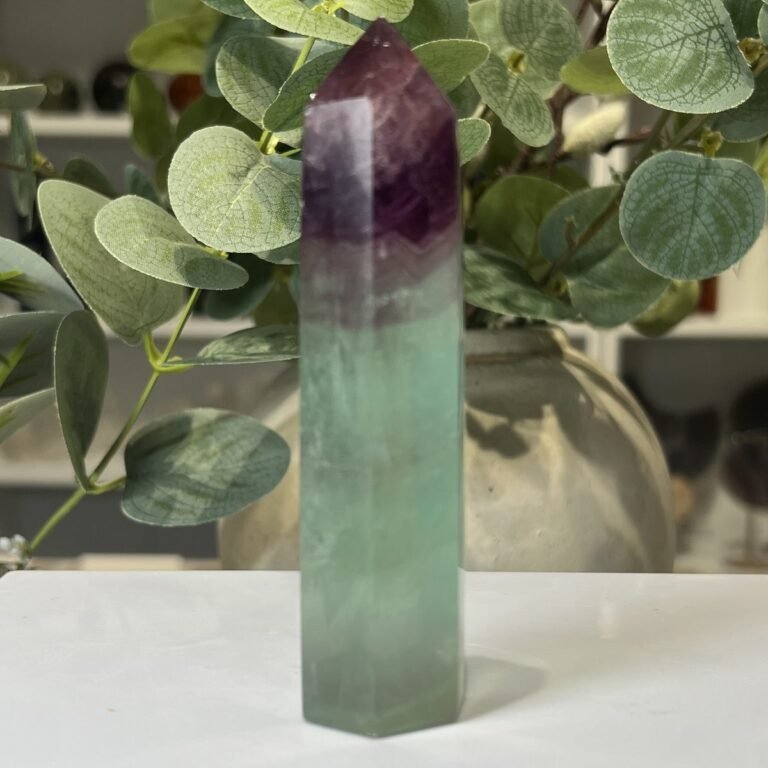
Projective stones, for the dominant wrist: tigers eye, citrine, carnelian, obsidian, fluorite, sunstone, garnet, hematite, onyx and bloodstone.
Clear quartz is both, which is why it is the one stone that can stand in for any other. Wear clear quartz on either wrist and it takes the character of what you are asking of it.
Black tourmaline is the one that surprises people. It is a protection stone, and protection sounds projective, but it is listed as receptive. That fits what it is traditionally used for: tourmaline absorbs rather than repels. So it goes on the receptive wrist, drawing in and holding what you would rather not carry around, which is a different job from a stone that pushes back.
When the stone and the intention disagree
They often will, and when they do the intention wins.
Tigers eye is projective, so by the rule it belongs on your dominant wrist. If you are wearing it because you want to feel steadier in yourself rather than more forward with other people, the receptive wrist is the better choice. Amethyst is receptive, so it belongs on the non dominant wrist. If you are wearing it to keep a clear head in a room full of other people’s moods, the projective wrist makes more sense.
Ask what you want the stone to do rather than what the stone is, and put it on the wrist that matches the answer. The stone’s own current is the starting point, not the ruling.
Rings, pendants and stones in a pocket
The same logic carries across. A ring follows the hand it is on. A pendant sits at the centre and takes neither side, which is why pendants suit stones you want working on you generally rather than directed one way. A stone in a pocket follows the side of the body it sits on, and a stone in a bag follows the shoulder you carry it on.
Holding a stone is where the two hands are clearest. Hold a stone in your receptive hand to sit with it and take something from it. Hold it in your projective hand when you are directing it, which is why a pendulum, a wand and a point are all held in the dominant hand.
What this is and is not
This is a traditional framework for making a decision, and that is all it claims to be. It is a way of being deliberate about something you would otherwise do at random, and being deliberate is most of what practice is. None of it is a substitute for medical or professional advice, and no stone on either wrist is doing anything to your body.
One practical note while we are here. If your bracelet has selenite in it, keep it away from water, because selenite is soft and water soluble and will pit and dull. The same goes for malachite, lepidolite and anything else soft or porous. Take a bracelet off before washing up and before the shower, whichever wrist it is on. Our guide to cleansing crystals covers which stones can take water and which cannot.
Bracelets and stones for either wrist
Browse our crystal jewellery, or go by stone with amethyst, tigers eye and clear quartz. If you are not sure where to begin, our guide to choosing crystals is the place to start.
This is a way of making a decision, not a treatment. Nothing here replaces medical or professional advice.
Continue Your Journey
Amethyst Meaning · Tigers Eye Meaning · How To Cleanse Crystals



Leave a Reply