Lunar eclipse crystals, a grid you can actually build, and four ways to bend it to the practice you already have
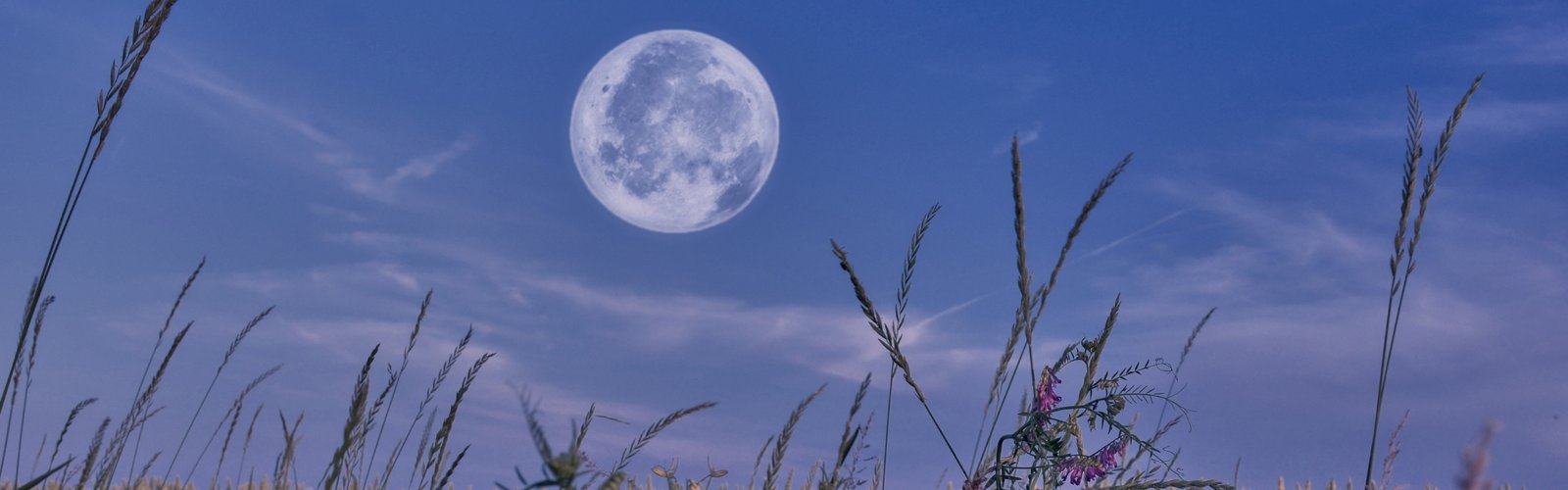
The last eclipse of 2026 lands at 5.12am on Friday 28 August, and for once British skies get the good one. This is a working guide to lunar eclipse crystals for that morning. What to put where, what to say, and what to do with the stones afterwards.
The Moon at a Glance
- Eclipse maximum: 5.12am BST, Friday 28 August 2026
- Full moon exact: 5.18am BST, the same morning
- Degree: 4 degrees and 54 minutes of Pisces
- Also: a deep partial lunar eclipse at the North Node, with ninety three per cent of the Moon’s diameter in the dark inner shadow
- Best window: 3.33am to 5.30am, or any time on the Friday if that hour is not happening
- Where to look: low in the west and southwest
The short version
Friday 28 August. Set an alarm for 3.30am if you want the whole thing, or 5am if you want the best of it. Look west and southwest, low. The Moon goes copper, then sets while still in shadow at around 6.30am.
Cleanse yes, charge no. An eclipse suits taking away rather than putting in, so cleansing on this moon is fine and many people prefer it. Hold off on charging until the next full moon with no shadow in it, which is Saturday 26 September.
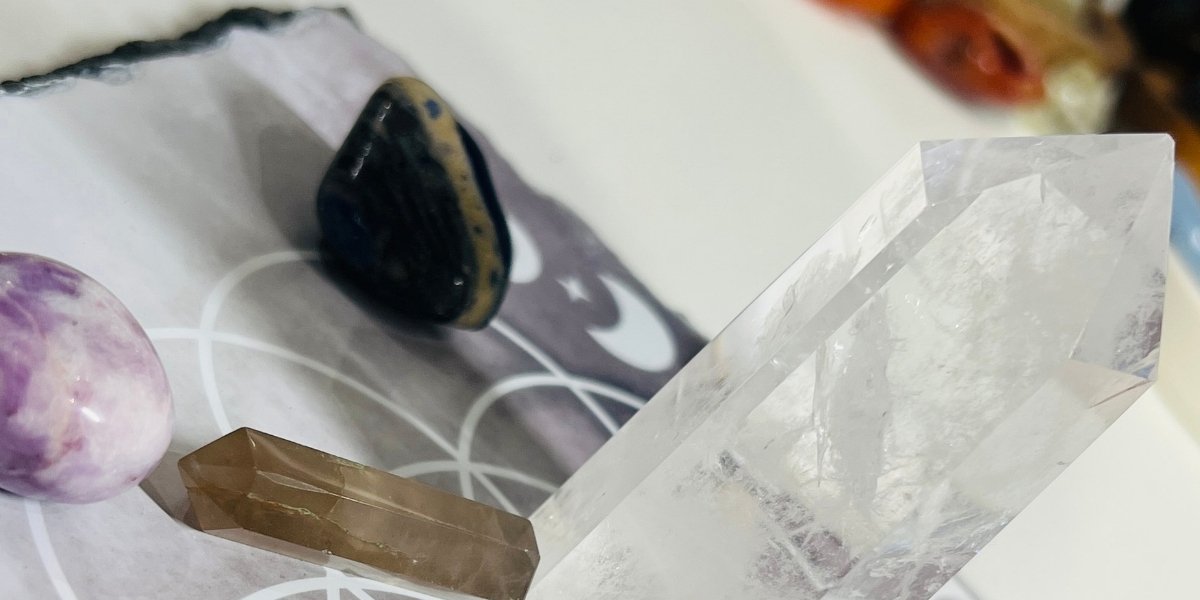
Four stones will build the grid. Clear quartz, moonstone, fluorite, smoky quartz. Everything below that is an upgrade, not a requirement.
When to be awake, and where to look
All times are British Summer Time. The Moon is low and dropping the whole way through, so a clear view towards the west and southwest matters more than anything else you do. A hedge in that direction will cost you the eclipse. This is worth checking in daylight on the Thursday rather than finding out at half past three in the morning.
- 2.23am. The outer shadow arrives. Around twenty five degrees up in the south southwest. A faint dulling on one edge. Honestly, you can skip this bit.
- 3.33am. The real bite starts. Around twenty degrees up in the southwest. This is where it becomes obvious to the naked eye.
- 5.12am. Maximum. Around ten degrees above the horizon in the west southwest, deep in shadow, with the sky already lifting towards dawn behind you.
- Around 6.30am. The Moon sets, still eclipsed.
Those altitudes are worked out for Shropshire. Anywhere in Britain or Ireland is within a degree or two, with the far south west holding the Moon slightly higher and Scotland slightly lower. On paper the eclipse ends at 6.51am, but from here the Moon has already gone. We get the build and the maximum and then it is taken off us, which is a fitting shape for this one.
Ninety three per cent of the Moon’s diameter goes into the dark inner shadow, and the part inside it turns copper. That colour is sunlight bent through the whole ring of the Earth’s atmosphere, every sunrise and sunset on the planet at once, landing on the Moon. The sliver left outside stays bright, which is what makes a deep partial look stranger than a total. Your eye keeps trying to correct for it and cannot. The Royal Observatory Greenwich has the observing detail if you want the astronomy on its own.
A total eclipse looks like something has happened. A deep partial looks like something is happening and has not finished.
Lunar eclipse crystals and the charging question
Every eclipse, the same argument goes round. Put your stones out. Never put your stones out. Both delivered with total confidence, neither one carrying a source.
Nobody can source either rule
Leaving crystals under moonlight is a modern habit. It does not turn up in the old lapidary writing, which was far more interested in what a stone did when it was worn, powdered or set into metal. The rule that eclipse light is somehow contaminated is more recent still and circulates almost entirely online. Both positions are sincerely held. Both were invented within living memory.
What we would actually do
Here is the line we hold, and it splits the question in two rather than answering it with a yes or a no.
Cleansing is fine. An eclipse is a shadow, and a shadow suits taking something away. If clearing a stone is what you are after, this is a good night for it and plenty of people choose an eclipse deliberately.
Charging is the one to hold off on. Not because the light is spoiled, but because the condition of the Moon decides what a working does, and an eclipse is not a night you can read cleanly. Put the charging off until the next full moon with no shadow anywhere near it, which is Saturday 26 September.
The argument against is duller and more real. It is 5.12am, it is a Friday, and the grass will be soaking. Selenite and satin spar will fog and eventually pit on wet ground. Lepidolite and howlite are soft enough to mark. Those go on an indoor windowsill facing west and the quartz family goes outside. That is a decision about materials rather than about spirits, and materials are the thing actually worth having a rule about.
The one rule we would keep. Do not push an intention into a stone at an eclipse the way you might at an ordinary full moon. Eclipses hold instructions badly. Set the stone to hold a question instead, and come back to it at the next ordinary full moon on Saturday 26 September to see what the question has turned into.
If you did the Leo ritual on 12 August
The new moon post two weeks ago asked anyone doing that ritual to write one line, fold it, put it under a stone and leave it there until this morning. This is that morning, so here is the other half of the instruction.
Take the paper out before you build anything and read it once. If the sentence is still true, burn it safely or bury it. If it has quietly stopped being true, which happens far more often than people expect, throw it away without any ceremony at all. Both of those are correct endings and neither one is the better outcome.
Then, if you want the grid as well, carry on below. The line you wrote in Leo is a reasonable candidate for the question you say aloud at 5.12am, though it does not have to be.
The Eclipse Circuit
The grid is built on the three points that are actually doing something in the sky that morning, rather than on a general list of eclipse stones. A Focus Stone at the centre, three Way Stones set to those three points, and an outer ring of six. Ten stones, which is a full count folding back to one, and a fair way to think about a crossing.
The three points, quickly
The Moon is at four degrees and fifty four minutes of Pisces, the Sun at the same degree of Virgo. Virgo is the sorting, the checking, the competence you already have. Pisces is the part that does not sort and cannot be measured.
Then Uranus, at five degrees and thirty seven minutes of Gemini, sitting at a right angle to both of them inside a single degree. That is the detail most eclipse write ups will miss and the one you will actually feel. Uranus in that spot arrives as information. A message, a piece of news, something said in passing that reorganises a week. With the eclipse falling before dawn, a fair amount of it may land as broken sleep and a mind that will not settle rather than as any event at all. Worth naming in advance so it does not get mistaken for something being wrong with you.
Choosing your Focus Stone
There is no single correct stone for the centre and anyone insisting otherwise is usually selling that stone. Three options, and what each one changes.
Clear quartz, the first choice
Clear quartz holds the centre because this chart has no committed direction in it. Pisces answers traditionally to Jupiter and in modern practice to Neptune, and Neptune has already moved on into Aries, so the Moon sits in a sign its modern ruler has left. An uncommitted centre matches that. Clear quartz also takes a spoken word better than anything else in the grid, which matters for the practice further down. A point, a sphere or one tumblestone all work. Size is irrelevant.
Amethyst, if this is landing as feeling
Amethyst is the swap when the days around an eclipse arrive as mood rather than as events, which with a Pisces Moon is likely. It slows the centre down. Choose it if you already know your response to an eclipse is to feel a great deal and do very little, and you would rather that were held than fixed.
Labradorite, for the crossing itself
Labradorite goes in when what you want is the threshold rather than either side of it, the flash of colour that only shows at one angle. It turns the grid from a holding pattern into a doorway. Use it if you are genuinely mid decision about something.
And if a piece of moldavite is already in the house
Moldavite sits happily in the centre against that Uranus square, since both are in the business of arriving without warning. It is named last on purpose. Nobody needs it, the grid works without it, and a circuit built around a scarce stone is a circuit most people cannot build.
The three Way Stones
The Way Stones are the working layer. Nothing in the outer ring connects to the centre. Everything the centre holds passes through these three first, and each one changes it on the way through.
Moonstone, top, for the Pisces Moon
Moonstone takes the top because that is the eclipsed Moon itself. What it carries outward is the question as a feeling rather than as an instruction, which is the only form Pisces reliably passes on. It sits directly above the centre so the line between them is the shortest in the grid. Substitute selenite if you have no moonstone and accept that the circuit turns cooler and more architectural.
Fluorite, lower right, for the Sun and Mercury in Virgo
Fluorite holds the Virgo corner, where the Sun and Mercury sit together. Its job here is sorting. That end of the axis is the familiar, already mastered material, and the risk with it is never failure, it is repetition. Fluorite carries the discernment outward. Substitute sodalite, which does the same work more slowly and with more weight on what you say out loud.
Smoky quartz, lower left, for Uranus in Gemini
Smoky quartz takes the Uranus corner, and of the three this is the one to buy if you are only buying one. Uranus is the jolt, and smoky quartz carries it downward instead of letting it circle round your head at four in the morning. Substitute black obsidian or black tourmaline. Both are heavier and less forgiving, which some people prefer.
The outer ring, six stones in three pairs
Six stones alternating round the ring, so each Way Stone fans out to three of them. This is the cheapest part of the grid and tumblestones are entirely sufficient.
- Two selenite, top and bottom, setting the edge of the circuit. Doing boundary work here rather than the cleansing work it usually gets used for.
- Two sodalite, placed for the Gemini noise. This is where the fast verbal material collects instead of reaching the centre.
- Two lepidolite, placed for the hour. The two nights either side of this are likely to be broken. Substitute howlite, which is easier to find and does much the same.
Short of stones, build the four stone version. Clear quartz in the centre, moonstone, fluorite and smoky quartz as the Way Stones, no outer ring at all. Same circuit with the edge left off. Clear quartz will also stand in at any position if you say out loud what it is standing in for as you set it down.
Five ways to bend the circuit
None of what follows is required, and that is rather the point. You already have a practice. It might be a candle and a cup of tea, or a deck you have used for twenty years, or a specific stone you carry without ever having decided to. The grid above is a shape. These five are ways of fitting your own practice into it rather than setting yours aside for the week. Take all five, take one, take none.
Venus, because it is a Friday
This one is specific to this eclipse and almost nobody will mention it. 28 August is a Friday, which is Venus’s day, and Venus that morning sits at twenty degrees of Libra, in her own sign, easily the most comfortable thing in an otherwise tense chart.
So there is one relaxed place to stand in all of this, and the traditional timing agrees with the chart for once, which does not happen often. Rose quartz is the obvious stone. Hold it rather than placing it, in the hand that is not holding the Focus Stone, and put it down when you are finished. Held rather than placed because the diagram is already full, and because the relief in this eclipse is something you carry rather than something you build into the structure. Green aventurine or unakite will do the same job if rose quartz is not something you get on with.
Herbs at the Way Stones
If you keep a herb practice, this is where it goes. One dried sprig laid beside each Way Stone, not inside the circuit and not on top of the stone. Nothing here is for taking or drinking. It is placed, looked at, and cleared away afterwards.
- Mugwort beside the moonstone. The long standing lunar and dreaming herb, and conveniently one of the few in this list still flowering on a Shropshire verge in late August.
- Rosemary beside the fluorite. The remembering and sorting herb, which suits the Virgo corner, and the one most likely to already be in your kitchen.
- Yarrow beside the smoky quartz. Steadying, and it grows in every rough edge and hedge bottom in the country at this time of year.
If you have none of them, a bay leaf from the cupboard beside all three is a perfectly respectable answer. It is the gesture of placing something living beside something mineral that is doing the work, not the species list.
A card face down under the centre
For anyone who reads. One card, chosen deliberately rather than drawn, placed face down beneath the Focus Stone and turned over on the Saturday morning when the grid comes apart.
The Virgo end of this axis is The Hermit and the Pisces end is The Moon. The Uranus corner is The Fool. Worth knowing that those planetary attributions come from the Golden Dawn in the 1890s rather than from anywhere ancient, which does not make them useless. It makes them about the same age as most of what we do, and they have been worked with by a great many people since, which is its own kind of weight.
If turning a chosen card over feels like cheating, draw one on the Friday morning instead and put it under the stone unread until Saturday. Either version works. Ours is not the practice that matters here.
The goddess of the month, and one stone already in the grid
August belongs to Diana in the older calendar correspondences, goddess of the hunt and of the moon, with her festival on 13 August. The Romans matched her to the Greek Artemis, and the moon end of that identification is the part that has stuck. August also carries holly and hazel as its trees and the poppy and gladiolus as its flowers, if you like to lay the month out properly.
The honest note is that a tidy one goddess per month calendar is an arrangement rather than an inheritance. Diana is genuinely old. So is Artemis. The neat table pairing each of them to a month, a tree, a flower and an angel was assembled a great deal later, out of Roman, Greek, Norse and Celtic pieces that never sat in one system while anybody was actually worshipping them. Both of those things can be true, and the table is still useful. It is a working index, not a lineage.
The good part is that you do not need to buy anything for this layer. Look at the selenite already sitting in your outer ring. Selenite takes its name from Selene, the Greek moon herself, by way of the old term for moon stone, and that naming is genuinely ancient rather than a modern invention. So the stone holding the top and bottom edge of your circuit is the one already carrying the goddess. Nothing moves. You simply know what it is doing.
If you want the layer to be audible rather than structural, say the name once as you set each piece of selenite down on the Thursday evening, and say nothing else about it. If you work with Arianrhod or another figure instead, use that name. The grid does not mind, and the point of a layer is that it is yours.
The second harvest
The eclipse falls four weeks after Lughnasadh and a little under four weeks before the equinox on 23 September, which puts it squarely in the grain end of the year. If you keep the Wheel, this is the second harvest stretch, and a grid built at this point sits differently to one built in spring. Less about starting, more about what is worth carrying through.
The honest note is that the Wheel of the Year as a single eight festival calendar was assembled in the middle of the last century. The late August harvest in Britain, on the other hand, is genuinely old and genuinely local, and people in this country have been marking the end of the grain for as long as there has been grain. The season is ancient. The tidy diagram of it is recent. Both of those can be true at the same time.
Worth knowing what to call it, too. Most of the coverage this month will say Sturgeon Moon, which is a North American name that reached British use fairly recently. The older correspondence tables used here in Britain give August the Corn Moon, which for a late August grain harvest in Shropshire is the one that actually describes what is happening outside.
The practical version: bring one thing to the grid that came out of the ground this year. A seed head, a wheat stalk, a windfall apple. Put it beside the outer ring, not in it.
The practice, around 5.12am
No imagery in this one. It runs on sound, breath and the weight of a stone in your hand, and it is written for the twenty minutes either side of maximum. If being awake at that hour is not happening, it works at any point on the Friday and loses very little.
Build the grid on the Thursday evening on a windowsill facing west. Leave the centre empty overnight, and keep the Focus Stone somewhere you will find it in the dark.
- Sit with the empty grid and the Focus Stone closed in your hand. Feel the temperature of it change against your palm, and wait for that to stop changing before going on. It takes about two minutes and there is no way to hurry it.
- Ring a bell or strike a bowl once. Do not follow the sound. Listen instead for the exact moment you can no longer hear it, and let that moment start the practice rather than the sound itself.
- In the silence, say the question out loud. Not an intention, a question. Something beginning with what or how, that you do not already know the answer to. Say it twice.
- Place the Focus Stone in the centre as you finish saying it the second time.
- Breathe four times, slowly, with your free hand flat on your chest so the breath registers as movement under your palm rather than as a count.
- Ring the bell once more and leave it there. Nothing gets closed off. The circuit stays open until the Moon sets.
Take the grid apart on Saturday morning, one stone at a time, ending with the centre. As you lift each one, say what it was holding. If nothing comes for a stone, put it down and move on. Inventing something for it is worse than leaving it silent.
What were you doing in August 2008
Eclipses run in families. Every eighteen years and eleven days or so, the same alignment comes back round, and Babylonian astronomers had that rhythm written down on clay tablets by the seventh century before the common era, along with the omens they read from it.
The last eclipse in this particular family fell on 16 August 2008. The next arrives on 7 September 2044. The naming is more recent than the counting, as usual. The word saros was fixed to eclipses by Edmond Halley at the end of the seventeenth century and the numbering that files this one as series 138 was worked out in the 1950s. Fred Espenak’s technical page carries the full figures.
The useful part is the date. August 2008. Most people can find something there without trying very hard, and whatever comes up first is generally the one worth looking at. That is not a mystical claim. It is just that eighteen years is roughly the distance at which a thing stops being a wound and becomes a story, and this eclipse is asking about direction of travel.
Prompts for the days after
The Uranus contact means the useful material often turns up two or three days late, as news rather than as insight. Keep these somewhere findable rather than answering them all in one sitting.
- What did I hear this week that I have not told anybody about yet.
- Where am I being competent instead of being honest.
- What did the question turn into by the time I had said it out loud twice.
- What did I think was finished on 12 August that has come back round.
- Which stone did I have nothing to say about, and why that one.
Building the circuit
Every one of the lunar eclipse crystals named here is in the Grove, photographed as it is, so the piece in the picture is the piece that turns up. Clear quartz, moonstone, fluorite and smoky quartz will get you the working four stone version and tumblestones will cover the outer ring. Posted from Shropshire on tracked delivery. The eclipse is on the Friday, so the Monday post is the last comfortable one.