Crystal Shop UK · Rooted in intention, curated with care

Tag: Intuition

  • The Ogham Alphabet: Letters, Tree Meanings and How to Read Ogham

    The Ogham Alphabet: Letters, Tree Meanings and How to Read Ogham

    The ancient Irish alphabet of strokes and notches: where it came from, all twenty letters with their trees and meanings, and how to make and read your own Ogham set

    Ogham is the old Irish alphabet carved as short strokes along the edge of standing stones. It is often called the tree alphabet, because each letter carries the name of a tree or plant: birch, rowan, oak, hazel, yew. Today many people use it as a gentle way of reading guidance, much like runes or tarot. Here is where Ogham really came from, the full alphabet with its meanings, and a simple way to make a set and read three staves.

    Ogham at a Glance

    • What it is: an early medieval alphabet used to write Old Irish, made of strokes cut along a central line
    • How to say it: OH·um, or OG·um; in modern Irish it is spelled ogham and in Old Irish ogam
    • When: the stone inscriptions date from around the 4th to the 7th centuries AD
    • Where: mostly in Ireland, especially the south, with more in Wales, Scotland, the Isle of Man, Cornwall and Devon
    • Letters: twenty, in four groups of five called aicmí (singular aicme), plus five later extra letters
    • Named after: trees and plants, starting with Beith, the birch
    • Said to be invented by: Ogma, the Irish god of eloquence
    • Used today for: divination, meditation, journalling and spellwork

    What Is Ogham?

    Ogham is the only writing system made by a Celtic people. Rather than curved letters, it uses straight lines: one to five strokes cut to one side of a central line, to the other side, or straight across it. On standing stones, the corner edge of the stone itself serves as that central line, called the stemline. The writing usually starts at the bottom and runs upwards, sometimes turning over the top and down the other side.

    Each letter has a name, and each name is linked to a tree or plant. The first letter, Beith, is the birch. That is why Ogham is so often called the Celtic tree alphabet, and why it feels so close to the natural world.

    Where Does Ogham Come From?

    The oldest Ogham inscriptions are carved on standing stones and date from around the 4th to the 7th centuries AD. There are several hundred of them, most in Ireland, with the greatest numbers in Kerry, Cork and Waterford. Others stand in Wales, where many are carved in both Ogham and Latin, and in Scotland, the Isle of Man, Cornwall and Devon.

    Most of these Ogham stones carry a simple message: a person’s name and the name of their father or family, in the form “of so and so, son of so and so”. They were probably memorials or markers of land, set up where everyone passing could see them.

    No one knows exactly how Ogham began. Some scholars think it was modelled on the Latin alphabet, which was known in Ireland through contact with Roman Britain. Others suggest it grew from a system of tally marks, or that it was simply a clever invention of its own. The medieval Irish had their own answer. A learned treatise on language, the Auraicept na nÉces, says Ogham was created by Ogma, the god of eloquence and poetry, and named after him.

    Ogham in story

    Ogham does not only appear on stones. Medieval Irish tales mention messages cut in Ogham on sticks of wood. In one story, The Wooing of Étaín, a druid named Dalán cuts four wands of yew and writes Ogham on them to discover where the lost Étaín has been taken. It is a tradition many keep that the ancient Celts used Ogham for magic and for casting divination sticks, and stories like this one show how closely the letters were bound up with hidden knowledge.

    The Tree Meanings: Old and New

    The tree names come from medieval Irish manuscripts, written centuries after the first stones. These texts give each letter a tree and also short riddling phrases, called the Bríatharogam or word oghams, which hint at each letter’s meaning. Whether the tree names go back to the very beginning of Ogham or were added later by scholars is still debated. Either way, they have been part of Ogham for well over a thousand years.

    Many modern books also give each letter a month of the year, starting with Beith in November. This tree calendar comes from the poet Robert Graves, in his 1948 book The White Goddess. It is beautifully written and has been very influential, but it is a modern creation and does not appear in any medieval source. Plenty of people still enjoy working with the months as a modern tradition. It simply helps to know where they came from.

    How the Ogham Alphabet Is Built

    The twenty letters fall into four groups of five, each called an aicme, meaning “family”, and each named after its first letter. Within each group, the letters are told apart by the number of strokes, from one to five.

    • Aicme Beithe (B, L, F, S, N): strokes to the right of the stemline, or below it when written across the page.
    • Aicme hÚatha (H, D, T, C, Q): strokes to the left of the stemline, or above it.
    • Aicme Muine (M, G, NG, Z, R): longer strokes slanting right across the stemline.
    • Aicme Ailme (A, O, U, E, I): the vowels, short straight strokes or notches across the stemline.

    So Beith, the birch, is one stroke to the right; Nuin, the ash, is five strokes to the right; Ioho, the yew, is five notches across.

    The Ogham Alphabet: All Twenty Letters and Their Meanings

    Spellings vary between books (Beith or Beth, Sail or Saille, Ngetal or Ngetel), so do not worry if you see slightly different forms elsewhere. The meanings below are the ones used for divination.

    LetterSoundTreeMeaning in a reading
    BeithBBirchPurification, change, new beginnings
    LuisLRowanGaining control of your life, protection from the control of others
    FearnF, VAlderHelp with choices, spiritual guidance and protection
    SailleSWillowFinding balance in your life
    NuinNAshLocked into a chain of events, binding
    HuatheHHawthornBeing held back for a short time
    DuirDOakSecurity and strength
    TinneTHollyEnergy and guidance, with problems to come
    CollC, KHazelCreative energy for work or projects
    QuertQAppleA choice must be made
    MuinMVineInner growth is happening, but take time to rest
    GortGIvyTime for soul searching, or wrong decisions may be made
    NgetalNGReedUpsets or surprises
    StraifZ, STBlackthornResentment and confusion, refusing to see the truth
    RuisRElderThe end of a cycle or of a problem
    AilimASilver firLearning from past mistakes
    OhnOFurze (gorse)Information that could change your life
    UrUHeather and mistletoeHealing and growth on a spiritual level
    EadhaEWhite poplar or aspenProblems, doubts and fears
    IohoI, J, YYewA complete change in direction or attitude

    The five extra letters, the forfeda

    A fifth group, the forfeda or “extra letters”, was added later to cover sounds the first twenty did not. Their tree links are less certain, and many readers leave them out of their sets. If you would like to include them, the meanings often used are: Koad, the grove, wisdom gained by seeing through past illusions; Oir, spindle, finish your obligations so life can move forward; Uilleand, honeysuckle, proceed with caution; Phagos, beech, new experiences and information coming; and Mor, the sea, travel.

    Tree Lore Woven Through Ogham

    The trees of Ogham carry a great deal of old folklore, and knowing a little of it adds depth to a reading.

    • Oak, ash and thorn were known as the fairy triad. Where all three grow together, it is said the fairies still live there.
    • Hawthorn blossom was thought unlucky to bring indoors, and many people still follow that rule. Beltane Eve was the one time a hawthorn branch could be cut without inviting bad luck.
    • Elder should never be cut without first asking the tree’s permission.
    • Rowan has long been planted by doors and gates in Ireland, Scotland and Wales as a protection for the home, which fits its meaning in Ogham.

    How to Make Your Own Ogham Set

    Making your own set is the best way to learn the letters. By the time you have finished, they will be in your hands and in your voice as well as in your head.

    1. Choose your material. Wooden staves are traditional: twenty small, smooth sticks of about the same length and width. Flat pebbles of a similar size, or cards cut from stiff paper, work well too. If you gather wood, take fallen twigs and give thanks, rather than cutting living trees.
    2. Decide how many letters. A traditional set has the twenty letters in the table above. You can add the five forfeda if you wish.
    3. Learn the associations. Read through the trees and meanings before you begin, so you understand what you are marking.
    4. Mark the letters. Draw a straight stemline down the centre of each piece, then add the strokes for one letter with a fine pen, a paint pen or a small carving tool. Check each one against the stroke groups above.
    5. Speak as you make. As you finish each piece, say the letter’s name and its tree aloud: “Beith, birch”, “Luis, rowan”. Run your finger along the strokes so you learn each letter by touch as well as by sight.
    6. Personalise it. You might add a small symbol or a touch of colour that means something to you, or write the tree name on the back.
    7. Cleanse and bless it. Pass the set through incense smoke, sprinkle it lightly with salt water, or leave it out in moonlight for a night. Many people like to do this on a full or new moon; avoid eclipse nights. Hold the set and say why you will be using it, for guidance and for learning.
    8. Keep it safe. Store your staves in a cloth bag or a box on your altar.

    Autumn is a lovely time to begin. As the year darkens towards Samhain on 31 October, many people of many paths turn to divination and quiet reflection.

    How to Read Ogham: A Three Stave Reading

    Reading Ogham takes practice, and it grows richer the more you use it. This simple layout follows the shape of a tree.

    1. Settle yourself. Find a quiet moment. Light a candle if you like and take a few slow breaths.
    2. Write your question. Write it clearly in your journal. A question such as “What do I need to know about this new job?” works better than a simple yes or no.
    3. Mix the staves. Shake the bag, or stir the staves gently with your hand, so that you draw without choosing on purpose.
    4. Draw three. Take out three staves one at a time and lay them in a row from left to right.
    5. Read the positions. The first is the roots, what lies behind the situation. The second is the trunk, where you stand now. The third is the branches, what is growing and the guidance for what comes next.
    6. Look at the links. Notice how the three relate. Do they agree, or pull against each other? Are two from the same aicme?
    7. Trust your own sense. The set meanings are a starting point. Pay attention to any thought, feeling or memory that comes as you look at each letter.
    8. Record and reflect. Write down the letters and your thoughts, then snuff your candle. Look back at the reading in a week or two and note what made sense.

    An example reading

    Say you ask about starting a new creative project and draw Huathe, Beith and Coll. In the roots, Huathe, the hawthorn, speaks of a time you felt held back. In the trunk, Beith, the birch, says you are at a fresh start now, clearing the way. In the branches, Coll, the hazel, promises creative energy for work and projects. Together they suggest the waiting is over and this is a good time to begin.

    One stave a day

    For a gentler way to learn, draw one stave each morning for a week. Say its name and tree aloud, carry its meaning with you through the day, and write a few lines about it each evening. By the end of the week, those letters will feel like old friends.

    Questions People Ask

    What is the Ogham alphabet?

    Ogham is an early medieval alphabet used to write Old Irish. It is made of one to five strokes cut along a central line, usually the edge of a standing stone, and each of its twenty letters is named after a tree or plant, which is why it is called the Celtic tree alphabet.

    How old is Ogham?

    The surviving Ogham stones date from around the 4th to the 7th centuries AD. Ogham went on being used and studied in Irish manuscripts for many centuries after that, and the tree names come from those medieval texts.

    Where can you see Ogham stones?

    Most are in Ireland, especially in Kerry, Cork and Waterford, where some still stand in fields and churchyards. Others are in Wales, often alongside Latin, and a few are in Scotland, the Isle of Man, Cornwall and Devon. Many are now kept safe in museums.

    Is the Celtic tree calendar ancient?

    The idea of giving each Ogham letter a month comes from Robert Graves’s book The White Goddess, published in 1948. It is a modern system rather than an ancient Celtic one, though many people enjoy using it alongside the older tree meanings.

    Can anyone use Ogham for divination?

    Yes. Ogham is open to anyone who approaches it with respect and a willingness to learn its history. Making your own set and drawing one stave a day is a simple way to start. For more Celtic signs to work with, see our guide to Celtic symbols and meanings.

    How do you write your name in Ogham?

    Spell your name by sound, then match each sound to its letter in the table above, writing the strokes along a single line from bottom to top. Letters like J, V and Y borrow from the nearest sounds: Ioho for J and Y, Fearn for V.

    Keep reading: Celtic Symbols and Meanings · What Is a Sigil? · Samhain Meaning · Celtic Circles and Ancient Crystal Magic
  • How to Know Which Goddess Is Calling You: Signs, Simple Ways to Find Out and a Short Quiz

    How to Know Which Goddess Is Calling You: Signs, Simple Ways to Find Out and a Short Quiz

    The signs people notice when a goddess draws close, simple traditional ways to find out who she is, and a short quiz to help you begin

    It often starts quietly. A name you keep hearing. Crows on the fence every morning. A pull towards the dark of the moon, or towards a candle flame in February, that you cannot quite explain. Many people reach a point where they wonder whether a goddess is calling them, and if so, which one. There is no test that gives a certain answer, but there are signs worth noticing and gentle, time honoured ways to find out. Here they are, with the moon goddesses and the Celtic goddesses of these islands side by side.

    Does a Goddess Choose You, or Do You Choose Her?

    Both, in most traditions. In the Celtic world in particular, a relationship with a goddess is understood as reciprocal: you choose her, and she chooses you. It is also understood as something that grows slowly. The old gods of these islands were not distant figures on a mountain top; they were met at springs, rivers, hilltops and crossroads, by people who paid attention. When a goddess does make herself known, it is rarely dramatic. It is more like mist arriving: a gradual sense of presence that is there for as long as you keep paying attention.

    It is worth knowing, too, that the goddess who calls you may not be the one you expected or wanted. People who set out to work with a gentle moon goddess sometimes find that it is the Morrígan who keeps turning up. Trust what actually happens rather than what you hoped would happen.

    Signs a Goddess May Be Calling You

    These are the signs people describe most often. One on its own may be coincidence; several together, over weeks, are worth taking seriously.

    • Her name keeps appearing. In books, conversations, song lyrics, shop names, a film you happened to catch. You start to notice it everywhere.
    • Her animal keeps finding you. Crows or ravens for the Morrígan, dogs for Hecate, deer for Artemis, a white horse for Rhiannon, a hare for Cerridwen.
    • Her symbols turn up. Keys and crossroads, cauldrons, flames, crescent moons, a silver wheel, a well or a spring.
    • She appears in your dreams, or you dream of her places, creatures or season.
    • Her story stays with you. You read a myth once and cannot stop thinking about it, or you feel unexpectedly moved by it.
    • You are drawn to a particular time. A phase of the Moon, a festival such as Imbolc or Samhain, a season of the year that feels like yours.
    • Saying her name feels different. When you speak it aloud, something shifts: a stillness, a warmth, a sense of being listened to.
    • What she stands for is exactly what you need now. Courage, inspiration, rest, a way through a crossroads in your life.

    How to Find Out Which Goddess Is Calling You

    These are the traditional ways, and they work best together, over at least one full cycle of the Moon.

    1. Read her stories

    Start with the myths themselves rather than modern summaries. For the Welsh goddesses, the Mabinogion is the place to begin; for the Irish goddesses, the tales of the Tuatha Dé Danann; for the Greek moon goddesses, the old hymns and myths. Notice which figure you keep returning to.

    2. Keep a notebook for one lunar month

    From one new moon to the next, write down every name, animal, symbol and dream that feels significant, with the date and the phase of the Moon. At the end of the month, read it back. Patterns that are invisible day to day often stand out clearly on the page. A moon phase notebook is made for exactly this.

    3. Make a simple offering and speak her name

    Offering is at the heart of every tradition here: you give before you ask. A traditional offering might be milk, water, bread, honey, a poem, a song, or simply your full attention. Set it down, light a candle, and speak the goddess’s name aloud three times, slowly, pausing between each. Learning to say her name properly is itself a mark of respect, especially with the Welsh names. Then sit quietly for a few minutes and notice what you feel. Many people repeat this at the same time each day for two weeks.

    4. Meditate on the threshold

    Close your eyes, breathe slowly, and picture yourself at a threshold: a crossroads at night, the edge of a wood, the mouth of a well, the shore at low tide. Ask quietly who walks with you, and wait. Some people see a figure, an animal or a colour; others hear a name or simply sense a presence beside them. Afterwards, write down whatever came, without judging it.

    5. Ask the cards

    Tarot and oracle cards are a gentle way to ask the question directly. Shuffle, ask “Which goddess is calling me, and what does she want me to know?”, and draw three cards: who she is, what she is calling you towards, and how to begin. A goddess deck such as the Goddess Arcana tarot makes the answer especially clear.

    6. Look to the Moon and the year

    Many modern practitioners notice which phase of the Moon or which festival they feel most alive in, and look to the goddesses of that time. If you know the phase of the Moon you were born under, that can be a lovely place to start: waxing for the Maiden goddesses, full for the Mother, waning and dark for the Crone. This is a modern approach rather than an ancient rule, but many people find it a helpful way in.

    7. Give it time

    If nothing is clear after one month, keep going for another. A calling that is real tends to grow stronger the more attention you give it. One that was only curiosity tends to fade, and that is fine too.

    Which Goddess Are You Drawn To? A Short Quiz

    This quiz cannot tell you who is calling you; only time and attention can do that. What it can do is show you which goddess’s world you are naturally drawn to, so you know where to start reading.

    Six questions, no right answers

    1. Which time of year feels most like yours?

    2. Which creature seems to keep finding you?

    3. What are you longing for most right now?

    4. Where do you feel most at peace?

    5. What would you place on your altar first?

    6. Which Moon do you notice most?

    Goddesses Who Often Call: A Quick Guide

    GoddessSigns and symbolsHer time
    SeleneWhite horses, the full moon, dreams of the night skyFull moon
    ArtemisDeer, bears, the woods, the crescent and the bowWaxing moon
    HecateDogs, keys, torches, crossroads, doorwaysDark moon
    BrigidFlames, wells and springs, ewes, the rush crossImbolc, 1 February
    The MorríganCrows and ravens, a river ford, prophetic dreamsSamhain, 31 October
    CerridwenThe cauldron, hares, hens, a grain of wheatWaning moon
    RhiannonWhite horses, songbirdsFull moon
    ArianrhodA silver wheel, the stars, the sea at low tideStarry nights

    For the moon goddesses of Greece, Rome and beyond, see our full guide to moon goddess names and meanings.

    The Celtic Goddesses of These Islands

    For many people in Britain and Ireland, the goddesses who call most strongly are the ones whose stories belong to the land they live on. Celtic goddesses work a little differently from the Greek ones. They are less like characters on a mountain top and more like presences in the land: a goddess may be the river she lives in, and the same power may carry different names in different places. They also love threes: three Brigids, three faces of the Morrígan.

    Seven Celtic Goddesses: a one minute film, from the standing stones to the Samhain fire

    Brigid (BRIJ·id)

    The most beloved of the Irish goddesses, daughter of the Dagda. She is often seen as three sisters of the same name, each with her own fire: the fire of poetry, the fire of healing and the fire of the forge. Her name comes from a word meaning the high one. Her festival is Imbolc, at the start of February, when the ewes come into milk and winter begins to loosen its grip. She later became Saint Brigid of Kildare, whose flame was kept burning for centuries and was relit in 1993. Signs she is near: candle flames that catch your attention, holy wells and springs, a sudden urge to write, make or heal.

    The Morrígan (MOR·ree·gan)

    The great queen, or phantom queen, of Irish myth: a goddess of prophecy, sovereignty, fate and battle. She is not so much a fighter as the one who knows how a battle will end. She is often three, appearing as the Morrígan, as Badb the crow and as Macha. She is seen as a crow over the battlefield, or washing armour at a river ford, and she meets the Dagda at Samhain. She is fierce, but people who work with her often describe her as the goddess who teaches them to stand up, set boundaries and own their power. Signs she is near: crows and ravens, Samhain, dreams that feel like warnings or prophecies. A carved raven skull is a fitting altar piece for her.

    Cerridwen (keh·RID·wen)

    The Welsh keeper of the cauldron of inspiration, the awen. She brewed a potion for a year and a day; three drops splashed onto the finger of the boy Gwion Bach, who stirred it, and he received all its wisdom. She chased him through a series of shape shifts, hare and greyhound, fish and otter, bird and hawk, until he became a grain of wheat and she, as a hen, swallowed him. He was reborn as Taliesin, the greatest of the Welsh poets. Cerridwen is the demanding mother of creativity and transformation. Signs she is near: cauldrons and slow cooking, hares, a creative project that will not leave you alone. A small iron cauldron is her natural symbol. Read more in our guide to Cerridwen.

    Rhiannon (hree·AN·on)

    The Welsh queen of the First Branch of the Mabinogi, who arrives on a white horse that no one can catch, however fast they ride. Her name probably comes from words meaning great queen, and she is linked with the horse goddess Epona. Falsely accused of harming her own child, she bears her punishment with dignity until her name is cleared. Her birds sing so sweetly that time stands still. Signs she is near: white horses, birdsong, a season of having to hold your head up while you wait to be proved right.

    Arianrhod (ar·ee·AN·rod)

    The Welsh lady of the silver wheel, daughter of the mother goddess Dôn. Her fortress, Caer Arianrhod, is said to lie in the sea off the coast of Gwynedd, and a reef of rocks can still be seen there at very low tides. Her name has been linked with the Moon and with the stars of the Northern Crown. In her story she refuses the roles others try to give her, and many people today see her as a goddess of independence. Signs she is near: the sea, starry skies, wheels and circles, a need to say no.

    Brigid, the Morrígan and Cerridwen will each have their own full guide in our new Celtic goddesses series, alongside Danu, Rhiannon and Arianrhod. Read more in our guide to Arianrhod.

    Questions People Ask

    How do you find out which goddess you belong to?

    Most traditions would say you do not belong to a goddess so much as build a relationship with one. Notice which names, animals and symbols keep appearing, read the stories that draw you, make a simple offering and speak her name, and keep a notebook for at least one lunar month. The pattern usually becomes clear with time.

    What are the signs a goddess is calling you?

    Her name, animal or symbols turning up again and again, dreams of her or her places, a story you cannot stop thinking about, a strong pull to a particular moon phase or festival, and a feeling of presence when you say her name aloud.

    How do you know if Hecate is calling you?

    People often notice dogs, keys, crossroads and doorways, a pull towards the dark of the moon, and a sense of standing at a turning point in life. Our guide to Hecate has a gentle dark moon practice to begin with.

    What is a patron goddess?

    A patron goddess is one a person chooses to honour above others, often for many years, and feels a particular bond with. In the ancient world cities had patron deities, such as Athena for Athens. Today the term usually means a personal relationship rather than a formal one.

    Can more than one goddess call you?

    Yes. Many people work with two or more, sometimes at different times of life or different times of year: Brigid at Imbolc and the Morrígan at Samhain, for example.

    A Few Gentle Cautions

    • Go slowly. A relationship with a goddess is built over months and years, not in one evening.
    • Be respectful. Learn her story and her name before you ask her for anything, and always give before you ask.
    • Look after yourself. If a practice leaves you unsettled, stop, ground yourself with food and fresh air, and come back to it another day.
    • Be honest about history. Some ideas about the goddesses are ancient and some are modern. Both can be meaningful, but it helps to know which is which.

    Keep reading: moon goddess names and meanings, Hecate and the dark moon, and Samhain meaning and a home ritual.

  • Hecate: Goddess of Crossroads, Keys and the Dark Moon, Her Symbols and How to Say Her Name

    Hecate: Goddess of Crossroads, Keys and the Dark Moon, Her Symbols and How to Say Her Name

    Hecate, the Greek goddess of crossroads, keys, torches and the dark of the moon: who she was, how to say her name, her symbols, and a gentle way to honour her at the next dark moon

    Hecate is one of the most searched goddesses in Britain, and one of the most misunderstood. She is often painted as a frightening figure of the night. In the ancient world she was something more comforting: the one who held the torch at the crossroads, guarded the front door and walked with travellers in the dark. Here is the real Hecate, her honest history, and a simple way to keep her company as autumn turns to winter.

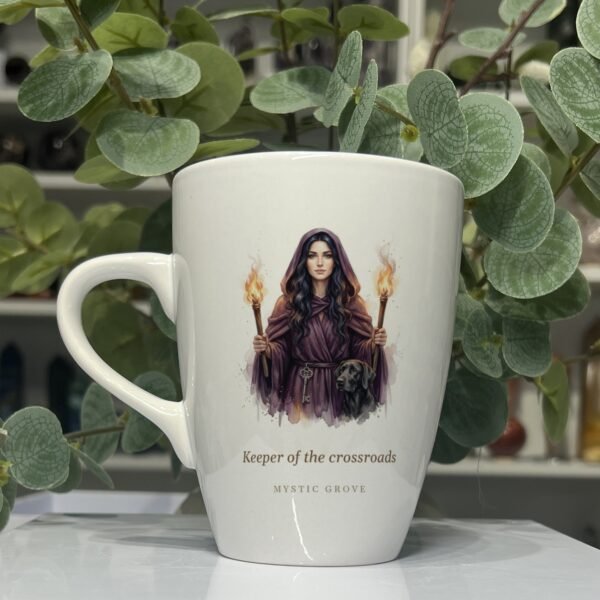
    Hecate stands where three roads meet, her torches burning and her black dog at her side.

    Hecate is one of the goddesses in our guide to moon goddesses, alongside Selene, Artemis, Luna, Diana and Chang’e.

    Hecate at a Glance

    • Who: a Greek goddess of crossroads, doorways, night, magic and the moon
    • How to say it: HEK·uh·tee in everyday British English; Hekate, said heh·kah·TAY, in Greek
    • Family: daughter of the Titans Perses and Asteria, the starry one
    • Roman name: Trivia, “of the three roads”
    • Symbols: twin torches, a key, the crossroads, a dog, the crescent moon and her three faced form
    • Her moon: the dark and waning moon, the last nights before the new moon
    • Her night: in ancient Athens, the dark of the moon at the end of each month
    • Next dark moons: Sunday 8 November 2026, before the New Moon in Scorpio at 7.02am on Monday 9 November; and Tuesday 8 December, before the New Moon in Sagittarius at 12.52am on Wednesday 9 December
    • Stones often linked with her: black obsidian, labradorite, Whitby jet, hematite

    Who Was Hecate?

    Hecate comes from a very old family of Greek gods. Her parents were the Titans Perses and Asteria, and Asteria was linked with the stars and with dreams that tell the future. That makes Hecate older than the Olympian gods like Zeus and Athena. When the Titans and the Olympians went to war, Hecate was one of the few Titans who sided with Zeus, and she was rewarded for it.

    The earliest long description of her comes from the poet Hesiod, writing around 700 BC. He praises her more warmly than almost any other goddess, and says Zeus gave her a share of honour in the earth, the sea and the starry sky. She could bring luck to fishermen, riders, farmers and anyone who called on her kindly.

    The torchbearer

    Hecate’s best known story is the loss of Persephone. When Persephone was carried down into the underworld, almost no one heard her cry. Hecate did. She went to the grieving Demeter carrying a torch in each hand, and together they went to find out what had happened. Later, when Persephone was allowed to return to the world above for part of each year, Hecate became her companion, walking with her between the two worlds. That is the heart of Hecate: the one who brings light into the dark and walks beside you through it.

    Hecate does not take the fear of the dark away. She simply brings a torch and walks with you.

    Goddess of Crossroads and the Front Door

    The Greeks saw a place where three roads met as a powerful, uncertain spot, a place of choice where you could easily lose your way. Hecate was its guardian. Small shrines to her stood at crossroads and beside front doors, and an image of her with three faces could look down all three roads at once. Her Roman name, Trivia, means exactly that: of the three roads. It is where the English word trivial comes from, by a long and winding route.

    She guarded the home too. A household shrine to Hecate by the door was a way of asking her to keep out whatever was not welcome and to watch over the family inside. Her key is part of this picture: the one who holds the key decides what comes in and what goes out.

    Hecate’s supper

    In ancient Athens, the last dark night of each lunar month was hers. Households swept the house clean, gathered up the leftovers of the old month, and left a small meal for Hecate at the nearest crossroads, often bread, eggs and little cakes. It was a way of clearing out the old month and asking her protection for the new one. Very often the poor of the city came by and ate the food, which was quietly understood to be part of the point.

    Hecate and the Moon

    Hecate was not always a moon goddess, but she grew into one. Her three faced form came to be read as the three faces of the moon, waxing, full and waning. Over time she was blended with the two great moon goddesses, Artemis and Selene, and took on much of their lunar meaning. She was linked with eclipses and with all the strange things that happen in the night sky.

    Above all, she belongs to the dark and waning moon, the last thin crescent and the moonless night before the new moon. This is the phase of endings, wisdom and quiet transformation, the time when one month is cleared away so that another can begin. Rites to her were held at night, by torchlight and moonlight, when people felt most in need of guidance.

    Hecate’s Symbols

    Twin torches

    Her oldest and most important symbol: light carried into the dark, both to see by and to keep others safe.

    The key

    The keeper of doors and gateways, between the home and the world, and between one stage of life and the next.

    The crossroads

    Choices, turning points and the moment you have to decide which way to go.

    The dog

    Dogs were her sacred animals, and the howling of dogs at night was said to announce her coming.

    The crescent moon

    Often shown on her brow or above her head, and in some images three crescents together.

    Hecate’s wheel

    A circle with a three way maze inside, often printed on jewellery and altar cloths. It is based on the strophalos, a spinning top described in a set of mystical verses called the Chaldean Oracles, from the second century AD. The neat design you see today is modern, though the idea behind it is old.

    The Honest History: What Is Old and What Is New

    It helps to know which parts of Hecate’s story are ancient and which have grown up more recently, because both are worth knowing.

    • Ancient: her Titan family, Hesiod’s praise, the torches, the crossroads shrines, the dogs, the dark moon suppers and her three faced statues. The sculptor Alcamenes made a famous three bodied Hecate for Athens in the fifth century BC.
    • Ancient, but later: her role as a goddess of witchcraft. In Greek drama and poetry the sorceress Medea is her priestess, and by Roman times Hecate was firmly the goddess of magic and spells.
    • Modern: the reading of Hecate as the Crone of a Maiden, Mother and Crone triple goddess. That pattern was set out by the poet Robert Graves in 1948. Many people today find it a meaningful way to see her as the wise old woman of the waning moon, and it is a lovely image, but it is not how the ancient Greeks described her.
    • Modern: a dedicated Night of Hecate on 16 November, kept by some people today. Its origin is unclear, and it does not appear in the ancient calendar we know of.

    Hecate also walked onto the English stage. In Shakespeare’s Macbeth she appears as the queen of the witches, and there her name is spoken with just two syllables, HEK·it, to fit the rhythm of the verse.

    How to Pronounce Hecate

    There is no single right answer, and you will hear all three of these.

    • HEK·uh·tee: the most common way in British English today, three syllables with the stress on the first.
    • heh·kah·TAY: close to the ancient Greek, Hekate, with the stress at the end.
    • HEK·it: the two syllable Shakespearean way, still heard in theatres.

    Crystals for Hecate

    These stones suit her themes of night, protection, crossroads and quiet wisdom. All are small tumblestones from the shop.

    Black Obsidian

    Dark, glassy and protective, obsidian is the stone most often placed on a Hecate altar. It holds the centre of her grid below.

    Labradorite

    Grey until the light catches it, then suddenly full of blue fire: a torch in the dark, in stone form.

    Whitby Jet

    Fossilised wood from the Yorkshire coast, the stone of Victorian mourning jewellery. It suits Hecate’s role as a companion between this world and the next.

    Hematite

    Heavy, silver and grounding, hematite is a classic protection stone for the doorway and the home.

    Snowflake Obsidian

    Black with soft grey flowers, a gentler obsidian for the endings of the waning moon.

    Bloodstone

    Dark green flecked with red, a stone of courage for the moment you choose your road.

    Chevron Amethyst

    Purple and white in bold stripes, a calm, intuitive stone for listening to your own inner voice.

    The Crossroads Grid

    This grid is laid like a place where three roads meet. The focus stone sits at the meeting point, Hecate’s place, and two stones line each road: the road behind you, the road you stand on, and the road ahead.

    MYSTIC GROVE · THE CROSSROADS GRID Focus 5 6 1 2 3 4 The road ahead 5 Labradorite, 6 Chevron Amethyst The road behind 1 Whitby Jet, 2 Snowflake Obsidian The road you stand on 3 Hematite, 4 Bloodstone Black Obsidian THE CROSSROADS GRID Focus 5 6 1 2 3 4 Focus: Black Obsidian Behind: 1 Whitby Jet, 2 Snowflake Obsidian Here: 3 Hematite, 4 Bloodstone Ahead: 5 Labradorite, 6 Chevron Amethyst
    The Crossroads Grid. Black obsidian sits where the three roads meet; two stones line each road, the nearest stone first.

    The Focus Stone

    Black Obsidian, the meeting point

    The centre is the crossroads itself, the place of choosing, so it holds protection and honesty together. If you would rather, hematite works well in the centre for a grid about keeping your home safe. If you have a small clear quartz point, stand it in the centre pointing upwards; and if you have neither, any clear quartz will do.

    The Three Roads

    The road behind: 1 Whitby Jet and 2 Snowflake Obsidian

    What you are leaving and what you want to remember from it. Whitby jet carries remembrance; snowflake obsidian helps you let the rest go.

    The road you stand on: 3 Hematite and 4 Bloodstone

    Where you are now. Hematite keeps your feet on the ground; bloodstone gives you the courage to make a choice.

    The road ahead: 5 Labradorite and 6 Chevron Amethyst

    Where you are going. Labradorite is the torch for the unknown; chevron amethyst is the calm voice telling you which way.

    How this grid connects. There are no Way Stones in the Crossroads Grid. Each road is a straight line running out from the focus stone, with its two stones on it, the nearer one first. Lay the centre first, then the road behind, then the road you stand on, then the road ahead.

    A Gentle Dark Moon Practice for Hecate

    This is a simple, respectful way to mark the dark of the moon in Hecate’s company. The next dark moon night is Sunday 8 November 2026, the evening before the New Moon in Scorpio. There is no need to call on her if that does not sit right with you; it works just as well as a quiet night of clearing out and choosing your road.

    What you need

    The practice

    1. Clear the threshold. Sweep or tidy just inside your front door. Listen to the sound of the brush and let it mean that the old month is going.
    2. Settle. Sit somewhere quiet with the lights low. Breathe in for four, out for six, five times.
    3. Light the candle. As the flame catches, say: “A light at the crossroads.”
    4. Build the grid. Place the obsidian first, then each road in turn, naming it out loud: the road behind me, the road I stand on, the road ahead.
    5. Hold the key. Feel its cold weight warm in your hand. Name, out loud, one thing you are locking out of the coming month and one thing you are opening the door to.
    6. Listen. Sit with the key in your lap for a few minutes in silence. Notice any sound, word or feeling that comes. Some people find a picture comes; others hear a word or simply feel a sense of which way to go. All are welcome.
    7. Close. Snuff the candle. Put the key back in its usual place, by the door if you can.
    8. Leave the supper. In the morning, put the bread or seed out in the garden for the birds, or give something to a food bank that week. It is the modern version of Hecate’s supper, and very much in her spirit.

    Signs Hecate Is Calling You

    People who feel drawn to Hecate often describe the same handful of signs. None of them proves anything on its own, but several together, over a few weeks, are worth paying attention to.

    • Dogs. Dogs were sacred to Hecate. A dog that follows you, or a black dog in your dreams, is the sign people mention most.
    • Keys, doors and crossroads. Finding old keys, noticing doorways and thresholds, or arriving at a crossroads in your life.
    • The dark of the moon. Feeling most awake and most yourself in the nights before the new moon.
    • Torchlight and candle flames that catch and hold your attention at night.
    • Her name. Hearing or reading it again and again, especially in autumn and around the Night of Hecate in November.
    • A turning point. Hecate tends to arrive when a choice has to be made, or one chapter of life is ending.

    If this sounds familiar, the dark moon practice above is a gentle way to begin. For the signs of other goddesses, and a short quiz, see how to know which goddess is calling you.

    The Seven Moon Goddesses Film

    Hecate closes our short film of seven moon goddesses, which follows the moon from the Hunter’s Moon to Samhain night. Meet the others in our guide to moon goddesses.

    Seven Moon Goddesses: a one minute film, from the Hunter’s Moon to Samhain

    Questions People Ask About Hecate

    What is Hecate the goddess of?

    Crossroads, doorways, keys, the night, magic, the moon and the paths between this world and the next. She is also a protector of the home.

    Is Hecate a good or bad goddess?

    In the ancient world she was mostly seen as a helper and protector, praised warmly by Hesiod and kept at front doors. Her darker reputation grew later, through stories about witches and the night. Both sides are part of her.

    What are Hecate’s symbols?

    Twin torches, a key, the crossroads, dogs, the crescent moon and her three faced form. Hecate’s wheel is a newer symbol based on an old idea.

    Is Hecate a moon goddess?

    She became one over time. Her three faces came to stand for the phases of the moon, and she was blended with the moon goddesses Artemis and Selene. She belongs especially to the dark and waning moon.

    Is Hecate the Maiden, Mother and Crone?

    Not in ancient sources. Her three faces are ancient, but the Maiden, Mother and Crone pattern comes from Robert Graves in 1948. Many people use it today as a modern way of seeing her.

    When is Hecate’s night?

    In ancient Athens, the dark of the moon at the end of each month. The next one is the night of Sunday 8 November 2026.

    Your Hecate Toolkit

    For the dark moon on Sunday 8 November: black obsidian and Whitby jet for the Crossroads Grid, black or white Manifest Magic chime candles with a triple moon candle holder, the triple moon offering plate, and a carved raven skull for a dark of the year altar.

    Shop black obsidian

    Bring Hecate home

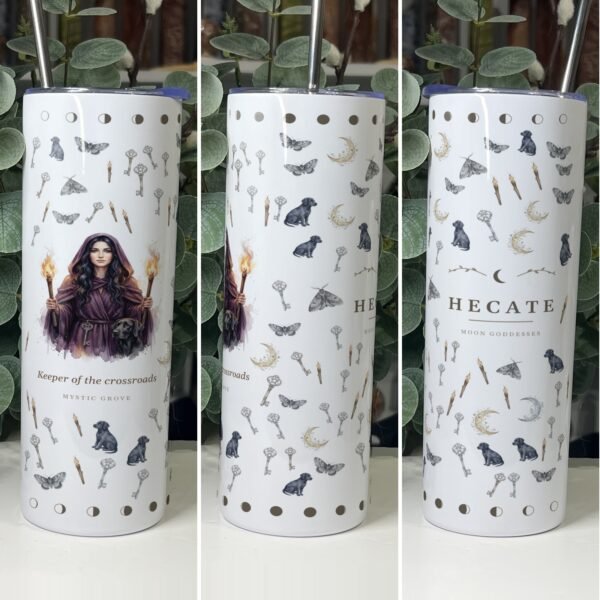
    The Hecate artwork from this series now comes on a 13oz white ceramic mug and a 20oz skinny tumbler wrapped all the way round in keys, torches and moths. Each one comes with a printed card telling her story, so it is ready to keep or to give.

    See all the goddess tumblers

  • 777 Angel Number Meaning: Reflection, Inner Wisdom and Why 777 Is Called Lucky

    777 Angel Number Meaning: Reflection, Inner Wisdom and Why 777 Is Called Lucky

    777 angel number meaning: reflection, inner wisdom and trusting what you already know, why 777 is called lucky, and a seven day practice with one stone for each day of the week

    Seeing 777 on clocks, receipts and number plates? It is one of the most searched angel numbers in the UK, just behind 444 and 1111. Most people know 777 as the jackpot line on a fruit machine, but in the angel number tradition it means something quieter and, many would say, more valuable. Here is what the 777 angel number is said to mean, where its lucky reputation comes from, and a gentle week long way to work with it.

    What Does the 777 Angel Number Mean?

    The 777 angel number is linked with reflection, inner wisdom and spiritual learning. Seven is the number of looking inward in numerology: study, thought, intuition and the kind of knowing that does not come from being told. When it appears three times in a row, the reading is that you are on the right track, and that the answer you are looking for is already somewhere inside you.

    People often notice 777 when they are learning something new, thinking hard about a decision, or starting to trust their own instincts after a long time of listening to everyone else. The meaning that has grown around it is a calm one: slow down, listen, and trust what you know.

    777 is not a shout. It is the quiet voice that was right all along.

    777 in Love, Work and Everyday Life

    777 and love

    In love, 777 is read as a sign to look at what you really want rather than what you think you should want. If you are with someone, it can point to a deeper, quieter kind of closeness: better conversations, more honesty. If you are single, it suggests time spent getting to know yourself is not time wasted.

    777 and work or study

    Seven is the number of the student and the researcher, so 777 is a classic number for learning. If you keep seeing it while thinking about a course, a qualification or a new skill, the traditional reading is that the time is right to start. It also suits work that needs patience and careful thought.

    777 and the everyday

    Day to day, 777 is a nudge to make room for quiet. Ten minutes without your phone, a walk on your own, a page in a journal. Seven is a reflective number, and it tends to show up when life is too loud to hear yourself think.

    The Numerology of 777

    Numerology reads 777 in two ways. By its repeating digit, seven, it is all about reflection and inner wisdom. Added down, 7 + 7 + 7 = 21, and 2 + 1 = 3, the number of growth and expression. Put together, 777 says that quiet thinking leads to real growth: what you work out on your own is what helps you move forward. You can read more about how every number is read in our angel numbers guide.

    Why seven has always felt special

    Seven turns up everywhere in human history. The old astrologers counted seven moving lights in the sky: the Sun, the Moon, Mercury, Venus, Mars, Jupiter and Saturn. Each of our seven days of the week was named after one of them, and in English several still carry the old names: Sunday for the Sun, Monday for the Moon, Saturday for Saturn. There are seven colours named in the rainbow, seven notes in a musical scale, and seven days of creation in the book of Genesis. With so many sevens woven into how we count our time, it is no wonder the number feels meaningful.

    Why Is 777 Called Lucky?

    The lucky 777 comes mostly from the fruit machine. On many slot machines, three sevens in a row is the top prize, and the picture of a jackpot has become part of everyday life. That is why you will see 777 called the luck number, and why our own 777 crystal ball carries the name.

    The angel number reading adds a gentler layer. The real luck of 777 is the moment everything lines up because you finally trusted yourself. Luck and wisdom are not opposites: a good decision, made quietly and well, is about the luckiest thing there is.

    Where the 777 Meaning Comes From

    Giving numbers a character is thousands of years old, going back to the followers of Pythagoras in ancient Greece. The modern idea of angel numbers is much younger. It was set down in the 2000s by the American writer Doreen Virtue, whose book Angel Numbers came out in 2005; she later stepped away from that teaching. Our angel numbers guide covers the full honest history, including why a number can seem to follow you once you start noticing it.

    Crystals for the 777 Angel Number

    Stones for reflection, intuition and calm thought, all on the shelf now.

    Chevron Amethyst

    Purple and white in bold stripes, chevron amethyst is the classic stone for intuition and quiet reflection. If you choose one stone for 777, choose this one.

    Lapis Lazuli

    Deep blue flecked with gold, lapis has been prized for wisdom and truth since ancient Egypt. It suits the student side of seven.

    Lepidolite

    Soft lilac and gently glittering, lepidolite is a calming stone, kept for quieting a busy mind long enough to hear yourself think.

    The 777 Crystal Ball

    A small crystal ball made for this number, to sit on a desk or bedside table as a quiet reminder to listen to yourself.

    The Week of Sevens: A Seven Day Practice

    Seven is the number of days in a week, and each day has its own planet and its own colours in the old correspondences. This practice gives you one stone for each day. Lay them in a line, and each morning pick up that day’s stone and carry it with you.

    MYSTIC GROVE · THE WEEK OF SEVENS 1 2 3 4 5 6 7 SundayTiger’sEye MondayHowlite TuesdayRedJasper WednesdayChevronAmethyst ThursdayLapisLazuli FridayRoseQuartz SaturdayHematite SunMoonMarsMercuryJupiterVenusSaturn Seven days, seven planets, seven stones · Wednesday sits in the middle THE WEEK OF SEVENS Sunday · Tiger’s Eye Monday · Howlite Tuesday · Red Jasper Wednesday · Chevron Amethyst Thursday · Lapis Lazuli Friday · Rose Quartz Saturday · Hematite
    The Week of Sevens. One stone for each day, matched to that day’s planet and colours, with chevron amethyst at the centre of the week.

    The seven stones

    • Sunday, the Sun: tiger’s eye, golden like the Sun’s colours, for confidence.
    • Monday, the Moon: howlite, white like the Moon’s colours, for calm.
    • Tuesday, Mars: red jasper, red for Mars, for courage and steady energy.
    • Wednesday, Mercury: chevron amethyst, purple for Mercury and the middle of the week, for clear thinking and intuition.
    • Thursday, Jupiter: lapis lazuli, dark blue for Jupiter, for wisdom and learning.
    • Friday, Venus: rose quartz, pink for Venus, for kindness and love.
    • Saturday, Saturn: hematite, dark grey for Saturn, for grounding and keeping promises.

    How to do it

    1. Lay the line. On a shelf or windowsill, lay the seven stones in a row from Sunday to Saturday, with chevron amethyst in the middle.
    2. Each morning, pick up that day’s stone. Hold it, take seven slow breaths, and feel its weight and temperature in your palm.
    3. Ask one question. Say quietly: “What do I already know about this?” and name whatever is on your mind.
    4. Carry it. Keep the stone in a pocket for the day. Each time your hand finds it, pause for one breath.
    5. Each evening, write one line in a notebook: what you noticed, heard or decided. Put the stone back in the line.
    6. After seven days, read your seven lines aloud. Most people find a clear answer in there that they had not quite said to themselves before.

    If you like, light a chime candle in that day’s colour while you write: yellow on Sunday, white on Monday, red on Tuesday, yellow or violet on Wednesday, dark blue or violet on Thursday, pink on Friday and black on Saturday. White can stand in for any of them. Snuff it when you finish rather than blowing it out.

    Questions People Ask About 777

    What does 777 mean spiritually?

    Reflection, inner wisdom and spiritual learning. It is read as a sign that you are on the right path and that you can trust what you already know.

    Is 777 a lucky number?

    In everyday life, yes: it is the jackpot on a fruit machine. In the angel number tradition, its luck is the kind that comes from good, quiet decisions.

    What does 777 mean in love?

    A deeper, more honest closeness with a partner, or time well spent getting to know yourself if you are single.

    What does 7777 mean?

    The same themes made stronger: reflection and inner wisdom, four times over. Added down, 7 + 7 + 7 + 7 = 28, then 10, then 1, the number of beginnings, so 7777 is often read as wisdom that is ready to become a new start.

    Is seeing 777 a good sign?

    Yes. It is one of the most encouraging numbers in the angel number tradition.

    Your 777 Toolkit

    The 777 crystal ball for your desk, chevron amethyst and lapis lazuli tumblestones for the Week of Sevens, angel number affirmation cards for a daily word, and a notebook for your seven lines.

    Shop the 777 crystal ball

  • Lunar Goddess Archetypes and Moon Magic Crystals

    Lunar Goddess Archetypes and Moon Magic Crystals

    The lunar goddess archetypes, from maiden to crone, and the crystals that pair with each

    When you look up at the night sky, the Moon is not just a giant piece of rock or a simple clock tracking the days of the month. To our ancient ancestors, she was a living, breathing entity with distinct, powerful personalities that completely changed as her light shifted across the sky. While understanding the physical science of your crystals is wonderfully helpful, stepping into the true soul of earth magic means connecting deeply with these ancient lunar rhythms. This is the point where the technical skill of building a crystal grid meets the intuitive art of spiritual alchemy.

    This guide explores the Triple Goddess, the maiden, the mother and the crone, how each one is linked to a face of the Moon and the crystals traditionally paired with them.

    The Three Faces of the Moon

    For thousands of years, wise women, druids, and ancient alchemists looked at the ever changing phases of the Moon and saw three distinct feminine energies looking back at them. They called these faces the Maiden, the Mother, and the Crone. It is incredibly important to remember that these titles are not about literal age; they are universal energetic archetypes. They are vast pools of cosmic emotion and power that anyone can tap into, regardless of gender or life stage.

    We all carry the wild independence of the Maiden, the nurturing love of the Mother, and the strict boundaries of the Crone inside us. By understanding which phase the Moon is currently in, we know exactly which archetype is dominating the cosmic weather. When we know the weather, we know exactly which crystals to use and which grids to build to make our manifestation efforts infinitely more successful. Let us dive deep into each face of the moon.

    The Maiden: The Waxing Crescent and the Power of Initiation

    The Maiden represents the Waxing Moon. This is the time right after the dark New Moon, when a tiny, sharp sliver of silver light is just beginning to grow in the night sky. The Maiden embodies the raw energy of youth, wild freedom, fierce independence, and fearless fresh starts. Think of the ancient Greek goddess Artemis, running free and untamed through the forest with her bow and arrow, answering to absolutely nobody but herself.

    The Maiden is completely unbothered by the opinions of others. She is curious, fast moving, and filled with boundless potential. When you need a sudden burst of confidence to start a brand new project, when you need to find your independent voice to stand up for yourself at work, or when you simply want to break free from a stagnant routine, you call on the Maiden. Her energy is fast, sharp, and highly focused. She does not overthink the details; she simply takes action and trusts her instincts.

    In your crystal practice, the Maiden requires stones that are high vibration and highly stimulating. You are looking for crystals that activate the solar plexus and the throat chakra, helping you to both find your courage and speak your truth. This is the phase of “I am” and “I can.”

    In Theory: The Maiden Independence Grid

    Imagine you have spent years living for other people. Perhaps you have been in a long relationship where you lost your own identity, or you are in a job that makes you feel invisible. You want to reclaim your sense of self and remember who you are when nobody is watching. This is a Maiden intention.

    You would wait for the first sliver of the Waxing Moon. You would build a three stone triangle grid, as three represents action and the self. In the centre, you would place a vibrant piece of Amazonite to represent your truth. At the base, you would place your Rising Sign Personal Anchor stone to link this independence directly to your physical aura. You would wire your points outward, broadcasting your new boundaries to the world. As you activate the grid, you visualise yourself as Artemis, fearless and free. This grid does not ask for permission; it simply claims your space.

    The Mother: The Full Moon and the Power of Fruition

    As the Moon continues to grow, it eventually reaches absolute peak illumination. It becomes a huge, glowing orb in the sky. This is when we meet the Mother. She represents the Full Moon and the energy of deep nurturing, profound creation, and overflowing abundance. She is the ultimate caretaker, the fierce protector of her family, and the bringer of life. Think of Demeter, the ancient goddess of the golden harvest and the rich, fertile earth.

    The Mother archetype is not just about having children. It is about the act of nurturing anything into its full, beautiful potential. When you are trying to grow a small business into a thriving empire, when you want to nurture a new romantic relationship, or when you simply want to create a feeling of absolute safety, warmth, and love in your family home, you tune your crystal grids to the Mother archetype. Her energy is warm, heavy, completely supportive, and infinitely patient. She represents the “I create” and “I sustain” energy of the cycle.

    To work with the Mother, your crystals should be soft, rounded, and polished. You want stones that resonate with the heart chakra and the sacral chakra. The energy here is not about the sharp speed of the Maiden; it is about the deep, steady pulse of life itself.

    In Theory: The Mother Abundance Grid

    Let us imagine your business has been through its startup phase and is now ready to expand. You need to attract more clients, but more importantly, you need to attract the *right* clients who value what you do. You want sustainable, long term growth that feels good.

    On the night of the Full Moon, you would build a six stone hexagon grid. Six is the number of harmony and service. In the centre, you place a large piece of Green Aventurine or Jade to represent the growth of your business. You surround it with Moonstone to tap into the Mother’s intuitive nurturing. You wire your quartz points inward first to gather the resource, and then outward to share your gift with the world. This creates a breathing circuit of abundance that mimics the nature of the Mother: she gives, but she is never empty because she is constantly replenished by the earth.

    The Crone: The Waning Moon and the Power of Release

    Eventually, the brilliant light of the Full Moon begins to fade. It shrinks smaller and smaller until the sky is completely black. As the light fades and the Moon enters her dark phase, we meet the final and most powerful archetype. We meet the Crone. In modern times, people are often a little intimidated by the dark and society tends to fear getting older, but ancient cultures deeply revered the Crone. She represents ultimate spiritual wisdom, strict boundaries, and the absolute power to let things go. Think of Hecate, the ancient goddess of magic, the shadow world, and the mystical crossroads.

    The Crone has seen everything and survived everything. She no longer cares about pleasing people or seeking validation. You call on the Crone when you need to do deep emotional clearing, when you need to firmly release toxic habits, or when you need to protect your home from outside drama. She is the fierce protector who is completely unafraid to cut ties with absolutely anything that no longer serves your highest good. She represents the “I release” and “I know” energy.

    Crystals for the Crone are often dark, grounding, and protective. They should be used with the intention of shadow work, looking into the parts of ourselves we usually hide and allowing the Crone to clean them with her ancient wisdom.

    In Theory: The Crone Boundary Grid

    Imagine you have a person in your life who is constantly overstepping your boundaries. They drain your energy, they ignore your “no,” and they leave you feeling spiritually exhausted. You have tried being polite, but it is not working. You need the Crone to step in.

    During the Waning Moon, you build a four stone square grid for maximum stability. In the centre, you place a piece of Black Obsidian, the stone of the sharp truth. You wire your quartz points inward, creating a vacuum that pulls their influence out of your personal space. As you tap each stone to activate the grid, you state clearly: “I release what does not belong to me.” You are not being mean; you are being wise. The Crone teaches us that you cannot grow new flowers until you pull up the weeds. This grid is your energetic weed killer.

    The Hidden Face: The New Moon Enchantress

    Between the Crone and the Maiden lies a moment of absolute darkness. This is the New Moon. Some call this the face of the Enchantress. This is the moment where the exhale is finished but the inhale hasn’t started yet. It is a moment of pure magic and infinite possibility. This is the time to build grids for things you cannot yet see, for dreams that are still in the womb of your mind.

    For New Moon grids, use stones like Labradorite, which looks like dark stone until the light hits it and reveals a hidden flash of colour. This is the archetype of the “I dream.”

    The Art of Personalised Lunar Gridding

    While the basics of lunar archetypes provide a fantastic foundation, the true art of Crystal Grid Alchemy comes when you switch these up with your personal astrology. If you are a Water Rising (like Pisces or Cancer), you might find the emotional depths of the Mother and the Crone come naturally to you, but you struggle with the Maiden fierce fire. In theory, you would adjust your grid by placing your Rising Sign Personal Anchor stone (like Moonstone or Aquamarine) at the base of your Maiden grid to bridge that wild energy into your sensitive physical field safely.

    By referencing your unique birth chart, you can see how each lunar goddess interacts with your personal houses. Getting the basics right gives you a brilliant start, but as you grow, you will learn to layer these ancient archetypes over your own Rising Sign to turn your gridding into a bespoke piece of cosmic art. You are no longer just following a recipe; you are writing your own spells.

    Tracking the Lunar Tides

    To truly master the art of lunar gridding, you must know where the Moon is in her cycle at all times. This helps you understand which archetype is currently dominating the sky and which face is looking down at your crystals. You can find the exact current phase and track the lunar calendar using the link below.

    Track the Current Lunar Phase:

    Explore the Lunar Calendar and Moon Phases

    Living the Lunar Life Every Day

    When you begin to view the Moon through the lens of these archetypes, your entire crystal practice changes from a hobby into a lifestyle. You are no longer just putting rocks on a table and hoping for the best. You are actively engaging in a beautiful, monthly conversation with the universe. You learn that life is not meant to be a straight line of constant productivity. You learn to push forward with the Maiden, build your wealth with the Mother, and rest deeply with the Crone.

    This is what it truly means to live a lunar life. It is the understanding that you do not have to be high energy every single day. Just like the Moon, you are allowed to have phases of brilliant illumination and phases of complete darkness. By matching your crystal grids to these changing faces, you align your human life with the deepest, oldest rhythm in the natural world. You find peace in the cycle.

    Your Lunar Goddess Toolkit

    You can easily invite these powerful archetypes into your daily practice by keeping their favourite stones on your altar or your bedside table. Having these specific energetic keys ready ensures you are always prepared for the shifting cosmic weather.

    • The Maiden Stones: Amazonite is your master stone for courage and personal truth. Pair it with Carnelian for fiery motivation and Clear Quartz to amplify your wild, independent intentions as the moon begins to wax.
    • The Mother Stones: Selenite holds the pure, high frequency light of the Full Moon, bringing absolute peace to your space. Pair it with Rose Quartz for unconditional love and Moonstone to tap directly into deep feminine intuition and abundant creation.
    • The Crone Stones: Black Obsidian acts as your ultimate protective shield and cord cutting tool. Pair it with Smoky Quartz to compost heavy negative energy and Amethyst to connect with deep spiritual wisdom during the dark moon phase.
    • The Enchantress Stones: Labradorite is the stone of the New Moon. It represents the hidden magic and the infinite potential of the dark. Use it to anchor your deepest dreams.

    You can find these beautiful archetypal stones waiting to join your practice in our Mystic Grove Crystal Category.

    Working with the maiden, the mother and the crone brings a living story to your crystal practice. To carry the Moon’s energy with you through the month, our guide to moon water and lunar elixirs shows you how to make your own.

    Shop the stones in this guide

    Quartz · Moonstone · Labradorite · Obsidian · Crystal Towers and Points · Tumble Stones

  • Moon Phase Meanings and Lunar Gridding

    Moon Phase Meanings and Lunar Gridding

    The meaning of each moon phase, and how to build a crystal grid to work with it

    The Moon is the closest and most familiar light in the night sky, and for many people it sits at the heart of their crystal practice. This guide walks through each phase of the lunar cycle, what it is traditionally used for and how to build a grid to match.

    The Moon is the great emotional engine of our planet. Its gravitational pull is so incredibly strong that it physically drags the vast oceans across the earth, creating the tides. Because human beings are made almost entirely of water, our bodies and our energy fields are naturally pulled by this exact same force. When you build a crystal grid, you are essentially building a sail to catch that lunar wind.

    If you learn how to map your grid intentions to the phases of the Moon, you stop relying solely on your own human energy to make things happen. You start using the oldest, most reliable rhythm in the natural world. Today, we are going to explore the lunar cycle and learn exactly which stones and layouts match each phase of the Moon.

    The Rhythm of the Lunar Cycle

    The Moon completes a full cycle every twenty eight days, moving from complete darkness to brilliant illumination and back again. This is not just a pretty light show in the sky; it is a huge cycle of building and releasing energy. If you want your crystal grids to perform at their absolute peak, you must align your wiring with this natural breathing process.

    Think of the lunar cycle as a simple breath. The first two weeks are the inhale, where energy is gathering and building. The second two weeks are the exhale, where energy is releasing and clearing. Let us break down the four primary phases and look at how your grids should adapt to each one.

    The New Moon The Blank Canvas

    The New Moon occurs when the sky is completely dark. In ancient times, this was a moment of deep stillness and rest. In Crystal Grid Alchemy, the New Moon is the blank canvas. It is the absolute best time to set brand new intentions, plant seeds for the future, and start fresh.

    During the New Moon, your grids should be focused on quiet potential. This is a brilliant time to use Inward Intake wiring to pull fresh inspiration into your mind. You want to use stones that are associated with hidden potential and magic, like Labradorite and Black Moonstone. Place these dark, shimmering stones on a simple template like the Seed of Life to invite gentle, steady new beginnings into your world.

    The Waxing Moon Building Momentum

    As the sliver of light appears and begins to grow larger every night, we enter the Waxing Moon phase. The energy of the earth is rising, building, and expanding. This is the inhale. If you set an intention on the New Moon, the Waxing Moon is when you actually start doing the physical work to make it happen.

    Your grids during this phase should be dynamic and active. This is the perfect time to switch your quartz points to Outward Broadcast wiring. You are pushing your intentions out into the universe, riding the rising tide of lunar energy. Use bright, active stones like Citrine, Carnelian, and Clear Quartz to build motivation, attract wealth, and expand your opportunities.

    The Full Moon Peak Illumination

    When the Moon is perfectly round and bright, we reach the climax of the cycle. The Full Moon is the peak of energetic power. The tides are at their highest, and human emotions often run incredibly deep. This is a time of illumination, celebration, and maximum broadcast volume.

    If you have been working with a grid all month, the Full Moon is the time to place it on your windowsill to absorb that direct, powerful light. Your grid is fully charged. The Full Moon is also the ultimate time to use Selenite. Placing a large Selenite sphere in the centre of an Outward Broadcast grid during a Full Moon will flood your entire home with cleansing, high frequency light, illuminating any shadows and bringing deep clarity to your life.

    The Waning Moon Releasing and Clearing

    After the peak of the Full Moon, the light begins to shrink. We enter the Waning Moon phase, and the energy of the earth begins its long exhale. This is not a time for starting new projects or pushing forward. This is a time for releasing, letting go, cleaning house, and shedding anything that is no longer serving you.

    Your crystal grids must reflect this shift in the weather. Switch your wiring back to Inward Intake to create an energetic vacuum. Use dark, heavy stones like Smoky Quartz, Hematite, and Black Tourmaline. A Waning Moon grid is designed to pull stress, anxiety, and bad habits out of your aura and ground them safely into the earth. It is the ultimate cosmic deep clean before the cycle begins all over again.

    In Theory The Complete Lunar Manifestation

    Imagine you want to call a brand new career into your life. In theory, you would not just build a grid on a random Tuesday and hope for the best; you would map your entire process to the Moon to guarantee success.

    You would start on the night of the New Moon, building a quiet, inward facing grid to gain clarity on exactly what kind of job you want. As the Moon begins to wax and grow, you would switch the quartz points to face outward, adding bright Citrine to the centre to broadcast your confidence out to potential employers. On the night of the Full Moon, you would charge your grid under the moonlight to give your applications a huge burst of lucky energy. Finally, as the Moon wanes, you would add Smoky Quartz to the grid to absorb your interview nerves and release your fear of rejection. By mapping your grid to the lunar phases, you turn a static collection of stones into a living, breathing manifestation engine.

    Your Lunar Gridding Toolkit

    To fully harness the power of the Moon, you need stones that reflect its changing light. Here are the essential tools for your lunar practice.

    • The New Moon Stone: Labradorite is the ultimate stone of hidden magic and new beginnings, perfect for the dark sky.
    • The Waxing Engine: Clear Quartz towers act as powerful amplifiers to help you build your momentum as the light grows.
    • The Full Moon Mirror: Selenite spheres literally look like glowing moons and are essential for absorbing peak lunar energy.
    • The Waning Anchor: Smoky Quartz is the perfect heavy stone to help you release stress and let go of negative energy as the cycle closes.

    You can find all of these beautiful lunar companions ready for your next grid in our Mystic Grove Crystal Category.

    Working with the phases gives your grids a steady, reliable rhythm. When the sky is less predictable, during eclipses and retrogrades, our guide to gridding for eclipses and planetary aspects can help.