
The old woman of winter in Scottish, Irish and Manx lore: how to say her name, the mountains she built, her yearly handover to Brigid, and a gentle way to welcome the cold months
When the first hard frost silvers the grass and the hills turn grey with cloud, the old stories say the Cailleach has woken. She is the great old woman of winter, the one who strides across the mountains with her staff, drops boulders from her apron and shapes the land as she goes. For centuries people in Scotland, Ireland and the Isle of Man told her stories through the long dark months. Here is who she is, where her lore comes from, and a quiet way to greet her as winter begins.
The Cailleach at a Glance
- Who: the old woman of winter, storms and wild places in the folklore of Scotland, Ireland and the Isle of Man
- How to say it: KAL·yakh, with the “kh” said softly in the throat, as in loch
- What the name means: “old woman”, from an old word linked with a veil, so “the veiled one”
- Other names: the Cailleach Bheur in the Scottish Highlands, the Cailleach Bhéarra or Hag of Beara in Ireland, Caillagh ny Groamagh in the Isle of Man
- Known for: building mountains, bringing the winter weather, her seasonal handover with Brigid
- Her season: Samhain to Beltane, the dark half of the year
- Symbols: her staff, an apron or creel of stones, mountains, standing stones, deer, the waning moon
- Colours: grey, blue, black, white and silver
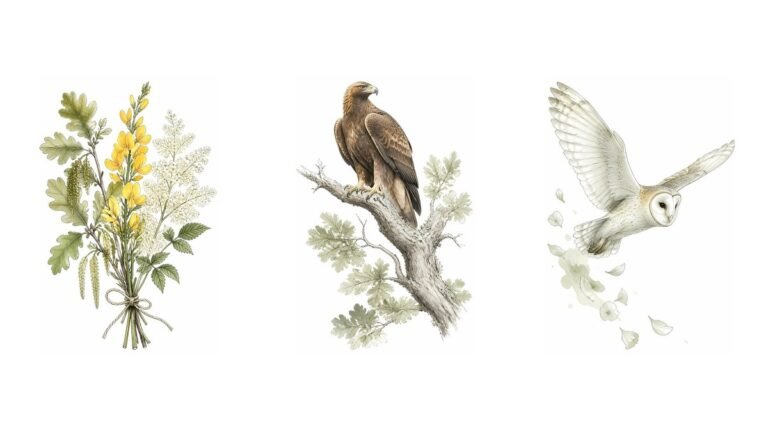
- Plants: witch hazel, holly, ivy and moss
Who Is the Cailleach?
The Cailleach is one of the oldest figures in the folklore of the Gaelic world. The stories say she has been here since the beginning of time, older than the hills, because she made many of them. She rules the weather and the turning of the seasons, and above all she rules winter.
Descriptions of her are wonderfully wild. In some tellings she is a giant old woman with a single eye in the middle of a blue black face, red teeth and matted hair white with frost. In others she is spoken of as beautiful. She has deep knowledge of the natural world and the strength to reshape it. Wild deer were said to be her herds, and she watched over them through the winter.
She is not evil, even when she is harsh. Winter in the Highlands and on the Atlantic coasts was hard and could be deadly, and the Cailleach is that hardness given a face. She is the cold that tests what is weak so that what is strong can survive, and the long rest the land needs before it can grow again.
The Maker of Mountains
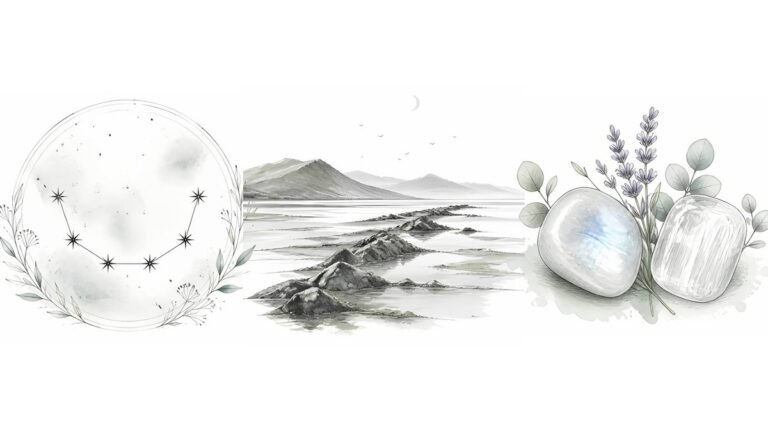
Many of the Cailleach’s stories are written into the landscape itself. She is said to have carried great loads of stone in her apron or in a creel on her back, and wherever she let some fall, a hill or a mountain was born. Lines of boulders across moorland, lone rocks on hillsides and whole ranges are explained this way across Scotland and Ireland.
In Ireland, the hills of Loughcrew in County Meath are known in Irish as Sliabh na Caillí, the mountain of the hag. The ancient cairns on their summits are said to be stones she dropped as she leapt from hill to hill, and a great carved stone there is still called the Hag’s Chair.
In Argyll, a well known tale tells how she kept a spring on Ben Cruachan, covering it with a stone slab every evening. One night, tired after a long day driving her cattle, she fell asleep and forgot. The water burst out, flooded the glen below and became Loch Awe.
Further out to sea lies the whirlpool of Corryvreckan, between the islands of Jura and Scarba. The old story says the Cailleach washes her great plaid there at the start of winter. When it comes out of the churning water clean and white, she spreads it over the land, and Scotland is covered in snow.
The Cailleach in Scotland
In the Highlands she is the Cailleach Bheur, said roughly KAL·yakh VAYR. She rules from Samhain to Beltane. As winter comes in, she grows stronger and more active, striking the ground with her staff so that the earth freezes, the rivers turn to ice and the snow falls.
When winter ends, the stories divide. In some she is turned to stone until the next Samhain. In others she becomes a young woman again. In one Highland telling she throws her staff beneath a holly tree when her season is over, and that is why no grass grows under holly.
Perhaps the most moving piece of her lore still in the landscape is a tiny stone shrine in Glen Lyon in Perthshire, known as Tigh nan Cailleach, the house of the old woman. Inside sit a handful of smooth, water worn stones said to be the Cailleach, her husband and their children. By long custom, the stones are brought out at Beltane to face the summer and put back inside at Samhain to shelter for the winter. It is one of the very few places in Britain where a seasonal custom like this is still kept.
The Hag of Beara in Ireland
In Ireland she is the Cailleach Bhéarra, the Hag of Beara, linked especially with the Beara peninsula in the far south west. The traditional teaching says she is almost the same figure as the Highland Cailleach, though less tied to winter and the wild beasts and more to building the land. On the Beara peninsula, a rock at Kilcatherine is still pointed out as the old woman herself, turned to stone as she looks out to sea.
Irish lore says she lived through seven periods of youth, outliving husband after husband and seeing whole generations come and go. An Old Irish poem known as the Lament of the Old Woman of Beare, usually dated to around the ninth century, gives her a voice: an old woman remembering the days when she was young and beautiful and kings sought her company. It is one of the oldest pieces of writing connected with her, and one of the most beautiful.
The Cailleach in the Isle of Man
In the Isle of Man she is Caillagh ny Groamagh, the old woman of gloominess. Manx lore, like Highland lore, ties her to the first day of February. On that morning she goes out to gather firewood for the rest of the winter. If the day is bright and dry, she can gather plenty, so the cold will last a long while yet. If the day is wet and stormy, she has stayed in, and that means she has enough wood and winter will soon be over.
It is the same idea as the American Groundhog Day, and it explains why a grey, rainy start to February was once welcomed with relief.
The Cailleach and Brigid
The heart of the Cailleach’s story is her relationship with Brigid, the bright goddess of spring, fire and healing. The Cailleach holds the land through the dark months. Brigid brings back the light. The changeover happens around Imbolc, on 1 February, which in 2027 falls on Monday 1 February.
The traditional teaching describes it as a yearly contest for sovereignty over the land, each trying to bring in her own season. How long and hard the winter is depends on how the struggle goes. In some versions the Cailleach finally yields and spring arrives. In others the contest simply goes round and round, year after year, winter and spring forever taking turns.
In parts of Scotland the two are spoken of almost as one: the old woman of winter and the young woman of spring, two faces of the same turning year. You can read more about her bright partner in our post on Brigid and about the festival itself in the meaning of Imbolc.
The Hag Who Becomes a Queen
The Cailleach also belongs to one of the oldest patterns in Irish storytelling: the hag of sovereignty. In these tales, a young man meets a hideous old woman, often guarding a well, who asks him for a kiss. The young men who refuse go on their way. The one who kisses her without hesitation finds her changed into a beautiful woman, and she tells him she is Sovereignty itself. He will be king.
The lesson is that the land must be accepted whole, in its harsh season as well as its gentle one, and that the right to rule belongs to the one who honours it. The Cailleach, old and young, wintry and green, carries that idea in every story. The Morrígan, the Great Queen, carries a fiercer version of the same teaching.
The Cailleach, Samhain and the Waning Moon
Her season opens at Samhain, kept on 31 October by people of many paths, and in 2026 it falls on Saturday 31 October. It marks the start of the dark half of the year, and in Highland lore it is the night the Cailleach takes up her staff. Our guide to the meaning of Samhain covers the festival in full.
Her moon is the waning moon, the shrinking light that leads down into darkness. Through the Wheel of the Year she walks from Samhain, through Yule and the longest night, to Imbolc. In the sky, these are the months of Scorpio, Sagittarius and Capricorn, ending as the Sun moves through Aquarius at Imbolc: signs of depth, endurance and slow, patient building, all very much in her spirit.
The Honest History
Many people today honour the Cailleach as an ancient goddess of the land, a tradition many keep with real devotion. It is worth knowing where her stories come from.
Most of what we know about her is folklore: tales, sayings and place names gathered by collectors in Scotland, Ireland and the Isle of Man, largely between the eighteenth and early twentieth centuries. Some threads are much older. The Lament of the Old Woman of Beare dates back over a thousand years, and her name is woven into very old place names. But we have no ancient inscriptions or temples to tell us exactly how people saw her before Christianity, or whether she was worshipped as a goddess in the way we would understand it today.
What we can say is that people in the Gaelic world spoke of her for a very long time, tied her to real mountains, lochs and stones, and kept customs for her, like the stones of Glen Lyon, into living memory.
How to Pronounce Cailleach
Cailleach is said KAL·yakh. The first part rhymes with “pal”. The ending is a soft breathy sound at the back of the throat, like the ch in the Scottish word loch, not a hard “k”. In Irish you will sometimes hear it as KAL·yukh, slightly softer. Cailleach Bheur is KAL·yakh VAYR, and Cailleach Bhéarra is KAL·yakh VAY·ra.
Crystals for the Cailleach
Stones in her colours of grey, white, blue, black and silver suit a winter altar for her:
- Hematite: heavy, silver grey and grounding, traditionally linked with her
- Snowflake obsidian: black flecked with white, like the first snow on dark hills
- Howlite: white with grey veins, a calm stone for winter rest
- Sodalite: deep winter blue, often kept for quiet reflection and inner wisdom
- Silver leaf jasper: grey and silver patterned, an earthy stone of patience and endurance
A Simple Winter Welcome for the Cailleach
This practice greets her at the start of her season, at Samhain or on the first frosty night of autumn, and closes again at Imbolc. Offerings traditionally linked with her are stones: little cairns, spirals, painted pebbles and hag stones, the stones with natural holes through them.
- Gather stones. On a walk, pick up a small handful of stones that catch your eye, taking only what is loose and plentiful. A hag stone is a lovely find if one comes your way.
- Set your space. On a windowsill or outdoors, place a grey, blue or white candle, with a sprig of holly, ivy or witch hazel beside it. Add your crystals if you like.
- Light the candle and greet her. Breathe slowly, then speak aloud: “Old woman of the mountains, Cailleach, I welcome your season. Teach me to rest, to endure, and to trust that spring will come.”
- Build a small cairn. Stack your stones one by one into a small pile or spiral. With each stone, name something you will let rest this winter: a worry, a plan that needs time, an old habit.
- Sit in the cold quiet. Close your eyes and picture a mountain under snow, a wide grey sky and an old woman walking the ridge with her staff. Let the stillness of winter settle around you for a few minutes.
- Write it down. Note in your journal what you have chosen to rest, and what you hope will be ready to grow by spring.
- Close with thanks. Thank her and snuff the candle.
- Leave the cairn through winter. On Imbolc, return the stones to the earth or to where you found them, and light a candle for Brigid as the season turns.
Signs the Cailleach May Be Calling You
- A pull towards mountains, moorland, standing stones and wild weather
- Finding hag stones or noticing deer more often than usual
- Feeling deeply at home in winter, rather than simply enduring it
- A season of life that asks you to slow down, rest and let something lie fallow
- A growing respect for age, wisdom and the older women in your life
Questions People Ask
What does Cailleach mean?
Cailleach means “old woman” in Irish and Scottish Gaelic. The word is linked with an old word for a veil, so it can also be read as “the veiled one”. In everyday Gaelic it can simply mean an old woman.
How do you pronounce Cailleach?
Say it KAL·yakh, with the ending sounding like the ch in loch. In Irish it is sometimes softer, closer to KAL·yukh.
What is the Cailleach the goddess of?
She is linked with winter, storms, weather, mountains and wild places, and with the wild deer. She rules the dark half of the year from Samhain until the spring.
What is the connection between the Cailleach and Brigid?
They are the two halves of the year. The Cailleach holds winter and Brigid brings the spring, and the handover happens around Imbolc on 1 February. Our post on Brigid tells her side of the story.
Is the Cailleach the same as the Morrígan?
No, they are different figures, though both can appear as old women and both are tied to the land and sovereignty. The Morrígan is a goddess of fate and battle, while the Cailleach belongs to winter and the shaping of the landscape.
Is the Cailleach a crone goddess?
She is often called one today, and the old woman form is her best known. But in many stories she is young again in spring, so she can be seen as the whole cycle of the year rather than old age alone.
Keep reading: Brigid, Goddess of Fire and Spring · Imbolc Meaning · The Morrígan, Celtic Goddess of Prophecy · Samhain Meaning
Leave a Reply