
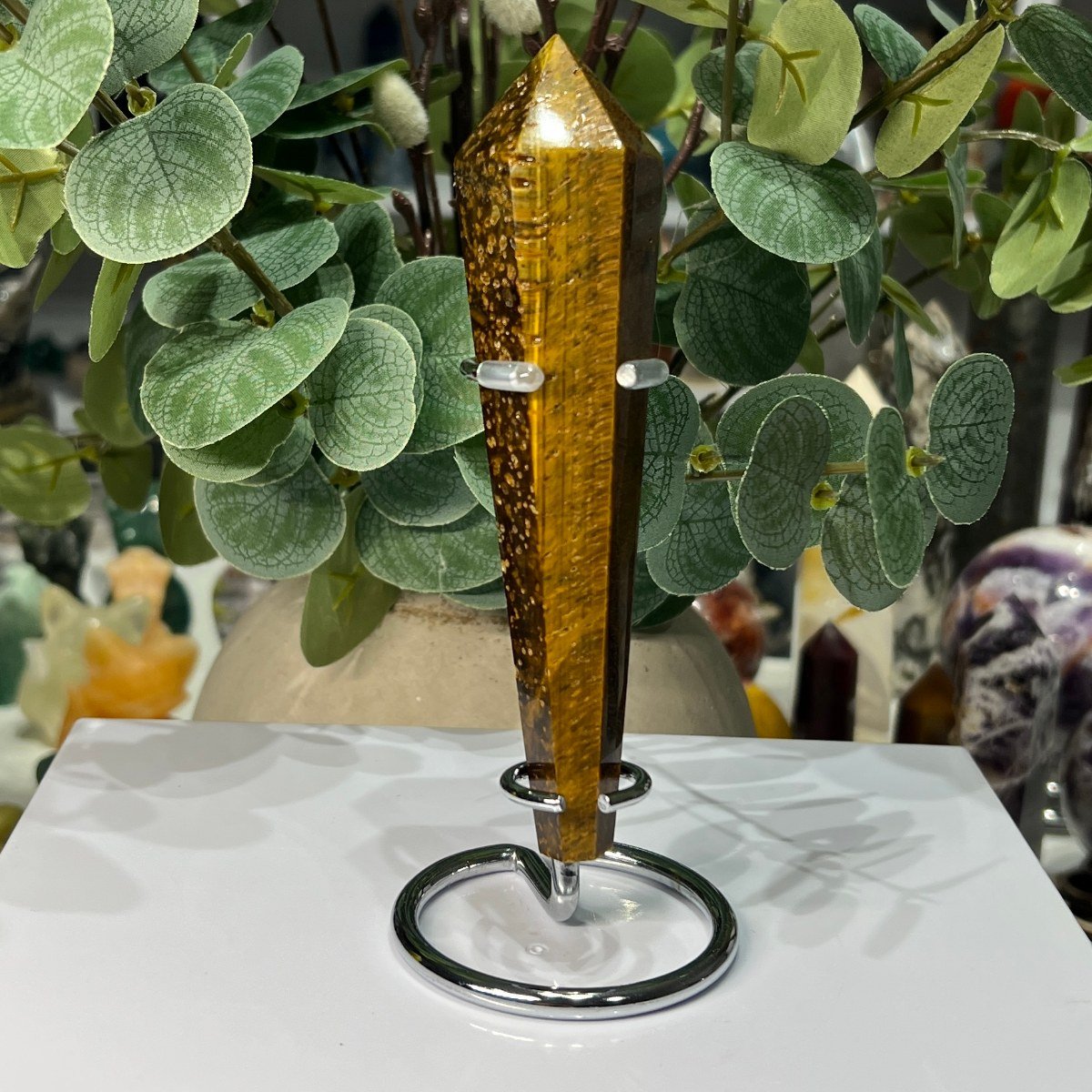
How the golden banding formed, a plain answer to the asbestos question, and how the stone is traditionally used
Tigers eye meaning is usually given as confidence and courage, and that is the right place to start. But there is a question people search for far more often than the meaning, and almost no shop will answer it: is tigers eye made of asbestos. It is a fair question with a real answer, and it comes below, because a stone you are worried about is not a stone you will use.
Tigers eye meaning and what the stone is
Tigers eye is quartz with a silky band of light that moves across the surface as the stone is turned. That moving band is called chatoyancy, from the French for cat’s eye, and it is caused by parallel fibres running through the stone reflecting light in a line.
It is 7 on the Mohs scale, the same as all quartz, so it takes daily wear well. Most of it comes from the Northern Cape in South Africa, with Western Australia the other main source. The golden brown is the familiar form. Red tigers eye is usually heat treated, blue is sold as hawk’s eye, and the mottled gold and blue material is tigers iron or marra mamba.
Mindat’s tiger’s eye entry has the mineralogy.
Is tigers eye dangerous, and is it asbestos
The short answer is that a finished, polished tigers eye is safe to hold, wear and keep, and the only sensible caution concerns cutting, drilling or sanding it dry.
Here is where the question comes from. Tigers eye forms in association with crocidolite, a fibrous blue amphibole mineral, and crocidolite is the mineral known industrially as blue asbestos. In the classic account the crocidolite fibres were gradually replaced by silica while keeping their parallel arrangement, which is what produces the moving band. More recent work suggests the quartz and the fibres grew alongside one another rather than one replacing the other. Geologists still discuss which is right.
What is not in dispute is the state of the stone in your hand. The fibres in finished tigers eye are bound inside solid quartz. Asbestos is a hazard when loose fibres are airborne and inhaled, and nothing about holding, wearing or displaying a polished stone releases fibres. There is no inhalation route from a tumblestone in a pocket.
The caution is for making rather than owning. Cutting, drilling, grinding or sanding tigers eye dry produces dust, and that dust may carry fibrous material as well as crystalline silica, which is its own well established hazard. Anyone working tigers eye for jewellery or resin should work wet, use extraction, and wear proper respiratory protection, exactly as they would for any silica. Buying, wearing and keeping it needs no precautions at all.
That is the honest position, and it is more useful than either pretending the question does not exist or treating a polished stone as hazardous.
Is tigers eye receptive or projective
Projective, and distinctly so. Its planet is the Sun and its element is Fire, which puts it at the opposite end of the system from amethyst or selenite.
Projective means sending outward and acting. The traditional intentions reflect that: courage, confidence, luck, prosperity, physical energy, protection and divination. This is not a stone for settling and listening. It is a stone for the part of the day when you have to do something, and it is the classic choice for an interview, a difficult conversation or anything requiring nerve.
Being Sun ruled also places tigers eye with Leo, with Sunday, and with solar work. Cunningham gives cat’s eye as its substitute, which is the same optical effect in a different mineral.
Worn as a bracelet it belongs on your dominant wrist, which is the projective hand. Our guide to which hand to wear a crystal bracelet explains when to move it to the other wrist, and tigers eye is a stone where people often should: if you want to feel steadier in yourself rather than more forward with other people, the receptive wrist suits better.
That is inherited correspondence, not a claim about what the stone does.
Can tigers eye go in water
Yes. At 7 on the Mohs scale and with no solubility, a short rinse in cool water is fine, and tigers eye is one of the more robust stones in a collection.
Two notes. Red tigers eye is usually heat treated, and sudden temperature change on heat treated material is more likely to crack it, so use cool water rather than hot. And prolonged soaking in salt water will dull the polish over time, which matters here because the polish is what makes the band visible. Rinse, dry, and cleanse by other means if you want to be careful.
What it means when tigers eye breaks
Tigers eye parts along its fibres, which is the obvious weakness in a stone built from parallel lines. A tower or an obelisk will split lengthways. Beads crack at the drill hole. The band itself marks the plane it will go along.
Traditionally a protective stone that breaks is read as having taken something and reached its limit. Tigers eye being projective, the reading usually offered is that it has spent itself rather than absorbed something. Hold it gently, and remember that a stone made of parallel fibres has an obvious reason to split without any of that being involved.
Broken pieces still show the band and still work in a pouch or a grid.
Our guide to what it means when a crystal breaks covers the superstition and where it came from.
Choosing a piece
The band is everything, so judge a piece on how strong and how sharp it is. Good material shows a tight bright line that moves cleanly as the stone turns. Poor material looks flat and brownish from every angle.
Tumbles and palm stones are the practical forms and show the chatoyancy well. Towers look striking and split most readily. Spheres show the band moving across a curve, which is the most satisfying way to see it.
Tigers eye is abundant and inexpensive, so there is no reason to pay much for ordinary material. Blue hawk’s eye and the gold and blue tigers iron cost a little more.
Tigers eye by form
Browse our tigers eye, or go by form with tumblestones and crystal spheres. Other protective stones are gathered in crystals for protection.
Traditional use is not medical use. For anything concerning your health, speak to a professional rather than a shop.
Continue Your Journey
Obsidian Meaning · Which Hand To Wear A Crystal Bracelet · How To Choose Crystals



Leave a Reply