A rock rather than a mineral, what the gold flecks really are, and how to tell real lapis from dyed stone
Lapis lazuli meaning carries more history than any other stone on the shelf. It has been mined from the same valley in Afghanistan for around six thousand years, it was ground into the most expensive pigment in European painting, and it sat on the face of Tutankhamun. It is also one of the most faked stones sold today. This guide covers what lapis actually is, how to tell a real piece from dyed jasper, whether it can go in water, and what the correspondences say.
Lapis lazuli meaning and what the stone is
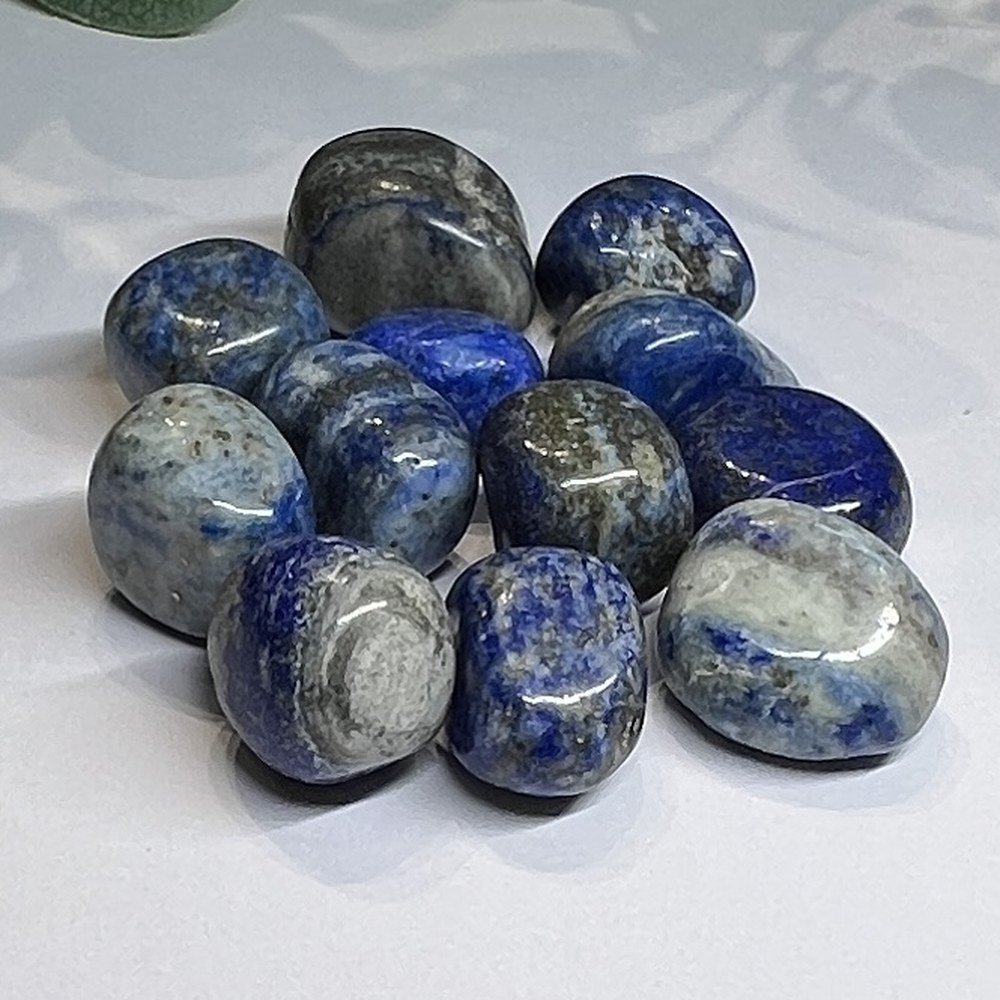
Lapis lazuli is a rock rather than a single mineral, and that is the key to understanding it. It is mostly lazurite, which supplies the blue, mixed with white calcite and flecks of golden pyrite. Those three components in different proportions are why no two pieces look alike, and why the pyrite flecks are the thing people recognise it by.
It is soft, 5 to 5.5 on the Mohs scale, which is softer than a steel knife blade and much softer than quartz. The best material comes from Sar-e-Sang in Badakhshan, Afghanistan, where it has been worked since the Neolithic. Chilean lapis is paler with more calcite, and Russian material sits somewhere between.
Ground and purified, lapis made ultramarine, the blue that cost more than gold and was reserved for the Virgin’s robe in Renaissance painting. Mindat’s lapis lazuli entry has the mineralogy.
Is lapis lazuli receptive or projective
Receptive, and unusually both of the main correspondence sources agree on it.
Cunningham gives lapis as receptive, with Venus as its planet and Water as its element, and the signs Taurus and Libra. Kynes gives the same current under the name Yin, the same element, Water, and adds Neptune alongside Venus. The two books were compiled separately, so agreement is worth something.
Kynes places lapis with the brow and throat chakras, with the September full moon, with Litha, with the number three, and with Isis, Justitia, Nut and Venus. Her zodiac list is wider than Cunningham’s: Aries, Capricorn, Libra, Sagittarius, Taurus and Virgo.
The traditional intentions sit around speaking and seeing clearly: courage, communication, insight, intuition, justice, knowledge, wisdom and peace of mind. A receptive stone for the throat is an interesting combination, and it fits the way lapis is usually given, which is for working out what you think before you say it rather than for being louder.
Worn as a bracelet it goes on the non dominant wrist, the receptive hand. Our guide to which hand to wear a crystal bracelet sets out the reasoning. All of this is correspondence handed down, and it is held as part of a practice.
Telling real lapis from dyed
This matters more for lapis than for almost anything else, because good lapis is expensive and the imitations are everywhere.
- Pyrite is the honest marker. Real lapis usually carries small irregular flecks of metallic gold pyrite scattered unevenly through it. Dyed imitations either have none or have suspiciously even sparkle.
- Dyed howlite and dyed jasper are the common fakes. Both come out an even flat blue with no calcite veining and no pyrite.
- The cotton bud test. A damp cotton bud, or one with a little acetone, rubbed on an inconspicuous spot will pick up blue from a dyed piece. Real lapis will not transfer colour.
- Reconstituted lapis is real lapis powder bound in resin. It looks too uniform and feels slightly warm and light for its size.
- White is normal. Calcite veining is a sign of real lapis, not a flaw, though heavily calcite rich material is cheaper.
Can lapis lazuli go in water
Better not. Lapis is the stone where the water answer is a firm no rather than a cautious yes.
It is soft and it is porous. The calcite in it reacts to anything acidic and dulls, water works into the boundaries between the three minerals, and the pyrite will rust and leave brown staining. Soaking also loosens any wax or resin used to improve the polish, which is common on commercial material, and it will lift dye straight out of an imitation.
Cleanse lapis with smoke, sound or moonlight, and keep it away from perfume, cosmetics and household cleaners as well as water. Wipe with a dry soft cloth. Our guide to cleansing crystals has the detail on dry cleansing.
What it means when lapis lazuli breaks
Lapis is a rock made of three minerals with different hardnesses stuck together, so it parts at the boundaries between them. A piece will often split along a calcite vein, which is why a broken lapis usually shows a white face. At hardness 5 it also scratches and chips far more easily than people expect from a stone that costs this much.
Tradition treats a break as a piece having run its course. With lapis, and with a stone this soft, the physical explanation covers nearly every case. A lapis bead cracked because the drill hole went through a calcite vein, not because of anything that happened to you.
The pieces remain useful, and a chipped lapis still shows the blue that people have been mining for six thousand years.
For the wider question of what a break means, see what it means when a crystal breaks.
Choosing a piece
Deep even blue with scattered pyrite and a little calcite is the material to want. Price rises steeply with the depth of blue and the absence of white. Paler, more heavily veined Chilean material is honest and much cheaper, and looks lovely in a tumble.
Tumbles and palm stones are the practical forms. Pendants work well because lapis is soft and benefits from not being knocked about. Bracelets are the form most likely to chip. Avoid anything suspiciously even in colour and anything priced well below the rest of the market.
Lapis in the shop
Browse our lapis lazuli, or go by form with tumblestones and crystal jewellery. For more blue stones, see our guide to blue crystals.
Lapis is worked with as part of a practice. It treats nothing, and professional questions belong with professionals.
Continue Your Journey
Blue Crystal Names · Labradorite Meaning · How To Cleanse Crystals


Leave a Reply