What it means when a crystal breaks, why it happens, and what to do with the pieces
It happens to almost everyone who keeps crystals. A tumblestone slips from your hand onto the kitchen floor, a tower tips off a shelf, or you notice a crack in a piece that was whole yesterday. The first thought is often a worried one: is a broken crystal bad luck?
It is not. In crystal practice a break is usually read as something gentle: a stone that has done its work, taken a knock on your behalf, or simply met a hard floor. Here is what a break is said to mean, the plain reasons crystals crack, what individual stones are thought to be telling you, and what to do with the pieces.
- Is it bad luck? No. A break is usually read as a sign of protection, change or a piece of work completed
- Most common cause: a knock, a drop or a sudden change of temperature
- Most likely to break: soft or layered stones such as selenite, fluorite and calcite
- Can you still use it? Yes. Many people keep working with the pieces
- What to do with the pieces: keep them, return them to the earth, set them in a plant pot, pass them on or mend them with gold
Caring for your stones
Cleansing tools and protective stones mentioned in this guide.
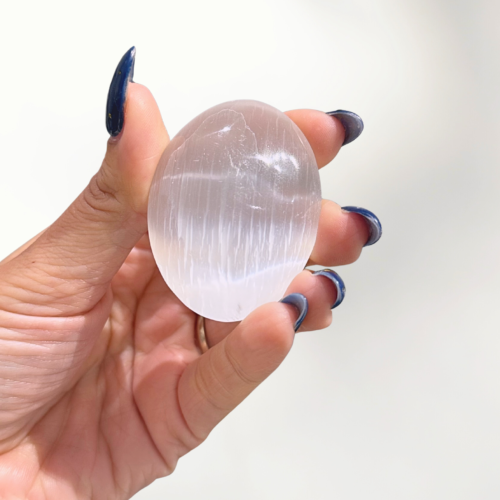 Selenite Palm Stone
 Selenite Heart Bowl
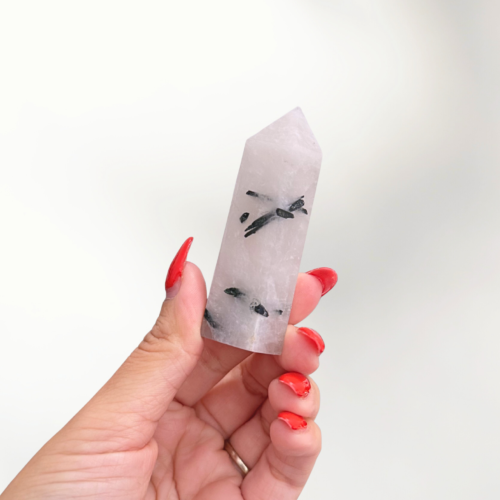 Black Tourmaline in Quartz
 Palo Santo Sticks
Is a Broken Crystal Bad Luck?
A broken crystal is not bad luck. The worry probably borrows from the old superstition about broken mirrors, which is about reflections rather than stones. In crystal practice the reading is almost always kinder. A break is taken as something to notice, not something to fear.
If you dropped your crystal and it broke in half, the fall is very likely the whole story. The spiritual reading matters most when a stone breaks with no obvious cause: on a shelf, in a pocket or in your hand.
Why Crystals Break: The Plain Reasons
Crystals are minerals, and every mineral has weak points. Before looking for meaning, it is worth checking whether one of these explains the break.
A knock or a drop
Hardness and toughness are not the same thing. Quartz is hard enough to scratch glass, yet a quartz point can still chip if it lands on its tip on a tiled floor.
Natural fractures and inclusions
Many stones carry fine internal cracks, veils and layers from the way they formed. These are part of their character, and they are also where a break is most likely to start.
Sudden changes of temperature
Moving a stone quickly between cold and heat, such as from a cold windowsill into warm water, makes the outside and the inside expand at different rates. Quartz, fluorite and calcite can all crack this way.
Soft and layered stones
Selenite is soft enough to mark with a fingernail and splits along its fibres. Fluorite and calcite have cleavage planes, natural flat lines along which they part cleanly. A break along one of these lines is the stone doing exactly what its structure allows. The British Geological Survey has a clear introduction to minerals and how they form.
What Does It Mean Spiritually When a Crystal Breaks?
When there is no plain reason, or a break simply feels significant, these are the three readings most often given in crystal practice.
It has protected you
This is the most common reading, especially for dark, grounding stones. The idea is that the stone has taken on more than it could hold during a difficult stretch, and the break marks the end of that load. Many people find it a comfort to see the break as a sign the stone has done what it was kept for.
You have moved on
A crystal that breaks during a time of change is often read as a sign that you have grown beyond the reason you chose it. The stone that carried you through one chapter may not be the one for the next.
The work is complete
Sometimes a break is read simply as a full stop. You chose the stone for a purpose, and that purpose has run its course.
A broken crystal is rarely a warning. In most traditions it is read as a stone that has finished its work, or taken a knock for you.
Whichever reading feels right, these are traditional meanings within a personal practice, not predictions. Your own sense of what the break means to you matters more than any list.
When Specific Crystals Break
When black tourmaline breaks
Black tourmaline is the stone most often linked with protection, so a break is usually read as a sign that it has absorbed what it was kept to absorb. It is also naturally ridged and brittle along its length, so long pieces snap more easily than people expect.
When obsidian breaks
Obsidian is volcanic glass, and like glass it breaks with sharp, curved edges. The traditional reading is the same as for black tourmaline: protection, and the end of a heavy stretch. Handle the pieces with care, as the edges can cut.
When amethyst breaks
Amethyst is linked with calm and steadiness, so a broken amethyst is often read as a sign that a restless time has passed. Clusters lose single points easily, and that is rarely anything more than a knock.
When rose quartz breaks
Rose quartz is linked with love and kindness to yourself, so a break is often read as an emotional chapter closing. Rose quartz is also commonly fractured inside, which is why it can crack along lines you could not see.
When selenite breaks
Selenite breaks more often than almost any other stone, simply because it is so soft. A snapped selenite wand is nearly always a physical break rather than a sign. Keep selenite dry, as water dulls and slowly dissolves its surface.
When a Crystal Bracelet Breaks
Crystal bracelets break more often than loose stones. A snapped bracelet is often read in the same way as a broken stone, as protection or as the end of whatever you were wearing it for.
There is a practical side too. Elastic that is stretched over the hand every day wears thin in time. Gather the beads, count them, and restring them on fresh elastic if you would like to keep wearing it.
Can You Still Use a Broken Crystal?
Yes. A broken crystal is still the same mineral, and many people feel it works just as well. Some keep the two halves together as a pair, others keep them in different rooms, and some give one half to someone close to them.
If the break has left a sharp edge, keep the piece somewhere it will not be handled often, or set it on the altar rather than carrying it in a pocket.
How to Know When a Crystal Has Finished Its Work
A crystal does not have to break for its time with you to come to an end. These are the signs people most often describe.
- It feels different. A stone you used to reach for every day now feels flat or ordinary in your hand.
- It keeps going missing. A crystal that is often lost is sometimes taken as one ready to move on.
- You stop reaching for it. You simply no longer want to wear it or hold it, which can mean its purpose for you is complete.
What to Do With a Broken Crystal
1. Keep it
Place the pieces back on your altar or in a small dish. Many people find a broken stone more meaningful, not less, because of what it has been through.
2. Return it to the earth
Bury the pieces in the garden or a quiet corner outdoors, with a word of thanks if you like. Choose a spot away from paths and vegetable beds.
3. Set it in a plant pot
Small, smooth pieces of quartz, amethyst or agate look lovely on the soil of a house plant. Leave out soft or water sensitive stones such as selenite and malachite, which do not belong in damp soil, and anything with sharp edges.
4. Pass it on
If the stone broke cleanly into two good pieces, keeping one and giving the other to a friend is a lovely way to share it.
5. Mend it with gold
Inspired by kintsugi, the Japanese art of mending pottery with gold, some people glue a broken stone back together and paint the seam gold. The crack becomes part of its story.
If you would rather part with the pieces altogether, wrap sharp shards such as obsidian or quartz in paper before they go out with the rubbish, so no one is cut handling them.
How to Stop Crystals Breaking
- Keep towers and points away from shelf edges, and stand them on a cloth or mat.
- Avoid sudden changes of temperature, such as hot water straight after a cold windowsill.
- Store soft stones like selenite and fluorite apart from harder ones, which can scratch and chip them.
- Check the elastic on bracelets every few months and restring before it wears thin.
- Take bracelets off before washing your hands or bathing, as many stones do not like water.
If you cleanse your crystals with water, check first which stones can safely go in. Our guide on how to cleanse crystals covers gentler ways too, and how to charge and program your crystals is a good next step for a new piece.
Questions People Ask
Is it bad luck if a crystal breaks?
No. In crystal practice a break is usually read as a sign of protection, change or a piece of work completed, never as a curse.
What does it mean when a crystal breaks in half?
A clean break into two pieces is most often read as protection or as a chapter ending. If you dropped it, the simplest reason is the fall itself.
What happens if you break a crystal?
Nothing harmful. The pieces are still the same stone. Some people deliberately split larger pieces to share them or to use in a crystal grid.
Why do crystals break on their own?
Hidden fractures, changes of temperature and soft, layered structure can all make a crystal crack without a knock. When there is no obvious cause, many people take it as a stone that has finished its work.
Should I throw away a broken crystal?
There is no need to. Keep it, return it to the earth, set it in a plant pot, pass a piece on or mend it with gold.
What does it mean when black tourmaline breaks?
Black tourmaline is kept for protection, so a break is traditionally read as the stone having absorbed all it could. It is also brittle along its length, so it does snap more easily than many stones.
Replacing a piece? Browse black tourmaline, obsidian, amethyst, rose quartz, tumblestones and crystal towers at Mystic Grove.
Crystal meanings in this post are traditional and part of a personal practice. They are not a substitute for medical or professional advice.
Keep reading: How to Cleanse Crystals · How to Charge and Program Your Crystals · Authenticity, Quality and Hidden Magic
Shop the stones in this guide
Quartz · Selenite · Tourmaline · Amethyst · Crystal Towers and Points · Energy Cleansing Tools