Crystal Shop UK · Rooted in intention, curated with care

Author: Mystic Grove

  • Pink Amethyst Meaning: The Crystal of Emotional Clarity

    Pink Amethyst Meaning: The Crystal of Emotional Clarity

    The crystal of emotional clarity and soft power: what pink amethyst is, where it comes from, how it differs from rose quartz and purple amethyst, and a simple calming practice to try at home

    Pink amethyst is one of the newest faces on the crystal shelf, and one of the gentlest. It has the soft blush of rose quartz with the sparkling, crystalline sweep of an amethyst geode, and many people describe it as a stone that feels both tender and clear at the same time. If you have spotted it and wondered what it actually is, what it means and how to look after it, this guide walks you through it all, honestly and simply.

    Pink Amethyst at a Glance

    • What it is: a pale pink to soft lavender variety of quartz, grown in the same way as purple amethyst
    • Where it comes from: mainly Patagonia, in the south of Argentina
    • When it appeared: it reached the crystal world around 2016 and 2017, so it is a very modern stone
    • Colour: from barely there blush to dusky rose, sometimes with a lilac or peach tint
    • Hardness: 7 on the Mohs scale, the same as all quartz
    • Traditionally linked with: the heart and the crown, calm, compassion and emotional clarity
    • Moon phase: lovely for the gentle waxing crescent, a time of soft new feeling
    • Care: keep it out of strong, direct sunlight, as its colour can fade

    What Is Pink Amethyst?

    Pink amethyst is quartz. So is purple amethyst, rose quartz, citrine and clear quartz. What makes each one look different is what was present while the crystal grew, and how it grew.

    Pink amethyst forms inside geodes, the hollow pockets left in old volcanic rock. Over a very long time, mineral rich water seeped into those pockets and slowly built up a lining of glittering crystal points. That is exactly how purple amethyst geodes form too, which is why the two look so alike in shape and sparkle.

    The difference is the colour. Purple amethyst owes its violet to traces of iron and to natural radiation in the rock. Pink amethyst is usually said to get its blush from very fine traces of hematite, an iron mineral, caught between the layers of the crystal as it grew. The result is a soft, milky pink that can lean towards lavender in some pieces and towards peach in others. No two geodes are quite the same shade.

    When you look closely at a slab or a polished piece, you will often see bands of colour, little sparkling points, and sometimes a rim of grey or brown rock around the edge. That rim is the volcanic host rock, and it is a lovely reminder of where the crystal came from.

    The Honest History

    This is the part many crystal guides skip, so here it is plainly: pink amethyst is new. It became widely known in the crystal world only around 2016 and 2017, when geodes from Patagonia in Argentina began to reach sellers and collectors. Before then, most people had never seen it.

    That means there is no ancient folklore about pink amethyst itself. No old herbals, temple records or medieval lapidaries mention it, because it simply was not known. The meanings people give it today are modern, and they have grown from two places: the long history of amethyst, and the gentle, heart centred feel that most people sense in its colour.

    Amethyst, by contrast, has a very long story. Its name comes from the ancient Greek word amethystos, meaning “not drunken”, and it was once believed to keep the wearer clear headed. It has been prized for thousands of years, and it was one of the stones our ancestors in the British Isles traded for. Rose quartz, too, has a long history of being linked with love and harmony.

    So when you work with pink amethyst, you are taking part in something fresh. Its meanings are being shaped right now, by the people who sit with it, keep it on their altars and notice how it feels to them. There is something quite special about that.

    Pink Amethyst Meaning: The Crystal of Emotional Clarity and Soft Power

    The phrase most often used for pink amethyst is emotional clarity, and it fits well. It brings together the two stones it is most often compared with. From amethyst it takes calm, a clear head and a quiet, steady mind. From the pink family of stones it takes warmth, kindness and an open heart.

    Heart and crown

    In modern chakra practice, purple amethyst is linked with the crown, at the top of the head, and pink stones are linked with the heart. Pink amethyst is traditionally seen as a bridge between the two. The idea is simple: it helps the heart and the head talk to each other, so that you can feel things fully and still think clearly.

    Calm and compassion

    Many people keep pink amethyst for moments when feelings run high. It is traditionally associated with calm, gentleness and compassion, both for others and for yourself. It is a stone people reach for after a difficult conversation, during a time of change, or simply at the end of a long day.

    Soft power

    Soft power is the quiet strength of someone who is kind without being a pushover. Pink amethyst is often kept as a reminder that gentleness is not weakness. You can be tender and still hold your boundaries, and you can be open hearted and still say no. In Reiki, one of the simple daily principles is to be kind to every living thing, and that includes yourself. Pink amethyst sits very naturally alongside that idea.

    Pink Amethyst vs Rose Quartz vs Amethyst

    These three are easy to mix up, especially in photos. Here is how they compare.

    StoneHow it looksHow it formsTraditionally linked with
    Pink amethystSoft pink to lavender, often sparkling with tiny crystal pointsInside volcanic geodes, mainly in Patagonia, ArgentinaEmotional clarity, calm, compassion, heart and crown
    Rose quartzMilky, even pink, usually without visible pointsIn large solid masses rather than geodes, found in many countriesLove, harmony, self love, the heart
    AmethystLight lilac to deep violet, often in sparkling clustersInside geodes, found all over the worldCalm, intuition, sleep, clear thinking, the crown

    The quickest way to tell pink amethyst from rose quartz is texture. Rose quartz usually grows in big, solid lumps, so polished pieces look smooth and creamy all the way through. Pink amethyst grows as points lining a geode, so you will often see banding, sparkle and the edges of tiny crystals.

    If you love the steady, all over pink of rose quartz, a rose quartz sphere or a pocket sized rose quartz tumblestone is a lovely companion piece. Many people keep the two side by side, with rose quartz for love and pink amethyst for calm clarity. You can browse more in our rose quartz collection and our amethyst collection, and our grounded guide to pink crystals covers the wider pink family.

    Choosing Your Shape

    Because pink amethyst grows inside geodes, it is often cut and polished into shapes that show off its banding and sparkle. The shape changes how you might use it, so it is worth choosing with care. There is no right or wrong answer. Go with the one you keep coming back to.

    Towers

    A pink amethyst tower stands upright with a point at the top. Towers are traditionally used to draw energy upwards and send it out into a room, so many people place one on a desk, bedside table or altar as a steady focal point. It is a good choice if you want a single piece that holds the space.

    Spheres

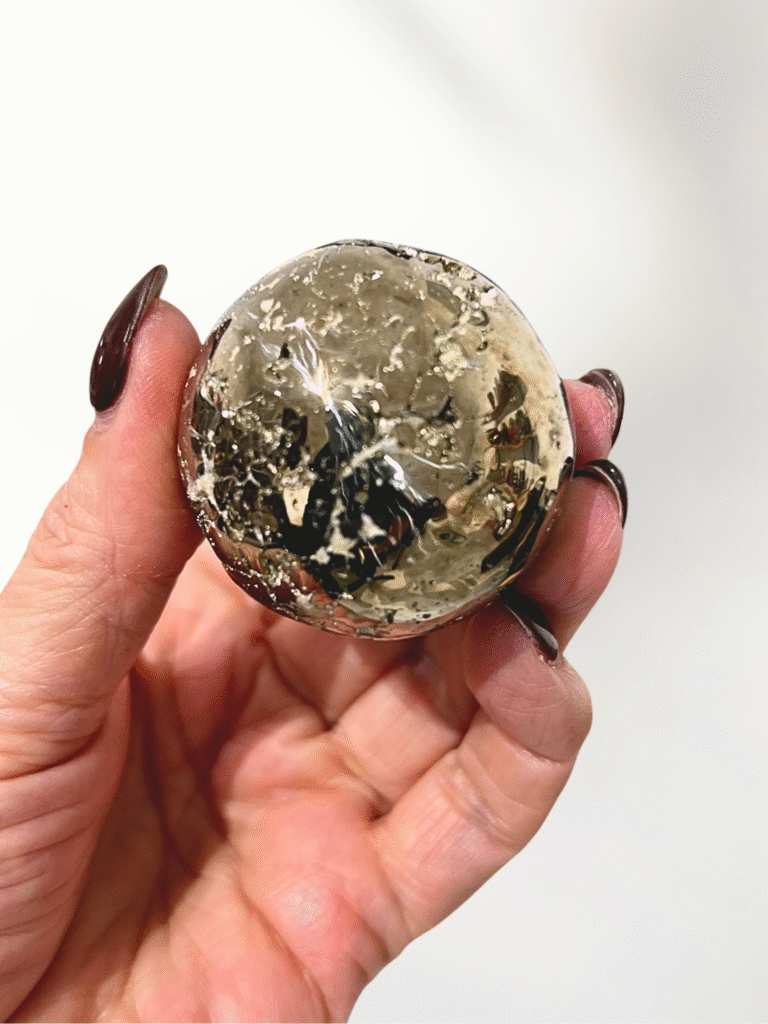
    A pink amethyst sphere has no edges and no beginning or end. Spheres are traditionally linked with wholeness and with energy that radiates gently in every direction. They are lovely to hold in both hands during quiet time, and the curve shows off the bands of colour beautifully as the light moves across it.

    Slabs

    A slab is a thin slice cut straight through a geode, so you see the whole cross section: the rim of host rock, the bands of colour and the sparkling points at the centre. A pink amethyst slab on a stand is the most natural way to see how the crystal actually grew, and it makes a striking display piece on a shelf or windowsill that does not get strong sun.

    Bowls

    A pink amethyst bowl is both beautiful and practical. Many people use one on their altar to hold tumblestones, rings or small offerings, or keep it by the bed for the jewellery they take off at night. A bowl is traditionally a symbol of receiving, which suits a stone so linked with the open heart.

    Butterfly wings

    Butterflies are a long standing symbol of change, growth and new beginnings. Pink amethyst butterfly wings on a stand make a gentle piece for a time of transition, or a thoughtful gift for someone going through a change in their life.

    How to Care for Pink Amethyst

    Pink amethyst is a hard stone, but its colour is delicate. A few simple habits will keep it looking its best for years.

    • Keep it out of strong sun. Like purple amethyst, pink amethyst can fade if it sits in strong, direct sunlight for long periods. A bright room is fine, but a sunny windowsill all summer is not. This matters most for slabs and display pieces.
    • Dust it gently. A soft, dry brush, such as a clean makeup brush or a soft paintbrush, is the best way to clean the sparkling points and the rough rim of a slab, where dust likes to settle.
    • Use a little water only if needed. Polished towers and spheres can be wiped with a slightly damp cloth and dried straight away. Avoid soaking slabs, as water can sit in the host rock.
    • Avoid sudden heat or cold. Quick changes in temperature can stress quartz, so do not move it from a cold room straight onto a radiator or into hot water.
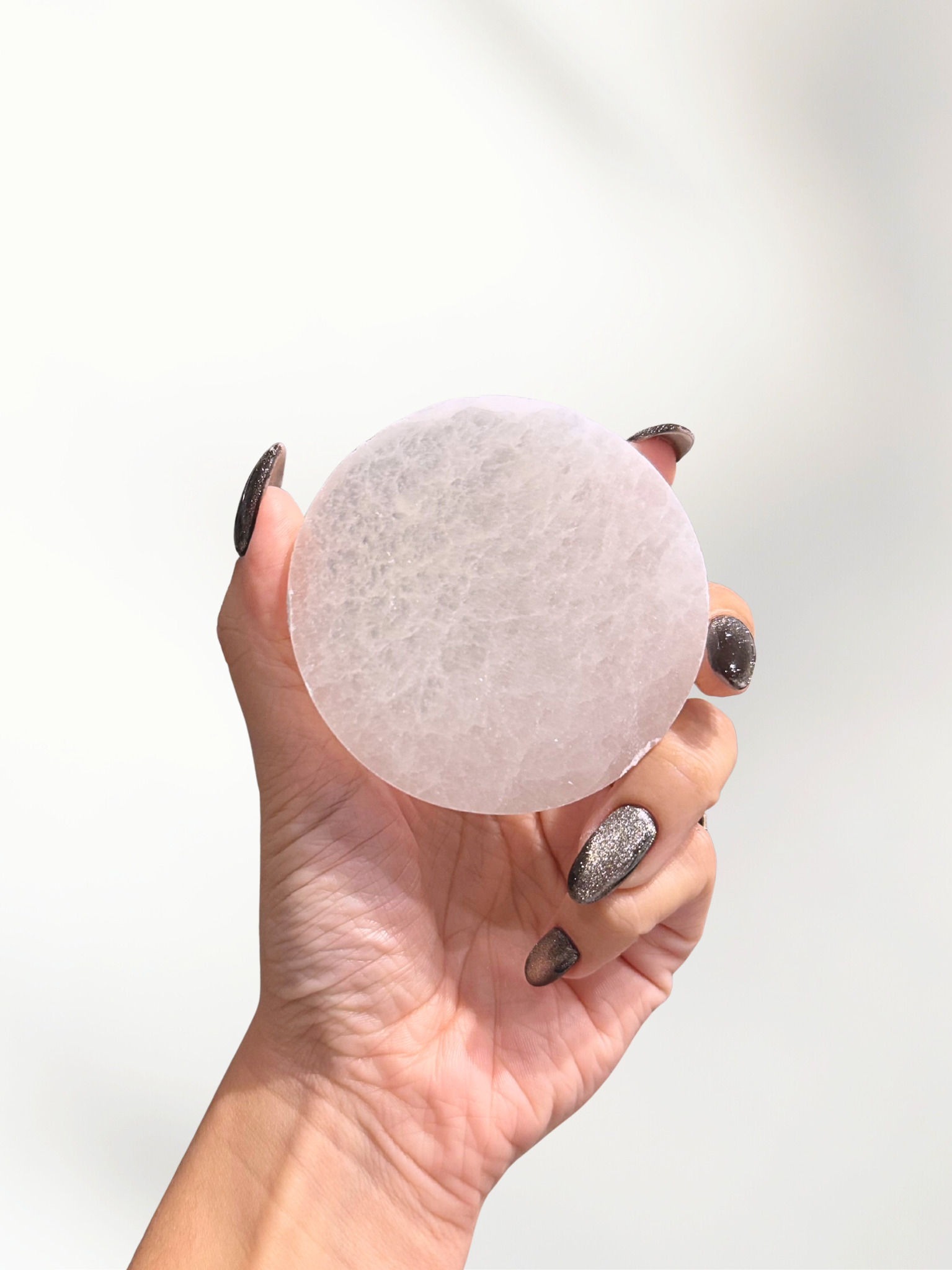
    • Cleanse in a way that suits it. Gentle methods work well: moonlight, the smoke of incense, sound from a bell or singing bowl, or resting it on a selenite plate. Moonlight is kinder than sunlight for this stone.

    A Simple Calming Practice with Pink Amethyst

    This is a short evening practice for when your feelings are tangled and you would like to find some calm and clarity. It suits any time, though many people like to do it during the waxing crescent moon, a gentle phase linked with fresh feelings and looking a little deeper. Our guide to the phases of the moon explains each phase.

    1. Prepare your space. Find a quiet spot and tidy it a little. Place a pink or white candle in front of you, as a white candle can stand in for any colour. Set your pink amethyst beside it.
    2. Light the candle. As you light it, say quietly: “I welcome calm, I welcome clarity, I welcome kindness.”
    3. Hold the stone. Pick up your pink amethyst and hold it in both hands, resting them against the centre of your chest.
    4. Breathe slowly. Take a slow breath in through your nose for a count of four, and out through your mouth for a count of six. Repeat this a few times until your body begins to settle.
    5. Meditate. Close your eyes and picture a soft pink light around the stone, spreading through your chest and rising gently up to the top of your head. Let it settle there for a few minutes.
    6. Write it down. Open your journal and write about what is on your mind. Then write one sentence that begins “What I know clearly is…” and finish it honestly.
    7. Close with thanks. Thank the stone, thank yourself, and snuff the candle.
    8. Keep it close. Leave the pink amethyst by your bed or in your pocket for the next day, as a small reminder of the calm you found.

    Questions People Ask

    What is pink amethyst good for?

    Pink amethyst is traditionally associated with calm, compassion and emotional clarity. Many people keep it for times when feelings run high, or as a gentle reminder to be kind to themselves.

    Is pink amethyst real amethyst?

    Yes. Pink amethyst is a natural variety of quartz that grows in geodes just as purple amethyst does. Its soft pink colour is usually said to come from tiny traces of hematite caught inside the crystal as it formed.

    Where does pink amethyst come from?

    Most pink amethyst comes from Patagonia in Argentina. It became widely known only around 2016 and 2017, which makes it one of the newer stones in the crystal world.

    What is the difference between pink amethyst and rose quartz?

    Both are pink quartz, but they grow differently. Rose quartz forms in large solid masses and looks smooth and even, while pink amethyst grows as sparkling points inside geodes and often shows banding. See our guide to pink crystals for more.

    Does pink amethyst fade in the sun?

    It can. Like purple amethyst, its colour may fade if it sits in strong, direct sunlight for long periods. Keep it in a bright spot away from a sunny windowsill and it will keep its colour.

    What chakra is pink amethyst?

    In modern chakra practice, pink amethyst is linked with both the heart and the crown. It is often described as a bridge between the two, bringing together warmth of feeling and a calm, clear mind.

    Keep reading: Pink Crystals: A Grounded Guide · Agate Meaning · Moon Phases Explained
  • Agate Meaning: Properties, Types and How to Use Agate

    Agate Meaning: Properties, Types and How to Use Agate

    The stone of balance and steady ground: what agate is, how it forms, the meaning of each variety from blue lace to moss and flower agate, and how to choose, cleanse and work with yours

    Agate is one of the oldest stones people have ever carried, and one of the friendliest to start with. It is hard wearing, safe in water, found all over the world and made in an almost endless range of colours and patterns. In crystal tradition it is known as the stone of balance and stability, a calm, steady companion rather than a dramatic one. Here is what agate really is, what each of the main varieties is said to mean, and a simple grounding practice to begin with.

    Agate at a Glance

    • What it is: a banded form of chalcedony, a very fine grained member of the quartz family
    • How to say it: AG·it
    • Hardness: around 6.5 to 7 on the Mohs scale, so it is tough enough for everyday wear
    • Known for: balance, stability, grounding, calm and steady confidence
    • Chakra (by tradition): root chakra for agate in general, with each colour linked to its own centre
    • Zodiac (by tradition): most often Gemini, with varieties paired to Virgo, Capricorn and others
    • Element: earth
    • Safe in water: yes, natural agate is fine to rinse
    • Name: from the river Achates in Sicily, as recorded by the Greek writer Theophrastus

    What Is Agate?

    Agate is a type of chalcedony, which is quartz made of crystals too tiny to see, even with a hand lens. What makes agate special is its banding: fine layers, curving rings or wavy lines, sometimes in many colours, sometimes in soft greys and whites.

    Because it belongs to the quartz family, agate is tough, does not mind water and takes a beautiful polish, which is why it has been carved, worn and carried for thousands of years.

    Some stones called agate, such as moss agate and tree agate, show branching patterns instead of bands. A geologist might call them chalcedony with inclusions, but the name agate has long stuck.

    How Does Agate Form?

    Most agate forms inside volcanic rock. When lava cools, gas bubbles leave hollow pockets behind. Over a very long time, water rich in silica seeps into these hollows and slowly leaves its silica behind, layer upon layer, rather like the rings of a tree. Tiny changes in the water, such as a trace of iron or manganese, give each band its own shade.

    Sometimes the hollow does not fill completely. The centre may be left open and lined with sparkling quartz crystals, which is why some agates crack open to show a little crystal cave inside. Those small glittering pockets are called druzy, and you can see them in pieces such as our flower agate sphere with druzy pockets.

    Agate is found on every continent. Scotland is famous for its agates, which Victorian jewellers set into much loved brooches.

    The History of Agate

    Agate is one of the earliest decorative stones in human history. People in the ancient Near East, Egypt and the Indus Valley were shaping agate into beads, seals and amulets thousands of years ago, and it remained a favourite for carved cameos and signet rings in Greece and Rome.

    The Greek writer Theophrastus, in one of the first books about stones, recorded that agate was named after the river Achates in Sicily, where it was found.

    Agate also has a place in the old crystal lore of these islands. Alongside jet, amber and quartz, it was one of the stones our ancestors knew and traded. In the traditional teaching many keep today, agate is said to bring vitality and quiet confidence, and when it is drawn at random in stone divination it is read as a sign of a pleasant surprise on its way. In Celtic practice, agate also appears among the stones offered to Brigid, and grey and blue agate are linked with the Cailleach, the old winter goddess of Scotland and Ireland.

    The colour and chakra pairings you will read below are much more recent. They grew mainly out of twentieth century crystal healing, and they are best held as a living tradition rather than ancient law.

    Agate Meaning: The Stone of Balance

    Across almost all its varieties, agate carries one central meaning: balance. It is traditionally known as a slow, steady stone. It is thought to work gently over time, helping you feel more settled, patient and at home in yourself.

    Its layered bands are often read as a reminder that growth happens a little at a time, one thin layer after another.

    Choosing Your Agate Variety

    Each variety has its own look and its own traditional meaning. Here are the ones people ask about most.

    VarietyLooks likeTraditionally linked with
    Blue lace agateSoft pale blue with white lacy bandsCalm, gentle speech, throat chakra
    Moss agateClear or white with green branching patternsGrowth, nature, new beginnings, heart chakra
    Black agateDeep black, often with faint bandingProtection, grounding, root chakra
    Crazy lace agateSwirling cream, red, brown and gold patternsJoy, laughter, optimism
    Flower agateSoft pink and cream with tiny flower shapesGentle growth, self belief, heart chakra
    Volcano agateBands of grey, cream and dark chalcedonyStrength, courage, letting go
    White and tree agateMilky white, often with fine green or grey markingsPeace, clarity, a sense of rootedness

    Blue lace agate

    Blue lace agate is the soft sky blue stone with delicate white lines that look like lace. It is traditionally a stone of calm and kind communication, said to help you speak your truth gently and to settle a racing mind. It is linked with the throat chakra and is a favourite to hold before a difficult conversation. Our blue lace agate tumbles are a lovely small size for a pocket or a bedside dish.

    Moss agate

    Moss agate is clear to milky stone filled with green patterns that look like moss, ferns or little underwater gardens. It is often called the gardener’s stone, and it is traditionally linked with growth, abundance and a closer feeling for the natural world. It sits with the heart chakra and is often paired with Virgo. A moss agate tower makes a calm centrepiece on an altar or desk, and a moss agate bracelet keeps the stone with you through the day.

    Black agate

    Black agate is traditionally a stone of protection and grounding. It is linked with the root chakra and often with Capricorn, and many people wear it during busy or unsettled times to feel more solid and secure. Much black agate has been treated to deepen its colour, a practice that goes back centuries, and it is still agate. A black agate bracelet is one of the simplest ways to keep it close. You can read more about protective stones in our guide to crystals for protection.

    Crazy lace agate

    Crazy lace agate is the cheerful one of the family, full of tight swirls and zigzags in cream, red, brown and gold. It is sometimes called the laughter stone, and in crystal tradition it is linked with joy, optimism and finding the fun in everyday life. Our crazy lace agate moon on a stand brings that warmth to a shelf or altar and pairs nicely with moon work.

    Flower agate

    Flower agate is one of the newer varieties on the crystal scene. It is soft pink, peach and cream, with tiny markings that look like scattered flowers or blossom. Its traditional meaning is gentle, steady growth: the idea of something blooming in its own time. It is linked with the heart chakra.

    Volcano agate

    Volcano agate carries bands of grey, cream and glassy dark chalcedony, and many pieces glow under a UV torch. It carries the feeling of fire and earth together, and it is traditionally linked with strength, courage and letting go of what is ready to be released. A volcano agate tower makes a strong, grounding statement piece.

    White agate and tree agate

    White agate is soft and milky, a quiet stone traditionally linked with peace, purity of intention and clear thinking. Tree agate is white with fine green branching markings and is traditionally associated with feeling rooted, sheltered and connected to the land. Our white agate tower is a peaceful presence in any room.

    There are many more agates to meet, including fire agate, Botswana agate, dendritic agate and the orca agate many people now love for its soft flowing pinks and greys. You can browse the whole family in our agate collection.

    Agate Chakra and Zodiac Links

    In modern crystal practice, agate as a whole is linked with the root chakra, the energy centre at the base of the spine that is associated with feeling safe and grounded. Each coloured variety then takes on its own link: blue lace agate with the throat, moss and flower agate with the heart, and black agate with the root.

    For astrology, agate is most often paired with Gemini, the changeable air sign said to benefit from agate’s steadiness. Moss agate is often given to Virgo, and black agate to Capricorn. These pairings vary from book to book.

    Many people like to set an intention with agate at the new moon and return to it as the moon builds to full. Our guide to moon phases explained walks through each phase.

    How to Choose Your Agate

    Start by looking at what you need. If you want calm, blue lace agate is a gentle first step. If you want fresh growth, try moss or flower agate. If you want protection, black agate is the traditional choice, and if you simply want more lightness in your days, crazy lace agate may be the one.

    Then hold a few if you can, or look at them closely. If one stone catches your eye, that pull is a perfectly good way to choose. Shape matters too: tumbles for pockets, towers and spheres for an altar, and carvings such as our goddess body crystal carvings as a gentle focus for honouring the body.

    How to tell if agate is real

    • Look at the bands. Natural agate bands follow the shape of the stone, curving and wrapping round, often with slight irregularities.
    • Check the colour. Very bright pinks, purples, electric blues and lime greens are almost always dyed. Dye tends to gather in cracks and along the bands, making them look unnaturally strong.
    • Feel the weight and temperature. Real agate feels cool to the touch at first and has a pleasing heft. Glass and plastic copies warm up quickly.
    • Hold it to the light. Many agates let light glow through their thinner edges. Copies often look flat or have tiny round air bubbles inside.

    Dyed agate is still genuine agate underneath. It is simply good to know what you are buying.

    How to Cleanse and Care for Agate

    Agate is one of the easiest crystals to look after. Natural agate is perfectly safe in water, so you can rinse it under a cool tap and dry it with a soft cloth. Avoid soaking dyed agate for long, as the colour may slowly fade, and keep harsh soaps and cleaners away from it.

    Popular ways to cleanse agate include:

    • Rinsing under cool running water
    • Passing it through the smoke of incense or a herb bundle
    • Resting it on a selenite plate or in a bowl of dry rice or salt overnight
    • Leaving it on a windowsill under the light of a full moon

    Brightly coloured agate can fade in strong sunlight over time, so moonlight is the gentler choice for those pieces.

    A Simple Agate Grounding Practice

    This practice takes about ten minutes. Any agate will do, though black, moss or crazy lace agate are lovely choices.

    1. Find a quiet spot and sit comfortably with your feet flat on the floor. If you like, light a candle and set it safely in front of you.
    2. Hold your agate in your hands for a moment. Notice how cool and solid it feels, and the smoothness of its surface.
    3. Close your eyes and take three slow breaths, breathing in through your nose and out through your mouth, letting each out breath be a little longer.
    4. Picture roots growing from the soles of your feet down into the earth, steady and strong, like the slow layers inside the agate.
    5. Place the agate in your lap or by your feet and silently say a simple intention, such as “I am steady, I am grounded, I am here.”
    6. Sit for a few minutes, simply breathing and feeling the weight of your body resting down.
    7. When you are ready, open your eyes, thank the stone, and snuff the candle. You might like to write a line or two in a journal about how you feel.

    For a deeper practice, you can place several agates in a pattern around a central stone. Our guide on how to build and wire a crystal grid shows you how, step by step.

    Questions People Ask

    What is agate good for spiritually?

    Agate is traditionally known as a stone of balance and stability. People use it to feel grounded, to calm busy thoughts and to build steady, quiet confidence, with each variety adding its own focus, such as calm for blue lace agate or growth for moss agate.

    Can agate go in water?

    Yes. Agate is a hard member of the quartz family and natural agate is safe to rinse in water. Dyed agate is best rinsed quickly rather than soaked, so the colour stays bright.

    Who should wear agate?

    Anyone can wear agate. In crystal tradition it is most often linked with Gemini, and it is a popular choice for anyone wanting more calm and steadiness. Because it is hard wearing, it is ideal for bracelets and everyday jewellery.

    How can you tell if agate is real?

    Real agate feels cool and fairly heavy, often lets light glow through its edges and has natural, slightly irregular bands. Very bright pinks, purples and electric blues usually mean the agate has been dyed.

    Which agate is best for beginners?

    Blue lace agate and moss agate are lovely first stones. Blue lace agate is gentle and calming, and moss agate is linked with growth and nature. Both are easy to care for and widely loved.

    Keep reading: Crystals for Protection · How to Build and Wire a Crystal Grid · Moon Phases Explained · Shop Agate
  • How to Make Moon Water: A Moon by Moon Guide and What to Avoid

    How to Make Moon Water: A Moon by Moon Guide and What to Avoid

    How to make moon water, which moon to choose, and when to leave the jar indoors

    If you’ve ever stood at the back door on a bright night and felt the pull of the Moon, you already understand moon water. It’s one of the gentlest, loveliest practices there is, and you can start tonight with a jar from the kitchen cupboard. Here’s how to make moon water, what each phase and zodiac sign brings to your jar, and the nights when it’s kinder to leave it on the shelf.

    Moon Water at a Glance

    • What it is: water left out under the Moon overnight, with an intention spoken over it
    • What you need: clean water, a glass jar with a lid, and a few quiet minutes
    • Best night to begin: any full moon, though every phase has something to offer
    • Two things to check: the Moon’s phase and the zodiac sign it’s travelling through
    • When to set it out: after moonrise
    • When to bring it in: before sunrise
    • Nights to skip: eclipses, and any night you feel poorly, rushed or out of sorts
    • Never: drink water that has had unsafe crystals in it, or water that wasn’t drinking water to begin with

    What Is Moon Water?

    Put simply, moon water is ordinary water that has spent a night under the Moon with a purpose. That’s all. No special kit, no complicated rules. You choose your night, say what you’d like the water to hold, and let the Moon keep it company until morning.

    Plenty of people make a fresh jar every month and dip into it through the weeks that follow, in a ritual bath, on the altar, for the houseplants or to anoint a candle. Every time you use it, you’re quietly stepping back into the intention you set on that night. Think of it as a bookmark for a feeling.

    And it’s for everyone. Whatever path you walk, or none at all, there’s nothing to join. If you like the idea of stepping outside on a clear night and setting a jar down with a few chosen words, you’re already there.

    Where moon water comes from

    The name moon water is modern, and it grew popular alongside modern witchcraft and seasonal living over the last few decades. The instinct behind it is much older, and rather charmingly British. For centuries, people went out on May morning to gather dew and wash their faces in it, trusting it for beauty and good health. The diarist Samuel Pepys noted in 1667 that his wife had gone off to gather May dew for exactly that reason. Water collected at a special moment and kept for what it means turns out to be a very old habit indeed.

    How to Make Moon Water

    This is the traditional method, much as it has been passed down: a clean vessel, a clear intention and a night of moonlight. Take your time. There’s no rush on a moonlit night.

    1. Choose your water

    Tap water is perfectly good for ritual use, so there’s no need to buy anything fancy. If there’s any chance you’ll want to drink it, start with fresh drinking water.

    2. Choose your jar

    Clean glass with a lid is ideal. The lid keeps out dust, moths, slugs and anything else that fancies a midnight drink. Plastic is best left out, since it can taint the water, and glass simply feels more special in your hands. On frosty nights, leave a little room at the top. Water expands as it freezes and a full jar can crack, which is not the magical sound you were hoping for.

    3. Settle yourself

    Hold the jar in both hands. Notice its weight and the cool of the glass against your palms. Breathe in for four and out for six, three times, and let your shoulders drop. If you have a singing bowl or a bell, strike it once beside the jar and listen until the very last of the sound has gone.

    4. Speak your intention

    Say out loud what you’d like the water to hold. One word is plenty: “courage”, “peace”, “clarity”. If you prefer a sentence, try something like “I charge this water with the light of the full moon, for calm in my home.” Say it the way you’d say it to a friend. It doesn’t need to sound grand to mean something.

    5. Set it out after moonrise

    A windowsill, a doorstep, a balcony or the garden all work beautifully. And yes, this is Britain, so there may well be cloud. That’s fine. The Moon is still up there doing its thing, and many people find a cloudy night makes a softer, quieter water.

    6. Bring it in before sunrise

    Tradition says moon water shouldn’t sit in the sun, and there’s a sensible reason too, since warm water in sunshine is a lovely home for bacteria. Pop a label on it with the date, the phase and the sign. Future you will be grateful.

    7. Store it well

    Keep ritual water somewhere cool and dark, like a cupboard. If it turns cloudy or starts to smell a bit tired, give it back to the garden and make a fresh jar. Drinking water belongs in the fridge and should be used within a few days.

    The Moon does the lighting. Your words do the choosing.

    Choosing Your Moon: Moon Water by Phase

    The full moon gets most of the attention, but every night of the cycle has its own personality, and you can make moon water at any of them. Two things shape your jar. The phase tells you what the water does, whether that’s growing something, clearing something or resting. The zodiac sign the Moon is passing through tells you which part of life it’s working on. Start with the phase, then add the sign.

    MYSTIC GROVEWhat each phase of the Moon brings to your waterNew Moonfresh startsWaxing CrescentgrowthFirst Quartercourage to actWaxing GibbousbuildingFull Moonall purposeWaning GibbousgratitudeLast QuarterreleaseBalsamic Moonrest, protectionMOON WATERby phaseECLIPSE NIGHTSjars stay indoors, rest and ground instead MYSTIC GROVEWhat each phase of the Moon brings to your waterNew Moonfresh startsWaxing CrescentgrowthFirst Quartercourage to actWaxing GibbousbuildingFull Moonall purposeWaning GibbousgratitudeLast QuarterreleaseBalsamic Moonrest, protectionMOON WATERby phaseECLIPSE NIGHTSjars stay indoors, rest and ground instead
    Moon water by phase. Read the wheel anticlockwise from the New Moon on the left. Each phase carries the intention written beneath its name, and eclipse nights sit outside the cycle altogether.

    New Moon: fresh starts

    The sky is dark and everything is about to begin. New moon water is quiet, hopeful water for seeds and first steps. Anoint a brand new journal with it, or give it to a plant you’ve just brought home.

    Waxing Crescent: growth

    The first silver sliver is back. This is water for anything you want to grow slowly and steadily, like a new habit that needs a bit of encouragement.

    First Quarter: courage to act

    Half lit and gaining, the first quarter Moon is all about the next step. Save this water for the mornings you need a gentle shove out of the door.

    Waxing Gibbous: building

    Nearly full and almost there. This is the phase for polishing and finishing touches, so it suits water for work, study and creative projects that are close to done.

    Full Moon: all purpose

    The big one. Full moon water is the strongest and most versatile, so if you only make one jar a month, make it now. It’s wonderful for charging crystals, refreshing your altar and pretty much any intention you care to give it.

    Waning Gibbous: gratitude

    The light is just starting to soften. This is thank you water, for honouring everything that has already come good.

    Last Quarter: release

    Half lit and shrinking, this is the Moon of letting go. Use this water to wipe down a room after a difficult conversation, or pour it at the roots of a tree while you say out loud what you’re done with. It’s surprisingly satisfying.

    Balsamic Moon: rest and protection

    The last thin crescent before the dark. This is the Moon’s way of saying put your feet up. Water made now suits rest, protection, sleep and quiet endings.

    Moon Water Through the Zodiac, at Any Phase

    Here’s the part many guides miss. The Moon doesn’t just change shape through the month, it also travels through all twelve zodiac signs, spending around two and a half days in each. So whatever the phase, the Moon is always in a sign, and that sign gives your water its own flavour. Any moon calendar or astrology app will tell you where the Moon is tonight.

    If the Moon changes sign during the night, go with the sign it’s in when you set your jar out and speak your words.

    What each Moon sign brings to your water

    • Moon in Aries: bold, brave water for courage, fresh starts and finally speaking up
    • Moon in Taurus: slow, steady water for comfort, money and a cosy home
    • Moon in Gemini: chatty, curious water for clear words, learning and conversations that need to happen
    • Moon in Cancer: tender water for home, family and looking after your heart
    • Moon in Leo: sunny, warm water for confidence, joy and creative sparkle
    • Moon in Virgo: tidy, practical water for good routines, order and common sense
    • Moon in Libra: sweet, balanced water for fairness, harmony and relationships
    • Moon in Scorpio: deep, honest water for transformation and getting to the heart of things
    • Moon in Sagittarius: adventurous water for optimism, travel and wider horizons
    • Moon in Capricorn: sensible, steady water for goals, structure and patience
    • Moon in Aquarius: fresh, friendly water for community, friendship and bright ideas
    • Moon in Pisces: dreamy water for intuition, compassion and a good night’s sleep

    Putting phase and sign together

    An easy way to think about it: the phase is the verb and the sign is the subject. A waxing Moon grows things, a waning Moon clears them, and the sign tells you what’s being grown or cleared. A few favourites to get you started:

    • Waxing Crescent in Taurus: for slowly building savings or a settled sense of home
    • First Quarter in Leo: for the nerve to finally share your creative work
    • Full Moon in Cancer: an all purpose jar for a happy, peaceful home
    • Waning Gibbous in Libra: for thanking the people who always stand by you
    • Last Quarter in Scorpio: for letting go of an old hurt, properly this time
    • Balsamic Moon in Pisces: for deep rest and quiet dreaming
    • New Moon in Capricorn: for starting a long term goal on solid ground

    New and full moons follow a neat little pattern. A new moon always falls in the same sign as the Sun, and a full moon always sits in the sign opposite the Sun. That’s why a full moon in Aries turns up in September or October, while the Sun is in Libra, and a new moon in Aries arrives in March or April. Every other phase can land in any sign, which gives you plenty of choice across the year.

    Special moons worth a jar

    The Harvest Moon

    The full moon nearest the autumn equinox, often rising low and golden. Its water is made for gratitude and gathering in the good things of the year.

    Supermoons

    When a full moon falls close to the Moon’s nearest point to Earth, it looks a touch bigger and brighter. Many people treat supermoon water as an extra strong batch. The next two full moons of 2026, on 24 November and 24 December, are both supermoons, so it might be time to find a couple more jars.

    Blue moons

    A second full moon in one calendar month, or the third of four in a season. They don’t come round often, so blue moon water tends to be saved for rare wishes and the things you’ve been waiting a long time for.

    Full moons near the Wheel of the Year

    A full moon close to one of the eight seasonal festivals picks up the feel of that time of year too. Water made near Samhain, for example, suits remembrance and protection.

    What Not to Do: When to Skip Moon Water

    Eclipses

    Most people who make moon water leave the jar indoors on eclipse nights, and we’d gently suggest the same. During an eclipse the usual flow of light between the Sun, Earth and Moon is interrupted, and in modern astrology eclipses are linked with sudden changes and endings that arrive on their own timetable rather than yours. Lovely to watch, less lovely to bottle and splash about for the next month.

    In fairness, this is modern practitioner wisdom rather than an ancient rule, and some experienced witches make eclipse water on purpose for deep release work. If you’re new to moon water, though, give eclipses a miss and use those nights to rest and ground yourself instead. Plenty of people leave a day either side too.

    The next eclipses to note in your diary are the annular solar eclipse on 6 February 2027, the penumbral lunar eclipse on 20 February 2027, the penumbral lunar eclipse on 18 July 2027, the total solar eclipse on 2 August 2027, which we’ll see as partial here in the UK, and the penumbral lunar eclipse on 17 August 2027. For stones to keep close at those times, have a look at our eclipse season crystals guide.

    Eclipse nights are for rest, not for bottling. Keep your jars indoors, ground your energy, and make your next batch at the following full moon.

    Other times to hold back

    • When you’re poorly, worn out or upset. Moon water keeps the mood it’s made in, so wait for a night when you feel more like yourself.
    • When the Moon is void of course. Some people avoid the hours after the Moon has made its last major aspect and before it changes sign. It’s entirely optional, but handy to know if you enjoy fine tuning your timing.
    • When you’re in a hurry. A jar plonked on the windowsill on your way to bed, with no words at all, is really just a jar of water.

    Practical mistakes to avoid

    • Leaving the jar out to bask in morning sunshine
    • Using an open bowl, or a plastic bottle
    • Filling glass to the brim on a frosty night
    • Drinking water that wasn’t safe to drink in the first place
    • Keeping drinking water for more than a few days
    • Popping unsafe crystals into the water

    Crystals and Moon Water

    Crystals and moon water are natural friends, but only some stones should ever go for a swim.

    The indirect method

    The safest way to include any crystal is to let it sit beside the jar, on top of the lid, or in a small sealed glass inside the bigger jar. The stone keeps the water company all night without ever touching it. Everyone’s happy.

    Stones that are generally water safe

    Clean, polished tumblestones of clear quartz, rose quartz, amethyst and smoky quartz are hard and stable, and are generally considered fine to sit in ritual water. Even so, if you’re planning to drink the water, the indirect method is the kinder choice.

    Stones to keep out of water

    • Selenite softens and slowly dissolves, which is heartbreaking to watch
    • Malachite contains copper
    • Pyrite and hematite can rust and discolour the water
    • Lapis lazuli can contain pyrite and loses its lovely polish
    • Fluorite, calcite, celestite and kyanite are soft or fragile and can be damaged
    • Any raw or dusty stone, because the dust ends up in your water

    If you’re not sure, keep the stone out. A selenite bowl or charging plate beside the jar is a beautiful way to bring selenite into the ritual while keeping it nice and dry.

    Ways to Use Your Moon Water

    • Add a splash to a ritual bath or a warm foot soak
    • Water your houseplants, or a special plant on your altar
    • Anoint a spell candle before a ritual, keeping the wick dry
    • Wipe down your altar, front step or windowsills
    • Rinse water safe crystals as part of cleansing them
    • Mist a room after a long day, using a clean spray bottle
    • Add a few drops to a cup of tea, but only if it began as drinking water with no crystals in it

    Moon Water Questions

    Can moon water only be made at the full moon?

    Not at all. The full moon is the most popular night, but you can make moon water at any phase. Pick the phase that matches your intention, then check which sign the Moon is in for an extra layer of meaning.

    Can I make moon water indoors?

    Absolutely. A windowsill works well, especially one facing the Moon. Open the window a crack if you like the feel of the night air.

    Does the jar need a lid?

    It’s a good idea. A lid keeps the water clean and doesn’t stop the Moon doing its work.

    Can moon water touch sunlight?

    Tradition says bring it in before sunrise, but don’t panic if a bit of morning light catches it as you carry it indoors. What you want to avoid is leaving it to warm up in the sun.

    Does moon water go off?

    Ritual water kept somewhere cool and dark lasts a good while. Drinking water should live in the fridge and be used within a few days. Anything cloudy or stale goes back to the garden.

    Can I make moon water tonight?

    If the Moon is up and there’s no eclipse, then yes. The full moon is the classic choice, but any night can work when you choose a phase and sign that suit your purpose.

    Reading this around the Harvest Moon? Our guide to the Full Moon in Aries includes a moon water practice for courage, perfect for this weekend.

    Your Moon Water Toolkit

    Water safe quartz tumblestones, selenite bowls and charging plates to sit beside your jar, singing bowls to settle the water with sound, and spell candles to anoint. Everything you need for your next full moon is waiting in the shop.

    Shop Crystals

    Shop the stones in this guide

    Quartz · Selenite · Amethyst · Calcite · Zodiac Crystal Sets · Spell Candles

  • Gemini New Moon June 2026: A Fresh Page for the Mind

    Gemini New Moon June 2026: A Fresh Page for the Mind

    A New Moon for clear thinking, honest words, and the quiet decision underneath the noise

    The Gemini New Moon arrives at 3.54am BST on Monday 15 June 2026, the dark Moon peaking in the early hours after the night of Sunday 14 June. She is the New Moon of the thinking mind, ruled by Mercury, and her invitation is to clear the mental clutter, find the honest words, and choose one direction from the many.

    This guide walks you through the astrology of the lunation, the crystals that match her energy, and a simple body led practice you can do on the evening she begins.

    When is the Gemini New Moon in 2026

    The Gemini New Moon reaches her exact peak at 3.54am BST on Monday 15 June 2026. Because that is the small hours of the morning, the natural time to work with her is the evening of Sunday 14 June, when the sky is already dark and the Moon is new in all but the final hours. Most people will mark this lunation on the Sunday night, and that is exactly right. The New Moon is invisible either way, her face turned fully from us, so the practice follows the dark sky rather than the clock.

    She sits in the middle degrees of Gemini, the mutable air sign of the Twins. This places her firmly in Gemini’s home territory, the realm of the mind, and gives the lunation a clear, quick, curious quality. After the heat and truth telling of the Sagittarius Blue Moon two weeks earlier, this New Moon feels like fresh air through an open window.

    Where This Moon Sits in the Cycle

    This New Moon is the seed that follows the Blue Moon’s revelation. The Sagittarius Blue Moon on 31 May asked the big question, where are you going and what are you leaving. The Gemini New Moon is where you begin to answer it, not with a grand declaration, but with information, conversation, and the small honest words that move a life forward.

    She also sits just days before Litha, the Summer Solstice on Sunday 21 June, the longest day and the peak of the solar year. The timing is lovely. The Gemini New Moon plants a quick growing seed, and within a week the Solstice floods it with the longest light of the year. Whatever you begin on this Moon gets an immediate surge of solar energy behind it.

    The Astrology of the Gemini New Moon 2026

    Gemini is the third sign of the zodiac, a mutable air sign ruled by Mercury, the planet of mind, message, and movement. Her domain is communication, learning, curiosity, the local world, siblings and neighbours, short journeys, and the endless human business of gathering and sharing information. A New Moon here is a reset for the mind.

    Mercury, her ruling planet, colours this lunation strongly. Where Mercury sits in your own chart is where this New Moon will ask you to bring clarity. The themes are mental rather than emotional. What do you need to say. What do you need to learn. What decision have you been avoiding because the noise of too many options has drowned out the quiet knowing underneath. Gemini, at her best, is not scattered at all. She is quick, clear, and precise. That is the energy on offer.

    The shadow side of Gemini is the scattered mind, the open browser tabs of the soul. This New Moon offers the chance to close some of them. Not all, Gemini would never allow that, but enough to think clearly again.

    What the Gemini New Moon Seeds

    Gemini rules the third house in the natural zodiac, the house of communication, learning, and the immediate world around you. A New Moon here invites intentions in any of these areas. The prompts that work best are clear and practical, because Gemini does not respond to vague longing. She responds to specifics.

    What conversation have you been putting off, and what would it free up to finally have it. What do you want to learn this season, a skill, a subject, a language, a craft. Where has your thinking become cluttered, and what would one clear decision do for your peace. What do you want to say, in writing or out loud, that you have not yet said.

    These are not heavy questions, and they are not meant to be. Gemini is air, light and quick. The work of this Moon is to lighten the mental load, not to add to it. Choose one thing. Gemini will always want to choose ten, so the discipline of this lunation is the choosing of one.

    Crystals for the Gemini New Moon

    Crystal work for this lunation centres on the throat and the third eye, the communication and clarity centres that Mercury and Gemini govern. The selection below supports clear thinking, honest words, and the focus that turns a scattered mind into a precise one. Each crystal is in stock at Mystic Grove and ready to come home.

    Blue Lace Agate tumble stones from Mystic Grove

    Blue Lace Agate

    She comes first because she is the communication stone, and communication is the heart of Gemini. Blue Lace Agate is the soft blue banded stone of clear, calm speech, working directly on the throat. She helps the words come, and she helps them come gently, without the rush or the sharpness that a busy Gemini mind can put behind them. She is the stone for the conversation you have been putting off, the one that needs to be had calmly. Hold her at the throat during your practice, or keep her with you on the day you mean to speak.

    Browse the Blue Lace Agate collection

    Clear Quartz tower from Mystic Grove

    Clear Quartz

    Clear Quartz is the master of clarity, and clarity is the whole work of this Moon. She is the most versatile stone in any collection, sometimes called the master healer, and her gift is amplification and focus. She takes a scattered intention and sharpens it to a point. On a Gemini New Moon she is the stone to hold while you decide which of the ten things actually matters. Sit with her in the receiving hand and let the mind quieten around a single clear thought.

    Browse the Clear Quartz collection

    Natural Citrine point from Mystic Grove

    Citrine

    Citrine carries the bright, optimistic side of Gemini, the curiosity and lightness that make this sign such good company. Her warm yellow energy lifts heavy thinking and brings a sense of possibility to the decisions this Moon asks you to make. Where Clear Quartz sharpens, Citrine warms. She is the stone for the part of the Gemini reset that is genuinely joyful, the fresh page, the new idea, the door that opens. Keep her on your desk or wherever you think and write.

    Browse the Citrine collection

    Rainbow Moonstone tower from Mystic Grove

    Moonstone

    Moonstone belongs on every New Moon altar, and on a Gemini Moon she plays a particular role. Her gentle shimmer mirrors the light of the Moon herself, and her energy is intuition and new beginnings. Where the rest of this selection works the thinking mind, Moonstone holds the quieter knowing underneath the thoughts, the felt sense that often has the answer before the mind catches up. On a sign that lives so much in the head, she is the reminder that the body and the intuition know things too. Hold her when you ask what you truly want, beneath what you think you should want.

    Browse the Moonstone collection

    Round Selenite charging plate from Mystic Grove

    Selenite

    Selenite is the stone of clearing, and a New Moon is a clearing kind of time. Her pure white sheen carries a calm, high vibration that lifts stagnant energy and quietens a busy mind. On a Gemini Moon, where the mental noise can run high, she is the one who creates the silence in which a clear decision can finally be heard. She also cleanses the other crystals on your altar, which makes her the natural keeper of the space. Place her at the centre of your New Moon setup and let her hold the calm.

    Browse the Selenite collection

    Tiger's Eye tumble stones from Mystic Grove

    Tiger’s Eye

    Tiger’s Eye is the ground beneath the air. Gemini’s gift is quickness, and her challenge is staying with one thing long enough to see it through. Tiger’s Eye steadies the scattered mind and turns a good idea into a followed through plan. She works the solar plexus, the seat of will and focus, and she is the stone for the moment after the decision is made, when the doing begins. If your Gemini New Moon intention needs staying power, she is the one to carry.

    Browse the Tiger’s Eye collection

    A Simple Practice for Sunday 14 June

    This practice follows the traditional shape of new moon work: settle, set the intention, seal it. Work it on the evening of Sunday 14 June, once the sky is dark. Read it through once first so you can move through it without checking the page.

    Choose your crystal or your small selection. If you are working with one stone, choose Clear Quartz. If you are working with more, set them where you can reach them, and let Selenite sit at the centre.

    Find a quiet place, light a candle if you wish, and sit somewhere your body feels supported. Take three long breaths in through the nose, longer out through the mouth. Gemini lives in the head, so this practice begins by coming down out of the head and into the breath. With each out breath, feel the shoulders drop and the jaw soften.

    Now do something a little different, suited to this air sign. Notice the sounds around you. The hum of the house, the wind outside, the small noises of the evening. Let your attention rest on hearing rather than thinking for a full minute. This is the Gemini mind settling, moving from generating noise to simply receiving it.

    Pick up your crystal and hold her at the throat or in the receiving hand. Notice her weight, her temperature, the way her presence changes the energy of the chest and the head. Stay with the sensation until the mind has quietened a little more.

    When you are ready, ask the body, not the racing mind, what one thing wants your attention this cycle. Wait. Gemini will offer ten answers. Let them come and let them go, and keep waiting for the one that has a little more weight than the others, the one that settles rather than sparkles. Trust that one.

    Write it down in a single clear sentence. One line. Then ask, what is the first small step. Write that beneath it. Gemini works in steps, not leaps.

    Speak both lines aloud, once. Then place the crystal where you will see her every day until the next New Moon. Close the candle. The page is fresh, the seed is planted, and the longest day of the year arrives within the week to light it.

    Working With This Moon Toward Litha

    The Gemini New Moon plants a quick growing seed, and the timing toward Litha is part of her gift. The Summer Solstice on Sunday 21 June, just six days later, brings the longest day and the peak of the solar year. Whatever you set in motion on this New Moon receives an almost immediate surge of light and energy.

    Watch the days between the New Moon and the Solstice. Gemini works quickly, and the answers she brings tend to arrive as conversations, messages, chance pieces of information, a book that falls open at the right page, a remark from a friend that lands harder than they meant it to. Stay open to the small signals. They are how this Moon speaks.

    The Strawberry Moon, a Full Moon in Capricorn, follows on Monday 29 June. She will bring the first harvest of what this New Moon planted, asking you to look at the structures and commitments your fresh thinking now needs. The cycle moves from the quick idea of Gemini to the grounded building of Capricorn in a single fortnight.

    This lunation is light on the surface and clear underneath. Honour the lightness. Trust the one thing that settles. Choose it, speak it, and let the longest day of the year carry it forward.

    Bring This New Moon Into Your Home

    Every crystal on this page is in stock at Mystic Grove, chosen with care for her resonance, her quality, and her readiness to work. Whether you are setting your first New Moon altar or adding to an established practice, the stones that match this lunation are waiting for you.

    Continue your journey with the Mystic Grove crystal collection.

  • Blue Moon May 2026: The Rare Sagittarius Micro Moon

    Blue Moon May 2026: The Rare Sagittarius Micro Moon

    A second Full Moon in one month, a fixed star alignment, and the slow business of widening the horizon

    The Blue Moon arrives at 9.45am BST on Sunday 31 May 2026, sitting at 9 degrees and 56 minutes of Sagittarius, the Archer. She is the second Full Moon of the month, the first Blue Moon since August 2024, and a Micro Moon at her furthest point from the earth. She closes May with a question worth asking out loud, and she rewards anyone willing to listen for the answer.

    This guide walks you through the astronomy of the lunation, the Antares alignment that makes her uncommon, the crystals that match her energy, and a simple body led ritual for the morning she peaks.

    When is the Blue Moon in May 2026

    The Blue Moon reaches her exact peak at 9.45am BST on Sunday 31 May 2026. The Moon will appear full from the evening of Saturday 30 May through the night of Sunday 31 May. She rises at sunset on Saturday and sets at sunrise on Sunday, which means the entire night is hers. The morning peak time is the astronomical exact, but the feeling of the Moon, the part the body responds to, is available across the whole window.

    She sits at 9 degrees 56 minutes Sagittarius. This is early Sagittarius, not late, which makes her energy fresh rather than completion oriented. Whatever shows up on this Moon is opening a chapter, not closing one. That distinction matters when you choose what to do with the energy.

    What makes this a Blue Moon

    The term Blue Moon has two definitions in modern astronomy, and the May 2026 Full Moon fits the more common one. She is the second Full Moon to fall within a single calendar month, following the Flower Moon in Scorpio that opened the month at 6.23pm BST on Friday 1 May. When two Full Moons land in the same month, the second is called a Blue Moon.

    Blue Moons are not rare in any cosmic sense. The next one falls in May 2027. The English phrase once in a blue moon comes from a 16th century idiom for something thought impossible, and the name stuck even though the event itself is more about calendar timing than celestial drama. The Moon does not turn blue. She looks the same colour she always does.

    What is rarer is the combination this Blue Moon carries. She is also a Micro Moon, sitting near apogee, the furthest point of her orbit from the earth. She will look slightly smaller in the sky than an average Full Moon, around 12 percent smaller than a Supermoon. The pairing of a Blue Moon and a Micro Moon does not happen often, and the next one of that kind is some way off.

    The Antares conjunction, the most distinctive feature of this lunation

    The astronomical feature that almost no one is talking about, and that genuinely deserves attention, is that this Moon sits close to Antares. Antares is a red supergiant star in the constellation of Scorpius, known as the heart of the Scorpion. She is one of the brightest fixed stars in the night sky, with a distinct orange red glow that the eye picks out easily.

    On the night of 30 May into 31 May, the Moon and Antares will sit side by side in the sky, both visible to the naked eye, the Moon glowing pale and Antares burning red beside her. Anyone with a clear view of the southern horizon after dark will be able to see them together.

    The astrological reading of this matters. The Moon is in Sagittarius, the sign of seeking, expansion, and the horizon. Antares sits at the heart of Scorpio, the sign of depth, intensity, and what lies beneath. To have these two energies side by side on a Blue Moon is to be asked a serious question. Where you are going, and what you are leaving in order to go. Sagittarius wants the new road. Antares asks whether you have honestly let go of the last one. The Moon between them holds both. This is not a lunation for posturing or vague mood board intentions. She wants honesty.

    The Sagittarius energy of this Blue Moon

    Sagittarius is the ninth sign of the zodiac, a mutable fire sign ruled by Jupiter. Her domain is the long view, higher learning, travel, philosophy, freedom, and the search for meaning that pulls a life forward. A Full Moon in Sagittarius lights up these areas with a heat that can feel uncomfortable for anyone who has been hiding from her own larger questions.

    The honest themes of this lunation are not soft. Where have you grown beyond a belief that used to hold you. What is your life teaching you about meaning that you have not yet said out loud. Where have you outgrown a role, a relationship, a town, a way of working, and where are you still pretending you have not. Sagittarius is the truth seeker, and when her Moon is full she stops being polite about it.

    That truth telling does not need to lead to upheaval. Sagittarius is fire, not water. She wants you to know, not necessarily to act. Knowing is the work. Acting comes later, in its own time, often after the dust has settled and the next clear move has revealed itself.

    Sagittarius wants the new road. Antares asks whether you have honestly let go of the last one. The Moon between them holds both.

    Crystals for the Blue Moon in Sagittarius

    Crystal work for this lunation centres on the throat and the third eye, the two energy centres Sagittarius and her Jupiter rulership preside over. The throat for the truth telling, the third eye for the long view. The selection below also reflects the release work this Blue Moon invites, the honest letting go that makes room for the next horizon. Each crystal is in stock at Mystic Grove and ready to come home.

    Lapis Lazuli tower from Mystic Grove

    Lapis Lazuli

    She comes first because she carries the Sagittarius signature more clearly than any other stone. Lapis Lazuli is the traditional Sagittarius birthstone and the long held crystal of wisdom and truth. Her deep blue, threaded with gold pyrite flecks, has been worn by truth seekers from Cleopatra to the philosophers, and her energy works directly on the throat and the third eye. She is the stone for the question this Blue Moon asks out loud. Sit with her at the throat during your ritual, or hold her in your lap and let her settle the mind into honesty.

    Browse the Lapis Lazuli collection

    Sodalite wand from Mystic Grove

    Sodalite

    Where Lapis Lazuli holds the wisdom, Sodalite holds the clarity. She is sometimes called the philosopher’s stone, and on a Sagittarius Moon she is essential for the work of articulation, the moving of an inner knowing into a clear sentence. If Lapis Lazuli is the deep, ancient blue, Sodalite is the colour of a thinking sky. She balances thought with intuition, which is exactly the bridge Sagittarius needs her people to walk. Hold her when you journal on this lunation. The right words tend to arrive.

    Browse the Sodalite collection

    Amethyst cluster from Mystic Grove

    Amethyst

    Amethyst is the traditional Sagittarius crystal alongside Lapis Lazuli, and she belongs on every Blue Moon altar in this sign. Her violet energy works the crown and the third eye, supporting the visionary thinking Sagittarius is here to do. She is also a calming stone, which matters under a Full Moon that can run hot. If the truth of this lunation feels too sharp to sit with, Amethyst softens it without diluting it. Place her at the head of your altar, or under your pillow on the Saturday night for the dreams that may come.

    Browse the Amethyst collection

    Labradorite slab from Mystic Grove

    Labradorite

    Labradorite is the stone for the threshold this Moon marks. She is the crystal of transformation, of crossing from one chapter to the next, and her flash of blue green light catches in the corner of the eye just like a shift in life direction does. The Inuit and the Innu of Labrador, where she takes her name, have long worked with her energy, and she holds a North Atlantic gravity that suits the seriousness of this lunation. Hold her when you ask what you are crossing out of, and what you are crossing into.

    Browse the Labradorite collection

    Smoky Quartz tower from Mystic Grove

    Smoky Quartz

    Smoky Quartz holds the release end of this lunation. Where Labradorite marks the threshold and Lapis Lazuli speaks the truth, Smoky Quartz is the stone that lets you put the old chapter down. She has a Scottish lineage worth knowing, found in the granite of the Cairngorms and worn for centuries in the Highlands. Her grounding energy steadies the body while the heart releases. If this Blue Moon is asking you to lay something down, Smoky Quartz is the one to hold while you do it. We cross from Beltane toward Litha now, the wheel turning, and she is the stone for that crossing.

    Browse the Smoky Quartz collection

    A Blue Moon ritual for Sunday 31 May

    This ritual follows the traditional shape of full moon work: intention, release and gratitude. The Moon peaks at 9.45am BST, which means the night before is the natural time to sit with her, and the morning of is the natural time to close the practice. You can do both, or you can do one. The body knows which.

    The night before, on Saturday 30 May, find a window or step outside if the sky is clear. The Moon and Antares will sit close in the southern sky after dark. If you can see them, look. There is something about the act of looking at a lunation in the actual sky that grounds the work in a way no indoor altar can match. If the sky is cloudy, the energy is still there. Step out anyway. The body knows.

    Set your altar simply. A piece of cloth in a colour that feels right, your chosen crystal or small selection, a candle, a journal, a glass of water. If you have Lapis Lazuli or Amethyst, use those. If you have one stone only, choose the one your hand reaches for. The body chooses better than the mind does.

    Light the candle. Sit somewhere your body feels supported. Take three long breaths in through the nose, longer out through the mouth. On each out breath, let the shoulders drop, the jaw soften, and the spine settle a little deeper. Stay here until the breath has slowed of its own accord.

    Pick up your crystal and bring her to the throat or the heart, whichever calls. Hold her there. Notice her weight, her temperature, the way her presence changes the energy of the chest. Stay with the sensation for at least a minute.

    When you are ready, ask the body, not the mind, what you have outgrown. Wait. Sagittarius will not answer with a long list. She will answer with one thing, sometimes a phrase, sometimes a single word, sometimes the name of a person or a place or a habit. Trust the first one that lands.

    Write it down. One line is enough. Then ask, what is the horizon now. Wait again. Write the answer beneath the first.

    Place the page under the crystal, or under the candle, or in the bowl of water, whichever feels right. Speak both lines aloud, once. Then sit with the silence that follows. The silence is part of the work.

    The next morning, on Sunday 31 May, return to the altar around the 9.45am peak if you can. Read the two lines again. Notice if anything has changed overnight. Close the candle. Place the crystal where you will see her every day until the next New Moon in Gemini on Sunday 14 June. The seed of this Blue Moon will move with you until then.

    The Beltane to Litha threshold

    This Blue Moon falls in a particular place on the Wheel of the Year. We are between Beltane, the fire festival of 1 May, and Litha, the Summer Solstice on Sunday 21 June. The land is at her most fertile, the days are nearly at their longest, and the energy of the wheel is rising toward the peak.

    Sagittarius is the fire sign that holds this part of the year. Her Moon, full and rare on the Blue Moon, marks the threshold between the planting of Beltane and the peak of Litha. Whatever you spoke into being on Beltane has had four weeks to grow. The Blue Moon is the moment to check on it. Is it still the thing you want. Has the horizon shifted since you set it. Sagittarius will tell you.

    Working with this Moon across the weeks ahead

    The Blue Moon plants for the medium term, longer than a normal Full Moon, shorter than the seed of a New Moon. She is a horizon Moon, which means the work she begins reveals itself over the next six to twelve weeks. Watch for it.

    The Gemini New Moon follows on Sunday 14 June at 11.54am BST. She will quicken what this Blue Moon revealed, asking you to gather information, ask questions, and begin to find the words for what you now know. Litha follows on Sunday 21 June, the longest day, the peak of the solar year. Whatever this Blue Moon set in motion will be standing in its first full light by the Solstice.

    This lunation is grounded in the body and sharp in the truth. Honour both. Trust what arrives. Plant what truly matters, and let the wheel do the rest.

    Bring This Blue Moon Into Your Home

    Every crystal on this page is in stock at Mystic Grove, chosen with care for her resonance, her quality, and her readiness to work. Whether you are setting your first Blue Moon altar or adding to an established practice, the stones that match this rare lunation are waiting for you.

    Continue your journey with the Mystic Grove crystal collection.

  • Taurus New Moon May 2026: A Quiet Pause Before the Blue Moon

    Taurus New Moon May 2026: A Quiet Pause Before the Blue Moon

    A grounded guide to the May New Moon, her astrology, crystals, and a simple seasonal practice

    The Taurus New Moon arrives at 9.01pm BST on Saturday 16 May 2026, sitting at 25 degrees of Taurus, the sign of the Bull. She is the May New Moon for 2026, the pause in the middle of an otherwise full month, and her invitation is to slow down, root in, and choose carefully where to plant.

    This guide walks you through the astrology of the lunation, the crystals that match her energy, and a simple body led practice you can do on the evening she peaks.

    When is the Moon in Taurus in 2026

    The Moon moves into Taurus several times across 2026 in her usual two to three day visits, but two of those visits matter more than the rest because they coincide with the major lunar events of the year. The New Moon in Taurus falls on Saturday 16 May 2026 at 9.01pm BST. The Full Moon in Taurus follows on Sunday 25 October 2026, completing the cycle that the May New Moon began. The May lunation is the seed. The October lunation is the harvest.

    This New Moon sits at 25 degrees of Taurus, in the late degrees of the sign. Late degrees carry an additional weight in astrology, a sense of completion that runs alongside the fresh start. Whatever you plant here is not new in the sense of unprecedented. It is the next step in something that has been quietly preparing in you for some time.

    Where this Moon sits in May 2026

    May holds three significant lunar events, and the Taurus New Moon is the quiet middle. The Scorpio Flower Moon, a Full Moon, opens the month at 7.23pm BST on Friday 1 May. The Taurus New Moon settles in mid month on Saturday 16 May. The rare Blue Moon in Sagittarius, the second Full Moon of the calendar month and the first Blue Moon since August 2024, closes the month at 9.45am BST on Sunday 31 May.

    That positioning matters. The Scorpio Full Moon is intense, emotional, and revealing. The Sagittarius Blue Moon is wide, restless, and seeking. The Taurus New Moon, sat between them, is the steady ground. She is the breath between two heavy events, and she rewards anyone willing to slow down for her.

    The Astrology of the May New Moon 2026

    This New Moon does not move alone. The Sun, the Moon, and Mercury all sit together in Taurus, drawing the mind into earth element thinking. There is a clarity available here that comes from the body rather than the head, a knowing that arrives through the senses rather than through analysis. Conversations may carry more weight than usual. Words spoken on this Moon tend to settle and stay.

    Uranus, newly in Gemini after a seven year stay in Taurus, sits close by. The shift is fresh. Uranus in Gemini opens the mind, awakens perception, and brings restless new ideas. Taurus grounds while Uranus opens. The two energies feel contradictory at first glance, yet on this lunation they form an unusual partnership. The mind is wide open and the body asks you to root. Hold both. The downloads, intuitive flashes, and sudden insights this Moon offers want to be brought into the body, not left floating as ideas.

    There is also a fixed star in play. The Taurus New Moon aligns with Algol, a star carrying a long reputation in astrology for confronting what lies beneath. Algol is not an easy presence, and there is no need to soften that. She asks what you have been afraid to look at, and what strength might be waiting on the other side of that fear. The pairing of Algol with Taurus earth is interesting. The fixed star brings the shadow into view, and the sign offers steady ground to stand on while you meet it.

    What Taurus Seeds

    Taurus rules the second house in the natural zodiac, the house of values, money, possessions, self worth, and the body. A New Moon here invites work in any of these areas. The classic prompts are useful and worth returning to, particularly under this lunation where the 25 degree placement carries that additional weight of completion and initiation.

    What do you genuinely value, beneath the values you have inherited or absorbed. What does abundance feel like in your body, rather than what it looks like on paper. Where are you undercharging, undervaluing, or quietly settling for less than your worth. Where are you rushing what wants to grow slowly.

    These are not surface questions. Taurus does not respond well to a quick journal session and a list of affirmations. She wants you to sit with the question for the full lunar cycle, until the answer arrives through the body. The seeds planted now will not bloom by the next New Moon. They will grow at the pace of an oak. Trust that pace.

    Taurus does not respond well to a quick journal session and a list of affirmations. She wants you to sit with the question for the full lunar cycle, until the answer arrives through the body.

    Crystals for the Taurus New Moon

    Crystal work for this lunation centres on the heart and the root, the two energy centres Taurus presides over. The heart through her Venus rulership, the root through her earth element nature. The selection below reflects the dual emphasis on self worth, abundance, and grounded presence. Each crystal is in stock at Mystic Grove and ready to come home.

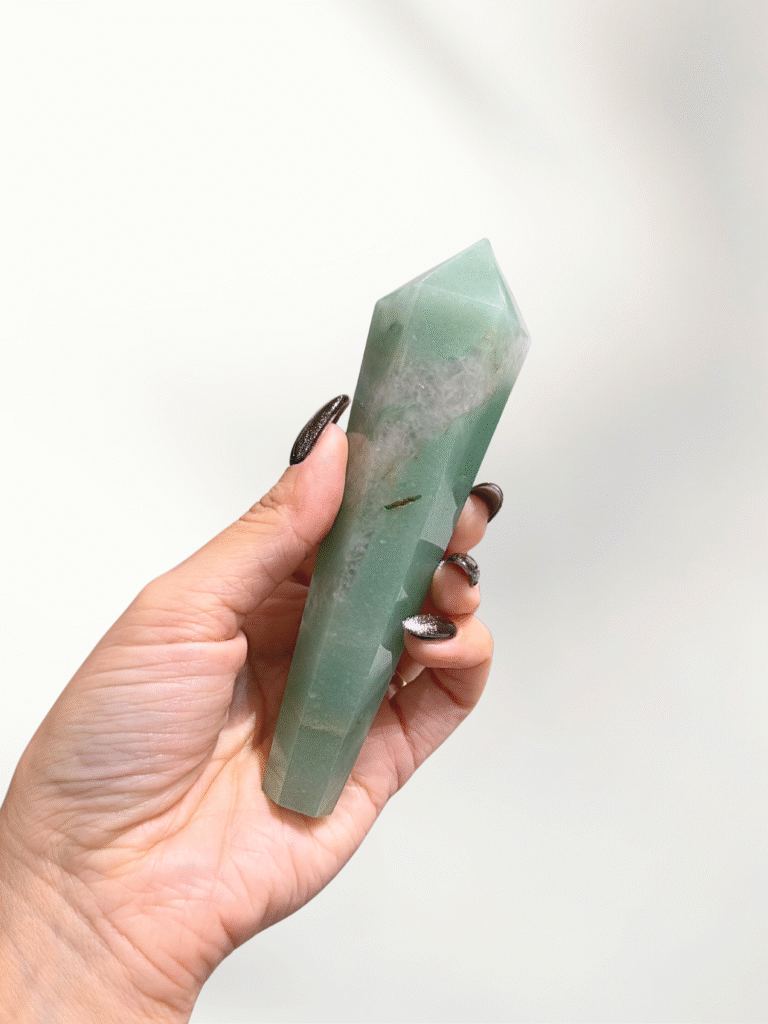
    Green aventurine wand from Mystic Grove

    Green Aventurine

    She comes first because she anchors every other intention in the body. Green Aventurine is the most versatile of all the Taurus stones, sometimes called the Stone of Opportunity. She opens the heart to receive, settles the nervous system, and creates the felt sense of permission that real abundance work asks for. Sit with her at the heart space during your New Moon practice. Notice the slight weight of her on the chest, the cool of her against the skin, the way her presence quietens the part of you that grasps.

    Browse the Aventurine collection

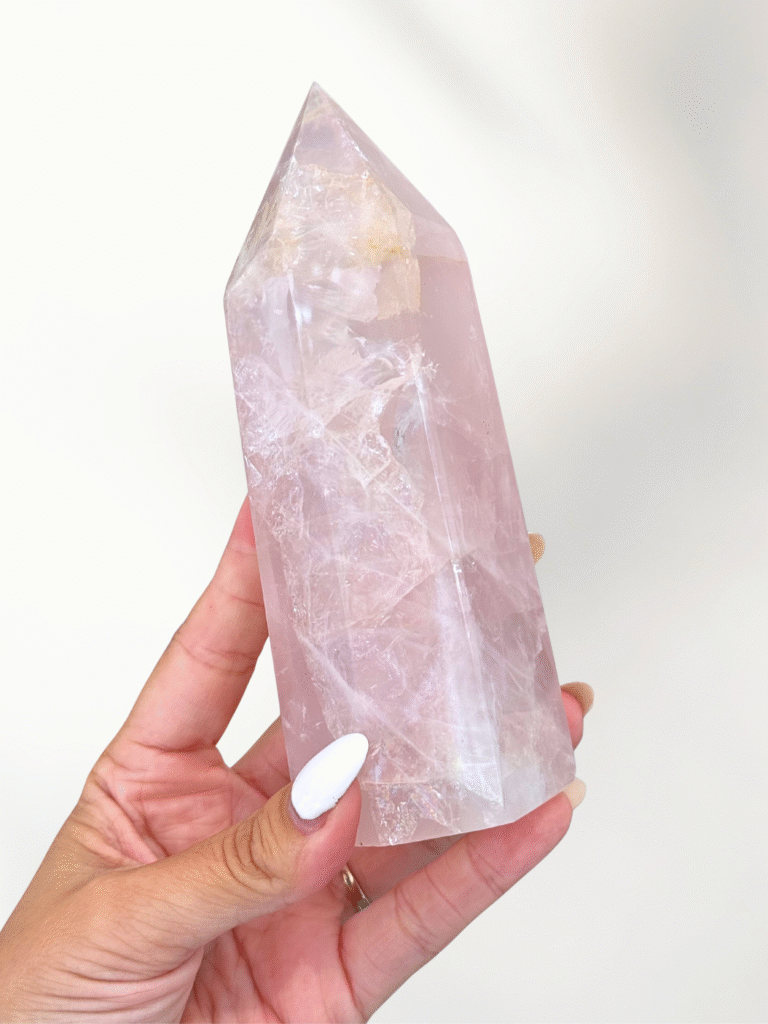
    Rose Quartz tower from Mystic Grove

    Rose Quartz

    Rose Quartz is the classic Venus stone, and on a Taurus Moon her energy is essential. Where Green Aventurine opens the receiving channel, Rose Quartz opens the channel back to the self. She holds the work of self love, self worth, and the soft, steady recognition that you are worth the life you are trying to build. Hold her in the palm of the receiving hand, usually the left, and let her warmth move into the chest.

    Browse the Rose Quartz collection

    Rough Jade tumble stones from Mystic Grove

    Jade

    Jade is the long held symbol of abundance, harmony, and lasting wellbeing, and she belongs at the centre of any Taurus altar. Her soft green energy encourages stability and calm confidence, holding the steady note while the rest of your selection moves around her. Where Green Aventurine handles the receiving channel and Pyrite handles the practical flow, Jade simply holds the field. She is the patient one. Place her at the centre of your grid or wherever the family of your intention sits.

    Browse the Jade collection

    Pyrite sphere from Mystic Grove

    Pyrite

    Pyrite, sometimes called fool’s gold, is the abundance stone with the brightest commercial reputation, and she earns it. She works on the second house Taurus territory of money and material flow, and she has a particular gift for the practical confidence that financial decisions need. Place her where you handle money, the desk, the purse, the place where the bills come in.

    Browse the Pyrite collection

    Tiger's Eye tumble stones from Mystic Grove

    Tiger’s Eye

    Tiger’s Eye carries the practical, follow through side of Taurus that the other stones do not quite cover. She is both grounding and energising at once, working at the solar plexus and the root together, and her job is the daily showing up that turns an intention into something real. If your New Moon work is heavy on dreaming and light on doing, she will rebalance you.

    Browse the Tiger’s Eye collection

    Carnelian tower from Mystic Grove

    Carnelian

    Carnelian deserves a particular mention on this lunation. She wakes the sacral chakra and supports new beginnings, and on a Taurus New Moon her courage element pairs well with the steadier stones. She is the spark Algol asks for, the willingness to meet fear with a grounded, confident step forward.

    Browse the Carnelian collection

    A Simple Practice for Saturday 16 May

    This practice is built for the body rather than the mind. There is no visualisation involved. Read it through once before you begin so you can move slowly through each step without checking the page.

    Choose your crystal or your small selection. If you are working with one stone, choose Green Aventurine. If you are working with more, set them where you can reach them comfortably.

    Find a quiet place, light a candle if you wish, and sit somewhere your body feels supported. The ground, a cushion, a low chair. Taurus does not need the spine soldier straight. She needs the body comfortable.

    Take three long breaths in through the nose, longer out through the mouth. On each out breath, let the weight of your body sink a little more into the surface beneath you. Feel the contact. The press of your sit bones, the weight in your hands, the place where your feet meet the floor.

    Pick up your crystal and bring her to your heart. Hold her there. Notice her weight, her temperature, the small shifts in how she feels against the body as the seconds pass. Stay with the sensation for at least a minute. There is no need to think.

    When you are ready, ask the body, not the mind, what wants to be planted on this Moon. Wait. The answer will arrive as a felt sense, a soft knowing, a phrase that surfaces, sometimes a single word. Trust the first one that lands.

    Speak the intention out loud once. Speak it again. Speak it a third time. Taurus likes three. Then place the crystal where you will see her every day for the rest of the lunar cycle, until the Blue Moon on 31 May.

    Close by thanking the body, the breath, the Moon, and the stone. Blow out the candle. The seed is planted.

    Working With This Lunation Across the Cycle

    A Taurus New Moon plants for the long term, and the immediate days after the New Moon are quiet by design. You may not see movement for two or three weeks. The Sagittarius Blue Moon on 31 May will likely shake some of what you planted, asking you to widen your view and to question the shape of your truth. That is part of the cycle. The intentions that survive Sagittarius will be the ones genuinely rooted in your values, not in inherited expectations.

    Litha, the Summer Solstice, follows on Sunday 21 June, the longest day of the year and the peak of the solar wheel. Whatever Taurus seeded on 16 May will be moving toward its first visible shoot by the Solstice. Watch for it. The body will tell you before the mind does.

    The full cycle closes with the Taurus Full Moon on Sunday 25 October 2026. That is the harvest of what you plant now. Six months of slow, earth paced growth between the seed and the bloom. Trust her timing.

    This lunation is gentle on the surface and serious underneath. Honour the slowness. Trust the body. Plant what truly matters, and let the earth do the rest.

    Bring This New Moon Into Your Home

    Every crystal on this page is in stock at Mystic Grove, chosen with care for her resonance, her quality, and her readiness to work. Whether you are building your first New Moon grid or adding to an established practice, the stones that match this lunation are waiting for you.

    Continue your journey with the Mystic Grove crystal collection.

    Shop the stones in this guide

    Aventurine · Jade · Quartz · Rose Quartz · Spell Candles · Journals and Books of Shadows

  • Blue Crystals: A Grounded Guide to Throat Chakra Stones

    Blue Crystals: A Grounded Guide to Throat Chakra Stones

    Sodalite, blue kyanite, lapis lazuli and how to choose the right blue stone for you

    A friendly guide to the most loved blue crystals in UK practice. What each one is called, what it means, and how to choose the right blue stone for you.

    Blue kyanite freeform, bladed structure with pale to mid blue colouring

    Blue is one of the most searched colours in UK crystal shopping, and it is not hard to see why. Blue stones are calming to look at, gentle to work with, and connected to the throat chakra, the part of the body associated with communication, honesty, and finding your voice. Whether you are buying your first crystal, choosing a gift, or adding to a collection, the blue range has something for almost every reason a person looks for a crystal in the first place.

    This guide covers the eight blue crystals you are most likely to find in a UK shop, including their names, their meanings, and how to choose between them. By the end you will know which stone fits what you are looking for, whether that is calm communication, clearer thinking, deeper meditation, or simply a beautiful piece for the home.

    What Blue Crystals Are Called

    Before going further, it is worth knowing the names you will come across. The blue crystal family is wider than people often realise, and the same stone sometimes goes by more than one name in different shops. The eight stones below are the ones you will find most often in UK crystal shops.

    • Sodalite
    • Blue Kyanite
    • Lapis Lazuli
    • Blue Lace Agate
    • Celestite (sometimes spelled Celestine)
    • Blue Calcite
    • Blue Apatite
    • Blue Onyx

    You may also see aquamarine, blue topaz, sapphire, and angelite in jewellery and gem shops, though these are less common in everyday crystal practice. The eight above are the working crystals, the ones most often used for meaning, healing, and altar work rather than for jewellery alone.

    What Blue Crystals Mean

    In crystal practice, colour carries meaning. Blue is the colour of the throat chakra, the energy centre at the base of the neck. The throat chakra is associated with communication, with self expression, with telling the truth, and with the kind of calm that lets you say what needs to be said. This is why blue crystals are often chosen by people going through a season of life that asks for clearer communication, whether that is a career change, a difficult conversation, or simply a desire to feel more grounded in how you speak to yourself and others.

    Blue stones are also associated with calm and with easing anxiety. Pale blues like blue lace agate and blue calcite carry a soft soothing energy, useful for stress or for a quieter mind. Deep blues like lapis lazuli and sodalite carry a more grounded clarifying energy, useful when you need to think more clearly or find the right words. Every blue stone shares the general family of meaning, but each one has its own particular tone.

    Why Crystals Are Blue in the First Place

    The blue in most crystals comes from tiny amounts of copper and iron sitting inside the stone. These trace elements scatter light in a way that makes the crystal read blue rather than clear or white. The depth of blue varies naturally, and a paler blue is not a lower quality stone, just a different one.

    Some blue stones get their colour in unusual ways. Lapis lazuli is technically a rock rather than a single mineral, made up of three things mixed together: lazurite (the deep blue), white calcite, and golden flecks of pyrite. The combination is what makes lapis instantly recognisable, with her deep blue body and golden sparkle. Sodalite gets her colour from a different source, chloride ions sitting in the mineral structure, which is why her blue reads as a deep navy rather than the royal blue of lapis.

    The Eight Blue Crystals

    The eight crystals below are ordered from the most familiar and accessible to the more unusual. Each one carries a different tone of blue energy.

    Sodalite

    Sodalite is the most accessible blue crystal in UK shopping. Deep navy blue with thin white veins running through her, she is sold widely as tumbled stones, bracelets, wands, and pendulums. She is associated with intuition, with clear thinking, and with finding the right words. A good first blue crystal for anyone who works with words for a living, anyone going through a phase that asks for clearer communication, or anyone simply drawn to the calming depth of dark blue.

    The Sodalite Wand is one of the most popular formats in the UK because the elongated shape feels good in the hand. The Sodalite Pendulum is a beautiful piece for anyone interested in dowsing or simple yes and no divination. The Sodalite Bracelet keeps her near the body through a working day, and the Sodalite Tumblestone is the simplest entry point for anyone meeting her for the first time.

    Sodalite wand, deep navy blue with white veining

    Blue Kyanite

    Blue kyanite looks like no other crystal. She has a flat bladed structure, almost like layers of glass stacked together, with pale to mid blue colouring that catches the light in ribbons. Most blue kyanite is sold as natural freeform pieces, where you can see the blade structure clearly. She is associated with throat chakra opening and with feeling aligned in yourself.

    One quiet detail worth knowing: kyanite is one of the only crystals that does not need cleansing. The structure does not hold onto negative energy, so she can sit alongside your other crystals without needing the usual moonlight or selenite reset. The Blue Kyanite Freeform is the format she comes in most often.

    Lapis Lazuli

    Lapis lazuli is the royal blue of the crystal world. Deep blue with golden flecks of pyrite running through her, lapis has been treasured for over six thousand years. The ancient Egyptians used her in the burial mask of Tutankhamun. Renaissance painters ground her to make ultramarine, the most precious blue pigment in medieval Europe. She is the stone of wisdom and inner truth, and there is something quietly powerful about owning a piece of a tradition that runs so deep.

    If you are buying lapis, look for visible variation in the blue and real golden specks (pyrite is metallic, not painted glitter). Uniform bright blue with no inclusions is often dyed howlite or sodalite sold as lapis. The Lapis Lazuli Tumblestone shows the natural pattern clearly, and the Lapis Lazuli Bracelet is a beautiful way to wear her every day.

    Lapis lazuli tumblestones, deep blue with golden pyrite flecks

    Blue stones are calming to look at, gentle to work with, and connected to the throat chakra. They are stones for clearer thinking and finding your voice.

    Light Blue Crystals

    Within the blue family, the pale stones have a softer feel than the deeper blues. If you are drawn to lighter shades, or if you find the deeper navy blues a bit too intense, these are the three to look at.

    Blue Lace Agate

    Blue lace agate is the gentlest blue crystal. Pale sky blue with delicate white banding running in soft waves through each piece, she is associated with calm communication and with easing anxiety. Where sodalite is sharp and clarifying, blue lace agate is soft and soothing. A lovely choice for anyone whose throat tightens before difficult conversations, anyone going through a stressful period, or anyone simply drawn to the prettiest of the blue stones.

    The Blue Lace Agate Tumbles come in approximately 50g pouches, so you get a small handful of pieces in one purchase, perfect for sharing or for placing around the home.

    Celestite

    Celestite (sometimes spelled Celestine) is pale sky blue, formed in clusters of tiny crystal points that catch the light like frost. She is associated with peace, with meditation, and with a sense of calm that settles into a room when she is present. A favourite among people who meditate regularly, and a beautiful piece for anyone who wants a more delicate blue stone for the bedroom or altar.

    One thing to know: celestite is fragile and sensitive to sunlight. Direct light fades her colour over time, so keep her in a shaded spot rather than a sunny windowsill. The Celestite Cluster is the form she comes in most often.

    Blue Calcite

    Blue calcite is softer than the other blues, often translucent, with a pale watery colour like a piece of frozen sea. She is associated with mental clarity and with recovery from stress, particularly the kind of mental tiredness that comes from too much screen time or too many demands. The Blue Calcite Egg is a lovely piece for a desk or workspace, and the egg shape sits well in the hand.

    The Bolder Blues

    Blue Apatite

    Blue apatite is the brightest of the blue family. Vibrant teal blue, sometimes with hints of green, she is associated with motivation, with focus, and with the kind of energy that helps you finish what you started. Less common in the UK than sodalite or lapis, which makes the sphere a striking piece for anyone collecting the rarer blues. The Blue Apatite Sphere is a real statement piece.

    Blue Onyx

    Blue onyx is deep blue, often reading almost black, with subtle banding through each piece. She is associated with grounding and stability, the rare blue stone that combines throat energy with a more rooted, settled feel. Useful for anyone who wants to feel both clearer in how they speak and more steady in themselves. The Blue Onyx Sphere is a beautiful altar piece, and the Blue Onyx Rune Set is a distinctive divination tool for anyone interested in the old Norse runes.

    Raw Blue Crystals or Polished?

    A question that comes up often when shopping for blue crystals is whether to choose raw natural pieces or polished smooth ones. There is no wrong answer, just a difference in feel.

    Raw crystals are pieces that have not been shaped or polished after being mined. They show the natural form of the stone, often with rough edges and visible texture. Many people prefer raw pieces because they feel more connected to the earth, and they often cost less because they need less work to prepare. The Rough Sodalite is a good example of a raw blue crystal at an accessible price.

    Polished pieces have been shaped and smoothed, sometimes into specific forms like spheres, towers, or palm stones, sometimes simply tumbled smooth. They are more comfortable to hold for long periods, which is why they are popular for carrying or for jewellery. Most of the products linked in this guide are polished, with rough or raw versions available where they exist.

    Start with whichever appeals to your eye. There is no advantage to one over the other in terms of meaning or energy. It is genuinely a matter of preference.

    How to Choose Between Them

    If you are buying a blue crystal for a specific reason, here is a simple shortcut:

    • For calmer communication: sodalite or blue lace agate
    • For meditation or peaceful sleep: celestite or blue calcite
    • For motivation and focus: blue apatite
    • For wisdom and depth: lapis lazuli
    • For feeling aligned and clear: blue kyanite
    • For grounded stability: blue onyx
    • For a beautiful gift: any of the above, depending on the person

    If you are buying without a specific reason, choose the one you keep coming back to in the photos. The right stone tends to be the one you notice. Trust that.

    Three Ways to Work With Blue Crystals at Home

    Blue crystals do not need a complicated practice to be useful. These three approaches are the most common and the easiest to fit into ordinary life.

    Keep One With You

    Slip a small tumble into a pocket or handbag in the morning. Hold it for a few breaths during quiet moments through the day, especially before a difficult conversation or after a stressful one. Many people find that simply knowing the stone is there has a calming effect.

    Place One Near Your Desk

    A blue crystal on the desk or near the screen helps with the kind of mental clutter that builds up during long work days. Blue calcite and blue apatite are particularly suited to this, but any of the blue stones will do the work. Notice the shift in how the space feels after a week.

    Use One in a Calm Corner

    Build a small calm corner with a blue crystal, a candle, and something living like a small plant or a flower. Place it somewhere you pass naturally, the windowsill above the kitchen sink, the corner of a desk, the top of a chest of drawers. The point is not to do anything elaborate, just to have a small spot in the home that quietly belongs to peace.

    Pairing Blue Crystals With Other Colours

    Blue crystals look and feel beautiful alongside other colours, and a few combinations work particularly well together.

    Blue with white is the cleanest pairing. Sodalite with selenite, or blue kyanite with clear quartz, gives you the calm of blue with the brightness of white. The white stones cleanse and amplify whatever sits beside them.

    Blue with pink is the bridge from throat to heart. Blue lace agate with rose quartz supports emotional honesty, particularly when you want to say something kind but truthful. Read more in our guide to pink crystals.

    Blue with gold or yellow is a powerful combination. Lapis lazuli already does this within a single stone, with her natural golden pyrite balancing the deep blue. For a more visible version, pair sodalite with citrine.

    Looking After Your Blue Crystals

    Most blue crystals are easy to look after. Sodalite, blue lace agate, blue calcite, blue apatite, and blue onyx can all be rinsed briefly under running water and patted dry. Lapis lazuli and blue kyanite are better cleaned with a dry cloth, because the iron in lapis can oxidise in water and the layered structure of kyanite can absorb moisture. Celestite should never go in water, and she should be kept out of direct sunlight to protect her colour.

    For energetic clearing, place your blue crystals on a selenite plate overnight, or leave them on a windowsill in the moonlight. Both methods are gentle and effective. Blue kyanite is the exception, as mentioned above, and does not need clearing at all.

    Every blue crystal at Mystic Grove is hand selected before she leaves the bench, dispatched in protective packaging from Mystic Grove HQ.

    Explore the complete crystal collection for everything you need to deepen your blue crystal practice.

    Continue Your Journey: Read about heart energy stones in our guide to pink crystals, or explore seasonal ritual in How to Build a Beltane Altar 2026.

  • Pink Crystals: A Grounded Guide to Heart Energy Stones

    Pink Crystals: A Grounded Guide to Heart Energy Stones

    Rose quartz, pink amethyst, rhodonite and how to work with them gently

    A practical guide to the most loved pink crystals in UK practice. What each one is, how to choose between them, and how to bring them gently into a working life.

    Polished pink rose quartz sphere on bone background, hand selected for heart chakra work

    Pink is the colour of the heart. In crystal practice, pink stones have long carried associations with the heart chakra, with self love, with relationships and emotional softening. The connection is not arbitrary. Pink in crystal form usually comes from trace minerals layered into a clear or white base, which gives these stones their soft luminous quality. Working with pink crystals tends to feel gentle rather than activating, supportive rather than challenging. They are stones for quiet days and tender ones.

    This guide walks through the most accessible pink crystals to start with, what each one is associated with, how to choose between them, and three simple practices for bringing them into daily life. Whether you are buying your first crystal or extending an existing collection, the pink range has something to offer at any level of practice.

    The Science of Pink

    The pink in most crystals comes from trace mineral inclusions. In rose quartz, microscopic fibres of titanium and traces of manganese sit inside an otherwise clear quartz body, scattering light in a way that reads as soft pink to the eye. Pink amethyst takes its colour from manganese sitting inside the same quartz family, but in a crystalline geode form rather than a solid body. Rhodonite carries manganese silicate at its core, which gives it the depth of pink and the characteristic black veining at the same time.

    The depth of pink varies naturally and is not a marker of quality. A pale rose quartz is not lesser, only different. What matters more is even colour through the piece, and clarity that reads warm rather than chalky. If you see fractures or cloudy patches inside a polished piece, those are part of the natural form. Avoid pieces that look uniformly bright pink with no variation at all, as those have sometimes been dyed.

    Most of the pink crystals on the world market come from Brazil, Madagascar, Namibia, and parts of South Africa. Pink amethyst comes almost exclusively from Patagonia, in southern Argentina, where the geological conditions for its formation are unusually concentrated. Rhodonite turns up in Brazil, Russia, and Australia. The named provenance matters because it tells you something about the history of the stone in your hand.

    The Crystals

    The five pink crystals below are the ones most worth knowing. They are ordered by accessibility, working from the most familiar to the more niche. Each carries a different tone of pink energy, and the right one for any given person depends on what they are reaching for.

    Rose Quartz

    Rose quartz is the crystal most people meet first. It turns up in gift shops and on bathroom shelves, on bedside tables and in jewellery boxes. It is associated with the heart chakra, with self love, with emotional softening, and with softening the field after grief or rupture. The poetic phrase that has followed it for years is “the stone of unconditional love”, and like most poetic phrases it is partly accurate and partly marketing.

    What is observably true is that rose quartz carries a gentle field. People who do not feel much from harder stones often report a soft warmth from it, the kind that does not announce itself but tends to be missed when it is not in the room. She is not activating like carnelian, not protective like black tourmaline, not amplifying like clear quartz. She is, more than anything, present.

    Rose quartz forms in solid bodies rather than crystalline points, which is why she is most often sold as polished pieces. The Rose Quartz Tower is the statement piece for an altar or a bedside table. The Rose Quartz Sphere radiates evenly in all directions and is a good place to start for anyone building a heart altar. The Rose Quartz Bracelet keeps her energy near the body through a working day. The Rose Quartz Palm Stone is the right shape for quiet practice, for holding during difficult conversations, or for slipping into a coat pocket on a hard morning.

    Hand selected pink rose quartz tower, soft pink colour with even clarity

    The energy she carries is gentle rather than activating. She is a quiet stone for quiet days, and a steady one for harder ones.

    Pink Amethyst

    Pink amethyst is rarer than rose quartz and reads as a different kind of stone. Where rose quartz forms in solid bodies, pink amethyst forms in crystalline geodes and clusters, with each tiny crystal point catching the light separately. The effect is brighter and more sparkling, and the energy follows the form. Pink amethyst is associated with emotional clarity rather than emotional comfort, and with the kind of heart work that asks you to look honestly rather than be soothed.

    She comes almost exclusively from Patagonia and is a step up in price from rose quartz at equivalent size. For the practitioner ready to invest in a hero piece, the Pink Amethyst Sphere is a striking altar stone. For something more dramatic, the Pink Amethyst Slab on Stand shows the crystalline structure in cross section, and the Pink Amethyst Bowl doubles as a charging station for smaller crystals.

    Rhodonite

    Rhodonite is the pink stone for harder seasons. She is deeper in colour than rose quartz, with characteristic black veining of manganese running through her, and she carries a different tone of heart energy. Where rose quartz is associated with self love and gentleness, rhodonite is associated with emotional resilience, with rebuilding after rupture, and with the quiet work of recovery. She is the stone people reach for when they have moved past the soft early grief and into the slower work of putting things back together.

    The Rhodonite Bracelet is the simplest way to keep her near the body, and the Rhodonite Tumblestone is small enough to carry in a pocket through a difficult week.

    Rhodonite tumblestones, deep pink with characteristic black manganese veining

    Pink Calcite

    Pink calcite is softer than rose quartz, more translucent, and less common in the UK market. She is associated with gentleness and emotional openness, with the kind of slow tenderness that allows feelings to surface without forcing them. Calcite as a mineral family carries an undertone of clearing, and pink calcite brings that clearing to the heart space rather than the mind. The Pink Calcite Slab is a quietly distinctive piece for an altar, and a useful counterpoint to rose quartz in a wider heart practice.

    Strawberry Quartz

    Strawberry quartz is the most playful of the pink range. She is clear or pale pink quartz with red iron oxide inclusions that look like seeds in a strawberry, and she carries a lighter tone than the other pink stones. She is associated with joy, with lightness, and with the recovery of pleasure after a long stretch of seriousness. A softer entry point for anyone whose heart work has been heavy lately. The Strawberry Quartz Tumblestone is the format she comes in most often, and a good gift for anyone in need of a lighter touch.

    How to Choose Between Them

    The honest answer is by feel, and the practical answer is by what you are reaching for. Both matter.

    For self love, gentleness, and the soft work of self acceptance, start with rose quartz. She is the most accessible of the pink stones and asks the least of the practitioner. For emotional clarity, for honest looking at relationships, or for a step up in altar work, pink amethyst is worth the investment. For resilience, recovery, and the slower seasons of rebuilding, rhodonite holds up where rose quartz can feel too soft. For tenderness without sweetness, pink calcite is the choice. For joy and lightness, strawberry quartz.

    By form, the question is what you are going to do with the stone. A small tumble or a polished palm stone is the right shape if you want to carry her with you, slip her into a pocket, or hold her for a few quiet minutes at the end of the day. A sphere or a tower belongs on an altar or a bedside table where she anchors a space rather than travels through it. A bracelet keeps her at the wrist through a working day. A slab or a bowl is for the practitioner already running an established practice and ready for a hero piece.

    By feel, the rule is to notice which piece pulls. If you are shopping in person, hold two or three options and see which one settles in the hand. If you are shopping online, the photographs and the descriptions usually do enough of the work, and the right one tends to be the one you keep returning to. There is no special skill needed. The body knows.

    Three Ways to Work With Them at Home

    Pink crystals do not need a complicated practice to be useful. The three approaches below are the ones that come up most often, and they cover most of what people are looking for when they bring a heart stone home.

    Carrying

    Slip a tumble or a palm stone into a pocket in the morning. That is the entire practice. Hold the stone for a few breaths during quiet moments through the day, particularly before a difficult conversation or after a hard one. The point is not to do anything with her. The point is to have her there. Many people find the simple awareness of a stone in the pocket settles the body more than they expect. Rose quartz works well for this. So does the smaller rhodonite tumble for harder weeks.

    Sleep Work

    Place a piece on the bedside table or beneath the pillow before sleep. Pink crystals are associated with calm rest and softer dreams, and this practice is one of the gentlest ways to test how the field affects you. Notice how mornings feel after a week of having her there. The shift, when it comes, is usually subtle and almost always supportive rather than disruptive.

    Altar Work

    Build a simple heart altar with one pink piece, one white piece for cleansing such as selenite or clear quartz, and a candle. Place the altar somewhere you pass naturally, the windowsill above the kitchen sink, the corner of a desk, the top of a chest of drawers. Light the candle for a few minutes when you arrive home or before bed. The practice is not religious. It is the small ritual of marking the heart as something worth honouring in your own house.

    Pairings With Other Colours

    Pink crystals work alongside almost every other colour, and a few combinations are worth knowing.

    Pink with white is the foundational pairing. Selenite cleanses and amplifies whatever sits beside her, and clear quartz extends the energy of the stone she is paired with. The classic gentle altar setup is rose quartz alongside selenite, which keeps the heart stone clear without any extra work from the practitioner.

    Pink with green is the full heart chakra pairing. Aventurine, malachite, and prehnite all sit naturally alongside rose quartz in heart work. Pink and green together is one of the oldest pairings in crystal practice and the colours balance each other on the visible spectrum as well as the energetic one.

    Pink with blue is the heart to throat bridge. Rose quartz and blue lace agate together support the practice of emotional honesty, particularly the work of saying out loud what the heart already knows. Useful when a difficult conversation is coming and you want to be steady rather than reactive.

    How to Look After Pink Crystals

    Most pink crystals are safe to clean briefly with running water, and a gentle wash followed by a pat dry is enough for most polished pieces. Rose quartz, rhodonite, pink amethyst, and pink calcite all hold up to brief contact with water. Avoid soaking any of them for long periods, and avoid prolonged sunlight, which can fade the pink in some pieces over time.

    For energetic clearing, a night on a selenite plate or in moonlight is the most reliable method. Selenite does not require recharging herself and can sit alongside other crystals indefinitely. Moonlight on a windowsill works for any of the pink stones and pairs particularly well with the lunar half of crystal practice.

    The Mystic Grove range includes the Ancient Witch Love Bath Potion with Rose Quartz Amulet for anyone wanting to fold rose quartz into a bath ritual, and the Twisted Silver Healing Wand for altar work that asks for a directional tool.

    Every pink crystal at Mystic Grove is hand selected before she leaves the bench, dispatched in protective packaging from Mystic Grove HQ.

    Explore the complete crystal collection for everything you need to deepen your heart practice.

    Continue Your Journey: Read more about working with stones in our guide Best Crystals for Beltane 2026, or learn how to set up a sacred space in How to Build a Beltane Altar 2026.

  • Aries New Moon April 2026

    Aries New Moon April 2026

    The Aries New Moon of April 2026, with carnelian, bloodstone and a ritual for bold new intentions

    As the wheel of the year turns and we step further into the spring season the sky prepares to offer us a magnificent energetic reset. The Aries New Moon arrives on Friday 17 April 2026 at approximately 12 51 BST. As the very first new moon of the astrological calendar this specific lunation carries an extraordinary weight and power. It is a moment that demands our attention calling for new beginnings bold action manifestation and a fierce sense of independence. For those of us who observe the changing phases of the moon and practise mindful intention setting this is not a time for quiet reflection. It is a time to stand up and claim exactly what we desire from the year ahead. The shift from the deep watery dreaming of Pisces into the active spark of Aries is profound. We are moving out of the realm of imagination and firmly into the realm of physical action.

    The Meaning of the Sky: Mars and Moon Magic

    Aries is the absolute pioneer of the zodiac. It is a fire sign ruled by the planet Mars bringing strong themes of leadership courage and intense energetic fire. When the moon goes dark in this constellation the atmosphere becomes highly charged and electric. Aries energy does not whisper and it certainly does not wait for permission. It acts quickly and it trusts its own instincts implicitly. If you have been hesitating over a project a relationship or a personal goal this lunation provides the exact spark required to push past your fear and initiate movement.

    In our study of moon magic we look closely at the dynamic interplay between the current sky and our own paths. The dark of the moon is the traditional time for planting seeds but these are not delicate flowers we are sowing today. We are planting the seeds of our most ambitious and courageous desires. The intensity of this cosmic fire can sometimes feel overwhelming especially if your personal energy is currently depleted or stressed. To navigate this we look at our crystal work and ritual space as a vital complementary practice. By focusing heavily on energy balancing and active stress reduction we ensure that our physical form remains deeply grounded while our spirit reaches for new heights. We use these tools to cultivate a harmonious internal environment allowing our natural vitality to thrive safely amidst the cosmic storm.

    The Crystal Toolkit for April 2026

    To work successfully with this fiery new moon you must choose crystals that can match its intensity while keeping you firmly grounded. We recommend focusing on stones that resonate strongly with the lower energy centres to ensure your physical body is fully supported as you reach for your goals.

    Carnelian: The Crystal of the Year
    There is no stone more perfectly aligned with this lunation than Carnelian. As our undisputed Crystal of the Year for 2026 Carnelian takes centre stage during this Aries season. Carnelian carries the fiery frequency of Mars making it an exceptional tool for boosting courage taking bold action and awakening deep creative passion. When you hold a piece of raw or tumbled Carnelian it is like holding a living spark of fire in your palm. It refuses to let you play small. If your intention involves stepping into a leadership role or starting a completely new chapter Carnelian is your essential companion. Explore our full Carnelian collection or keep the energy close to your pulse points throughout the day with a Carnelian bracelet.

    Bloodstone: The Anchor for Action
    While Carnelian provides the initial burst of inspiration Bloodstone provides the necessary endurance to see your plans through to the end. Bloodstone is the stone of grounded action physical courage and the reminder that your dreams deserve consistent effort. The Aries fire can burn out quickly if it is not properly anchored. Bloodstone ensures that your physical vitality remains strong and your focus remains sharp as you take your first steps forward. You might choose to carry a Bloodstone tumblestone in your pocket or place a standing Bloodstone tower on your desk to anchor your workspace beautifully.

    Red Jasper: The Steady Flame
    If your new moon intention is something that will take months or even years to fully materialise you will need the energy of Red Jasper. This beautiful stone offers a steady earthy and persistent fire energy. It does not rush but instead provides a slow burning stamina that is absolutely vital for extended projects. Red Jasper is incredibly grounding pulling excess mental energy down into the earth and helping you remain patient. A Red Jasper tumblestone is the perfect companion for long term manifestation.

    The Aries Spark Ritual

    The dark of the moon is the perfect moment to actively set your intentions. Begin by preparing your sacred space or altar. Intention setting is a deeply personal practice that helps focus the mind and balance the spirit. While some practitioners enjoy building complex geometric crystal grids for their intentions the direct and singular nature of Aries energy often responds best to a highly focused approach. If you do practise gridding keep your layout simple placing your primary stone in the centre to act as a singular beacon of light.

    Intention Setting Steps
    1. Light a candle from our Ritual Candles collection on your altar to represent the element of fire.
    2. Take a fresh page from your ritual journal and a pen. Spend a few moments breathing deeply to centre your energy and reduce any immediate stress.
    3. Write one bold intention on paper in your own hand. Do not write what you think is sensible or safe. Write down what you actually want because Aries is not interested in hesitation.
    4. Take your chosen crystal companion Carnelian Bloodstone or Red Jasper and hold it firmly in your receiving hand. Read your written intention aloud without apology. Feel the resonance of your voice vibrating through the crystal in your palm.
    5. Let the candle burn for at least twenty minutes before extinguishing it safely. Keep your journal and crystal together on your altar.

    The Magical Moon: Rising Sign House Focus

    Read for your Rising Sign to see which sector of your life is being hit by the cosmic lightning of this new moon. Understanding where this energy lands in your chart helps you direct your focus effectively.

    Aries Rising

    First House: Personal Identity and Appearance

    This is your personal new year. With the new moon in your own sign you are undergoing a total identity shift. The first house is how the world sees you. You may feel an urgent need to completely change your image or step into a much more visible role. Step into your power as a true visionary and embrace the fresh start.

    Taurus Rising

    Twelfth House: Spirituality and Subconscious Endings

    This is a quiet but profound reset. The twelfth house is the realm of the hidden the subconscious and spiritual retreat. The Aries fire here is burning away old hidden fears and patterns of holding yourself back. Release the need to control everything behind the scenes to prepare for your birthday season next month.

    Gemini Rising

    Eleventh House: Community and Future Dreams

    This lunation is electrifying your social circles. The eleventh house governs the pack you run with and your highest aspirations. You may find a sudden burst of energy to lead a group project or you might distance yourself from friends who no longer align with your future vision. It is time to find your true tribe.

    Cancer Rising

    Tenth House: Career and Public Reputation

    Your professional world is under the spotlight of the Aries fire. The tenth house represents your legacy and how the world sees you. A sudden burst of ambition regarding your work life or a desire to take the lead on a major project is highly likely. This new moon gives you the courage to pursue a promotion or launch a business.

    Leo Rising

    Ninth House: Higher Learning and Expansion

    Your mind is ready to soar. The ninth house is all about your belief systems travel and wisdom. You may receive a sudden impulse to travel somewhere entirely new or embark on a passionate study of a fresh subject. Embrace a more adventurous pioneering worldview and let your curiosity lead the way.

    Virgo Rising

    Eighth House: Transformation and Shared Resources

    This is a deep fiery reset. The eighth house governs intimacy shared finances and cycles of transformation. You are being asked to boldly sever old energetic cords or take decisive action regarding joint finances. It is a highly powerful time for claiming independence within your closest partnerships.

    Libra Rising

    Seventh House: Partnerships and Connections

    The Aries New Moon is shining directly into your relationships. This house governs marriage business partners and close connections. The fiery energy asks you to assert your needs much more clearly and stop compromising your own goals for the sake of peace. Speak your truth directly and unapologetically.

    Scorpio Rising

    Sixth House: Wellbeing and Daily Routines

    It is time for a dynamic overhaul of your daily life. The sixth house is the realm of habits service and physical health. This lunation provides a powerful surge of motivation to implement a radical new health or fitness regime. Channel this energy to work smarter and more actively to protect your physical form.

    Sagittarius Rising

    Fifth House: Creativity Joy and Romance

    Your heart is being ignited. The fifth house is the sector of play creative expression and joy. If you have been feeling creative blocks this new moon acts like a match to dry wood. Follow your passions fiercely start a new creative project or inject some fire into your romantic life.

    Capricorn Rising

    Fourth House: Home Family and Roots

    The Aries spark is happening at the base of your chart. The fourth house represents your home life and sense of security. You may feel a sudden urge to physically renovate your space move location or assert your independence within a family dynamic. Create a space that truly reflects your independent spirit.

    Aquarius Rising

    Third House: Communication and Intellect

    Your voice is receiving a fiery upgrade. The third house governs how you speak write and interact with your local community. This lunation will trigger a strong desire to speak your mind directly and honestly. Share your ideas boldly and do not hold back your authentic opinions.

    Pisces Rising

    Second House: Personal Value and Finances

    You are taking charge of your resources. The second house is the realm of money possessions and personal value. This new moon challenges you to boldly pursue a new income stream or take decisive action to secure your financial independence. Trust your ability to generate true abundance.


    Looking Ahead: Beltane and Beyond

    The magic of this cosmic window does not end with the new moon. Just a few days later the Lyrid Meteor Shower reaches its peak on 22 April. Observed for over two thousand years this is one of the oldest celestial events in recorded human history. Up to eighteen shooting stars per hour will cross the April sky providing a perfect moment to make a wish. This shower brings profound amplification cosmic wishes and ancient celestial fire.

    As we harness the pioneering energy of the Aries New Moon we must also cast our eyes toward the horizon. The astrological calendar is building toward a truly extraordinary crescendo. On 1 May we will celebrate the ancient fire festival of Beltane. This year Beltane arrives on the exact same night as the Full Flower Moon. This alignment of a traditional Celtic fire festival with the peak power of a full moon is a genuine rarity. The energy that is building is expansive passionate and fiercely creative bringing themes of fertility abundance and love. The seeds of intention you plant in the dark Aries sky today will be ready to burst into full bloom under the Beltane fires. Take a deep breath trust your inner fire and step boldly into this new cycle. The sky is ready for you to begin.

  • Solar Return Crystal Grids

    Solar Return Crystal Grids

    How to build a solar return crystal grid for your birthday and set intentions for the year ahead

    Each year we celebrate the day of our birth with joy and reflection. In the secular world it is a marker of getting older. But in the realm of astrology your birthday represents something far more profound. It marks your Solar Return the exact moment the sun returns to the precise mathematical degree it occupied in the sky the moment you took your first breath. It is your true cosmic new year.

    Your solar return is the moment each year when the Sun returns to the exact place it held when you were born, close to your birthday. Many people treat it as a personal new year. By building a solar return crystal grid you can let go of the past twelve months and set your intentions for the year ahead.

    Understanding Your Solar Return Energy

    The sun is the centre of our solar system and the centre of your astrological chart. It represents your vitality your ego your life purpose and the radiant core of who you are. When the sun returns to its home position your personal energetic battery is fully recharged. The cosmic weather is entirely focused on you.

    Many people intuitively feel this shift. In the weeks leading up to your birthday you might feel slightly drained or introspective. This is the natural winding down of your previous solar cycle. Then as your actual birthday arrives you often experience a surge of fresh inspiration. This is the Solar Return taking effect.

    A Solar Return crystal grid captures this surge of vitality. Instead of letting this powerful energy simply wash over you your grid acts as a clear focused lens. It takes the brilliant light of the sun and directs it exactly where you want to grow in your coming year.

    Designing Your Birthday Grid

    Building a grid for your Solar Return requires a blend of celebration and deep intention. The geometry you choose should reflect radiant outward expansion. A starburst pattern or the Flower of Life template works beautifully for this purpose. These shapes naturally draw energy into the centre and project it outward into your environment and your future.

    Your central stone must be a strong generator ideally one that corresponds to solar energy or your specific zodiac sign. Surrounding this centre you will place stones that represent your goals for the year ahead. Do you want to focus on career growth deep healing or attracting new friendships? Your outer stones will dictate the specific flavour of your year.

    It is best to set this grid up on the eve of your birthday or on the morning of the day itself. Leave it active in your space for at least a full lunar cycle to ensure the energy of your new year is firmly anchored into your daily reality.

    In Theory The Year Ahead Blueprint

    Imagine you are turning thirty and you want this next year to be defined by confident career growth and deep personal joy. In theory you would clear a special place on your altar on the eve of your birthday. You choose a vibrant Sunstone sphere for your centre to capture the radiant power of your Solar Return.

    Around the Sunstone you place pieces of Green Aventurine to invite career opportunities and Rose Quartz to ensure you cultivate joy and self love along the way. You wire the grid with Clear Quartz points facing outward sending your intentions into the next twelve months. When you wake up on your birthday your space is already humming with a clear empowering frequency. You have not just wished for a good year you have actively built the energetic blueprint for it.

    Essential Crystals For Solar Returns

    The stones you choose for your birthday grid should feel uplifting empowering and deeply personal. Here are the finest crystals to incorporate into your annual celebration.

    Sunstone: The ultimate stone for any solar event. It carries the bright warming energy of the sun promoting independence originality and a joyful disposition. It is the perfect central anchor for your birthday grid.

    Citrine: A powerful stone of manifestation and personal will. Citrine does not hold negative energy making it a beautiful clean slate for a new year. It attracts success abundance and a bright optimistic outlook.

    Clear Quartz: The master healer and amplifier. Clear Quartz is essential for wiring your grid and ensuring your birthday intentions are broadcast with absolute clarity into the universe.

    Your Zodiac Birthstone: Incorporating a stone specific to your sun sign adds a deeply personal signature to the grid. Whether it is Amethyst for an Aquarius or Carnelian for an Aries your birthstone roots the cosmic energy firmly into your personal identity.

    Tiger Eye: A wonderful stone for practical action and staying grounded while reaching for the stars. It ensures that the exciting ideas you have on your birthday translate into real tangible results throughout the year.

    Your Solar Return Toolkit

    Prepare your sacred space before your birthday arrives to ensure you can capture the peak energy of your cosmic new year.

    • The Solar Anchor: A prominent piece of Sunstone or Citrine to sit at the heart of your grid and capture the renewing energy of the sun.
    • The Intention Stones: Four to six stones chosen specifically for what you wish to manifest this year such as Green Aventurine for wealth or Rose Quartz for harmony.
    • The Personal Signature: A piece of your zodiac birthstone to align the grid entirely with your unique energetic frequency.
    • The Expansion Wires: Raw Clear Quartz points facing outward to project your birthday wishes boldly into the months ahead.

    Find the perfect stones to celebrate your cosmic new year in our Mystic Grove Crystal Category.

    A solar return grid turns your birthday into a quiet act of intention, so you step into your new year with clarity and confidence. For steady ground through the rest of the year, see our guide to surviving and thriving during retrogrades.

  • Mercury Retrograde

    Mercury Retrograde

    What Mercury retrograde really means, and the crystals and grids that keep communication clear and steady

    In the modern astrological landscape few cosmic events cause as much anxiety as Mercury Retrograde. We often hear warnings to brace ourselves for delayed trains crashed computers and intense arguments. It is easy to feel entirely at the mercy of the shifting skies. However as a practitioner of Crystal Grid Alchemy you do not need to fear this transit. You hold the tools to navigate any cosmic storm with absolute grace and profound grounding.

    When a planet appears to move backwards, it can feel as though its energy has reversed. Mercury retrograde is the best known example. By building a simple grid for the retrograde, you create a calm space that helps you review, slow down and communicate clearly, turning a period people dread into a useful pause.

    Understanding The Retrograde Illusion

    To master the energy of a retrograde we must first understand the science behind it. Mercury does not actually stop in its orbit and travel backward. It is simply an optical illusion caused by the relative speeds of Earth and Mercury as they travel around the Sun. Imagine driving on a motorway and passing a slower car. For a brief moment as you pull ahead the slower car appears to be moving backward relative to your position. This is precisely what happens in the cosmos.

    However in astrology optical illusions still create powerful energetic weather. Mercury is the ruling planet of intellect technology travel and communication. When it enters this apparent backward motion the energetic currents related to these areas become tangled and chaotic. Information gets lost emails go to the wrong folder and simple conversations can quickly escalate into misunderstandings. The external world loses its usual crisp efficiency.

    This is not the universe punishing you. It is the cosmos asking you to slow down. Mercury retrograde is a built in quarterly pause button. It is a period designed for reflection rather than initiation.

    The Magic Of The Prefix Re

    The secret to thriving during this transit is to focus all your energy on words that begin with the prefix re. This is the time to review reassess reconnect revise and repair. If you try to force new projects or sign major contracts during this time you are swimming against a very strong current. But if you use this energy to revisit old ideas finish abandoned projects or reconnect with old friends the universe will support you beautifully.

    Your crystal alchemy must reflect this inward turning energy. During a retrograde you are not gridding for rapid expansion or bold new beginnings. You are gridding for stability patience and clear boundaries. You are building an energetic shield that keeps the chaotic static of the outside world from disrupting your inner peace.

    Designing Your Retrograde Grid

    When constructing your grid the sacred geometry you choose is just as important as the stones. For a retrograde period you want to avoid shapes that promote rapid outward growth like spirals or complex starbursts. Instead you want geometry that promotes containment grounding and steady structure.

    A simple square is one of the most effective templates you can use. The square represents the element of earth offering four solid corners of undeniable stability. It anchors chaotic mental energy into the physical realm. Alternatively a series of concentric circles works beautifully to create layers of energetic protection around your intention keeping your mind insulated from external drama.

    Place this grid somewhere you will see it daily perhaps on your desk where you work or near the entryway of your home. The visual reminder of your stable circuit will help calm your nervous system every time you look at it.

    In Theory The Communication Protection Circuit

    Imagine you are navigating a very stressful week at work right in the middle of a Mercury retrograde. Emails are misfiring and your colleagues are uncharacteristically short tempered. Instead of absorbing this frustration you build a Communication Protection Circuit on your desk.

    You use a square template for maximum stability. In the centre you place a piece of Fluorite to act as your anchor of mental clarity. At the four corners of the square you place pieces of Black Tourmaline to absorb any misdirected anger from your environment. You wire the grid using Blue Lace Agate to ensure that any words you speak or write are filtered through a frequency of calm gentle truth. By doing this you establish a personal forcefield. The chaotic cosmic weather continues to swirl around your office but within your personal grid you remain clear focused and entirely unbothered.

    Essential Crystals For Mercury Retrograde

    The stones you select for this period must perform two specific jobs they must ground your physical body and they must clarify your mental space. You need crystals that act as spiritual anchors and mental filters.

    Fluorite: Known as the genius stone Fluorite is unmatched in its ability to clear mental fog. It organises chaotic thoughts and helps you process complex information. When Mercury scrambles the signals Fluorite acts like a high definition antenna keeping your mind sharp and your decision making clear.

    Black Tourmaline: This is your ultimate energetic bodyguard. During a retrograde people often project their frustrations onto others. Black Tourmaline absorbs this negative static preventing you from taking on the stress of the people around you. It keeps your aura completely clear and deeply grounded.

    Blue Lace Agate: The most comforting stone for the throat chakra. When words feel difficult to find or when you fear you might say the wrong thing Blue Lace Agate provides a soothing cooling energy. It ensures your communication remains gentle articulate and easily understood.

    Amazonite: Often called the stone of truth Amazonite allows you to express your boundaries without anger. If a retrograde brings an old conflict back to the surface Amazonite helps you navigate the conversation with profound grace ensuring both parties feel heard and respected.

    Hematite: A heavy iron rich stone that pulls your awareness entirely out of your anxious mind and down into your physical body. Hematite is the perfect stone to hold when travel plans are delayed or technology fails reminding you to breathe and stay present.

    Your Retrograde Survival Toolkit

    Prepare your sacred space before the transit begins. Having these specific stones ready will ensure you can build your protective circuit the moment the cosmic weather shifts.

    • The Clarity Anchor: A central piece of Fluorite to sit in the middle of your grid and organise your thought processes.
    • The Grounding Perimeter: Four pieces of Black Tourmaline or Hematite to place at the corners of your grid keeping chaotic energy at bay.
    • The Communication Wires: Small pieces of Blue Lace Agate or Amazonite to connect your grid ensuring all incoming and outgoing messages are completely clear.
    • The Amplifier Points: Raw Clear Quartz points facing inward toward your central stone to continuously feed your grid with focused stable energy.

    Find your essential stones for navigating cosmic shifts in our Mystic Grove Crystal Category.

    Mercury retrograde is not a curse but a natural pause, and with a grid in place you can use it to review and rest. For the most personal moment of the astrological year, see our guide to solar return crystal grids for your birthday.

    Shop the stones in this guide

    Fluorite · Agate · Tourmaline · Hematite · Crystal Towers and Points · Tumble Stones

  • Planetary Rulers and Crystal Grid Circuits

    Planetary Rulers and Crystal Grid Circuits

    The planets that rule each zodiac sign, and how to build crystal grid circuits around them

    Each zodiac sign has a ruling planet, and many crystal practitioners match their grids to those rulers, choosing the right day, the right stone and the right intention. This guide explains how the planetary rulers work and how to build a grid around them.

    In astrological tradition every zodiac sign every hour and every day of the week is governed by a specific planetary ruler. These planets act as giant cosmic transmitters constantly broadcasting unique energetic frequencies into our world. By understanding these frequencies and consciously aligning our crystal grids with them we transform a simple intention setting practice into a highly tuned energetic circuit.

    Understanding the Planetary Transmitters

    Think of your crystal grid as a radio receiver. The stones you choose the sacred geometry you lay down and your personal intention all work together to tune that receiver to a specific station. If you want to attract abundance you tune into the frequency of growth. If you want to protect your home you tune into the frequency of boundaries.

    The ruling planets represent the original cosmic frequencies. When you deliberately invite a planetary ruler into your grid you are plugging your personal alchemy directly into the main power source of the solar system. You are no longer generating all the energy yourself you are elegantly directing the currents that already exist above you.

    To do this effectively you need to know the core properties of the traditional inner planets and the stones that act as their perfect conductors on earth.

    The Sun for Vitality and Success: The centre of our solar system represents the conscious self radiant vitality and visible success. When you need a breakthrough or a surge of confidence grid with Sunstone Clear Quartz and Citrine. Sunday is the best day to activate a solar grid.

    The Moon for Intuition and Flow: The ruler of our emotional waters the moon governs intuition the subconscious and gentle healing. When you need emotional balance or spiritual connection grid with Selenite Moonstone and Labradorite. Monday is the ideal day for lunar grids.

    Mercury for Communication and Clarity: The swift messenger planet rules intellect technology travel and how we speak our truth. When you need to resolve a misunderstanding or focus your mind grid with Blue Lace Agate Sodalite and Fluorite. Wednesday is governed by Mercury.

    Venus for Harmony and Love: The radiant planet of beauty governs romance self worth luxury and harmonious relationships. When you want to attract love or cultivate deep self acceptance grid with Rose Quartz Rhodonite and Emerald. Friday is the perfect day for Venus grids.

    Mars for Action and Courage: The fiery red planet governs drive physical energy ambition and boundary setting. When you need to overcome procrastination or bravely defend your peace grid with Carnelian Red Jasper and Hematite. Tuesday belongs to the energy of Mars.

    Jupiter for Luck and Expansion: The great benefactor planet rules abundance philosophy spiritual growth and good fortune. When you are launching a new venture or seeking profound personal expansion grid with Amethyst Green Aventurine and Lapis Lazuli. Thursday is ruled by Jupiter.

    Saturn for Structure and Discipline: The ringed planet of time and karma rules boundaries long term goals and maturity. When you need to build solid foundations or commit to a difficult path grid with Smoky Quartz Black Tourmaline and Obsidian. Saturday is the traditional day of Saturn.

    Building Your Cosmic Circuit

    To build a planetary crystal grid you must layer three crucial elements your intention your timing and your stones. When these three elements align perfectly you create an unbroken circuit between the earth and the sky.

    First define your intention clearly. Are you trying to finish writing a book? That requires focus and communication making it a Mercury intention. Are you trying to save money for a home? That requires long term discipline making it a Saturn intention.

    Next choose your timing. If you have a Venus intention for romantic harmony you will amplify your results by building your grid on a Friday. This is because the energetic weather of that specific day naturally supports love and beauty. You are swimming with the current instead of against it.

    Finally select the stones that correspond to your chosen planet. Place a strong central generator stone in the middle of your grid to act as the primary receiver for the planetary frequency. Surround it with supporting stones that carry the same vibration and wire them together with Clear Quartz points to complete the circuit.

    In Theory The Wednesday Communication Circuit

    Imagine you have an incredibly important presentation at work on a Thursday morning. You are feeling anxious and you want to ensure you speak clearly and confidently. In theory you would not wait until Thursday to act. You would build a communication grid on Wednesday evening because Wednesday is ruled by Mercury the planet of intellect and speech.

    You lay down a Seed of Life template to encourage new growth. In the centre you place a piece of Blue Lace Agate to receive Mercury calm clear frequency. You surround it with Sodalite to enhance your logic and wire the grid with Clear Quartz points facing outward to project your voice. By intentionally matching the day the planet and the stones you create a highly efficient circuit that fills your space with confident articulate energy just in time for your presentation.

    Working With Planetary Transits

    Beyond the days of the week the planets are always moving through the zodiac signs creating dynamic cosmic weather known as transits. As you deepen your practice as a cosmic architect you will learn to adjust your grids based on where the planets are currently travelling.

    If Venus moves into fiery Aries the energy of love becomes passionate and spontaneous. You might adjust your Friday Venus grid by adding a piece of Carnelian to embrace that spark. If Saturn moves into watery Pisces the energy of discipline becomes more fluid and spiritual. You might add Amethyst to your Saturday grid to soften the rigid structure.

    This is the true art of Crystal Grid Alchemy. You are not simply memorising rigid rules you are learning to read the sky and respond beautifully with the earth.

    Your Cosmic Architect Toolkit

    To begin working with planetary rulers you need stones that resonate clearly with the core frequencies of the solar system.

    • The Mercury Anchor: Sodalite or Blue Lace Agate for clear communication intellect and safe travel.
    • The Venus Anchor: Rose Quartz or Rhodonite for drawing in deep harmony self love and beautiful environments.
    • The Mars Anchor: Carnelian for overcoming procrastination setting strong boundaries and finding your courage.
    • The Jupiter Anchor: Amethyst to invite profound spiritual expansion good fortune and an open mind.
    • The Saturn Anchor: Smoky Quartz to build firm boundaries establish long term discipline and ground your ambitious goals.

    Find your perfect planetary stones to complete your cosmic circuits in our Mystic Grove Crystal Category.

    Mapping your grids to the ruling planets adds another layer to your practice. When a planet appears to move backwards, things can feel less settled, and our guide to Mercury retrograde shows you how to stay clear and grounded.

    Shop the stones in this guide

    Quartz · Agate · Amethyst · Carnelian · Zodiac Crystal Sets · Crystal Towers and Points