
Why the protection stone is classed as receptive, what the striations tell you, and how to look after a piece
Black tourmaline meaning is almost always given as protection, and that is right as far as it goes, but it misses the part that makes the stone make sense. Black tourmaline is a receptive stone, not a projective one, which means it absorbs rather than repels. That one distinction changes where you put it, which wrist you wear it on, and why so many people find theirs has cracked.
Black tourmaline meaning and what the stone is
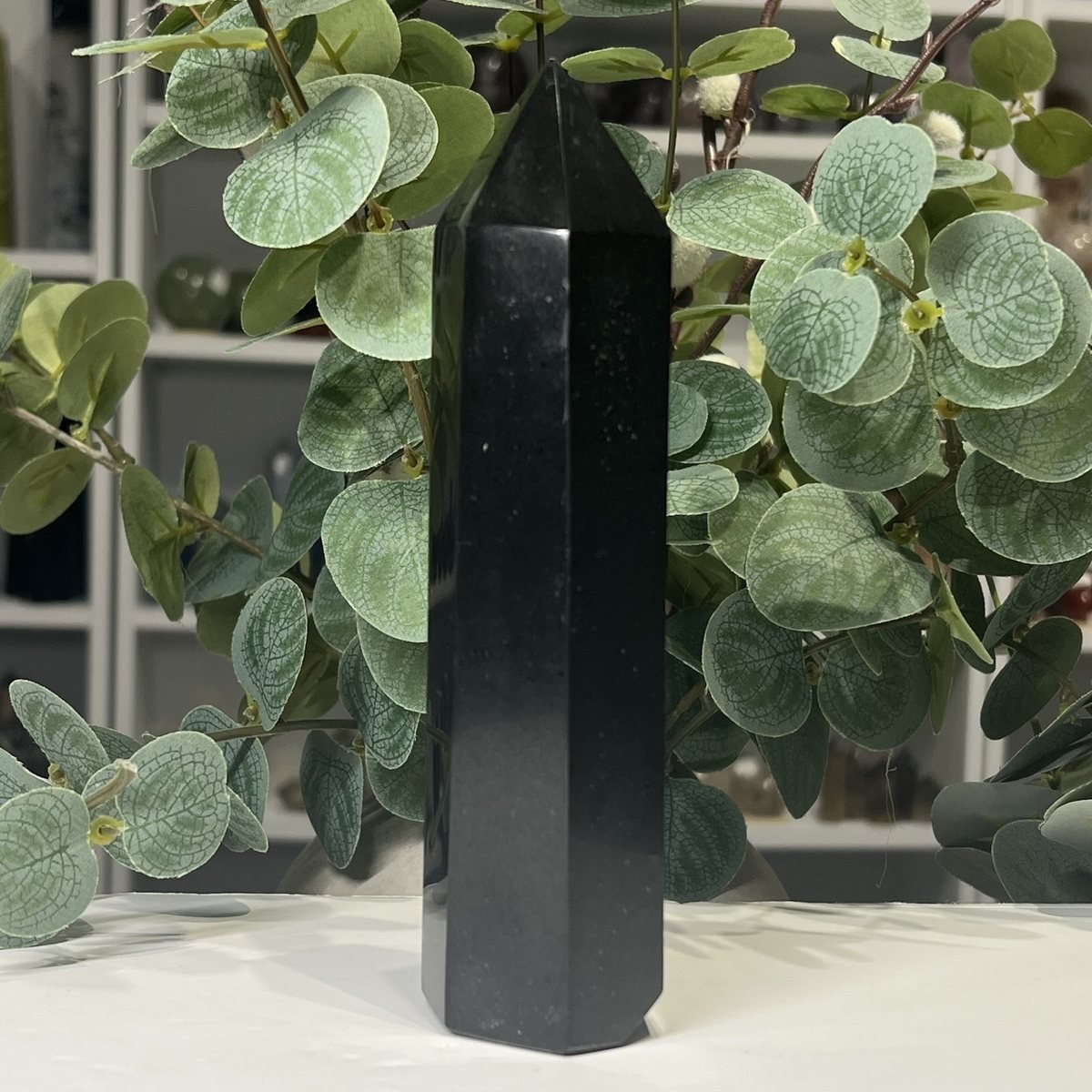
Black tourmaline is schorl, the iron rich member of the tourmaline family, and it makes up the great majority of all tourmaline on earth. It grows as long striated prisms, usually with a rounded triangular cross section, and those lengthways grooves are the easiest way to recognise a raw piece. It sits between 7 and 7.5 on the Mohs scale.
Schorl is pyroelectric and piezoelectric, which means it builds a small electrical charge when heated or put under pressure. That is a genuine physical property and it is almost certainly why tourmaline picked up its reputation for drawing things in. Dutch traders in the eighteenth century used heated tourmaline to pull ash out of their pipes and called it the ash drawer. Mindat’s schorl entry has the crystallography.
Most black tourmaline in shops comes from Brazil, Madagascar, Pakistan or Namibia.
Is black tourmaline receptive or projective
Receptive, and this surprises people. Protection sounds like an outward, pushing sort of job, so most would expect a projective stone. Black tourmaline is listed as receptive, with Saturn as its planet and Earth as its element, and its two traditional intentions are protection and grounding.
Once you know that, the stone reads differently. A receptive protector does not form a shield that bounces things away. It takes things in and holds them, the way earth takes in water. That is a different job and it suits different situations: a room that feels heavy, a desk you sit at all day, a doorway, the space beside a bed. It is less suited to the idea of warding something off, which is projective work and better served by obsidian or onyx.
Worn as a bracelet it goes on your non dominant wrist, which is the receptive hand. Our guide to which hand to wear a crystal bracelet covers the framework. Being Saturn ruled also places black tourmaline with Capricorn, with boundaries and limits, and with the slow steady end of practice rather than anything quick.
These are traditional correspondences, held as part of a practice, and none of it is a substitute for medical or professional advice.
What it means when black tourmaline breaks
This is the question people ask about black tourmaline more than any other, and it has a straightforward physical answer before it has a traditional one.
Schorl has perfect cleavage along its length and grows in long parallel fibres, so it splits and flakes along those lines very readily. A raw piece will shed splinters simply from being handled. Towers and points cut from schorl often part along a growth plane that was always there, and a bracelet of drilled black tourmaline beads is weaker again, because the drill hole runs across the grain. Black tourmaline breaks more than almost anything else on the shelf, and that is the stone, not a sign.
Traditionally a protective stone that breaks is read as having taken something and reached its limit, and the piece is thanked, returned to the earth or to running water, and replaced. That reading sits comfortably with a receptive stone whose job is to absorb. Hold it gently. It is a way of marking the moment, not a diagnosis of anything that happened to you.
If a piece of yours has cracked, the practical answer is that the fragments work perfectly well. Black tourmaline in a plant pot, tucked behind a radiator or buried at a doorway does the same job broken as whole.
Our guide to what it means when a crystal breaks takes the question stone by stone if you want the longer answer.
Can black tourmaline go in water
Briefly, and it is better not to. Schorl is hard enough that a rinse will not dissolve it, but water works into the cleavage planes and the fibrous structure, and a piece that has been soaked tends to flake and shed more afterwards. Raw clusters are the worst for it.
There is also iron in schorl, and any matrix or metal fitting attached to a piece will rust. A tumbled black tourmaline is fine under a tap. A raw piece, a tower or anything on a wire or in a setting should be kept dry and cleansed by smoke, sound or a night on the earth instead. Our guide to cleansing crystals runs through the options.
Telling black tourmaline from the stones sold as it
Several black stones get sold as tourmaline and a few of them are harder to tell apart than you would think.
- Black obsidian is glass. It has no striations at all, breaks with a curved shell shaped fracture, and feels glassy rather than gritty.
- Black onyx is banded chalcedony, almost always dyed to an even black, and has no lengthways grooves.
- Hematite is far heavier for its size and leaves a reddish streak.
- Black spinel and black garnet turn up in bead strands and are usually more evenly shiny than schorl, which has a slightly resinous, almost matte look between the striations.
The striations are the giveaway. Run a thumbnail along a raw piece and you should feel fine parallel grooves running the length of the crystal.
Choosing a piece
Raw black tourmaline is the most useful form for most of what the stone is traditionally used for, because it is placed rather than carried. A rough chunk in a corner, beside a router or by a door does the job and costs very little. Expect it to shed a few splinters.
Tumbled pieces suit a pocket or a bag and stand up to handling far better. Bracelets look good and are the most fragile option, so treat them as the thing most likely to need replacing. Towers are the least practical form for a stone that cleaves this readily, and a tall thin schorl tower is asking to snap.
Price is low for raw and tumbled material, because schorl is genuinely abundant. Anyone charging a premium should be able to say why.
Where to start with tourmaline
Browse our black tourmaline, or go by form with tumblestones and crystal towers. For more on protective stones, see our guide to crystals for protection.
Protection here is a traditional correspondence, not a medical one. Anything health related belongs with a professional.
Continue Your Journey
Obsidian Meaning · Crystals For Protection · Which Hand To Wear A Crystal Bracelet


Leave a Reply