How to celebrate Mabon, the autumn equinox, with crystals, a grid and a quiet hour
The year tips over at 1.06am on Wednesday 23 September 2026. If you have been wondering how to celebrate Mabon without buying into anything complicated, this is the whole of it: a few stones, a candle, and an honest look at what the year has grown.
Mabon at a glance
- The moment: 1.06am BST, Wednesday 23 September 2026, when the Sun crosses the celestial equator moving south.
- The equilux: Friday 25 September in the UK, the day daylight and darkness actually match.
- The Harvest Moon: full at 5.49pm BST on Saturday 26 September, rising close to sunset for several evenings.
- Sun sign: the Sun enters Libra at the equinox, the sign of the scales.
- Numerology: 23 September 2026 reduces to a 6, a number of home, tending and balance.
- The themes: balance, gratitude, and setting down what you are not carrying into winter.
- The stones: clear quartz, tiger’s eye, smoky quartz, citrine and carnelian.
How to celebrate Mabon, in one paragraph
Light a candle. Put two stones in front of you, one dark and one light. Say one thing you are grateful for and one thing you are ready to put down. Eat something from the season. That is a complete observance, and everything below is simply the longer, richer version of it, for anyone who wants to give the evening more shape.
The equinox is not a day off from the year. It is the moment the year asks what you actually grew.
What Mabon is, if the word is new to you
Mabon is the autumn equinox, and one of eight points on the Wheel of the Year. Two solstices, the longest and shortest days. Two equinoxes, when day and night stand level. Four older festivals in between, spaced roughly six weeks apart. The Wheel is simply a way of noticing where you are in the year instead of letting it rush past.
This one sits in the middle of three harvests. Lammas at the start of August brings in the first grain. Mabon takes the main harvest, the apples and the late crops. Samhain, at the end of October, gathers the last of it before winter closes in.
Where the name actually comes from
Here is the part most guides leave out. The name Mabon is young. The American writer Aidan Kelly attached it to the autumn equinox in 1974, while working out a set of names for the eight festivals, and he took it from Welsh legend rather than from any recorded equinox rite.
In that legend, Mabon ap Modron is a child taken from his mother when three nights old and held until he is found again by Arthur’s men. The names carry their own weight: Mabon comes from a British god whose name means Great Son, and Modron means Great Mother. Lovely material, and worth knowing as story rather than as evidence that anyone celebrated an equinox by that name.
None of that makes the day less real. Harvest has been gathered and given thanks for in these islands for as long as there has been a harvest to gather. A fifty year old name on a very old moment simply tells you the practice is still living, and that people are still adding to it.
And how do you say it?
Two pronunciations are in common use. The Welsh is closer to MAB on, with the short a of cat. Most of the English speaking pagan world says MAY bon. Neither will get you thrown out of anywhere. If you are anywhere near Wales, the first is the kinder choice.
The sky on the day
The equinox is a calculated crossing point rather than something you can watch happen. Royal Museums Greenwich gives the moment as 1.06am BST on 23 September 2026. Day and night are close to equal but not exactly so: London gets around twelve hours and eight minutes of daylight on the day itself, and the true even split, the equilux, arrives on 25 September.
Then the Harvest Moon, full at 5.49pm on Saturday 26 September. Its name is practical rather than mystical. Around the equinox the Moon rises only a little later each evening instead of the usual fifty minutes or so, which gave farmers several nights of working light to get the crops in. That is the whole of the tradition, and it is a good one.
The Equinox Balance Grid
A grid is a way of holding an intention in a shape, so it keeps working after you have got up from the table. This one is built for the equinox: a centre that holds, four Way Stones that carry, and an outer ring split evenly between dark and light.
The centre, and what to use instead
Clear quartz, the first choice
Clear quartz takes a spoken intention and holds it without colouring it. At an equinox, where the point is equality rather than a push in one direction, a neutral centre is exactly right. Most people already own a piece, which is the other reason it leads.
Smoky quartz, if the year has been heavy
Choosing smoky quartz for the centre changes the grid from balance to release. The whole circuit then runs towards setting things down, which is the honest choice if that is where you actually are.
Citrine, if the year has gone well
A citrine centre tilts the grid towards harvest and increase. Use it when you want the evening to be about gratitude and keeping momentum through the darker months rather than about letting go.
Nothing in the outer ring receives from the centre directly. The four tiger’s eye Way Stones are the only stones joined to the middle by a solid line. They take what the centre holds and pass it outward steadied, which is why tiger’s eye sits in that layer: its banding is the grid’s whole point in miniature, gold and brown running side by side.
The dashed lines are that distribution. Build the grid in that order too. Centre first, then Way Stones, then the ring.
The outer ring
Twelve stones, running in threes around the circle. Four smoky quartz for the dark half of the year and for what you are putting down. Four citrine for the light half and for the harvest you are counting. Four carnelian between them, because the turn is not a clean line: it is leaves going over, warmth held on to for a while longer. Seventeen stones in total.
Keep the sequence the same the whole way round rather than grouping the colours. The point of the ring is that dark, gold and red sit next to each other in rotation, which is what the season actually does.
Short of stones? Clear quartz substitutes into any position, as long as you say aloud what it is standing in for. Carnelian and citrine stand in for each other happily, being close in warmth. A grid of one centre and four Way Stones still works. So does a grid of two stones, one dark and one light, if that is your collection this year.
Five stones for the equinox table
Clear quartz
The amplifier and the blank page. Speak over it and it holds what you said. At Mabon it does the job of the scales themselves, taking neither side.
Tiger’s eye
Steadiness through change. Tiger’s eye is the stone for a season that is shifting under your feet, and for the practical decisions that come with darker mornings.
Smoky quartz
Grounding, and the clean end of a thing. Smoky quartz belongs at the equinox because the dark half of the year needs a stone that is comfortable in it.
Citrine
Harvest, warmth and confidence. Keep citrine where you work rather than where you sleep, and let it stand for what the year has actually produced.
Carnelian
The colour of the turning leaves, and the warmth you want when the evenings pull in early. Carnelian is the stone for motivation rather than celebration, which makes it the right neighbour for citrine in the ring: one counts what came in, the other keeps you moving through what comes next. If the autumn ahead is going to ask work of you, this is the piece to carry rather than to leave on the table.
A simple equinox practice
This works by sound, breath and touch, with nothing to picture. Fifteen minutes, or five if that is what you have.
- Light a candle and let the room go quiet. If you have a bell or a singing bowl, sound it once and listen until the note has completely gone. That silence afterwards is the start of the practice, not a gap in it.
- Take a dark stone in one hand and a light stone in the other. Feel the weight difference. Let your hands tell you which is which.
- Breathe in slowly, and name one thing you are grateful for. Out loud is better than silently. The dark hand is listening too.
- Breathe out slowly, and name one thing you are ready to put down.
- Repeat as many times as you need. Three pairs is a good number. Seven if the year has been full.
- Write both lists on a small piece of paper, fold it, and tuck it under the grid or beneath the two stones. Leave it there until Samhain on 31 October, then burn it safely or bury it.
- Sound the bell once more to close, and eat something from the season. Apple, bread, blackberries. The meal is part of it.
Setting an equinox altar
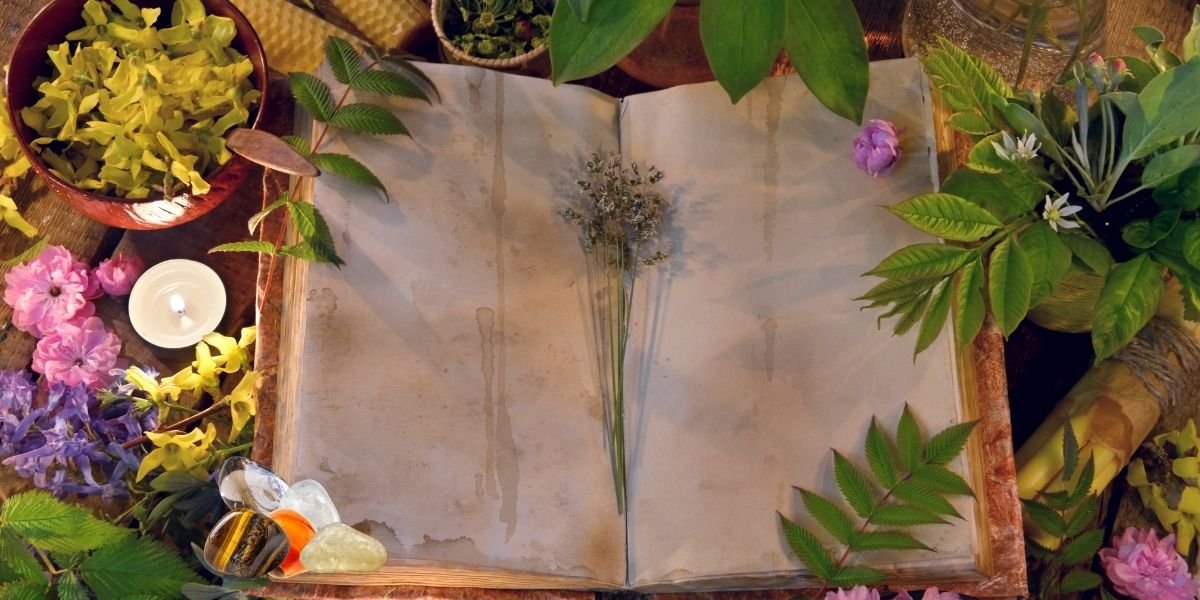
An altar at Mabon is really just a table that has been told what it is for. Everything on it should have come from the season or from your own year.
- Something harvested. Apples, blackberries, a heel of bread, a jar of something you made. Hedgerow finds count and cost nothing.
- Something turning. A few leaves on the turn, a seed head, conkers, a sprig of rowan or hawthorn.
- Two candles. One light, one dark, lit together and snuffed together. If you keep a single candle, light it at dusk instead and let that be the marker.
- The grid, or two stones. Placed where you will pass them daily rather than tucked away.
- The folded paper from the practice above, holding your gratitude and your release.
- Something of the harvest you are less proud of. A rejection letter, a note about a thing that did not work. The year produced that too, and an honest altar says so.
Leave it up for the whole of the equinox week, through the Harvest Moon on the Saturday, then clear it back to the stones alone. A cleared altar is part of the practice, not the end of it.
Working with the Harvest Moon on 26 September
The equinox and the Harvest Moon falling within four days of each other gives the week a natural arc. The equinox is the level point, the pause. The full Moon three nights later is where the work gets its light.
On the Saturday evening, take the grid outside or to a window if the sky is clear. Sound your bell or bowl once. Say the gratitude list again, out loud, and this time do not add anything to it. Full moons are for completion, not for asking, and a harvest counted twice tends to feel different the second time.
The Sun moves into Libra at the equinox, the sign of the scales, which is neat enough that it hardly needs pointing out. Libra weather asks the same question the season does: where are things genuinely even, and where have you simply got used to the tilt?
Journal prompts for the equinox
- What did I actually grow this year, whether or not I meant to?
- What have I been carrying out of habit rather than need?
- Where in my life are the scales genuinely level, and where am I pretending they are?
- What do I want the darker half of the year to be for?
- Who helped with this harvest, and have I told them?
Build your equinox table
The stones in the grid above are in the shop now, alongside candles for the evening and journals for the prompts. Balance takes very little kit: one dark stone, one light stone and something to write with will carry you to Samhain.
Leave a Reply