Why the pink fades in sunlight and never comes back, how to spot a dyed piece, and how the stone is traditionally used
Rose quartz meaning is given as love everywhere, and that is true, but it is not the useful half of the story. The useful half is that rose quartz is receptive, which is a different kind of love stone from a projective one, and that the pink fades in sunlight and will not come back. This guide covers what rose quartz is, why the colour is so variable, whether it can go in water, what a break means, and how to spot a dyed piece.
Rose quartz meaning and what the stone is
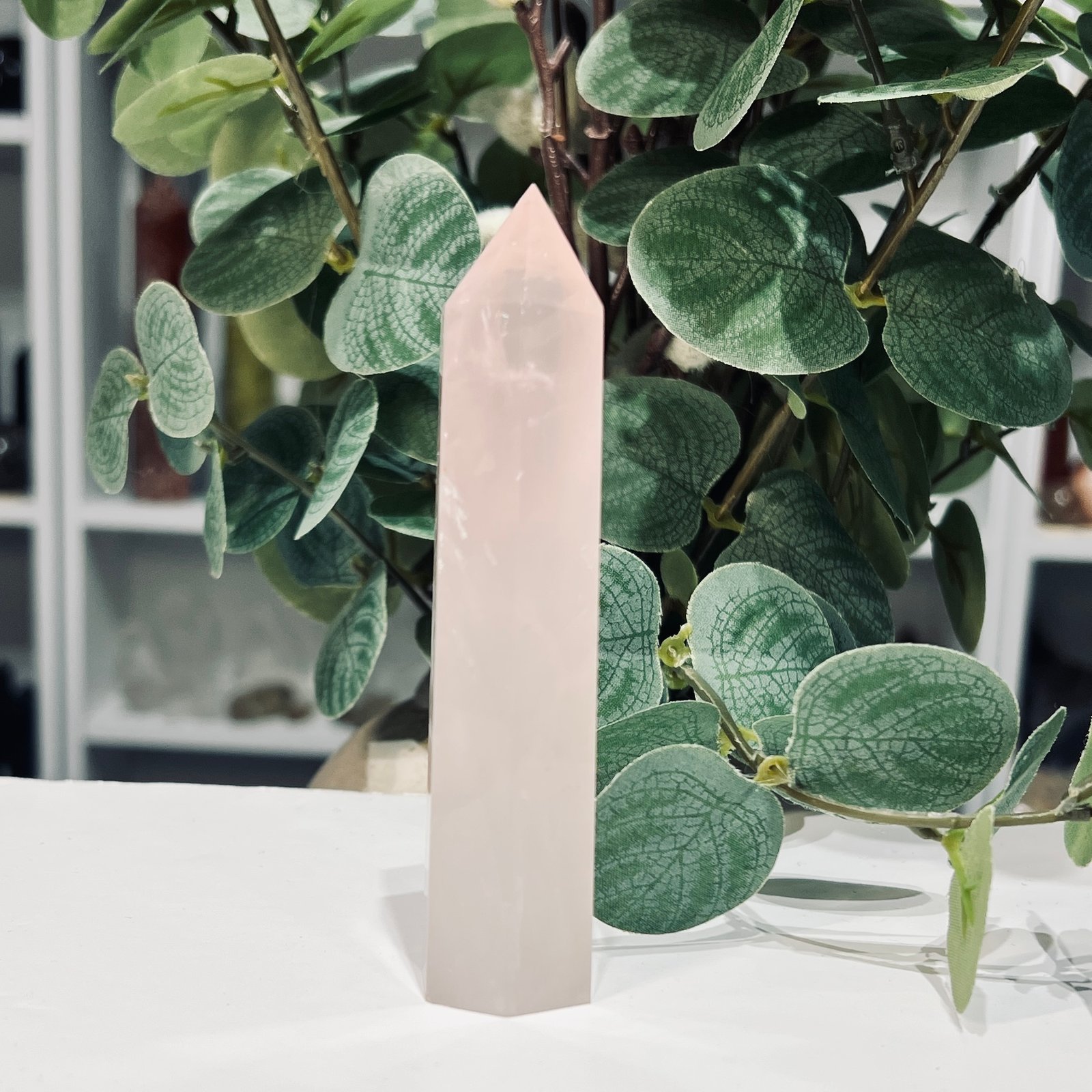
Rose quartz is quartz, silicon dioxide, coloured pink by microscopic fibres of a mineral related to dumortierite threaded through the crystal. That is why the pink is cloudy rather than clear, and why rose quartz almost never forms good points. The fibres scatter the light, which also gives a well cut sphere its soft glow and, in the best material, a faint star when lit from above.
It is 7 on the Mohs scale, the same as all quartz, so it takes handling well. Most of it comes from Brazil, Madagascar and South Africa. Mindat’s rose quartz entry has the mineralogy.
Colour runs from a pale dusty blush to a deep rich pink, and the deeper material costs more. Both are the same stone. Madagascan rose quartz tends to be the deepest.
Is rose quartz receptive or projective
Receptive, and for a love stone that distinction does a lot of work.
A projective love stone is outward facing. It is for attracting, for going towards someone, for the active end of the thing. Rose quartz is not that. Receptive means drawing inward and settling, and the love rose quartz is traditionally given for is the kind that comes back towards you: self regard, being able to accept care, softening after something hard. That is why it is given to people after a loss or a break far more often than it is given to people starting a romance.
Cunningham lists rose quartz as receptive without naming a planet or element. Kynes places it with Water, with Libra, with Friday and so with Venus, and with the January and May full moons. Where a source is silent it is better to say so than to invent a line.
Worn as a bracelet it belongs on the non dominant wrist, which is the receptive hand. Our guide to which hand to wear a crystal bracelet explains when to break that rule, and rose quartz is a stone where people often should: if you are wearing it to be warmer towards other people rather than towards yourself, the projective wrist makes more sense.
Those associations are traditional ones, carried rather than demonstrated.
Does rose quartz fade in sunlight
Yes. Rose quartz is one of the worst stones for it, worse than amethyst, and the loss is permanent.
The pink comes from those fine mineral fibres, and ultraviolet light breaks them down. A rose quartz sphere left on a windowsill will go from pink to a dull greyish white over a summer, and nothing brings it back. The deeper the original pink, the more obvious the loss.
Charge rose quartz in moonlight, which suits a receptive stone far better, or cleanse it with smoke or sound. Keep it off south facing windowsills and out of a conservatory. Our guide to cleansing crystals covers the methods.
Can rose quartz go in water
Yes, briefly and in cool water. It is hard, not soluble, and a rinse does no harm.
The caveats are the usual ones. Dyed material will bleed, so if the water goes pink you have your answer about the piece. Rose quartz is often heavily fractured inside, more so than clear quartz, so hot water on a cold piece can split it. And salt water pits any polished surface over time. A short cool rinse, then dry it properly.
What it means when rose quartz breaks
Rose quartz carries a great many internal fractures, which is part of why it is cloudy, and those are where it parts. Spheres and hearts are the most common forms and both concentrate stress at a point, so a dropped rose quartz heart usually breaks along a line that was already there. Thermal shock does the rest.
Traditionally a stone that breaks is read as having finished what it was carrying, and with a love stone people tend to read more into that than they should. It is worth saying plainly: a cracked rose quartz is not a statement about a relationship. It is a fractured mineral that met a hard floor.
The pieces keep working. A broken rose quartz heart in a pouch or a plant pot does the same job, and the fresh break often shows the pink more clearly than the polished face did.
If yours has chipped or split, what it means when a crystal breaks sets out the traditional reading and what to do with the pieces.
Telling real rose quartz from dyed
Dyed quartz and dyed howlite are both sold as rose quartz, particularly in bead strands and cheap tumbles.
- Even colour is the warning sign. Natural rose quartz is cloudy and uneven, with paler and deeper patches through one piece. A bead that is one flat uniform pink is dyed.
- Look into the fractures. Dye pools in cracks and shows as darker pink lines where the rest of the stone is pale.
- Howlite is softer. Dyed howlite sold as rose quartz can be scratched with a steel pin. Rose quartz cannot.
- Too cheap and too bright usually means glass or dyed material.
Choosing a piece
Hearts and spheres are what rose quartz is mostly cut into and they suit it, because the stone has no natural form worth preserving. A palm stone is the most practical thing to actually hold. Tumbles are the cheapest honest way in, and raw chunks are good value because the material is abundant.
Deeper pink costs more and is purely a preference. The pale dusty material is the same stone and often photographs badly while looking better in the hand.
Rose quartz in stock
Browse our rose quartz, or go by form with tumblestones and crystal spheres. For more pink stones, see our guide to pink crystals.
These are traditional associations rather than claims. Nothing here is a replacement for medical or professional advice.
Continue Your Journey
Pink Crystals Guide · Calcite Meaning · How To Choose Crystals


Leave a Reply