
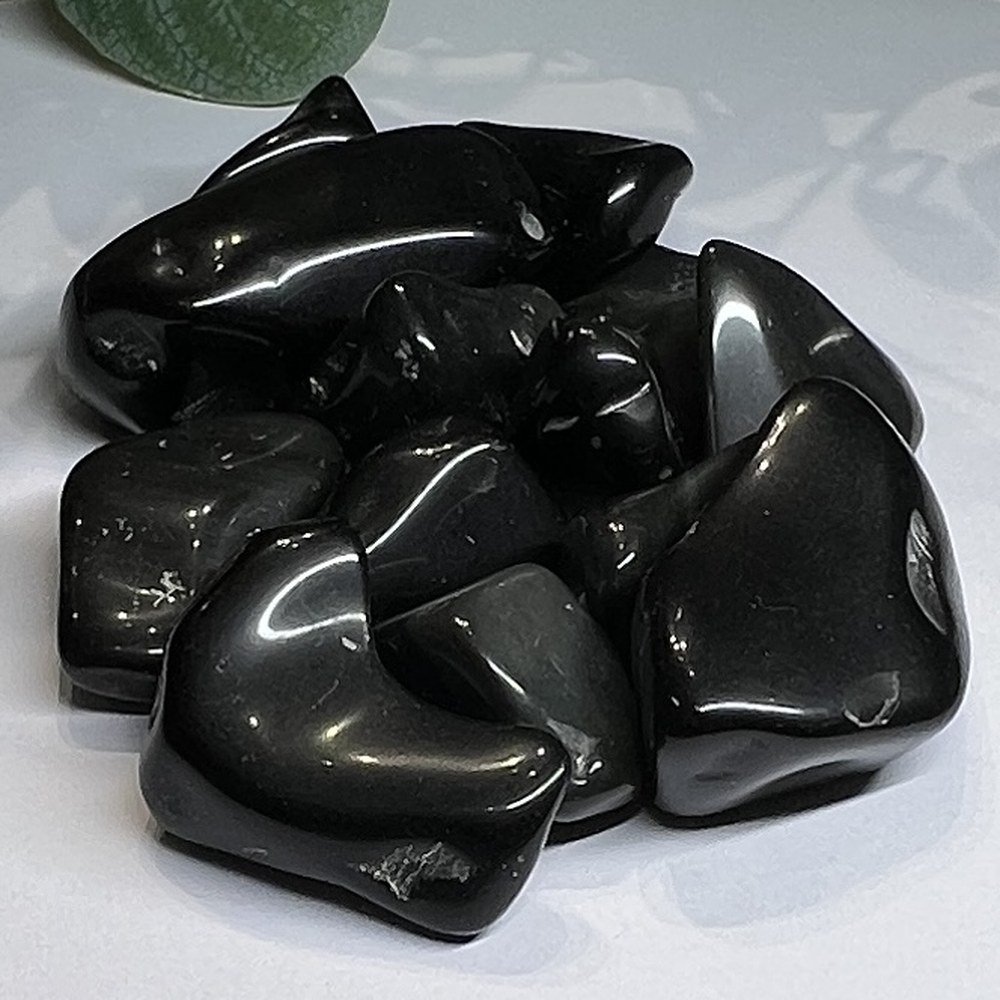
Volcanic glass rather than a mineral, the varieties worth knowing, and why it breaks the way it does
Obsidian meaning is tied to truth, protection and seeing things you would rather not, and for once the tradition and the material agree completely. Obsidian is volcanic glass. It formed in seconds, it breaks to an edge sharper than a surgical scalpel, and polished flat it makes a mirror. Every one of those physical facts shows up in what the stone is used for. This guide covers what obsidian is, the varieties, why it is not technically a crystal at all, and whether it can go in water.
Obsidian meaning and what the stone is
Obsidian is lava that cooled too fast to organise itself. When silica rich magma meets air or water at the edge of a flow, it chills in minutes, and the atoms are frozen where they stood instead of arranging into a crystal lattice.
That makes obsidian a glass rather than a mineral, and strictly not a crystal at all, which is a reasonable thing for a crystal shop to admit. It has no internal structure, no cleavage and no crystal faces. It sits at 5 to 5.5 on the Mohs scale.
It also means obsidian is young. Over long enough, glass slowly reorganises itself into crystals, so there is very little obsidian on earth older than about twenty million years, which makes it one of the youngest things in a crystal collection.
Because it has no structure to follow, obsidian breaks along smooth curved surfaces, the shell shaped conchoidal fracture, and the edge that produces can be a few molecules thick. Sharper than a steel scalpel, which is why it was worked into blades for tens of thousands of years and why obsidian scalpels are still occasionally used. Mindat’s obsidian entry has the detail.
The varieties
- Black obsidian is the plain form, coloured by fine iron particles.
- Snowflake obsidian has begun that slow reorganisation. The white flecks are cristobalite, small radiating crystals growing inside the glass. It is obsidian caught turning into something else.
- Rainbow and sheen obsidian carry layers of microscopic inclusions that split the light, so a sheet of colour appears at one angle and vanishes at another, like labradorite.
- Mahogany obsidian is streaked red brown by iron oxide.
- Apache tears are small rounded nodules, translucent brown at the edges when held to light.
Be careful with anything sold as blue, green or purple obsidian at a low price. Natural obsidian in those colours is rare and most of what is offered is manufactured glass.
Is obsidian receptive or projective
Projective, with Saturn as its planet and Fire as its element. For a stone born in a volcano and ruled by the planet of limits and boundaries, that is a tidy fit.
Projective means sending outward and acting, and this is where obsidian differs from black tourmaline, which people often treat as interchangeable with it. Black tourmaline is receptive and absorbs. Obsidian is projective and repels. If you want a stone that takes something in and holds it, that is tourmaline. If you want a stone that marks a line and pushes back, that is obsidian. Knowing which job you want makes the choice simple.
The traditional intentions are protection, grounding, divination and peace, and the divination one is specific. Polished obsidian mirrors have been used for scrying for a very long time, and the British Museum holds one that belonged to John Dee. A black reflective surface gives the eye nothing to settle on, which is the practical basis of mirror scrying.
Obsidian is also the stone most associated with shadow work, for the plain reason that a black mirror shows you yourself. Worn as a bracelet it belongs on your dominant wrist, the projective hand, and our guide to which hand to wear a crystal bracelet explains the framework.
All of it is tradition rather than instruction, and worth holding loosely.
Can obsidian go in water
Yes, briefly and in cool water. Obsidian is glass, it is not soluble, and it has nothing in it to bleed or rust.
The one real caution is thermal shock. Glass with no internal structure expands unevenly, and obsidian is more prone to cracking from a sudden temperature change than most stones. Never hot water, never a cold piece into warm water. And avoid salt water, which over time frosts a polished surface, which matters here because a dulled obsidian mirror is no longer a mirror.
Dry it with a soft cloth. Obsidian shows fingerprints and water spots more than any other stone in a collection.
What it means when obsidian breaks
Obsidian chips and shatters rather than splitting, because it has no cleavage planes to follow. A dropped piece will often take a shallow curved flake out of itself and leave a very sharp edge, so handle a broken piece with more care than you would any other stone. That sharpness is not a figure of speech.
Traditionally a protective stone that breaks is read as having done its work and reached its limit, and with obsidian the reading usually given is that it has turned something back. Hold it gently. A glass with no internal structure has an obvious reason to chip.
Keep the fragments if you want to, but wrap them, and do not put bare obsidian chips in a pouch you reach into.
Obsidian parts more readily than most stones, so what it means when a crystal breaks may be the more useful page.
Choosing a piece
Mirrors and flat polished discs are the form that does the one job obsidian does better than anything else. Spheres are the classic scrying shape and the most expensive. Towers and points look striking and are usually the cheapest substantial piece you can buy, because the material is abundant.
Look for a deep even black with a glassy shine and no cloudiness, and check the edges and tip for existing chips, which are easy to miss against a black surface and easy to catch yourself on.
Obsidian is one of the best value stones in any shop. Anyone charging a great deal for plain black obsidian should be able to say why.
Obsidian in stock
Browse our obsidian, or go by form with crystal spheres and crystal towers. There are more protective stones in our guide to crystals for protection.
Obsidian is used as part of a practice. It is not a treatment, and nothing here replaces professional advice.
Continue Your Journey
Black Tourmaline Meaning · Crystals For Protection · Tigers Eye Meaning


Leave a Reply