Crystal Shop UK · Rooted in intention, curated with care

Tag: Shadow Work

  • The Cailleach: The Celtic Winter Goddess and Hag of the Mountains

    The Cailleach: The Celtic Winter Goddess and Hag of the Mountains

    The old woman of winter in Scottish, Irish and Manx lore: how to say her name, the mountains she built, her yearly handover to Brigid, and a gentle way to welcome the cold months

    When the first hard frost silvers the grass and the hills turn grey with cloud, the old stories say the Cailleach has woken. She is the great old woman of winter, the one who strides across the mountains with her staff, drops boulders from her apron and shapes the land as she goes. For centuries people in Scotland, Ireland and the Isle of Man told her stories through the long dark months. Here is who she is, where her lore comes from, and a quiet way to greet her as winter begins.

    The Cailleach at a Glance

    • Who: the old woman of winter, storms and wild places in the folklore of Scotland, Ireland and the Isle of Man
    • How to say it: KAL·yakh, with the “kh” said softly in the throat, as in loch
    • What the name means: “old woman”, from an old word linked with a veil, so “the veiled one”
    • Other names: the Cailleach Bheur in the Scottish Highlands, the Cailleach Bhéarra or Hag of Beara in Ireland, Caillagh ny Groamagh in the Isle of Man
    • Known for: building mountains, bringing the winter weather, her seasonal handover with Brigid
    • Her season: Samhain to Beltane, the dark half of the year
    • Symbols: her staff, an apron or creel of stones, mountains, standing stones, deer, the waning moon
    • Colours: grey, blue, black, white and silver
    • Plants: witch hazel, holly, ivy and moss

    Who Is the Cailleach?

    The Cailleach is one of the oldest figures in the folklore of the Gaelic world. The stories say she has been here since the beginning of time, older than the hills, because she made many of them. She rules the weather and the turning of the seasons, and above all she rules winter.

    Descriptions of her are wonderfully wild. In some tellings she is a giant old woman with a single eye in the middle of a blue black face, red teeth and matted hair white with frost. In others she is spoken of as beautiful. She has deep knowledge of the natural world and the strength to reshape it. Wild deer were said to be her herds, and she watched over them through the winter.

    She is not evil, even when she is harsh. Winter in the Highlands and on the Atlantic coasts was hard and could be deadly, and the Cailleach is that hardness given a face. She is the cold that tests what is weak so that what is strong can survive, and the long rest the land needs before it can grow again.

    The Maker of Mountains

    Many of the Cailleach’s stories are written into the landscape itself. She is said to have carried great loads of stone in her apron or in a creel on her back, and wherever she let some fall, a hill or a mountain was born. Lines of boulders across moorland, lone rocks on hillsides and whole ranges are explained this way across Scotland and Ireland.

    In Ireland, the hills of Loughcrew in County Meath are known in Irish as Sliabh na Caillí, the mountain of the hag. The ancient cairns on their summits are said to be stones she dropped as she leapt from hill to hill, and a great carved stone there is still called the Hag’s Chair.

    In Argyll, a well known tale tells how she kept a spring on Ben Cruachan, covering it with a stone slab every evening. One night, tired after a long day driving her cattle, she fell asleep and forgot. The water burst out, flooded the glen below and became Loch Awe.

    Further out to sea lies the whirlpool of Corryvreckan, between the islands of Jura and Scarba. The old story says the Cailleach washes her great plaid there at the start of winter. When it comes out of the churning water clean and white, she spreads it over the land, and Scotland is covered in snow.

    The Cailleach in Scotland

    In the Highlands she is the Cailleach Bheur, said roughly KAL·yakh VAYR. She rules from Samhain to Beltane. As winter comes in, she grows stronger and more active, striking the ground with her staff so that the earth freezes, the rivers turn to ice and the snow falls.

    When winter ends, the stories divide. In some she is turned to stone until the next Samhain. In others she becomes a young woman again. In one Highland telling she throws her staff beneath a holly tree when her season is over, and that is why no grass grows under holly.

    Perhaps the most moving piece of her lore still in the landscape is a tiny stone shrine in Glen Lyon in Perthshire, known as Tigh nan Cailleach, the house of the old woman. Inside sit a handful of smooth, water worn stones said to be the Cailleach, her husband and their children. By long custom, the stones are brought out at Beltane to face the summer and put back inside at Samhain to shelter for the winter. It is one of the very few places in Britain where a seasonal custom like this is still kept.

    The Hag of Beara in Ireland

    In Ireland she is the Cailleach Bhéarra, the Hag of Beara, linked especially with the Beara peninsula in the far south west. The traditional teaching says she is almost the same figure as the Highland Cailleach, though less tied to winter and the wild beasts and more to building the land. On the Beara peninsula, a rock at Kilcatherine is still pointed out as the old woman herself, turned to stone as she looks out to sea.

    Irish lore says she lived through seven periods of youth, outliving husband after husband and seeing whole generations come and go. An Old Irish poem known as the Lament of the Old Woman of Beare, usually dated to around the ninth century, gives her a voice: an old woman remembering the days when she was young and beautiful and kings sought her company. It is one of the oldest pieces of writing connected with her, and one of the most beautiful.

    The Cailleach in the Isle of Man

    In the Isle of Man she is Caillagh ny Groamagh, the old woman of gloominess. Manx lore, like Highland lore, ties her to the first day of February. On that morning she goes out to gather firewood for the rest of the winter. If the day is bright and dry, she can gather plenty, so the cold will last a long while yet. If the day is wet and stormy, she has stayed in, and that means she has enough wood and winter will soon be over.

    It is the same idea as the American Groundhog Day, and it explains why a grey, rainy start to February was once welcomed with relief.

    The Cailleach and Brigid

    The heart of the Cailleach’s story is her relationship with Brigid, the bright goddess of spring, fire and healing. The Cailleach holds the land through the dark months. Brigid brings back the light. The changeover happens around Imbolc, on 1 February, which in 2027 falls on Monday 1 February.

    The traditional teaching describes it as a yearly contest for sovereignty over the land, each trying to bring in her own season. How long and hard the winter is depends on how the struggle goes. In some versions the Cailleach finally yields and spring arrives. In others the contest simply goes round and round, year after year, winter and spring forever taking turns.

    In parts of Scotland the two are spoken of almost as one: the old woman of winter and the young woman of spring, two faces of the same turning year. You can read more about her bright partner in our post on Brigid and about the festival itself in the meaning of Imbolc.

    The Hag Who Becomes a Queen

    The Cailleach also belongs to one of the oldest patterns in Irish storytelling: the hag of sovereignty. In these tales, a young man meets a hideous old woman, often guarding a well, who asks him for a kiss. The young men who refuse go on their way. The one who kisses her without hesitation finds her changed into a beautiful woman, and she tells him she is Sovereignty itself. He will be king.

    The lesson is that the land must be accepted whole, in its harsh season as well as its gentle one, and that the right to rule belongs to the one who honours it. The Cailleach, old and young, wintry and green, carries that idea in every story. The Morrígan, the Great Queen, carries a fiercer version of the same teaching.

    The Cailleach, Samhain and the Waning Moon

    Her season opens at Samhain, kept on 31 October by people of many paths, and in 2026 it falls on Saturday 31 October. It marks the start of the dark half of the year, and in Highland lore it is the night the Cailleach takes up her staff. Our guide to the meaning of Samhain covers the festival in full.

    Her moon is the waning moon, the shrinking light that leads down into darkness. Through the Wheel of the Year she walks from Samhain, through Yule and the longest night, to Imbolc. In the sky, these are the months of Scorpio, Sagittarius and Capricorn, ending as the Sun moves through Aquarius at Imbolc: signs of depth, endurance and slow, patient building, all very much in her spirit.

    The Honest History

    Many people today honour the Cailleach as an ancient goddess of the land, a tradition many keep with real devotion. It is worth knowing where her stories come from.

    Most of what we know about her is folklore: tales, sayings and place names gathered by collectors in Scotland, Ireland and the Isle of Man, largely between the eighteenth and early twentieth centuries. Some threads are much older. The Lament of the Old Woman of Beare dates back over a thousand years, and her name is woven into very old place names. But we have no ancient inscriptions or temples to tell us exactly how people saw her before Christianity, or whether she was worshipped as a goddess in the way we would understand it today.

    What we can say is that people in the Gaelic world spoke of her for a very long time, tied her to real mountains, lochs and stones, and kept customs for her, like the stones of Glen Lyon, into living memory.

    How to Pronounce Cailleach

    Cailleach is said KAL·yakh. The first part rhymes with “pal”. The ending is a soft breathy sound at the back of the throat, like the ch in the Scottish word loch, not a hard “k”. In Irish you will sometimes hear it as KAL·yukh, slightly softer. Cailleach Bheur is KAL·yakh VAYR, and Cailleach Bhéarra is KAL·yakh VAY·ra.

    Crystals for the Cailleach

    Stones in her colours of grey, white, blue, black and silver suit a winter altar for her:

    • Hematite: heavy, silver grey and grounding, traditionally linked with her
    • Snowflake obsidian: black flecked with white, like the first snow on dark hills
    • Howlite: white with grey veins, a calm stone for winter rest
    • Sodalite: deep winter blue, often kept for quiet reflection and inner wisdom
    • Silver leaf jasper: grey and silver patterned, an earthy stone of patience and endurance

    A Simple Winter Welcome for the Cailleach

    This practice greets her at the start of her season, at Samhain or on the first frosty night of autumn, and closes again at Imbolc. Offerings traditionally linked with her are stones: little cairns, spirals, painted pebbles and hag stones, the stones with natural holes through them.

    1. Gather stones. On a walk, pick up a small handful of stones that catch your eye, taking only what is loose and plentiful. A hag stone is a lovely find if one comes your way.
    2. Set your space. On a windowsill or outdoors, place a grey, blue or white candle, with a sprig of holly, ivy or witch hazel beside it. Add your crystals if you like.
    3. Light the candle and greet her. Breathe slowly, then speak aloud: “Old woman of the mountains, Cailleach, I welcome your season. Teach me to rest, to endure, and to trust that spring will come.”
    4. Build a small cairn. Stack your stones one by one into a small pile or spiral. With each stone, name something you will let rest this winter: a worry, a plan that needs time, an old habit.
    5. Sit in the cold quiet. Close your eyes and picture a mountain under snow, a wide grey sky and an old woman walking the ridge with her staff. Let the stillness of winter settle around you for a few minutes.
    6. Write it down. Note in your journal what you have chosen to rest, and what you hope will be ready to grow by spring.
    7. Close with thanks. Thank her and snuff the candle.
    8. Leave the cairn through winter. On Imbolc, return the stones to the earth or to where you found them, and light a candle for Brigid as the season turns.

    Signs the Cailleach May Be Calling You

    • A pull towards mountains, moorland, standing stones and wild weather
    • Finding hag stones or noticing deer more often than usual
    • Feeling deeply at home in winter, rather than simply enduring it
    • A season of life that asks you to slow down, rest and let something lie fallow
    • A growing respect for age, wisdom and the older women in your life

    Questions People Ask

    What does Cailleach mean?

    Cailleach means “old woman” in Irish and Scottish Gaelic. The word is linked with an old word for a veil, so it can also be read as “the veiled one”. In everyday Gaelic it can simply mean an old woman.

    How do you pronounce Cailleach?

    Say it KAL·yakh, with the ending sounding like the ch in loch. In Irish it is sometimes softer, closer to KAL·yukh.

    What is the Cailleach the goddess of?

    She is linked with winter, storms, weather, mountains and wild places, and with the wild deer. She rules the dark half of the year from Samhain until the spring.

    What is the connection between the Cailleach and Brigid?

    They are the two halves of the year. The Cailleach holds winter and Brigid brings the spring, and the handover happens around Imbolc on 1 February. Our post on Brigid tells her side of the story.

    Is the Cailleach the same as the Morrígan?

    No, they are different figures, though both can appear as old women and both are tied to the land and sovereignty. The Morrígan is a goddess of fate and battle, while the Cailleach belongs to winter and the shaping of the landscape.

    Is the Cailleach a crone goddess?

    She is often called one today, and the old woman form is her best known. But in many stories she is young again in spring, so she can be seen as the whole cycle of the year rather than old age alone.

    Bring the Cailleach home

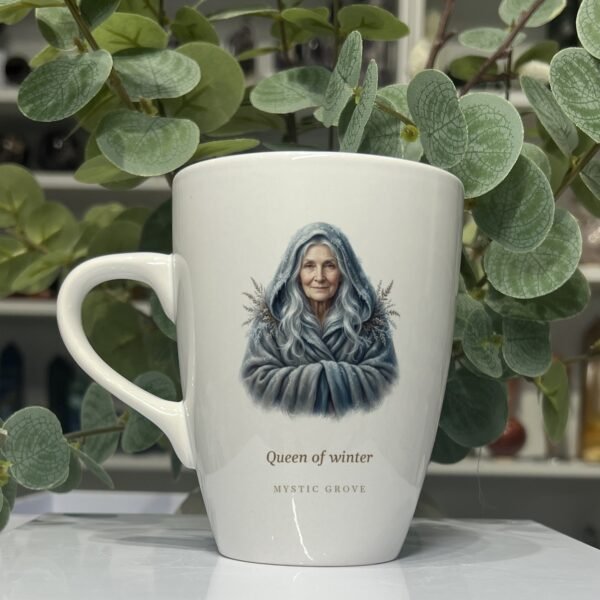
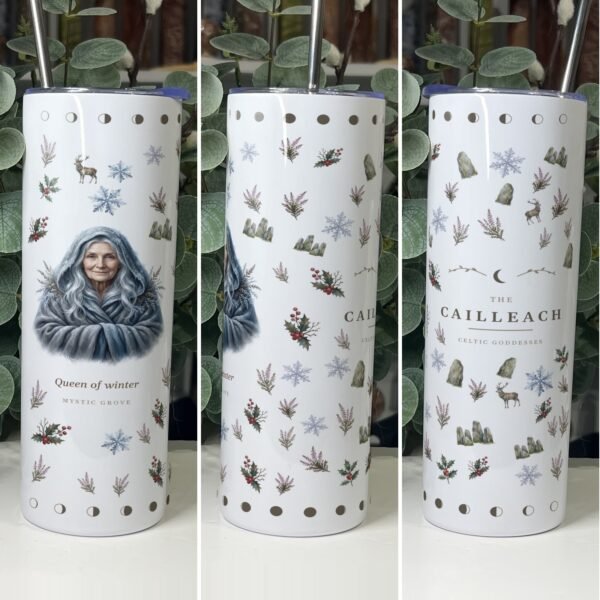
    The Cailleach artwork from this series now comes on a 13oz white ceramic mug and a 20oz skinny tumbler wrapped all the way round in snowflakes, holly and stags. Each one comes with a printed card telling her story, so it is ready to keep or to give.
    See all the goddess tumblers

    Keep reading: Brigid, Goddess of Fire and Spring · Imbolc Meaning · The Morrígan, Celtic Goddess of Prophecy · Samhain Meaning
  • The Morrígan: Celtic Goddess of Prophecy, Sovereignty and Fate

    The Morrígan: Celtic Goddess of Prophecy, Sovereignty and Fate

    The Great Queen of Irish myth: her three forms, the crow on the battlefield, her meeting with the Dagda at Samhain, and a quiet way to honour her as the dark half of the year begins

    Every October, as the nights draw in, the Morrígan seems to come closer. She is the crow on the battlefield, the woman washing armour at the river, the voice that speaks prophecy when the fighting is over. She can seem frightening at first. Spend a little time with her stories, though, and a different picture appears: a goddess of fate, of the land, and of seeing clearly what is coming. Here is who she is, where her stories come from, and a simple offering you can make at Samhain.

    The Morrígan at a Glance

    • Who: an Irish goddess of fate, prophecy, sovereignty, war and death, one of the Tuatha Dé Danann
    • How to say it: MOR·ree·gan, with the stress on the first part; often written Morrigan, without the accent
    • Her name: usually read as “Great Queen” or “Phantom Queen”
    • Her forms: the Morrígan herself, Badb and Macha; some tellings name Nemain
    • Known for: foretelling the outcome of battle, washing at the ford, her union with the Dagda at Samhain, testing the hero Cú Chulainn
    • Symbols: the crow and raven, the river ford, a red cloak, a grey spear, the chariot
    • Colours: black, red and white
    • Her festival: Samhain, Saturday 31 October 2026
    • Stones often linked with her: black obsidian, Whitby jet, bloodstone

    Who Is the Morrígan?

    The Morrígan belongs to the Tuatha Dé Danann, the divine people of Irish myth who were said to have ruled Ireland in the age before mortal kings. She is one of their greatest powers, and her loyalty in the old stories lies with them and with the land they held.

    She is often called a war goddess, but that is only half the story. She rarely fights the way a hero fights. Her power is over the outcome: she knows who will live and who will fall, and she speaks the prophecies that follow when the battle is done. She is less a goddess of fighting than a goddess of fate.

    Her Three Forms: Morrígan, Badb and Macha

    Like many Irish goddesses, the Morrígan is both one and three. The old texts speak of a group of sisters who share her work, and the names in that group shift from story to story. The best known trio is the Morrígan herself, Badb and Macha. Some tellings name Nemain instead.

    NameHow to say itWhat she is known for
    The MorríganMOR·ree·ganThe Great Queen herself: fate, prophecy, sovereignty and the shape shifter of the Táin
    BadbBAHVThe battle crow; her name is linked with the hooded crow, and she is often the one who washes at the ford
    MachaMAH·khaA queen of the land and the horse, remembered at Emain Macha in Ulster and in the curse she laid on the men of Ulster
    NemainNEV·inBattle frenzy and panic; named in some lists in place of one of the others

    Macha has her own famous tale. Forced to race against the king’s horses while heavily pregnant, she won the race, gave birth to twins at the finishing line, and cursed the men of Ulster to suffer the pains of labour at the very moment they most needed their strength. The great royal site of Emain Macha, near Armagh, carries her name, and Armagh itself is Ard Mhacha, Macha’s height. Her story ties the Morrígan’s family firmly to sovereignty: dishonour the goddess of the land, and the land will make you pay.

    Many people today link her three forms with the waxing, full and waning moon, a tradition many keep in their own practice, and it is a lovely way to sit with her through a lunar month.

    The Crow and the Washer at the Ford

    The crow is the Morrígan’s best known form. In the old tales the hooded crow or raven gathers over a battlefield, and a crow settling near a warrior is a sign that his fate is close. To this day, many people who feel drawn to her first notice it through crows and ravens: a bird that keeps turning up, landing close, calling at odd moments.

    Her other great image is the washer at the ford. A woman stands in a river, washing clothes or armour stained with blood, and whoever sees her is seeing their own fate. The washer appears across Gaelic folklore, and in the Scottish Highlands she lived on for centuries as the bean nighe, the washing woman of the streams. It is a stark picture, but the ford is also a crossing place, where one thing ends and the next begins.

    The Morrígan and the Dagda at Samhain

    One of the oldest and most important stories about her comes from the tale of the Second Battle of Mag Tuired, when the Tuatha Dé Danann faced their great enemies, the Fomorians.

    Shortly before the battle, at Samhain, the Dagda, the great father god of the Tuatha Dé Danann, went to a river in Connacht, the Unshin (written Unius in older spellings). There he found the Morrígan washing, with one foot on each bank of the river and her hair loosened. They came together there, and the place was afterwards known as the Bed of the Couple. She then told him where the Fomorians would land, and promised to take the strength from their king.

    This is not a romance in the modern sense but a joining of two great powers, abundance and fate, on the night the year turns. The old teaching held that their union at Samhain helped secure a good year to come for the fields, the herds and the people. Some traditions say a son, Aengus, the god of love and youth, was born of their meeting.

    When the battle was won, the Morrígan spoke two prophecies: a song of peace reaching up to the sky and plenty across the land, and a darker vision of a far future when summers would have no flowers and cattle no milk. She sees the good and the bad, and says both aloud. You can read more about the wider festival in our guide to the meaning of Samhain, and more about her partner in our post on the Dagda.

    The Morrígan and Cú Chulainn

    The Morrígan’s most famous human encounter is with Cú Chulainn, the young champion of Ulster, in the great Irish epic the Táin Bó Cúailnge, the Cattle Raid of Cooley.

    Medb, queen of Connacht, marches her army out to seize the Brown Bull of Cooley. The men of Ulster are laid low by Macha’s curse, and Cú Chulainn must hold back the invading army almost alone, fighting one champion after another at the fords. The Morrígan watches him closely. She comes to him as a young woman and offers him her love and her help. He turns her away, and she warns him that she will come against him when he is fighting.

    She keeps her word. During a hard fight at the ford she comes as an eel that wraps around his legs, as a grey wolf that drives cattle at him, and as a heifer leading a stampede. He wounds her in each form. Afterwards she appears as an old woman milking a cow, and offers him milk. With each drink he blesses her, and the wounds between them are healed. In other moments she comes as a crow and perches on his shoulder, bringing him omens and warnings of what lies ahead.

    In a later tale, the dying Cú Chulainn ties himself to a standing stone so he can face his enemies on his feet, and they only dare come near when a crow settles on his shoulder. Read together, the stories show the Morrígan as a tester of heroes, the one who keeps the appointment with fate.

    Sovereignty: The Queen and the Land

    In early Irish thought, the right to rule was a relationship with the land, and the land was understood as a goddess. A good king was, in a sense, married to her. If he ruled well, the land was fruitful; if badly, the crops failed.

    The Morrígan carries this idea in her very name. She is the Great Queen, fierce in defence of the land and those who belong to it, which is why she can be both terrifying and protective. For many people today, that is exactly her appeal.

    Samhain, the Moon and the Season of the Crow

    The Morrígan’s festival is Samhain, the old Celtic new year, kept on 31 October by people of many paths. The bright half of the year closes here and the start of the dark, a time when the veil between the worlds was said to be thin. In 2026 it falls on Saturday 31 October.

    The sky fits her well this year. The Sun is in Scorpio at Samhain, the sign of depth, endings and what lies beneath the surface. The Hunter’s Moon is full in Taurus early on Monday 26 October, so by Samhain the moon is waning, the phase traditionally used for letting go and clearing away. It is a fitting time to ask her what needs to end in your own life before winter.

    The Honest History

    Everything we know about the Morrígan comes from Irish stories that were written down by Christian monks, mostly from around the eleventh and twelfth centuries, in great manuscript collections such as the Book of the Dun Cow, the Book of Leinster and the Yellow Book of Lecan. Some of the material in them is clearly much older, carried in oral tradition for generations before anyone wrote it down. But the monks were not writing as worshippers, and we cannot be sure how much they changed, softened or left out.

    We have no temples or carved inscriptions that name her, and we do not know exactly how she was honoured before Christianity reached Ireland. What we have are her stories.

    The Morrígan as many people meet her today, a goddess of personal power, boundaries and empowerment, especially for women, is a modern understanding. It grew from the twentieth century onwards as people came back to the old tales and found something in her that spoke to their own lives. That does not make it false. It simply means it is new, built with care on old foundations, and it is worth knowing the difference.

    Crystals for the Morrígan

    These stones are often chosen for her altar or to carry when working with her:

    • Black obsidian: a dark, glassy stone of protection and honest reflection, long linked with her
    • Whitby jet: a traditional stone of mourning and remembrance, fitting for Samhain and her care for the dead
    • Bloodstone: deep green flecked with red, a warrior’s stone traditionally linked with courage
    • Snowflake obsidian: black with soft grey marks, a gentle companion for facing endings with a clear head
    • Red jasper: grounding and steady, in one of her three sacred colours

    Trees and plants traditionally linked with her include rowan, willow and yew.

    A Simple Samhain Offering to the Morrígan

    This is a gentle, traditional style offering for Samhain night, Saturday 31 October 2026, or any evening in the waning days around it.

    1. Prepare a small space. Lay a black or red cloth on a shelf or table. Place a black or red candle in the centre; a white candle can stand in for any colour. Add your stones, a dish for the offering, and a crow or raven image if you have one, or a feather you have found naturally on a walk.
    2. Choose your offering. Offerings often given to her today include a small dish of red beans, a piece of meat from your Samhain meal, a little red wine, milk, or bread.
    3. Light the candle and speak to her. Breathe slowly for a moment, then say aloud, in your own words or these: “Great Queen, Morrígan, I honour you on this night of turning. I bring this gift with respect. Help me see clearly what is ending and what is worth defending.”
    4. Sit with her. Close your eyes and picture a river ford at dusk, with a crow on a branch above the water. Notice what comes: a sound, a feeling, a word. If nothing comes, that is fine too. Simply sit for a few minutes in the quiet.
    5. Write it down. In a journal, answer two questions: What in my life has run its course? What am I willing to stand up for in the year ahead?
    6. Close with thanks. Thank her, then snuff the candle rather than blowing it out.
    7. Return the offering. The next morning, pour any liquid onto the earth and place food outside on soil or in the garden, away from paths, if it is safe for wildlife. Otherwise, bury it or compost it with thanks.

    If you are drawn to honour the dead as well, our Samhain guide includes a simple ancestor practice that sits beautifully alongside this one.

    Signs the Morrígan May Be Calling You

    People who feel drawn to her often describe a few of the same things:

    • Crows or ravens turning up again and again, landing close or calling at you
    • Dreams of rivers, fords, battles or a tall woman in red or black
    • A strong pull towards her name or image, especially in autumn
    • A season of life where you need to find your courage, speak up or protect something you love
    • A growing interest in prophecy, divination and seeing things as they really are

    You do not need a sign to begin learning about her. If you are not sure which goddess is reaching for you, our gentle guide Which Goddess Is Calling You? may help.

    Questions People Ask

    What is the Morrígan the goddess of?

    She is an Irish goddess of fate, prophecy, sovereignty, war and death. In the old stories she decides the outcome of battles rather than fighting in them, and she is closely tied to the land and the right to rule it.

    Is the Morrígan evil?

    No. She can be fierce and frightening in the stories, but she is not evil. She protects her people and her land, she tests heroes, and she speaks the truth about what is coming, whether it is welcome or not.

    Is the Morrígan a crow or a raven?

    Both appear in the tradition. Her sister Badb is closely linked with the hooded crow, and the Morrígan herself takes crow form in the Táin. Many people today honour her through ravens and crows alike.

    What is the Morrígan’s connection to Samhain?

    In the tale of the Second Battle of Mag Tuired, she meets the Dagda at a river on Samhain, before the battle against the Fomorians. Their union at the turning of the year was traditionally linked with the fertility of the land. You can read more in our post on the Dagda.

    How is the Morrígan different from Hecate?

    Both are goddesses many people turn to as the nights draw in. Hecate is Greek, a goddess of crossroads, keys and the dark moon, while the Morrígan is Irish and tied to fate, sovereignty and the land. Our post on Hecate tells her story.

    The Morrígan is said to take the form of a wolf in the old tales, and many people keep a crystal wolf head carving on their altar for her. A black obsidian mini goddess body carving is another fitting focus for this goddess of the darker half of the year.

    Bring the Morrígan home

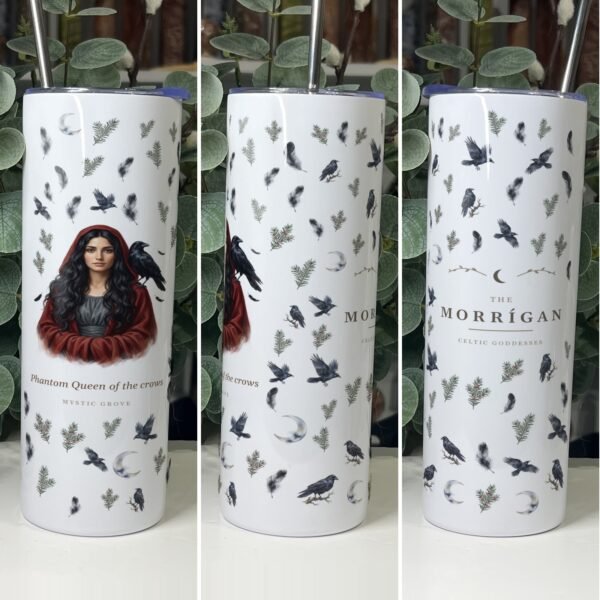
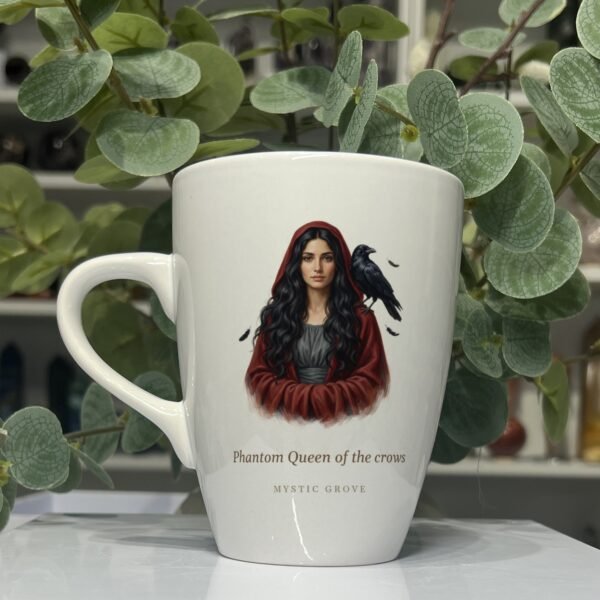
    The Morrígan artwork from this series now comes on a 13oz white ceramic mug and a 20oz skinny tumbler wrapped all the way round in crows, feathers and yew. Each one comes with a printed card telling her story, so it is ready to keep or to give.

    See all the goddess tumblers

    Keep reading: The Dagda, the Good God of Ireland · The Cailleach, the Celtic Winter Goddess · Samhain Meaning · Which Goddess Is Calling You? · Hecate, Goddess of the Crossroads

  • Hecate: Goddess of Crossroads, Keys and the Dark Moon, Her Symbols and How to Say Her Name

    Hecate: Goddess of Crossroads, Keys and the Dark Moon, Her Symbols and How to Say Her Name

    Hecate, the Greek goddess of crossroads, keys, torches and the dark of the moon: who she was, how to say her name, her symbols, and a gentle way to honour her at the next dark moon

    Hecate is one of the most searched goddesses in Britain, and one of the most misunderstood. She is often painted as a frightening figure of the night. In the ancient world she was something more comforting: the one who held the torch at the crossroads, guarded the front door and walked with travellers in the dark. Here is the real Hecate, her honest history, and a simple way to keep her company as autumn turns to winter.

    Hecate stands where three roads meet, her torches burning and her black dog at her side.

    Hecate is one of the goddesses in our guide to moon goddesses, alongside Selene, Artemis, Luna, Diana and Chang’e.

    Hecate at a Glance

    • Who: a Greek goddess of crossroads, doorways, night, magic and the moon
    • How to say it: HEK·uh·tee in everyday British English; Hekate, said heh·kah·TAY, in Greek
    • Family: daughter of the Titans Perses and Asteria, the starry one
    • Roman name: Trivia, “of the three roads”
    • Symbols: twin torches, a key, the crossroads, a dog, the crescent moon and her three faced form
    • Her moon: the dark and waning moon, the last nights before the new moon
    • Her night: in ancient Athens, the dark of the moon at the end of each month
    • Next dark moons: Sunday 8 November 2026, before the New Moon in Scorpio at 7.02am on Monday 9 November; and Tuesday 8 December, before the New Moon in Sagittarius at 12.52am on Wednesday 9 December
    • Stones often linked with her: black obsidian, labradorite, Whitby jet, hematite

    Who Was Hecate?

    Hecate comes from a very old family of Greek gods. Her parents were the Titans Perses and Asteria, and Asteria was linked with the stars and with dreams that tell the future. That makes Hecate older than the Olympian gods like Zeus and Athena. When the Titans and the Olympians went to war, Hecate was one of the few Titans who sided with Zeus, and she was rewarded for it.

    The earliest long description of her comes from the poet Hesiod, writing around 700 BC. He praises her more warmly than almost any other goddess, and says Zeus gave her a share of honour in the earth, the sea and the starry sky. She could bring luck to fishermen, riders, farmers and anyone who called on her kindly.

    The torchbearer

    Hecate’s best known story is the loss of Persephone. When Persephone was carried down into the underworld, almost no one heard her cry. Hecate did. She went to the grieving Demeter carrying a torch in each hand, and together they went to find out what had happened. Later, when Persephone was allowed to return to the world above for part of each year, Hecate became her companion, walking with her between the two worlds. That is the heart of Hecate: the one who brings light into the dark and walks beside you through it.

    Hecate does not take the fear of the dark away. She simply brings a torch and walks with you.

    Goddess of Crossroads and the Front Door

    The Greeks saw a place where three roads met as a powerful, uncertain spot, a place of choice where you could easily lose your way. Hecate was its guardian. Small shrines to her stood at crossroads and beside front doors, and an image of her with three faces could look down all three roads at once. Her Roman name, Trivia, means exactly that: of the three roads. It is where the English word trivial comes from, by a long and winding route.

    She guarded the home too. A household shrine to Hecate by the door was a way of asking her to keep out whatever was not welcome and to watch over the family inside. Her key is part of this picture: the one who holds the key decides what comes in and what goes out.

    Hecate’s supper

    In ancient Athens, the last dark night of each lunar month was hers. Households swept the house clean, gathered up the leftovers of the old month, and left a small meal for Hecate at the nearest crossroads, often bread, eggs and little cakes. It was a way of clearing out the old month and asking her protection for the new one. Very often the poor of the city came by and ate the food, which was quietly understood to be part of the point.

    Hecate and the Moon

    Hecate was not always a moon goddess, but she grew into one. Her three faced form came to be read as the three faces of the moon, waxing, full and waning. Over time she was blended with the two great moon goddesses, Artemis and Selene, and took on much of their lunar meaning. She was linked with eclipses and with all the strange things that happen in the night sky.

    Above all, she belongs to the dark and waning moon, the last thin crescent and the moonless night before the new moon. This is the phase of endings, wisdom and quiet transformation, the time when one month is cleared away so that another can begin. Rites to her were held at night, by torchlight and moonlight, when people felt most in need of guidance.

    Hecate’s Symbols

    Twin torches

    Her oldest and most important symbol: light carried into the dark, both to see by and to keep others safe.

    The key

    The keeper of doors and gateways, between the home and the world, and between one stage of life and the next.

    The crossroads

    Choices, turning points and the moment you have to decide which way to go.

    The dog

    Dogs were her sacred animals, and the howling of dogs at night was said to announce her coming.

    The crescent moon

    Often shown on her brow or above her head, and in some images three crescents together.

    Hecate’s wheel

    A circle with a three way maze inside, often printed on jewellery and altar cloths. It is based on the strophalos, a spinning top described in a set of mystical verses called the Chaldean Oracles, from the second century AD. The neat design you see today is modern, though the idea behind it is old.

    The Honest History: What Is Old and What Is New

    It helps to know which parts of Hecate’s story are ancient and which have grown up more recently, because both are worth knowing.

    • Ancient: her Titan family, Hesiod’s praise, the torches, the crossroads shrines, the dogs, the dark moon suppers and her three faced statues. The sculptor Alcamenes made a famous three bodied Hecate for Athens in the fifth century BC.
    • Ancient, but later: her role as a goddess of witchcraft. In Greek drama and poetry the sorceress Medea is her priestess, and by Roman times Hecate was firmly the goddess of magic and spells.
    • Modern: the reading of Hecate as the Crone of a Maiden, Mother and Crone triple goddess. That pattern was set out by the poet Robert Graves in 1948. Many people today find it a meaningful way to see her as the wise old woman of the waning moon, and it is a lovely image, but it is not how the ancient Greeks described her.
    • Modern: a dedicated Night of Hecate on 16 November, kept by some people today. Its origin is unclear, and it does not appear in the ancient calendar we know of.

    Hecate also walked onto the English stage. In Shakespeare’s Macbeth she appears as the queen of the witches, and there her name is spoken with just two syllables, HEK·it, to fit the rhythm of the verse.

    How to Pronounce Hecate

    There is no single right answer, and you will hear all three of these.

    • HEK·uh·tee: the most common way in British English today, three syllables with the stress on the first.
    • heh·kah·TAY: close to the ancient Greek, Hekate, with the stress at the end.
    • HEK·it: the two syllable Shakespearean way, still heard in theatres.

    Crystals for Hecate

    These stones suit her themes of night, protection, crossroads and quiet wisdom. All are small tumblestones from the shop.

    Black Obsidian

    Dark, glassy and protective, obsidian is the stone most often placed on a Hecate altar. It holds the centre of her grid below.

    Labradorite

    Grey until the light catches it, then suddenly full of blue fire: a torch in the dark, in stone form.

    Whitby Jet

    Fossilised wood from the Yorkshire coast, the stone of Victorian mourning jewellery. It suits Hecate’s role as a companion between this world and the next.

    Hematite

    Heavy, silver and grounding, hematite is a classic protection stone for the doorway and the home.

    Snowflake Obsidian

    Black with soft grey flowers, a gentler obsidian for the endings of the waning moon.

    Bloodstone

    Dark green flecked with red, a stone of courage for the moment you choose your road.

    Chevron Amethyst

    Purple and white in bold stripes, a calm, intuitive stone for listening to your own inner voice.

    The Crossroads Grid

    This grid is laid like a place where three roads meet. The focus stone sits at the meeting point, Hecate’s place, and two stones line each road: the road behind you, the road you stand on, and the road ahead.

    MYSTIC GROVE · THE CROSSROADS GRID Focus 5 6 1 2 3 4 The road ahead 5 Labradorite, 6 Chevron Amethyst The road behind 1 Whitby Jet, 2 Snowflake Obsidian The road you stand on 3 Hematite, 4 Bloodstone Black Obsidian THE CROSSROADS GRID Focus 5 6 1 2 3 4 Focus: Black Obsidian Behind: 1 Whitby Jet, 2 Snowflake Obsidian Here: 3 Hematite, 4 Bloodstone Ahead: 5 Labradorite, 6 Chevron Amethyst
    The Crossroads Grid. Black obsidian sits where the three roads meet; two stones line each road, the nearest stone first.

    The Focus Stone

    Black Obsidian, the meeting point

    The centre is the crossroads itself, the place of choosing, so it holds protection and honesty together. If you would rather, hematite works well in the centre for a grid about keeping your home safe. If you have a small clear quartz point, stand it in the centre pointing upwards; and if you have neither, any clear quartz will do.

    The Three Roads

    The road behind: 1 Whitby Jet and 2 Snowflake Obsidian

    What you are leaving and what you want to remember from it. Whitby jet carries remembrance; snowflake obsidian helps you let the rest go.

    The road you stand on: 3 Hematite and 4 Bloodstone

    Where you are now. Hematite keeps your feet on the ground; bloodstone gives you the courage to make a choice.

    The road ahead: 5 Labradorite and 6 Chevron Amethyst

    Where you are going. Labradorite is the torch for the unknown; chevron amethyst is the calm voice telling you which way.

    How this grid connects. There are no Way Stones in the Crossroads Grid. Each road is a straight line running out from the focus stone, with its two stones on it, the nearer one first. Lay the centre first, then the road behind, then the road you stand on, then the road ahead.

    A Gentle Dark Moon Practice for Hecate

    This is a simple, respectful way to mark the dark of the moon in Hecate’s company. The next dark moon night is Sunday 8 November 2026, the evening before the New Moon in Scorpio. There is no need to call on her if that does not sit right with you; it works just as well as a quiet night of clearing out and choosing your road.

    What you need

    The practice

    1. Clear the threshold. Sweep or tidy just inside your front door. Listen to the sound of the brush and let it mean that the old month is going.
    2. Settle. Sit somewhere quiet with the lights low. Breathe in for four, out for six, five times.
    3. Light the candle. As the flame catches, say: “A light at the crossroads.”
    4. Build the grid. Place the obsidian first, then each road in turn, naming it out loud: the road behind me, the road I stand on, the road ahead.
    5. Hold the key. Feel its cold weight warm in your hand. Name, out loud, one thing you are locking out of the coming month and one thing you are opening the door to.
    6. Listen. Sit with the key in your lap for a few minutes in silence. Notice any sound, word or feeling that comes. Some people find a picture comes; others hear a word or simply feel a sense of which way to go. All are welcome.
    7. Close. Snuff the candle. Put the key back in its usual place, by the door if you can.
    8. Leave the supper. In the morning, put the bread or seed out in the garden for the birds, or give something to a food bank that week. It is the modern version of Hecate’s supper, and very much in her spirit.

    Signs Hecate Is Calling You

    People who feel drawn to Hecate often describe the same handful of signs. None of them proves anything on its own, but several together, over a few weeks, are worth paying attention to.

    • Dogs. Dogs were sacred to Hecate. A dog that follows you, or a black dog in your dreams, is the sign people mention most.
    • Keys, doors and crossroads. Finding old keys, noticing doorways and thresholds, or arriving at a crossroads in your life.
    • The dark of the moon. Feeling most awake and most yourself in the nights before the new moon.
    • Torchlight and candle flames that catch and hold your attention at night.
    • Her name. Hearing or reading it again and again, especially in autumn and around the Night of Hecate in November.
    • A turning point. Hecate tends to arrive when a choice has to be made, or one chapter of life is ending.

    If this sounds familiar, the dark moon practice above is a gentle way to begin. For the signs of other goddesses, and a short quiz, see how to know which goddess is calling you.

    The Seven Moon Goddesses Film

    Hecate closes our short film of seven moon goddesses, which follows the moon from the Hunter’s Moon to Samhain night. Meet the others in our guide to moon goddesses.

    Seven Moon Goddesses: a one minute film, from the Hunter’s Moon to Samhain

    Questions People Ask About Hecate

    What is Hecate the goddess of?

    Crossroads, doorways, keys, the night, magic, the moon and the paths between this world and the next. She is also a protector of the home.

    Is Hecate a good or bad goddess?

    In the ancient world she was mostly seen as a helper and protector, praised warmly by Hesiod and kept at front doors. Her darker reputation grew later, through stories about witches and the night. Both sides are part of her.

    What are Hecate’s symbols?

    Twin torches, a key, the crossroads, dogs, the crescent moon and her three faced form. Hecate’s wheel is a newer symbol based on an old idea.

    Is Hecate a moon goddess?

    She became one over time. Her three faces came to stand for the phases of the moon, and she was blended with the moon goddesses Artemis and Selene. She belongs especially to the dark and waning moon.

    Is Hecate the Maiden, Mother and Crone?

    Not in ancient sources. Her three faces are ancient, but the Maiden, Mother and Crone pattern comes from Robert Graves in 1948. Many people use it today as a modern way of seeing her.

    When is Hecate’s night?

    In ancient Athens, the dark of the moon at the end of each month. The next one is the night of Sunday 8 November 2026.

    Your Hecate Toolkit

    For the dark moon on Sunday 8 November: black obsidian and Whitby jet for the Crossroads Grid, black or white Manifest Magic chime candles with a triple moon candle holder, the triple moon offering plate, and a carved raven skull for a dark of the year altar.

    Shop black obsidian

    Bring Hecate home

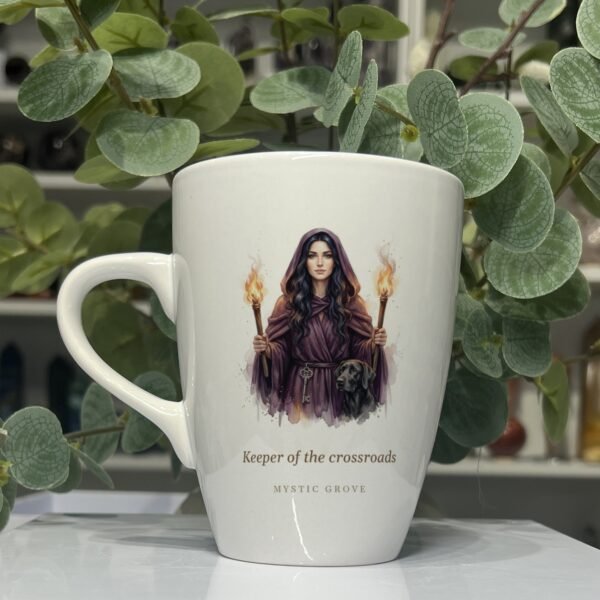
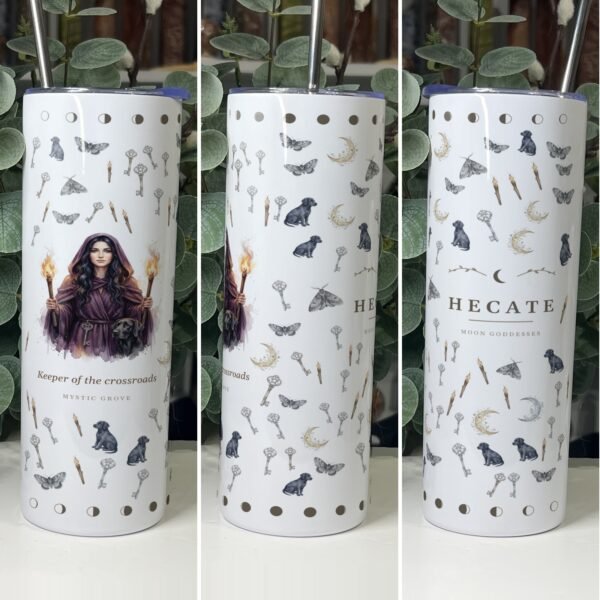
    The Hecate artwork from this series now comes on a 13oz white ceramic mug and a 20oz skinny tumbler wrapped all the way round in keys, torches and moths. Each one comes with a printed card telling her story, so it is ready to keep or to give.

    See all the goddess tumblers

  • New Moon in Scorpio 2026: Monday 9 November Ritual, Crystals and Grid

    New Moon in Scorpio 2026: Monday 9 November Ritual, Crystals and Grid

    The New Moon in Scorpio 2026 falls at 7.02am on Monday 9 November: a quiet new beginning in the darkest stretch of the year, with seven stones and a bulb planting ritual

    The next new moon

    Monday 9 November 2026 at 7.02am

    UK time (GMT). Work with it any time from Monday evening to Wednesday night.

    The New Moon in Scorpio 2026 arrives early on Monday 9 November, in the week the country falls quiet for Remembrance. It is the deepest new moon of the year, the one that sits in the dark of autumn, after the leaves have come down and before the lights of Yule go up. Scorpio is the sign of what lies under the surface, and this new moon asks a brave, gentle question: what is ready to begin again, now that something else has ended?

    New Moon in Scorpio 2026 at a Glance

    • Exact: Monday 9 November 2026 at 7.02am UK time (GMT)
    • Sign: Scorpio, a water sign, the sign of the scorpion
    • Ruling planets: Mars in traditional astrology; Pluto in modern astrology
    • Planetary day: Monday, the Moon’s own day, with its colours of white, lavender and grey
    • Numerology of the date: 9.11.2026; 9 + 1 + 1 + 2 + 0 + 2 + 6 = 21, and 2 + 1 = 3, the number of growth; the month itself carries 11, the number of intuition
    • Eclipse: none, this is an ordinary new moon
    • Working window: Monday evening to Wednesday night
    • First crescent: usually seen low in the south west just after sunset, around Wednesday 11 November
    • The week around it: Remembrance Sunday on 8 November and Armistice Day on Wednesday 11 November
    • Previous full moon: the Hunter’s Moon in Taurus, 4.12am on Monday 26 October
    • This cycle ends: the Beaver Moon in Gemini, a supermoon, at 2.54pm on Tuesday 24 November
    • Next new moon: the New Moon in Sagittarius, 12.52am on Wednesday 9 December

    Where This New Moon Sits in the Weeks Ahead

    Here is the whole stretch in order, from the Hunter’s Moon to the next new moon, so the dates never get muddled. Everything on this page is for 2026.

    MYSTIC GROVE · THE MOON IN ORDER Mon 26 Oct Hunter’s Moon Sat 31 Oct Samhain Sun 8 Nov Remembrance Sunday Mon 9 Nov New Moon in Scorpio 7.02am · this one Wed 11 Nov Armistice Day Tue 24 Nov Beaver Moon supermoon 2.54pm Wed 9 Dec New Moon in Sagittarius 12.52am All times UK clock time · 2026 THE MOON IN ORDER Mon 26 Oct Hunter’s Moon in Taurus Sat 31 Oct Samhain Mon 9 Nov, 7.02am New Moon in Scorpio this one Wed 11 Nov Armistice Day Tue 24 Nov, 2.54pm Beaver Moon supermoon Wed 9 Dec, 12.52am New Moon in Sagittarius
    The weeks ahead in order. Open circles are new moons, filled circles are full moons. All times are UK clock time for 2026.

    Last year’s Scorpio new moon fell on 20 November 2025. The dates move each year because the Moon’s month is a little shorter than our calendar months, so always check the year at the top of a moon guide. Our moon guides are sorted by year to make that easy.

    Never Kept a New Moon Before? Start Here

    Once a month the Moon passes between us and the Sun. The side lit by the Sun faces away from us, so for a night or two there is no Moon to see at all. That dark night is the new moon. Over the following two weeks a thin crescent appears in the evening sky and grows to the full moon, then shrinks away again. The whole round takes about 29 and a half days.

    Keeping a new moon simply means pausing on that dark night to choose one thing you want to begin, and giving it the month to grow. Traditionally the work is done once the dark has passed and the very first crescent is on its way, which is why the best evenings for this one are Monday to Wednesday. A candle, a notebook and a few small stones are plenty.

    The one thing to remember. The new moon is the exact moment, 7.02am on Monday 9 November. You do not need to do anything at that minute. Monday evening is ideal, and the beginning energy stays fresh until Wednesday night, when the first silver crescent appears.

    What the New Moon in Scorpio Means

    Every new moon happens in the same sign as the Sun, and in early November the Sun is in Scorpio. Scorpio is a water sign, but it is water deep underground: still, dark and powerful. Its themes are endings and renewal, honesty, loyalty, privacy and the things we feel most strongly but rarely say out loud.

    That makes the New Moon in Scorpio a beginning that comes after an ending. It suits a fresh start after a loss, a hard truth you are finally ready to face, a habit you are ready to leave behind for good, or a commitment you want to make to yourself in private, without telling anyone yet. Scorpio intentions are best kept close. They grow strongest when they are not talked about too soon.

    A bulb in November soil looks like nothing at all. Scorpio knows better.

    A Monday new moon in the week of Remembrance

    This year the new moon lands on a Monday, the Moon’s own day, the day of home, family and peace. It also sits between Remembrance Sunday on 8 November and Armistice Day on Wednesday 11 November, when the country keeps two minutes of silence at the eleventh hour. Scorpio has always been the sign most at ease with remembering those who have gone. If you are missing someone this autumn, this is a kind new moon for an intention that carries them forward with you.

    The number of the date

    The date reads 9.11.2026. Nine is the number of completion, and eleven, the number of the month, is one of numerology’s master numbers, linked with intuition. Add every digit together and they come to 21, then 3, the number of growth. Completion, intuition, growth: a fair summary of what this moon is for.

    The story behind the sky

    In ancient Athens, the last dark night of each lunar month belonged to Hecate, the goddess of crossroads, keys and the night. Households cleared out the old month and left a small supper for her where the roads met, so that the new month could begin clean. It is a story worth carrying into a Scorpio new moon: tidy away the old, and then begin. Our guide to Hecate, goddess of crossroads and the dark moon tells her story in full.

    The Honest History of Scorpio

    The scorpion is one of the oldest figures in the sky. Babylonian astronomers saw a scorpion in these stars more than three thousand years ago, and the Greeks inherited it. For a long time the Scorpion was so large that the stars we now call Libra were counted as its claws, until the Romans settled the scales as a sign of their own. In Greek myth, the scorpion was sent to defeat the hunter Orion, and the two were set on opposite sides of the sky, so that Orion sets in the west as the Scorpion rises in the east.

    Scorpio’s traditional ruler is Mars. When Pluto was discovered in 1930, many astrologers began to give Scorpio to Pluto instead, and today you will see both. We mention both, because both readings are in common use.

    Crystals for the New Moon in Scorpio

    These stones are chosen for Scorpio’s themes of depth, honesty, courage and renewal. Every one is a small tumblestone, so the whole set sits in one hand.

    Purple Labradorite

    Labradorite is the classic new moon stone, dark until the light finds it and then suddenly full of colour. This purple variety holds the centre of the grid, for beginnings that start in the dark.

    Black Obsidian

    Volcanic glass, formed when molten rock cools too quickly to make crystals. Obsidian is the traditional stone of honesty with yourself, which is where every Scorpio beginning starts.

    Whitby Jet

    Fossilised wood from the Yorkshire coast. Whitby jet became the stone of mourning jewellery in the nineteenth century, so it carries remembrance in a very British way. It belongs here for anyone carrying someone with them into the new month.

    Bloodstone

    Dark green with flecks of red, bloodstone is a stone of courage, long linked with Mars, the traditional ruler of Scorpio. It is kept for the bravery a new start sometimes needs.

    Ruby Zoisite

    Green with pink and red set into it, ruby zoisite is a stone of growth and renewed energy, a lovely picture of something bright coming through something solid.

    Dragon Stone

    Deep green streaked with red, dragon stone is a steady, strengthening stone, kept for staying the course once the excitement of beginning wears off.

    Lepidolite

    Lilac and gently glittering, lepidolite is a calming stone. Scorpio feels everything deeply, so a little calm belongs in the mix.

    The Spiral Grid for the New Moon in Scorpio

    This grid is laid as a spiral, the oldest shape for going down into the dark and coming back out renewed. The focus stone sits at the heart, and the other six follow a single winding line outwards, from the deepest work to the gentlest.

    MYSTIC GROVE · THE SPIRAL GRID Focus 1 2 3 4 5 6 Focus Purple Labradorite 1 Black Obsidian 2 Whitby Jet 3 Bloodstone 4 Ruby Zoisite 5 Dragon Stone 6 Lepidolite Follow the line from the centre outwards, one to six THE SPIRAL GRID Focus 1 2 3 4 5 6 Focus: Purple Labradorite 1 Black Obsidian, 2 Whitby Jet 3 Bloodstone, 4 Ruby Zoisite 5 Dragon Stone, 6 Lepidolite
    The Spiral Grid. Purple labradorite at the heart; the six stones follow one winding line outwards, from the deepest work to the gentlest.

    The Focus Stone

    Purple Labradorite, the seed in the dark

    The centre of a spiral is the deepest point, where the journey turns and begins to come back out. Labradorite sits here because it is the new moon’s own stone, dark until the light catches it. If you would rather, black obsidian works well in the centre for an intention about honesty or a clean break. If you have a small clear quartz point, it can stand in the centre instead, pointing upwards; and if you have neither, any clear quartz will do.

    The Spiral Stones

    1 Black Obsidian and 2 Whitby Jet, the truth and the remembering

    The two stones closest to the centre hold the deepest work. Obsidian asks for honesty about what has ended; Whitby jet carries what you want to remember from it.

    3 Bloodstone and 4 Ruby Zoisite, the courage and the renewal

    The middle turns of the spiral. Bloodstone brings Mars courage to the beginning, and ruby zoisite carries the first signs of new growth coming through.

    5 Dragon Stone and 6 Lepidolite, the staying power and the calm

    The outermost turns, closest to everyday life. Dragon stone keeps you going once the start is behind you, and lepidolite keeps it all gentle.

    How this grid connects. There are no Way Stones in the Spiral Grid. A single line winds from the focus stone out through each stone in turn, one to six, so the energy runs like a path. Lay the centre first, then follow the spiral outwards, saying each stone’s two words as it goes down: the truth, the remembering, the courage, the renewal, the staying power, the calm.

    A New Moon in Scorpio Ritual: Planting in the Dark

    November is the month for planting tulips and other spring bulbs, which makes it the perfect time for a new moon ritual you can hold in your hands. About twenty minutes, any evening from Monday to Wednesday.

    What you need

    The practice

    1. Settle. Turn the lights low. Breathe in through your nose for a count of four, and out slowly through your mouth for a count of eight, letting the breath out as a long, quiet sigh. Repeat seven times.
    2. Light the candle. As the flame catches, say quietly: “Something ended. Something begins.”
    3. Name what ended. In your notebook, write one or two lines about what has finished this autumn. Read them aloud once, then close the notebook.
    4. Write the beginning. On the small slip, write one private intention, a single sentence with a date in it. For example: “By Yule I will have finished the first chapter.” Fold it small.
    5. Build the grid. Place the labradorite first, then follow the spiral outwards, saying each stone’s two words as it goes down.
    6. Hold the bulb. Take the bulb in your hand and feel its weight, its papery skin and its point. Press the folded intention against it and say your intention aloud.
    7. Plant it. Plant the bulb, point upwards, about three times its own depth, with the folded slip tucked into the soil beside it. Press the soil down firmly with your palms.
    8. Close. Snuff the candle. Leave the grid in place until the Beaver Moon on 24 November. In spring, when the first green shoot appears, read your intention again.

    Questions People Ask About the New Moon in Scorpio

    What time is the New Moon in Scorpio 2026?

    7.02am UK time (GMT) on Monday 9 November 2026.

    When should I do a new moon ritual?

    Any evening from Monday 9 to Wednesday 11 November. The exact moment is early on Monday morning, and the beginning energy is fresh for the next two to three days, until the first crescent is seen.

    Is there an eclipse in November 2026?

    No. The New Moon in Scorpio 2026 is an ordinary new moon.

    What is the New Moon in Scorpio good for?

    Fresh starts after an ending, private commitments, honesty with yourself, breaking an old habit for good, and remembering someone you have lost while carrying on with your own life.

    When is the next full moon?

    The Beaver Moon in Gemini, a supermoon, at 2.54pm on Tuesday 24 November 2026.

    Is this the same as last year’s Scorpio new moon?

    No. Last year’s fell on 20 November 2025. The guide you are reading is for 2026.

    Journal Prompts for the New Moon in Scorpio

    • What ended this year that I have not yet fully let myself feel?
    • What truth about my life am I finally ready to say, if only to myself?
    • Who would I like to carry with me into the new year, and how?
    • Which habit would I quietly leave behind if no one were watching?
    • What would I begin if I trusted that it could grow in the dark for a while?

    Your New Moon in Scorpio Toolkit

    Everything for Monday 9 November in one place: the Scorpio Crystal Zodiac Tumblestone Set, single tumblestones for the Spiral Grid including purple labradorite and Whitby jet, the New Moon Manifestation Candle with Clear Quartz, white Manifest Magic chime candles, and a Moon Phase Notebook to keep each moon’s intention in one place.

    Shop the Scorpio set

  • Full Flower Moon 2026: Scorpio’s Shadow Meets the Beltane Fires

    Full Flower Moon 2026: Scorpio’s Shadow Meets the Beltane Fires

    A grounded UK guide to the rare Beltane Full Moon alignment

    The Full Flower Moon 2026 rises in Scorpio on Friday 1 May, exactly on Beltane. A grounded guide to what is happening in the sky, the crystals to work with, and a simple ritual you can do at the kitchen table.

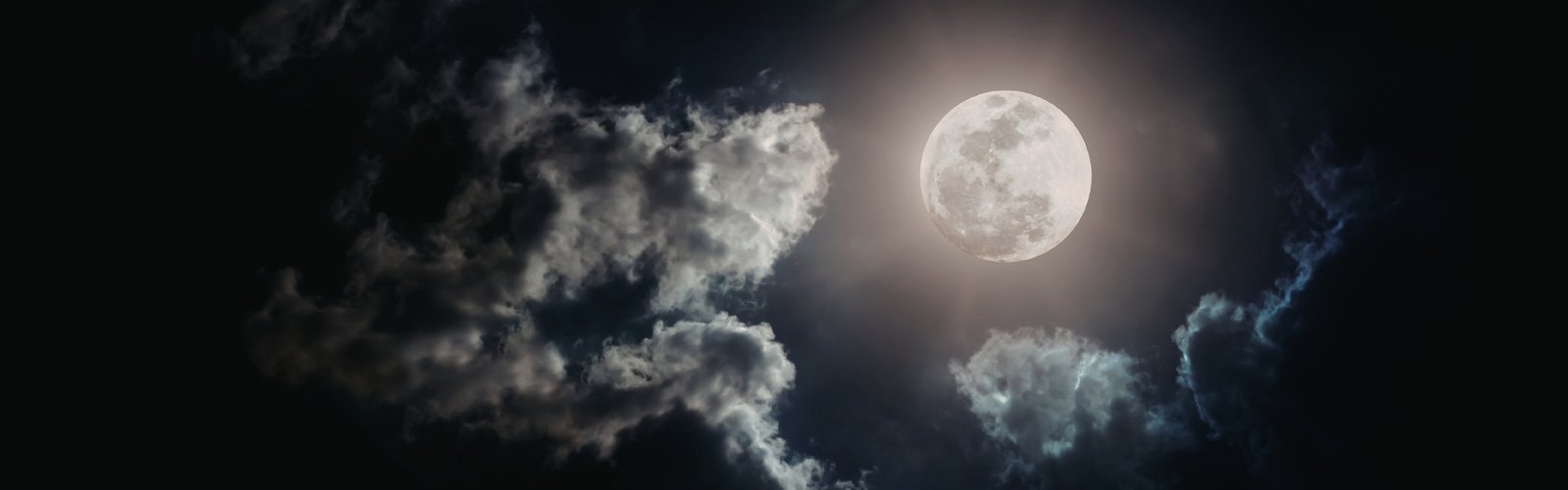
    Full Flower Moon 2026 in Scorpio rising over a hawthorn hedgerow on Beltane night

    There is a particular quality to the May hedgerow that the country walker knows in her body before she knows it in her head. The hawthorn is out. The blackthorn has finished. The bluebells have done their two week burn and are starting to fade. The whole green world has tipped over from waking up into being awake.

    This is the air the Full Flower Moon 2026 rises into. She arrives on Friday 1 May at 9.23pm BST, sitting in Scorpio at 11°21′. The same evening Beltane lights her fires across the Wheel of the Year. The same evening the country has held as a fire festival for as long as anyone has bothered to remember.

    It is not often that one of the great cross quarter festivals of the Wheel falls on the night of a Full Moon, and rarer still that the Moon herself is in Scorpio when she does. The two energies are doing very different work. Beltane wants you outside, in your body, in the warm light. Scorpio wants you honest about what is moving underneath. They do not cancel each other out. They make a strange and useful pair for one night.

    The May Full Moon in Scorpio is also a Micro Moon, the furthest of the year from earth, and the first of two Full Moons in May. Fifteen days from this peak, on 31 May, the Blue Moon in Sagittarius arrives to close the chapter. What you sit with on Friday night is the seed of what releases at the end of the month.

    What is Actually Happening This Year

    The 2026 Full Flower Moon is technically a Micromoon. She sits at apogee, her furthest point from earth in her orbit, and will appear slightly smaller and softer in the sky than an average Full Moon. The energy follows the form. Micromoons tend to feel less dramatic and more internal than the big perigee Supermoons. For a Scorpio Full Moon to arrive in Micro form is fitting. The work she invites is the quiet kind.

    The peak is at 9.23pm BST on Friday 1 May. The most charged window for ritual work is the four to six hours after that exact peak, which means anything from 9.23pm through to the early hours of Saturday morning is the working window for the night.

    And there is one more layer. May 2026 is a rare two Full Moon month. The Blue Moon in Sagittarius arrives on 31 May at 9.45am BST at 9°56′. So this Flower Moon is opening a thirty day chapter that closes with one of the most expansive lunations of the year. The Scorpio Moon asks you to name the truth. The Sagittarius Blue Moon asks what you are going to do about it. Hold the two of them as one arc.

    Beltane and the Scorpio Moon, the Odd Pair

    Beltane is one of the most embodied festivals on the Wheel of the Year. Bonfires, hawthorn flowers, the maypole, bare feet on warm grass, the leaping of fires for blessing. She lives in the body, in the senses, in the pleasure of being alive. She is not subtle.

    Scorpio is the opposite kind of energy. She is the most internal of the water signs, the bit of you that knows things before you have admitted them out loud. A Full Moon in Scorpio always brings up what has been kept quiet, even if you were not aware you were keeping it quiet.

    When you put them together, you get something rare. Beltane gives you permission to actually feel pleasure in your body and enjoy being alive. Scorpio asks you to be honest about what you find when you do. Most of the year we celebrate without being too truthful, or we get truthful but lose the ability to celebrate. This Moon is asking for both at once.

    Most of the year we celebrate without being too truthful, or we get truthful but lose the ability to celebrate. This Moon is asking for both at once.

    A Simple Ritual for the Flower Moon

    This is the heart of the Moon. Everything else in this piece holds her in context, but the ritual is where the work lives. Build it for the hours immediately after the Full Moon goes exact at 9.23pm BST on Friday 1 May. If you can be outside for any part of it, that is a gift. If not, a windowsill with a view of the sky is enough.

    There are two versions below. The first is the full altar version, suited to anyone who has the time and the inclination to settle into a longer working. The second is the kitchen table version, which uses what is already in your house and takes ten minutes. Both honour the same alignment. The Moon does not measure the gesture by what it cost.

    Version one | The full altar ritual

    What you will need

    • A white candle for Beltane and a black or deep red candle for Scorpio
    • A small heatproof bowl
    • A piece of paper and a pen
    • One or more of the crystals listed below. Moonstone, Labradorite or Selenite if you can choose
    • A sprig of hawthorn or any white blossom from a hedge or garden
    • A stick of incense if you have one. Frankincense, sandalwood or rose

    The ritual

    Light the white candle first. As the flame catches, name aloud or in your head what you are celebrating about this season of your life. What has bloomed. What has come back to you. What you can feel growing. Take your time. Beltane is not a sign that asks for haste.

    Light the black or red candle next. As the second flame catches, ask yourself the Scorpio question. What is the truth I have not let myself say? Sit with whatever rises. There is no need to write it down yet. The point is to feel it without flinching.

    When you are ready, write the truth on the paper. One or two sentences. Keep it simple.

    Hold your crystal in your dominant hand. Read the truth back to yourself, slowly, three times. The first reading is for acknowledging it. The second is for honouring it. The third is for letting it go.

    Light the corner of the paper from the black candle. Let it burn safely in the heatproof bowl. As it burns, watch the smoke rise. Beltane carries the truth out into the world. Scorpio releases what you have been holding.

    When the paper has burned to ash, blow out the candles in the order you lit them. White first, then black. In the morning, take the ash outside and return it to the earth. The base of a hedge or a tree, a wild patch on your walk, a windowbox if you have one.

    Leave your crystal on the windowsill overnight to charge in the moonlight.

    Version two | The kitchen table ritual

    This is for anyone who does not have an altar set up, who does not want to buy something new for one ritual, or who simply wants the ten minute version. Your kitchen holds enough.

    What you will need

    • One candle. Any candle. A tea light from the bottom drawer is fine
    • A small bowl or saucer
    • A piece of paper and a pen
    • A pinch of salt
    • Whatever crystal you have, if you have one

    The ritual

    Sit at your kitchen table. Light the candle. Place the bowl in front of you with the pinch of salt in the bottom. Salt has carried cleansing in folk practice across most of Europe for centuries. She does the same job here.

    Hold the crystal if you have one. Hold your own hand if you do not. Speak the Beltane question first. What am I celebrating tonight? Then the Scorpio question. What truth have I been keeping quiet?

    Write whatever surfaces on the paper. Fold it twice. Tear off one corner and burn that corner over the candle, dropping the ash into the bowl with the salt. The rest of the paper goes in the bin in the morning, and the salt and ash go onto the soil of a houseplant or out into the garden.

    That is the whole ritual. Ten minutes. Done at the kitchen table with a candle and a bowl. The Moon receives it as fully as she receives the longer version.

    It is not a Moon for performing. It is a Moon for arriving. Wherever you arrive, the answer is yes.

    The Crystals for the Flower Moon

    Six crystals carry this Moon particularly well. Each does a slightly different job, and they layer beautifully if you have several. If you only have one, choose by feel rather than by list. And if you have none, the kitchen table ritual works without them. The whole Mystic Grove crystal collection is here when you are ready.

    Each of these stones has qualities that have been recognised across many cultures and over long stretches of time. We work with them here within the rhythm of the Wheel of the Year, holding their wider lineages with respect rather than claim.

    Moonstone

    Moonstone is the one I always reach for first on a Full Moon night. The Romans believed she was made of solidified moonbeams, and both Greeks and Romans associated her directly with their lunar deities. In Sri Lanka and India she has been venerated for at least two thousand years as a sacred stone of the moon, set traditionally on the brow of lunar deities and carried as a stone of intuition and night travel.

    Most commercial moonstone today comes from Sri Lanka, with the finest blue flash variety historically from Myanmar, where she is known as Mukdahan. The qualities people have recognised in her, the lunar tuning, the soft adularescence that catches the light like the moon catches it, the association with cycles and intuition, are extraordinarily consistent across the cultures who have known her.

    For the Scorpio Flower Moon she takes the edge off the intensity. Where Scorpio can feel airless, Moonstone reminds you that emotion comes in waves, the wave will pass, and the Moon herself returns to the same point every month. Hold her while you ask the harder question. Browse Moonstone at Mystic Grove.

    Labradorite

    Labradorite was first identified in 1770 by Moravian missionaries on the Labrador peninsula in Canada, though the Innu and Inuit peoples of that land had known her long before. Innu legend holds that the northern lights were once trapped inside the rocks of the Labrador coast, and that a warrior struck the rocks with his spear and freed most of the lights into the sky, leaving the remainder caught inside what we now call Labradorite. The flash you see when you turn her in the light is the part of the aurora she still holds.

    She is for intuition, for dream work, and for the place where the seen and the unseen meet, which is a description of Scorpio if there ever was one. Hold her in your dominant hand during the moments of the ritual when you ask the deeper question. Her flash of blue and gold under the dark surface is also a useful visual reminder of what Scorpio actually is. Depth that holds light at the heart of it. Browse Labradorite at Mystic Grove.

    Selenite

    Selenite takes her name from Selene, the Greek goddess of the moon. She has been worked since antiquity, and translucent slabs of her were used in temple windows in ancient Rome to let in a soft, lunar quality of light, which is where the original Roman name lapis specularis came from. Selene’s stone, mirror stone, the moon’s own glass.

    She is your cleanser through any lunar work. She does not need recharging herself, she does not need looking after, and she will clear whatever you put on her. After the ritual, lay your other crystals on a piece of Selenite to clear what they picked up during the working. She is also the easiest stone to charge in moonlight. A tower on the windowsill catches the moonbeams and holds them through the next month. Browse Selenite at Mystic Grove.

    Black Tourmaline

    Black Tourmaline, known in mineralogy as Schorl, has been used as a protective stone in folk practice across Europe and Asia for centuries. Mediaeval sources describe her being placed at the four corners of a working space, and she still does the same job today. Her crystal structure is what mineralogists call pyroelectric, meaning she carries a small electrical charge when warmed, which may be part of why people have intuitively turned to her as a stone of grounding and energetic clearing for so long.

    For Scorpio work she is essential. When the deeper question gets asked and the body starts answering with old grief or memory you had forgotten about, Black Tourmaline keeps you anchored. She does not stop the work happening. She makes it safer to do. Place a piece at each corner of the altar, or carry one in your pocket through the evening. Browse Tourmaline at Mystic Grove.

    Rose Quartz

    Rose Quartz is one of the oldest worked stones in the human record. Beads have been recovered from sites in the ancient Near East dating to around 7000 BCE. The Greeks held her as a stone of Aphrodite, who became Venus to the Romans, and she has been associated with the heart and with gentleness across many cultures since.

    She is the Beltane half of this alignment. Where Scorpio asks for truth, Beltane asks for love, and Rose Quartz lets the truth be received gently rather than harshly. She softens the field around the working so that whatever surfaces can be met with kindness rather than judgement. The stone that says, whatever comes up tonight, I will not be cruel to myself about it. Browse Rose Quartz at Mystic Grove.

    Obsidian

    Obsidian is volcanic glass, born of fire meeting cold and cooled before crystals could form. She has been worked across many cultures for tools, weapons and scrying mirrors, with John Dee’s famous obsidian mirror in the British Museum a 16th century example of the latter. The Aztec and Mayan peoples of central America held her as a stone of the underworld and of unflinching sight, and her qualities of cutting through illusion have been recognised independently in many other lineages.

    She is for the practitioner ready for the most direct version of Scorpio work. If there is something specific you have been avoiding looking at, Obsidian will ask you to look. Use her with care and only if you are ready. She is not a stone for soothing. She is a stone for truth, and there is a difference. Browse Obsidian at Mystic Grove.

    An Ancestral Note on the Beltane Fires

    Beltane fires were once lit on every hilltop in Ireland and Scotland on the eve of 1 May. Cattle were driven between two fires for blessing on the way to summer pasture. Couples leapt the fires for fertility. The folklorist Frederick Marian McNeill recorded that in some Highland communities into the early 20th century, every household hearth was extinguished on Beltane Eve and relit only from a coal carried from the communal need fire on the hill.

    The same fires that once travelled by hand from hilltop to home are the fires this Moon lights now. Whatever scale you keep them at, you are keeping a very old flame. A single candle on a kitchen table is enough.

    Journal Prompts for the Days Around the Moon

    The energy of the Flower Moon does not arrive only on the evening she peaks. It builds in the days before her and softens for a few days after. The prompts below are for working through the whole window, from late April into the first week of May. Pick one prompt per evening. Write for ten minutes without stopping. The point is not to be eloquent. The point is to be honest.

    • What has come into bloom in my life that I have not noticed?
    • What truth has been stirring that I have been keeping quiet?
    • If I let myself live fully in my body this month, what would change?
    • Which relationship is asking for honesty rather than smoothing over?
    • What desire have I been pretending not to feel?
    • What old grief is asking to be honoured before I let it go?
    • If Beltane gives me permission to celebrate, what am I celebrating?
    • If Scorpio asks for the truth, what am I avoiding?

    Herbs, Oils and Candles to Layer With

    If you would like to deepen the ritual with the wider apothecary of the season, here are some traditional correspondences that sit naturally alongside the Flower Moon. Use what you have to hand. None of this is required. All of it is welcome.

    Herbs and flowers

    • Hawthorn, the May tree herself, blooming exactly now and the gateway plant of Beltane
    • Mugwort, traditional for Scorpio and the thinning veil between worlds
    • Rose petals, for Venus and the heart
    • Rosemary, for cleansing and remembering
    • Yarrow, for Scorpio protection and the folk magic of the season
    • Vervain, the Beltane procession herb of these islands
    • Meadowsweet, for sweetness and the gentler half of the alignment

    Essential oils

    A drop of the right oil will lift any ritual into another register. Browse the essential oils and blends at Mystic Grove, and consider these for the Scorpio Flower Moon.

    • Frankincense, for sacred fire and the deeper reach of Scorpio
    • Myrrh, the underworld oil, for honest sitting with what surfaces
    • Rose, for the Beltane heart
    • Sandalwood, for grounded presence through the working
    • Patchouli, for the deep earth and Scorpio’s underground rivers
    • Hawthorn, when you can find her, for the Beltane lineage

    Candles

    Candle colour carries its own quiet language. Our ritual candle collection sits in the wider Mystic Grove candle range, and these colours are the ones aligned with this Moon.

    • White, for Beltane and the Full Moon
    • Black, for Scorpio and the work of release
    • Deep red, for the Beltane fire and the heart of Scorpio
    • Silver, for lunar work and the Goddess
    • Pink, for Venus and the gentle heart

    Light any single candle from this list during the ritual. Anoint it with one drop of any oil from the list. Sit a small handful of any herb at the base. The combinations are yours to build from what you have, and the Moon receives whatever is offered with the same patient grace.

    Frequently Asked Questions

    What date is the Full Flower Moon 2026?

    The Full Flower Moon 2026 falls on Friday 1 May at 9.23pm BST in the UK. She rises in Scorpio at 11°21′ and is a Micromoon, sitting at apogee, her furthest point from earth in her orbit. She is also the first of two Full Moons in May, with the second arriving on 31 May as a Blue Moon in Sagittarius. The 1 May date means this Flower Moon falls on Beltane itself, an unusual alignment that does not come along often.

    What is the spiritual meaning of the Flower Moon in Scorpio?

    The Flower Moon in Scorpio brings together two distinct energies. The Flower Moon herself is the May Full Moon traditionally associated with bloom, fertility and the noticing of what has survived the winter. Scorpio is the most internal of the water signs and is associated with honest emotion, hidden truth, and the surfacing of what has been kept quiet. Together they ask the practitioner to celebrate what has bloomed in her life while being honest about what is moving underneath.

    What is a Beltane Full Moon and why is it rare?

    A Beltane Full Moon is a Full Moon that falls on or close to Beltane, the cross quarter fire festival of the Wheel of the Year on 1 May. The alignment is rare because the lunar cycle and the solar calendar move at different rates, and a Full Moon falling exactly on a major festival day happens only every few years. The 2026 Beltane Full Moon is particularly significant because she lands on the festival itself and is in Scorpio, which adds a layer of depth and emotional honesty to the celebration.

    What crystals work best for a Scorpio Full Moon?

    The crystals most associated with Scorpio Full Moon work are Moonstone for lunar tuning, Labradorite for intuition and dream work, Selenite for cleansing, Black Tourmaline for grounding, Rose Quartz for the gentle heart, and Obsidian for the most direct truth work. For the 2026 Flower Moon, layering Moonstone with Labradorite is particularly powerful because both stones bridge the seen and the unseen in different ways.

    How do I do a Full Moon ritual at home?

    A Full Moon ritual at home does not have to be elaborate. The simplest version uses one candle, a piece of paper, and ten minutes at your kitchen table. Light the candle. Name what you are celebrating. Name what you are releasing. Write the release on the paper, burn a corner of it safely, and return the ash to the earth in the morning. The longer altar version layers in two candles, crystals, herbs and incense, but the gesture is the same. The Moon receives both versions equally.

    Every crystal at Mystic Grove is hand selected before she leaves the bench, dispatched in protective packaging from Mystic Grove HQ.

    Explore the full Beltane Fire Festival collection for everything you need for the Flower Moon ritual.

    Continue Your Journey: Read more about working with the season in our guide Best Crystals for Beltane 2026, or learn how to set up your sacred space in How to Build a Beltane Altar 2026. For more lunar work and monthly moon guidance, visit our Moon Crystals and Rituals journal.

  • Black Moon Lilith Shadow Work: A Crystal Grid and Gentle Practice

    Black Moon Lilith Shadow Work: A Crystal Grid and Gentle Practice

    A gentle Black Moon Lilith practice for honest shadow work, with a simple crystal grid, journal prompts and a way to close safely

    Shadow work is simply the practice of looking kindly at the parts of ourselves we learned to hide. In astrology, Black Moon Lilith points straight at those parts, which makes her a natural guide for it. This practice keeps things steady and safe: a small crystal grid to hold the space, a few honest questions and a clear way to close when you are done.

    • Best timing: the dark moon, or when the Sun, Moon or Mercury crosses your Lilith
    • You will need: a few tumblestones, a candle, a journal and about thirty minutes
    • Focus stone: a clear quartz point, or labradorite or gold astrophyllite
    • The grid: obsidian, smoky quartz and labradorite tumblestones
    • The aim: to notice, not to fix; to accept, not to judge

    Before You Begin

    Shadow work can stir up old feelings. Go gently, choose a time when you will not be rushed and stop whenever you need to. If something feels too heavy to hold alone, talk to someone you trust or to a professional. This practice is meant to support you, not to replace that kind of care.

    Find your Lilith first if you can. Our guide to Black Moon Lilith explains how. Knowing her sign and house gives your questions a focus, though the practice works without it.

    When to Do It

    The dark moon, the quiet days just before the new moon, is the traditional time for inner work. You can also choose a day when the Sun, the Moon or Mercury passes over your natal Lilith. The Moon does this every month, so there is always another chance coming.

    The Lilith Crystal Grid

    This grid uses tumblestones, laid in two rings around a central stone, on a cloth or a flat surface where it can stay undisturbed for a few days. You can find the stones in our crystals for protection tumblestones, which include obsidian, smoky quartz and labradorite.

    The focus stone, at the centre

    Use a clear quartz point if you have one, pointing upwards. Clear quartz amplifies the intention you set and keeps the grid clear and bright while the work goes deep. If you would rather work with a stone that speaks to Lilith directly, choose labradorite for intuition, or gold astrophyllite for seeing your whole self. A clear quartz tumblestone works well too.

    The inner ring: four obsidian

    Place four obsidian tumblestones close around the centre, at the four directions. Obsidian is the mirror stone, kept for seeing clearly and for protection. It sits nearest the centre because it holds the honest reflection at the heart of the work.

    The outer ring: four smoky quartz

    Place four smoky quartz tumblestones further out, between the obsidian. Smoky quartz is kept for release and grounding. It sits on the outside as the boundary of the grid, gently drawing away whatever you are ready to let go of.

    The way stones: labradorite

    Lay one labradorite tumblestone on each line between the centre and the outer ring. These way stones carry your intention outwards from the focus stone, and they carry intuition and protection with it, so you feel safe while you look at what comes up.

    When the grid is laid, hold your hand over the centre and say your intention out loud or quietly to yourself. Something simple works best: “I am ready to see myself clearly and kindly.”

    The Practice

    1. Light a candle and sit with your grid. Take a few slow breaths and let your shoulders drop.
    2. Hold the focus stone or one of the obsidian tumblestones in your hand.
    3. Open your journal and work through one or two of the prompts below. Write without stopping to correct yourself.
    4. Read back what you wrote and underline one line that feels true.
    5. Name one small boundary you could keep this week that honours that line.
    6. Close the practice by thanking the stones, blowing out the candle and holding a smoky quartz tumblestone for a minute to ground yourself.

    Journal Prompts for Lilith

    • What part of me have I been hiding to keep other people comfortable?
    • When was I told I was too much, and what was really being asked of me?
    • Where am I saying yes when I mean no?
    • What would I do differently if I did not need anyone’s permission?
    • What strength have I found in the places I was pushed out of?

    After the Work

    Leave the grid in place for a few days if you can, then cleanse the stones before you use them again. Moonlight, sound or a selenite bowl all work well, and our guide to cleansing crystals covers each method. Notice how you feel over the following week. Shadow work often lands quietly, a little at a time.

    To balance the deeper work, many people follow it with something light. Our White Moon Selena grid is a gentle partner practice for grace and protection.

    Correspondences are traditional and offered as part of a practice, not as a substitute for medical or professional advice.

    Keep Exploring

  • Lunar Shadow Work and the Dark Moon

    Lunar Shadow Work and the Dark Moon

    Shadow work with the dark moon, gently and safely, with crystals to support each step

    In our modern world, we are taught to value the light. We celebrate the Full Moon for its brilliance, we grid for growth, and we seek out “high vibration” experiences. But as any experienced alchemist will tell you, the light only tells half the story. To live a truly balanced Lunar Life, we must eventually turn our attention to the velvet darkness. We must step into the realm of Lunar Shadow Work and the Dark Moon.

    The Dark Moon occurs in the final days of the lunar cycle, just before the first sliver of the New Moon appears. It is a time of absolute stillness and profound silence. While the Full Moon is a time of outward manifestation, the Dark Moon is a time of inward investigation. It is the perfect cosmic window for “Shadow Work”, the practice of looking at the hidden, uncomfortable, or suppressed parts of our psyche to find the wisdom hidden within them. Today, we will explore how to use your crystal grids to navigate the darkness safely and effectively.

    The Wisdom of the Void

    In the Triple Goddess archetypes, the Dark Moon is the absolute domain of the Crone. She is the wise woman who sits at the crossroads, unafraid of the dark because she knows it is where the most powerful transformation happens. Think of the dark as the fertile soil. Nothing can grow in constant sunlight; seeds require the cool, damp darkness of the earth to break open and begin their journey toward the light.

    When you engage in Lunar Shadow Work, you are not looking for trouble. You are looking for the “gold” hidden in your basement. You are investigating your fears, your resentments, and your self limiting beliefs. By bringing these things into the conscious space of a crystal grid, you stop them from running your life from the shadows. You take back your power by acknowledging the parts of yourself you have tried to ignore.

    Gridding for the Descent

    Shadow work can feel intimidating, which is why the structure of a crystal grid is so vital. The grid acts as your energetic container, a safe ritual space that holds you while you do the deep work. When gridding for the Dark Moon, we move away from the fast action of triangles and toward the heavy stability of squares or the infinite depth of a single central focus point.

    Your stones for this work should be “low vibration” in the best possible sense. You want crystals that are dense, grounding, and capable of absorbing or reflecting deep emotional energy. This is not the time for bright Citrine or sunny Carnelian. This is the time for Obsidian, Smoky Quartz, and Labrodorite.

    In Theory: The Truth Mirror Grid

    Imagine you have been feeling a persistent sense of jealousy toward a friend’s success. You know it is irrational, and it makes you feel like a “bad person,” so you have been trying to squash the feeling down. But the more you ignore it, the more it poisons your friendship. In theory, you would use the Dark Moon to look at this feeling directly.

    You would build a four stone square grid using Black Tourmaline for absolute protection. In the centre, you place a piece of Black Obsidian. Obsidian is known as the “Truth Stone” because it acts like a mirror for the soul. You wire your quartz points inward, pulling that jealousy out of your heart and into the obsidian. As you sit with the grid, you ask: “What is this jealousy trying to tell me?” You might discover that the jealousy is actually a hidden desire for your own creative growth that you have been neglecting. The Crone helps you see the truth without judgment. Once the “gold” (the desire for growth) is found, the “shadow” (the jealousy) naturally begins to dissolve.

    Stones of the Dark Moon

    Each stone used in shadow work has a specific job to do during the descent into the subconscious mind. Understanding these roles allows you to build a highly effective energetic toolkit.

    Black Obsidian: This is the master stone of the Dark Moon. It is volcanic glass that was used by ancient priests for “scrying”, looking into the future or the past. In shadow work, it acts as a vacuum, pulling hidden truths to the surface. It is fierce, honest, and protective.

    Smoky Quartz: If obsidian is the mirror, smoky quartz is the filter. It takes the heavy, “muddy” energy of trauma or resentment and gently composts it back into the earth. It is a fantastic stone for those who find shadow work a little too intense, as it provides a softer, more grounded experience.

    Labradorite: This is the bridge between the Crone and the Maiden. Labradorite is a dark stone that contains hidden flashes of “labradorescence.” It reminds us that even in the deepest dark, there is magic and light waiting to be discovered. It is the stone of transformation and the “Enchantress” face of the moon.

    The Personal Anchor in the Dark

    Doing shadow work can sometimes make you feel “spacey” or disconnected from reality. This is where your Rising Sign Personal Anchor is non negotiable. By placing your Rising Sign stone (the one that matches your physical element) at the base of your shadow grid, you ensure that you stay firmly plugged into your physical body while your mind explores the subconscious. It acts like a safety rope in a dark cave, ensuring you can always find your way back to the surface.

    In Theory: The Ancestral Release Grid

    Many of us carry “shadows” that don’t even belong to us. We carry the fears or the poverty mindsets of our parents or grandparents. This is known as ancestral shadow. In theory, you would use a Dark Moon grid to release these inherited weights.

    You would use a circle template to represent the family line. In the centre, you place a piece of Petrified Wood or Smoky Quartz. Around the edge, you place four pieces of Black Tourmaline. You wire the quartz points to face outward this time, as you are pushing this inherited energy back into the past where it belongs. You state clearly: “I honour my ancestors, but I release the burdens that are not mine to carry.” By doing this work in the dark, you clear the way for your own light to shine brighter during the next waxing cycle.

    Your Dark Moon Toolkit

    Navigating the shadows requires specialized tools that can handle heavy lifting. Here are the essential stones for your Lunar Shadow Work.

    • The Truth Mirror: Black Obsidian is essential for any grid designed to uncover hidden truths and deep subconscious patterns.
    • The Composter: Smoky Quartz helps you ground and release heavy emotions without becoming overwhelmed by them.
    • The Shield: Black Tourmaline provides the “four walls” of protection you need when doing deep internal work.
    • The Transformer: Labradorite helps you find the hidden flashes of inspiration and hope within the darkness of the void.

    Gather your protective and grounding stones in the Mystic Grove Crystal Category.

    Working with the dark moon completes the lunar cycle, finding value in the quiet as well as the bright. For a personal way to time your practice, see our guide to lunar returns, your own monthly moon moment.

  • Black Moon Lilith: Meaning, Myth and How to Find Yours

    Black Moon Lilith: Meaning, Myth and How to Find Yours

    What Black Moon Lilith is, where her story comes from, what she shows in a birth chart and how to find your own

    Black Moon Lilith turns up in birth charts, horoscopes and moon forecasts, usually described in rather dramatic terms. Take the drama away and there is something quieter and more useful underneath: a point in the sky that astrologers read as the part of us that will not be tamed, shamed or made smaller to keep the peace. This guide covers what Lilith actually is, the honest history of her name, how she is read in a chart and the crystals that suit her.

    • What she is: a calculated point, not a planet or a moon
    • In the sky: the lunar apogee, where the Moon’s orbit is farthest from the Earth
    • Her cycle: about nine years round the zodiac, roughly nine months in each sign
    • Her themes: instinct, independence, the parts of us we were told to hide
    • Her partner point: White Moon Selena
    • Crystals: labradorite, obsidian, smoky quartz and gold astrophyllite

    What Is Black Moon Lilith?

    The Moon does not travel round the Earth in a perfect circle. Its path is an ellipse, slightly stretched, so there is a point where the Moon is closest to us and a point where it is farthest away. That farthest point is called the apogee. Black Moon Lilith marks the lunar apogee, projected onto the zodiac so astrologers can place it in a sign and a house.

    Because the Moon’s path wobbles a little, astrologers use two versions. Mean Lilith smooths out the wobble and moves steadily. True Lilith, sometimes called osculating Lilith, follows the wobble and can swing back and forth. Most charts show Mean Lilith by default, and it is the one most people start with. Either way, Lilith takes about nine years to travel all the way round the zodiac, spending roughly nine months in each sign.

    So Lilith is not a planet, not an asteroid and not a second moon. She is a point of empty space that the Moon reaches and then turns away from. Astrologers find that fitting: a place of distance, of being furthest from home, of seeing things from the edge.

    Where the Name Comes From

    The name is borrowed from a much older figure. In ancient Mesopotamia there were night spirits called lilitu, linked with storms and the dark. The word lilith appears once in the Hebrew Bible, in Isaiah, where it is usually translated as a night creature or screech owl.

    The story most people know, of Lilith as the first wife of Adam who refused to be ruled and left the Garden rather than submit, comes from a later text called the Alphabet of Ben Sira, written in the medieval period. Over the centuries Lilith was cast as a demon, a warning to anyone who would not behave. In the twentieth century she was reclaimed as a symbol of independence and self respect, and that is the Lilith modern astrology works with.

    It helps to hold both truths. The myth is old and layered, and much of what is said about Lilith today is a modern reading of it. That does not make it less meaningful. It simply means you are free to meet her as she makes sense to you.

    What Lilith Shows in Your Chart

    Astrologers read Lilith as the wild, honest part of us that does not bend easily. She points to:

    • Your instincts: the raw, unfiltered responses you may have learned to hide
    • Where you felt pushed out: the area of life where you were told you were too much, too loud or too different
    • Your boundaries: the place where your sacred no lives, and where saying it matters most
    • Your untamed power: creativity, desire and self trust that grows stronger once it is accepted rather than suppressed

    The sign Lilith sits in describes how this energy shows up. The house describes where in life you meet it. Lilith in Taurus might look like a fierce need to own your own body and comforts. Lilith in the seventh house might show up in relationships, as a refusal to shrink for a partner. If houses are new to you, our easy guide to the twelve houses is a gentle place to start.

    How to Find Your Lilith

    You need your date, time and place of birth. Most free birth chart websites and apps will show Black Moon Lilith, often marked with a small black crescent above a cross. Look for the sign and the house, and note whether the chart is showing Mean or True Lilith. If the two fall in different signs, read both and see which feels more like you.

    When the Sun, Moon or another planet passes over your Lilith, many people notice old feelings rising to the surface: a pattern becomes clear, or something you have kept quiet asks to be said. Those are good times for the gentle practice in our guide to Black Moon Lilith shadow work.

    Crystals for Lilith

    Lilith work asks for honesty and protection in equal measure. These stones are traditionally kept for both.

    Labradorite

    Grey until the light catches it, then flashing blue and gold. Labradorite is kept for intuition and for protecting your energy while you look at things that feel tender. It suits the quiet, inward side of Lilith. Find it in our labradorite range.

    Obsidian

    Volcanic glass, dark and reflective. Obsidian has long been used as a mirror stone, kept for seeing clearly and for grounding when emotions run high. See obsidian.

    Smoky Quartz

    A soft, see through brown. Smoky quartz is kept for releasing heavy feelings and staying steady, which makes it a kind companion after deeper work. See smoky quartz.

    Gold Astrophyllite

    Golden blades scattered like starlight across a dark stone. Astrophyllite is kept for self discovery and for seeing your whole self, edges and all. It is a beautiful stone for Lilith work. See astrophyllite.

    Correspondences are traditional and offered as part of a practice, not as a substitute for medical or professional advice.

    Lilith and Selena

    Many astrologers read Lilith alongside White Moon Selena, a point associated with grace, protection and what comes easily to us. Where Lilith asks you to look at what was pushed away, Selena reminds you of the light you already carry. Working with both brings balance: honesty without harshness, and joy without denial.

    Keep Exploring