Which of the famous protection symbols have a manuscript behind them, and which turn out to be Victorian
Search for a protection sigil and the same handful of designs comes back, nearly all of them described as ancient. A few genuinely are. One of the most popular can be traced to a single handwritten book finished in 1860. Sorting out which is which takes nothing away from any of them, and it changes what you are able to say about them with a straight face.
Two different practices, one phrase
The words protection sigil get used for two quite separate things, and most of the confusion starts there.
The first is a symbol you inherit. It already exists, it has a name, it arrived through a tradition, and you wear it or draw it roughly as it was handed to you. The Helm of Awe is one of these. So is a planetary seal copied out of an old book.
The second is a symbol you build yourself, out of a sentence you have written, so that nobody else has ever seen that particular shape. That method has its own guide here, and this piece deliberately leaves it alone: see how to make a sigil for the step by step.
What follows is about the inherited kind, because that is where the dating goes astray, and because those are the designs being sold.
The seals you can pin to a shelfmark
The oldest protective designs in the European tradition sit in the grimoires, and the useful thing about them is that they can be checked. Copies survive in libraries with catalogue numbers attached.
The Key of Solomon is the obvious example. It comes down through a scatter of manuscripts in several languages, and the dated ones reach a long way back. An Italian copy now in Paris carries the year 1446. A Latin copy at Oxford is placed in the late fifteenth century. Others, in Latin and Italian, are of the seventeenth century.
The version almost everyone has actually read is much younger. It was edited by Samuel Liddell MacGregor Mathers from manuscripts in the British Museum and published by George Redway in 1889.
Hold on to that gap. A fifteenth century manuscript, a Victorian translation, and a modern reader who meets only the second one. The same shape repeats with everything below. The planetary side of this tradition, and how anyone decided which sign ruled what, is the subject of the Agrippa piece.
The Norse staves, and the year 1860
Two designs dominate protection jewellery. The Helm of Awe, a figure of eight barbed arms radiating from a centre, and the Vegvisir, a rounder arrangement of eight staves. Both are sold as Viking. Neither has been found in anything from the Viking age.
What the Helm of Awe actually is
The name is old, and that is what makes this one slippery. Ægishjálmr turns up in Old Norse poetry, in Fáfnismál and in Völsunga saga, where it belongs to the dragon Fáfnir and is taken from his hoard by Sigurd.
But in those texts it is a helm. An object, worn on the head, that terrifies whoever looks at the wearer. It is not a drawing, and no drawing accompanies it.
The eight armed stave is a separate thing that carries the same name. Designs of that kind survive in the Icelandic books of magic, and the manuscripts holding them are of the seventeenth century and later. So the word is medieval or older, and the symbol as people now draw it is early modern at best. Those are two different claims, and they get told as one.
The Vegvisir, and the compass that is not one
This one is tighter, and the trail stops at a single book.
The Vegvisir appears in the Huld Manuscript, catalogued as ÍB 383 4to at the National Library of Iceland, compiled by Geir Vigfússon at Akureyri in 1860. It is routinely sold as a Viking compass. There is no clear connection to the Viking age, a point the Old Norse scholar Jackson Crawford has made about as plainly as it can be made.
1860 is worth sitting with for a moment. Photography already existed. Dickens was still publishing. The design is four centuries younger than that Italian Key of Solomon manuscript, and half a century older than the method most people reading this were taught as the modern one.
A young symbol is not a weak one. None of this is a reason to put a pendant back in a drawer. A design works through attention, through being meant, and through the weight of everyone who has meant something by it before you. The Vegvisir has had more than a century and a half of that. What the dating changes is only what you can honestly claim. An Icelandic protective stave first recorded in the nineteenth century is an accurate description, it makes for a better story than the vague alternative, and nobody can take it off you in an argument.
Where an inherited symbol tends to go
Placement is the part the old books are least prescriptive about, which leaves room for sense. Four habits recur.
At a threshold. Doors, window frames, the inside of a porch. Drawn small on the frame itself, or on paper and tucked behind something that stays put. The logic is plain: a boundary marked is a boundary noticed.
On something you carry. Inked on the back of a phone case, scratched into the base of a pebble, drawn on a card kept in a wallet. This is the version that survives a working week.
Under a candle. Drawn on paper and set beneath the holder, so the symbol sits under the flame for as long as the candle burns. Black is the colour most often reached for in protective work.
In a journal. Drawn on its own page, dated, with a line about why. This is the one that pays off later, because in six months you can read back what you were actually asking for.
The stones traditionally reached for
Protective correspondence in the Western tradition leans heavily on dark stone, and three of them do most of the work.
| Stone | Traditionally associated with | Worth knowing |
|---|---|---|
| Black tourmaline | Boundaries and warding, the classic protective stone of modern practice | Often strongly striated along its length, so pieces split readily with the grain |
| Obsidian | Protection and plain sight, the stone most often linked with looking at difficult things | Volcanic glass, so edges can be genuinely sharp on raw pieces |
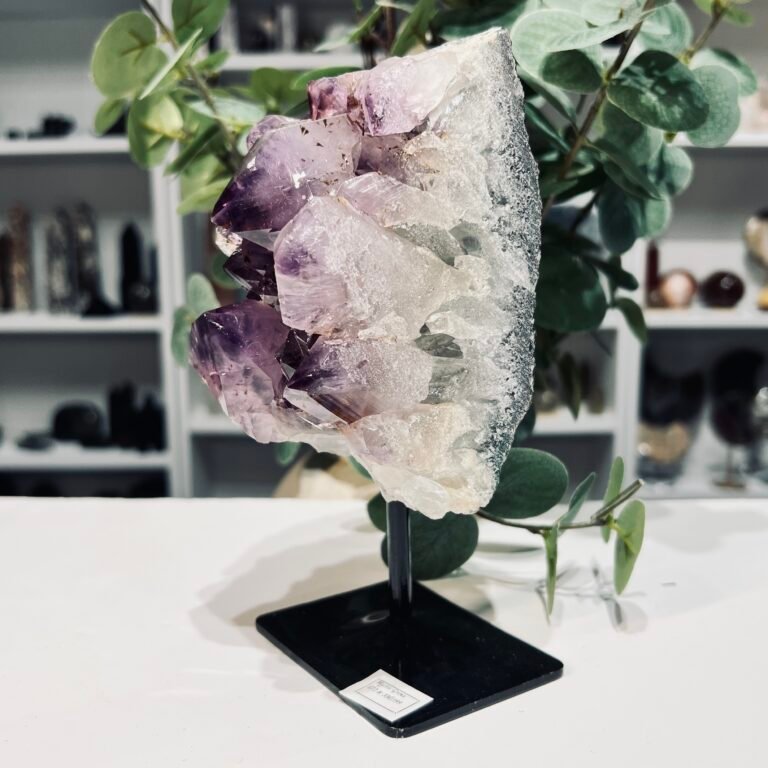
| Smoky quartz | Grounding alongside protection, a gentler choice than the two above | The colour can fade with long exposure to strong sunlight |
If you want the fuller correspondence picture rather than three stones, the protection stones guide sets out more of them.
Making one that belongs to you
An inherited symbol brings a lineage with it, which is its strength and also its limit: it was never about your situation. A symbol built from your own sentence is the opposite trade, no lineage at all and an exact fit.
There is no competition between the two, and plenty of people keep a bought pendant and a drawn page going at once. The method for the second, worked through from the sentence to the finished glyph, is in the sigil guide.
Questions people ask
Is the Helm of Awe a genuine Viking symbol?
The name is genuinely old and appears in Old Norse poetry, where it means a helm rather than a design. The drawn stave is known from Icelandic manuscripts of the seventeenth century and later. So the name is early, the picture is not, and the two are usually run together.
What is the oldest protection symbol I could actually use?
Of the designs in common circulation, the seals of the grimoire tradition have the longest documented trail, with manuscripts reaching back to the middle of the fifteenth century. Older protective marks certainly existed, but a mark you cannot date is a mark you cannot make claims about.
Does it matter that a symbol is modern?
Not to whether it works for you, which is a question about your practice rather than about a date. It matters to what you tell other people, and it matters if you are teaching, selling or writing, because an overstated claim is the thing that gets corrected.
Should I use a symbol from a tradition that is not mine?
Worth thinking about rather than worth a rule. The Icelandic staves sit in published manuscripts and are not a closed practice, which is a different situation from a living tradition with its own gatekeepers. Where a symbol comes from a culture that is still being asked about its use, the respectful move is to go and read what people from it have said.
Do I have to burn or destroy an inherited symbol?
No. Destruction belongs to the made sigil, where the point is to let go of the sentence behind it. A symbol that came with a name is meant to be kept, worn and re used.
Shop the stones in this guide
Protective work asks very little in the way of kit. A dark stone, a black candle and somewhere to draw covers it.
Carry on reading: how to make a sigil for building one from your own sentence, crystals for protection for the wider correspondence list, and where crystal correspondences came from for the planetary tradition these seals belong to.

Leave a Reply