Cerridwen, the Welsh goddess of the cauldron: her story, the awen, the three drops, the chase and the birth of Taliesin
Cerridwen is the keeper of the cauldron of inspiration in Welsh tradition, the one who brews for a year and a day and does not give her gift easily. Here is who the Cerridwen goddess is, where her story really comes from, what her cauldron means, and the crystals and quiet practices people use to work with her today.
Cerridwen at a glance
Say it: ke RID wen. The older Welsh spelling is Ceridwen, with one r.
Tradition: Welsh, from the Tale of Taliesin and the poems of the Welsh bards.
Known for: the cauldron of inspiration, the awen, shapeshifting, and giving birth to the poet Taliesin.
Home: Llyn Tegid, the lake at Bala in north Wales.
Symbols: the cauldron, three drops, the hen, the grain of wheat, the leather bag on the water.
Season: many modern pagans honour her at Samhain, the dark turn of the year.
Who Is the Cerridwen Goddess?
Cerridwen is a figure from Welsh legend who owns a great cauldron. In it she brews a mixture that, once ready, gives whoever tastes it the awen: the Welsh word for poetic inspiration, the flowing spirit that the old bards believed came to them from outside themselves.
She is not one of the gods of the Mabinogi. She belongs to a separate tale, the story of how the greatest Welsh poet, Taliesin, came to be born. In that tale she is a powerful wise woman, a mother, a brewer of herbs and a shapeshifter. Over the centuries poets called her cauldron the source of their art, and in the last two hundred years she has grown into one of the best loved goddesses of modern witchcraft.
People come to Cerridwen for three things above all: inspiration, transformation and the courage to begin again. Her story is the old pattern of an initiation, where the self that went in does not come out the same.
The Story of Cerridwen and Gwion Bach
A cauldron for her son
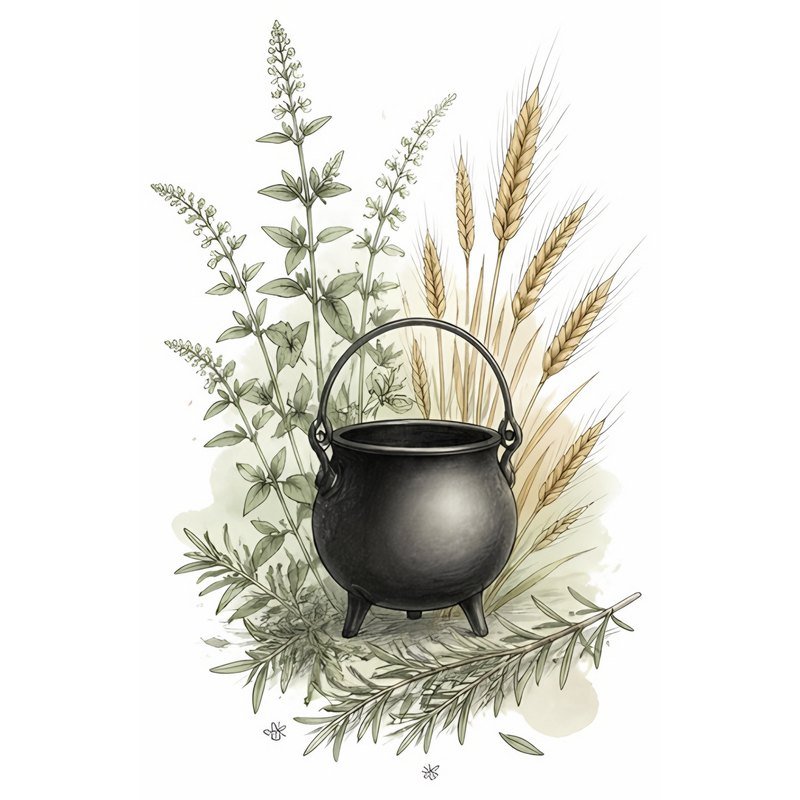
Cerridwen lived with her husband, Tegid Foel, at Llyn Tegid, the lake now known as Bala Lake. They had a daughter, Creirwy, said to be the most beautiful girl in the world, and a son, Morfran, also called Afagddu, said to be the most unfortunate looking. To make up for her son’s looks, Cerridwen decided to give him something better: wisdom and inspiration so great that no one would ever think less of him.
She gathered herbs at their proper times and set her cauldron to boil. The brew had to simmer without stopping for a year and a day. An old blind man named Morda kept the fire, and a village boy, Gwion Bach, was set to stir.
Three drops
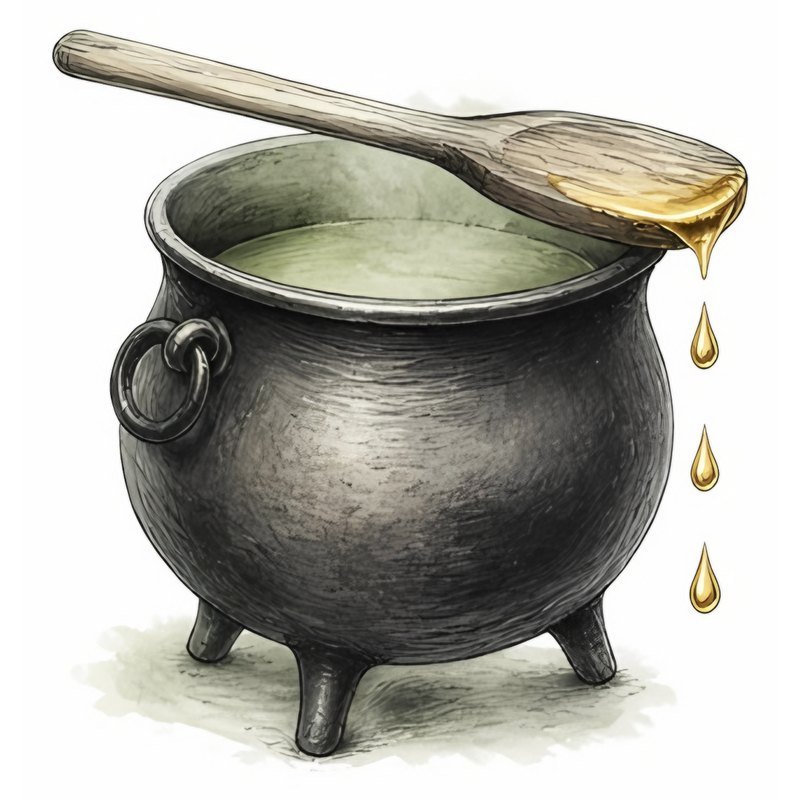
At the very end of the year, as the brew finished, three drops leapt out of the cauldron and landed on Gwion’s finger. They burned, and he put his finger in his mouth. In that moment all the wisdom meant for Morfran passed to him. The rest of the brew became poison, the cauldron cracked, and the poison ran away into a stream.
The gift was never meant for Gwion. It found him anyway, and he spent the rest of the story running from what it cost.
The chase
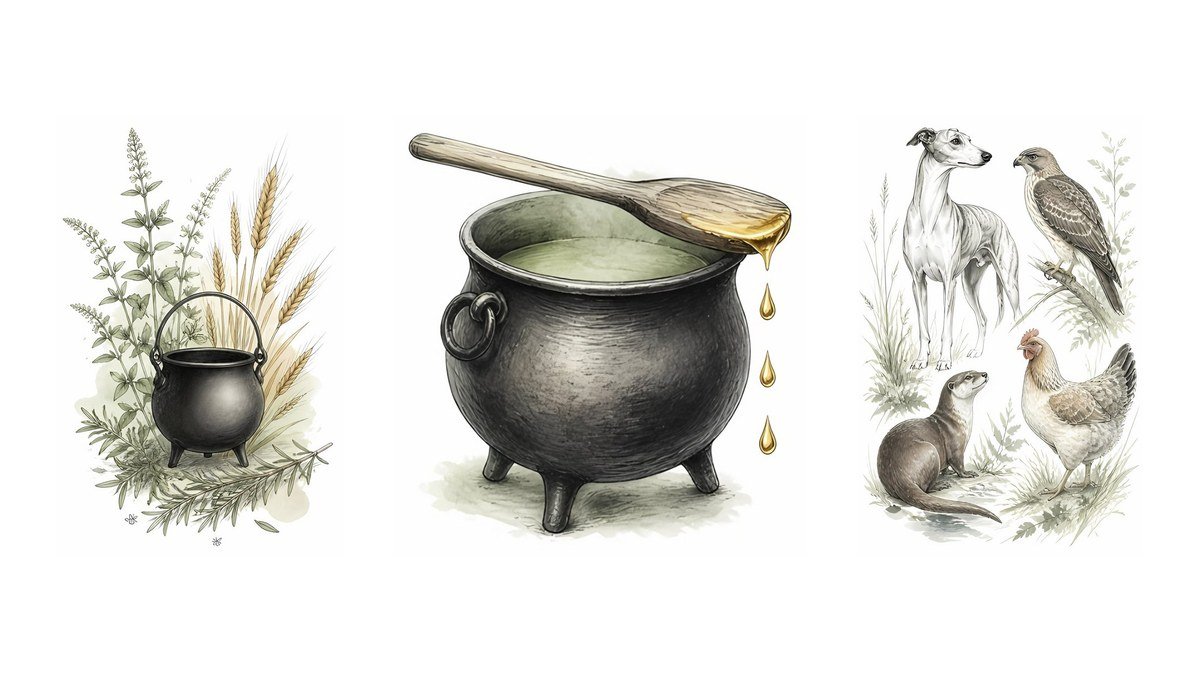
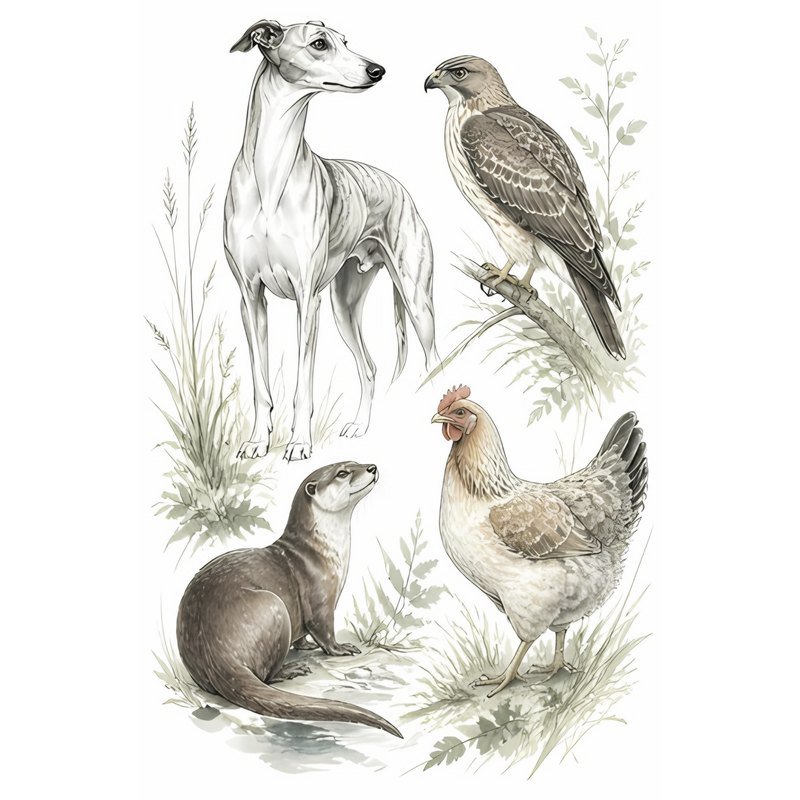
Gwion knew at once that Cerridwen would come for him, so he ran. What follows is one of the great chases of Celtic myth. Each time he changed shape, she changed into the creature that hunts it.
At last Gwion fell into a barn as a single grain of wheat among thousands. Cerridwen became a black hen, scratched through the floor and swallowed him.
The child in the leather bag
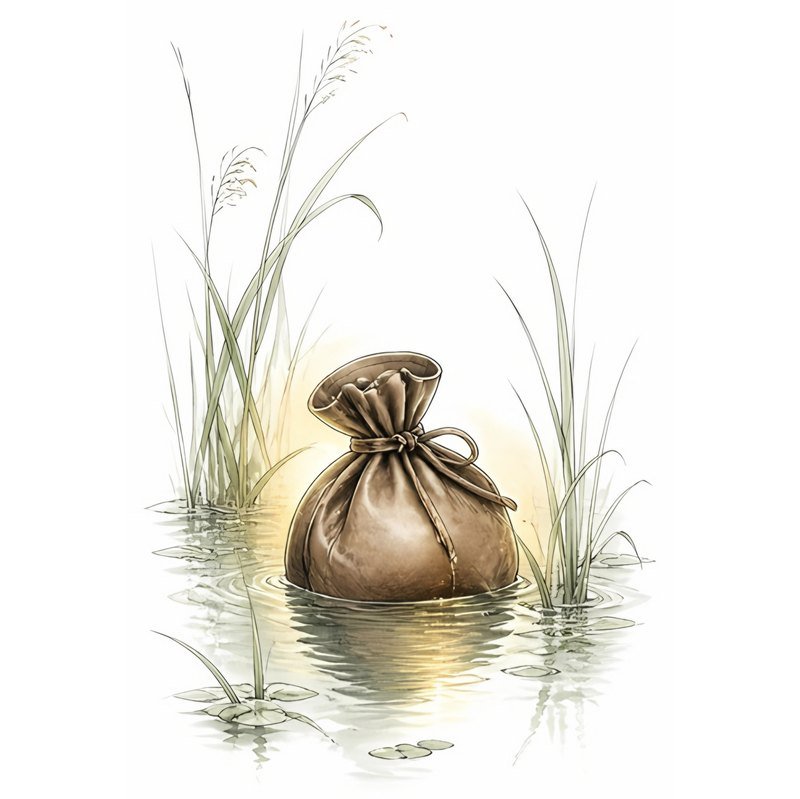
Nine months later Cerridwen gave birth to a baby boy. He was so beautiful that she could not bring herself to harm him, so she wrapped him in a leather bag and set him adrift on the water. The bag was caught in a salmon weir, where a young man named Elffin found it. When he opened it and saw the child’s shining forehead, he called him Taliesin, which means radiant brow. Even as a baby, Taliesin spoke in verse.
What the Cerridwen Story Means
Read slowly, the tale follows the shape of an initiation. Gwion takes something he was never offered. He is hunted through every form he can think of. He is swallowed, carried in the dark, and born again with a new name. Gwion Bach ends and Taliesin begins.
That is why Cerridwen is so often called the demanding one. She is not a gentle fairy godmother who hands out talent. Her inspiration is boiled for a year and a day, it burns, and it changes the person who receives it. For anyone who writes, sings, makes or teaches, her story is a reminder that real creative work asks something of you.
The cauldron in Welsh tradition
Cauldrons appear again and again in Welsh story. There is the cauldron of rebirth in the Second Branch of the Mabinogi, which brings dead warriors back to life, and the cauldron of the Head of Annwn in the old poem The Spoils of Annwn, which will not boil food for a coward. Cerridwen’s cauldron sits in this company as the cauldron of knowledge and poetry. Many people today simply say there is one cauldron with many stories.
The awen
Awen is a Welsh word that is still used today. It means inspiration, the creative spark a poet waits for. In modern Druidry it is often chanted as three long sounds, AH, OO, EN, and drawn as three rays of light. The three rays are a modern symbol, created in the eighteenth century revival of Druidry, but the word itself and its link to Cerridwen’s cauldron are genuinely old.
Cerridwen, Samhain and the Moon
No medieval source gives Cerridwen a festival. Today, though, many witches and pagans honour her at Samhain, at the end of October, when the year tips into its dark half. The cauldron is one of the great symbols of Samhain, a place where old things are broken down so that new life can form, and her story of death and rebirth sits naturally in that season. Some versions of the tale place Taliesin’s discovery at the start of May or at Samhain itself, which may have helped the link along.
In modern moon work Cerridwen is usually honoured at the waning and dark moon, the nights for letting go, brewing ideas in private and waiting before you act. A year and a day is also a figure that still lives on in magical practice. Many traditions use it as the length of study before an initiation, which owes something to her slow brewing.
If you would like to read more about the season she belongs to, our guide to Samhain covers its history and traditions.
The Honest History of Cerridwen
Cerridwen is much loved, so it helps to know which parts of her story are old and which are recent.
What the old sources say
The earliest mentions of Cerridwen are in the work of Welsh court poets of the twelfth and thirteenth centuries, who name her as the source of their inspiration, much as a classical poet might call on the Muse. Two of these poems survive in the Black Book of Carmarthen, written down around 1250. She also appears in poems in the Book of Taliesin, a manuscript of the early fourteenth century.
The full story of the cauldron, the chase and the leather bag is later still on paper. The earliest surviving copy was written in the sixteenth century by Elis Gruffydd, a Welsh soldier based at Calais, in a vast chronicle of world history. Scholars think the tale itself is centuries older, since the poets clearly knew it, but the version most people read today is a nineteenth century English retelling. You can read an older translation on Mary Jones’s Celtic Literature Collective, and the Eryri National Park has a lovely short retelling tied to the real places around Bala.
What is modern
The idea of Cerridwen as the great goddess of ancient Britain began with the Welsh antiquarian Edward Davies in 1809. In 1948 Robert Graves made her a dark moon and crone goddess in his book The White Goddess, and modern witchcraft took much of its idea of her from there. Historian Ronald Hutton, in his Gresham College lecture Finding Lost Gods in Wales, explains how figures like Cerridwen were built up into deities in modern times.
None of that makes her less real to the people who work with her today. A living tradition grows, and Cerridwen has grown a great deal. It simply means you can enjoy the medieval tale for what it is, and know that the crone of the dark moon is a newer and still meaningful layer.
Her name is also debated. The ending probably comes from an old Welsh word for woman. One scholar read the whole name as crooked woman, another suggested a link with words meaning fierce or to be believed in. No one knows for certain.
Crystals for Cerridwen
No medieval text links Cerridwen with any crystal. The stones below are modern correspondences, chosen for what her story is about: the dark cauldron, the long brew, the change of shape and the spark of inspiration. Each is one we stock, so you can find it in the shop.
Labradorite, for shapeshifting and change
Labradorite looks grey and plain until the light catches it and blue and gold flash across its surface. It is the stone people most often reach for with Cerridwen, because it mirrors the chase: one thing becoming another. Hold a labradorite tumblestone while you journal about a change you are in the middle of, or keep a labradorite tower on your writing desk.
Black obsidian, for the dark of the cauldron
Obsidian is volcanic glass, formed when molten rock cools too quickly to crystallise. That fits a goddess whose cauldron melts things down. It is a traditional Samhain stone and a good companion for the waning moon, when you are clearing out what no longer serves. See our obsidian collection.
Amethyst, for wisdom
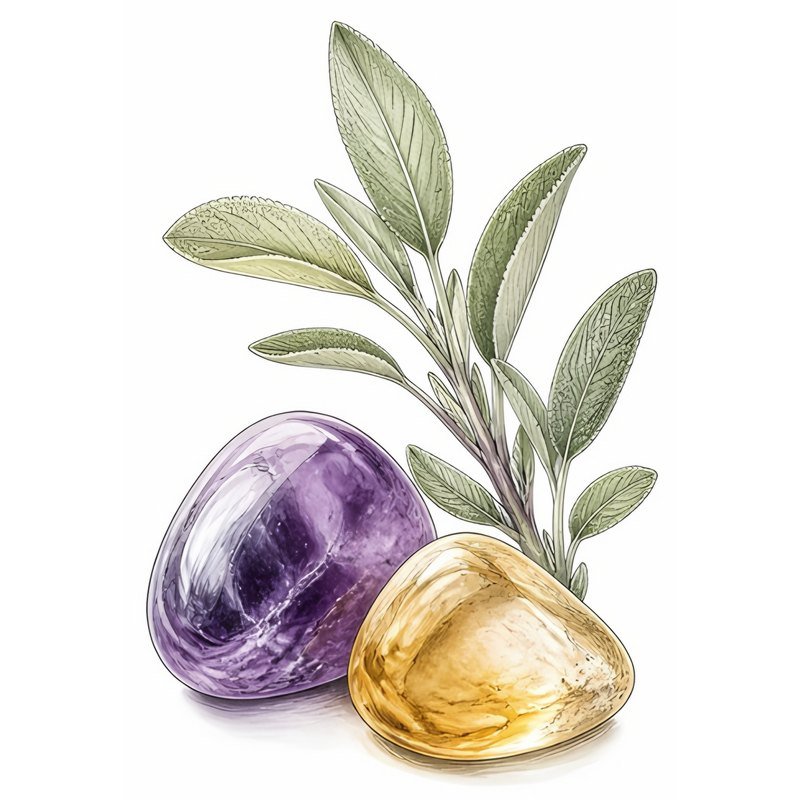
Amethyst has been linked with a clear and sober mind since the ancient Greeks. With Cerridwen it stands for the wisdom in the brew, the knowledge that came to Gwion in a single taste. A piece of amethyst by the bed suits dream journalling.
Citrine, for the spark
Golden citrine carries the colour of the three drops. Use it when you want ideas to come, for a writing project, a new course or a creative business. Our natural citrine points and tumblestones both work well.
Smoky quartz, for letting the old self go
Smoky quartz is clear quartz darkened deep in the earth. It is a grounding stone, often used when an ending feels heavy. With Cerridwen it speaks to the part of the story where Gwion has to stop running. Try a smoky quartz tower.
Fluorite, for study
Fluorite is sometimes called the student’s stone. Cerridwen gathered every herb at its proper hour and watched her brew for a whole year, which is about as dedicated as study gets. A rainbow fluorite tower makes a quiet desk companion for anyone learning a craft.
If you only have one stone, choose clear quartz and tell it plainly what you are asking for. Many people find a single stone held with a clear intention says more than a full set left in a drawer.
A Simple Cauldron Practice for Cerridwen
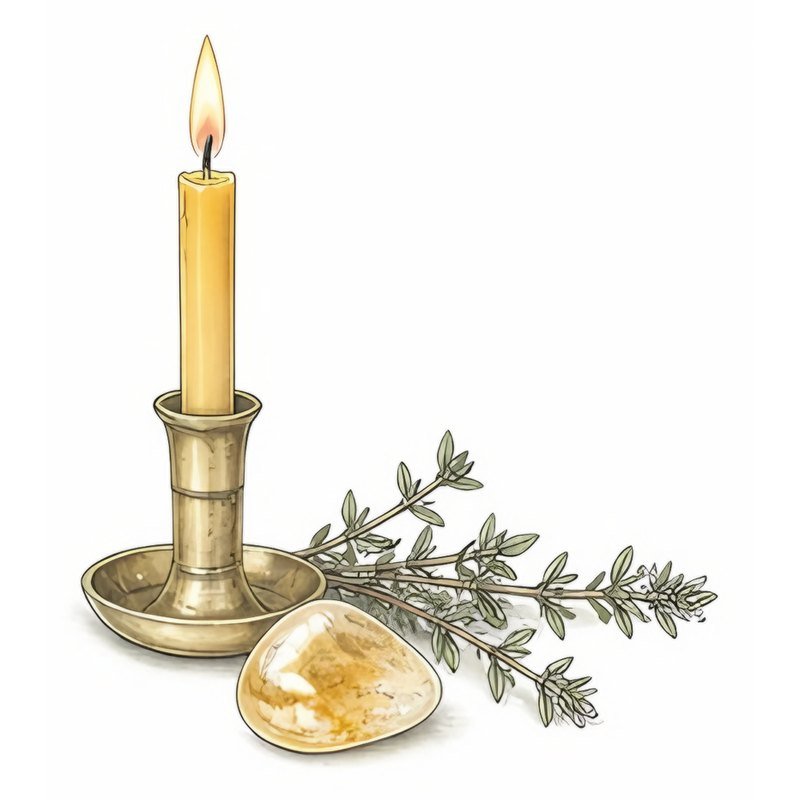
This is a gentle practice for the waning or dark moon, or for any evening when you want to call in fresh ideas. You need a small cauldron or heatproof bowl, a yellow chime candle, a pen and paper, and one of the stones above.
- Set your space. Place the cauldron in front of you with the candle beside it and the stone in your hand.
- Light the candle. Say her name aloud three times: Cerridwen, Cerridwen, Cerridwen.
- Write what you are ready to leave behind. A habit, a fear, an old way of seeing yourself. Fold the paper and place it in the cauldron. If it is safe to do so, burn it there. If not, tear it up and leave it in the bowl.
- Write what you are stirring. One idea, one project or one question you would like inspiration for. Keep this paper.
- Sit with the brew. Rest your hands on the warm sides of the bowl, or simply breathe slowly. Some people like to hum or chant the three sounds of the awen, AH, OO, EN, on the out breath. Others sit in silence. Either is fine.
- Close. Thank Cerridwen, put out the candle, and keep the second paper somewhere you will see it for the next month.
Signs Cerridwen May Be Calling You
- You keep returning to cauldrons, brewing, herbs or kitchen witchcraft.
- You are in a season of big change, where the old version of you no longer fits.
- A creative project will not leave you alone, even when you try to set it down.
- Hens, hares, otters or hawks keep appearing in your days or dreams.
- You feel drawn to Wales, to Welsh poetry or to the Welsh language.
If you are not sure which goddess is reaching for you, our guide to which goddess is calling you has some simple ways to find out.
Light a candle for Cerridwen
Our Manifest Magic chime candles come in ten colours. Yellow is the colour of the three drops and the spark of inspiration, and black suits the dark of the cauldron and Samhain.
Questions People Ask About Cerridwen
What is Cerridwen the goddess of?
Cerridwen is the Welsh goddess of the cauldron of inspiration, known for wisdom, poetry, transformation and rebirth. In modern witchcraft she is also honoured as a goddess of herbs, magic and the dark moon.
How do you pronounce Cerridwen?
Say ke RID wen, with the stress on the middle syllable. The c is hard, like a k.
Is Cerridwen a moon goddess?
Not in the medieval sources. The link with the moon, and especially the dark moon, comes from the twentieth century, largely through Robert Graves. Many people today still honour her at the waning and dark moon, and that modern practice is perfectly valid.
Is Cerridwen a crone goddess?
In modern witchcraft she is often seen as a crone, the wise elder of the triple goddess. In the old tale she is a mother of grown children, a wife and a skilled brewer, with no mention of great age.
Who is Cerridwen’s son?
Her first son is Morfran, also called Afagddu. Her second, through the swallowed grain, is the poet Taliesin.
What are Cerridwen’s symbols?
The cauldron above all, together with the three drops, the hen, the grain of wheat, the greyhound, the otter, the hawk and the leather bag on the water.