What amethyst actually is, why it fades, whether it can go in water, and how to tell a natural piece from a dyed one
Amethyst meaning has been tied to clarity and calm for so long that the stone has become shorthand for both. Amethyst is also one of the most misunderstood crystals on a shop shelf, because a good deal of what is sold under the name has been helped along in ways nobody mentions. This guide covers what amethyst actually is, how to tell a natural piece from a treated one, whether amethyst fades, whether amethyst can go in water, what it means when a piece breaks, and how the traditional correspondences are used in practice.
Amethyst meaning and what the stone really is
Amethyst is quartz. The same silicon dioxide as clear quartz, turned purple by traces of iron in the crystal structure and by natural irradiation in the surrounding rock over a very long time. That is the whole of it. Nothing is added and nothing is unusual about the chemistry.
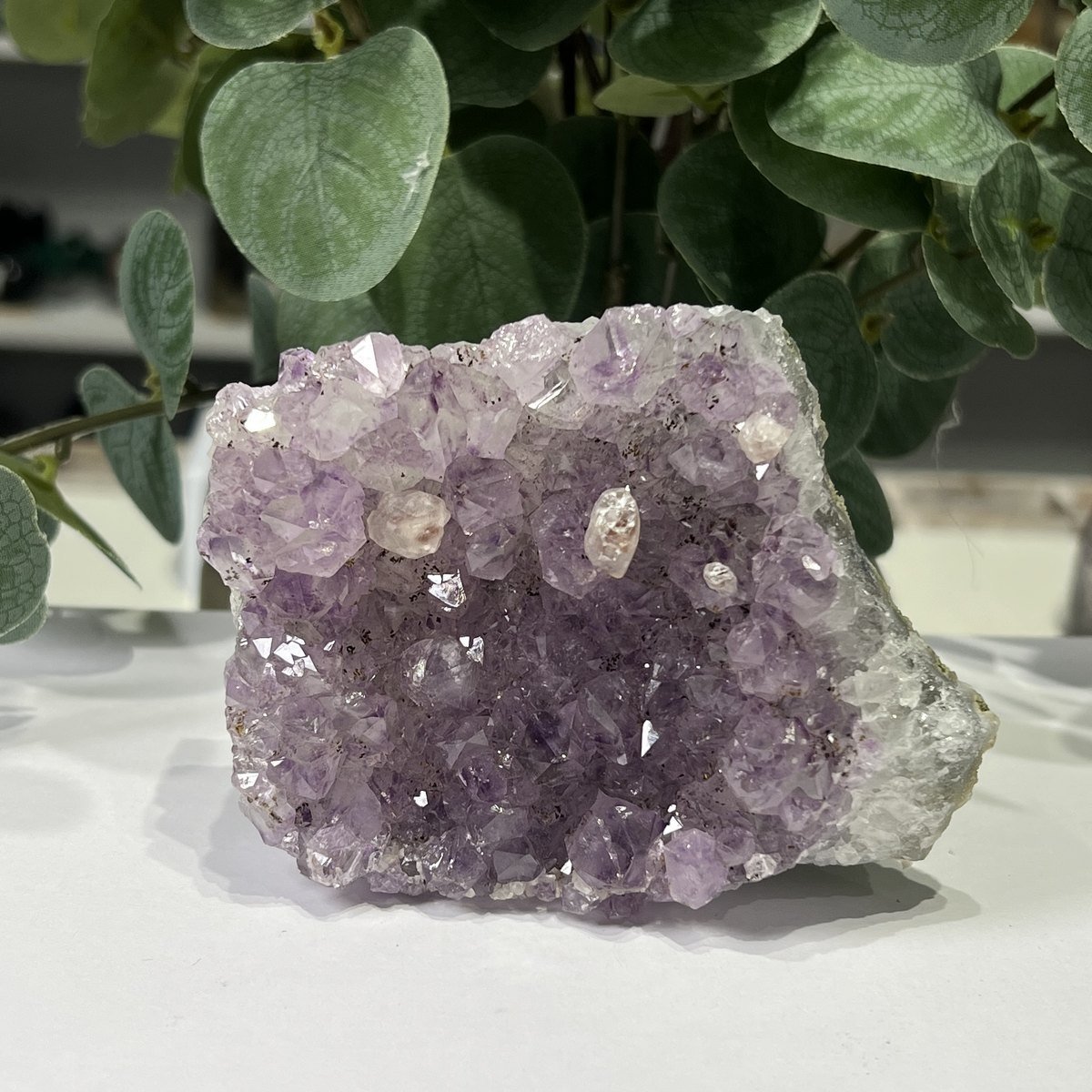
Amethyst sits at 7 on the Mohs hardness scale, which makes a piece hard enough to live on a shelf and be handled daily without marking. It grows in cavities in volcanic rock, which is why so much of it arrives as a geode or a cluster with a grey or brown base still attached. The main sources are Brazil, Uruguay, Zambia and Madagascar. Uruguayan material tends to be the deepest purple, and Zambian material often carries a reddish flash.
The name comes from the Greek amethystos, meaning not intoxicated. Greeks and Romans carved drinking cups from amethyst in the belief that the stone would keep a drinker clear headed, and that single association is why amethyst is still linked to sobriety and moderation today. For the mineralogy, Mindat’s amethyst entry lists the crystallography and the localities.
The varieties worth knowing
- Chevron amethyst is banded purple and white, where amethyst and milky quartz grew in alternating layers. A real and distinctive variety.
- Black amethyst is amethyst darkened by inclusions of hematite and other minerals. We have a separate guide to black amethyst meaning.
- Pink amethyst is a genuine Patagonian material, pale and botryoidal rather than pointed. Covered in our guide to pink amethyst.
- Ametrine is amethyst and citrine in one crystal, almost all of it from a single deposit in Bolivia.
- Vera Cruz and Brandberg are locality names for clear, pale, well formed crystals. The price reflects the locality, not a different stone.
- Green amethyst is not amethyst in any useful sense. It is prasiolite, usually amethyst heated until the purple turns green. A fair seller says so.
Is amethyst receptive or projective
Amethyst is receptive. In the correspondence tradition every stone carries one of two currents: receptive, which draws inward and settles, and projective, which sends outward and acts. Sandra Kynes calls the same pair Yin and Yang. Amethyst sits firmly on the receptive side, which tells you how to use it. It is a stone for taking in, for quiet and for listening, rather than one for pushing back.
Its planets are Jupiter and Neptune and its element is Water, which fits. The signs traditionally given are Sagittarius and Pisces, both Jupiter ruled, and amethyst is the February birthstone. The chakras are the third eye and the crown.
In practice, being receptive means amethyst belongs on your non dominant wrist if you wear it as a bracelet, because that is the receptive hand. Our guide to which hand to wear a crystal bracelet explains the whole framework and when to break the rule.
The traditional intentions attached to amethyst are courage, dreams, happiness, love, peace and intuition. Those are correspondences, held as part of a practice rather than as claims, and none of it is a substitute for medical or professional advice.
Does amethyst fade in sunlight
Yes, and this is the care fact that matters most. The purple comes from colour centres in the quartz that break down under ultraviolet light. Leave an amethyst cluster on a sunny windowsill and over months the purple will drift towards grey or a dull brown, starting at the tips where the crystal is thinnest.
The fading cannot be reversed. No amount of cleansing or charging brings the colour back, because nothing has been added or taken away except the thing that made it purple. Charging amethyst in sunlight is common advice and it is the one piece of advice that will cost you the piece. Moonlight suits a receptive stone far better anyway. Our guide to cleansing crystals goes through the methods.
Can amethyst go in water
A polished amethyst tumblestone or sphere is fine in water. Amethyst is hard, it is not soluble, and a short rinse under a cool tap does nothing to the surface.
Three things change that answer. A geode or cluster usually sits on a cut base, and plenty of them are glued or filled to stand straight, so soaking one can loosen the base rather than harm the crystal. A dyed piece will bleed. And salt water should be kept away from all of it, because salt pits a polished surface over time and works into the cavities between points where it cannot be rinsed out properly.
So a rinse, yes. A long soak in salt water, no, and not because amethyst is delicate but because there is nothing to gain from it.
What it means when amethyst breaks
Look at the physical reason first, because there usually is one. Amethyst points are at their thinnest and most fragile right at the tip, and a knock against a hard surface will take one off. Many clusters carry internal fractures from the way they grew, invisible until the piece is dropped or moved between a cold room and a warm one. Thermal shock splits quartz readily, so a stone taken from a windowsill into hot water can part along a plane that was always there.
Traditionally a stone that breaks during work is read as having finished what it was being used for, and the pieces are either returned to the earth or kept and used separately. That is the traditional reading, held gently rather than as a rule. It is not a warning and it is not a verdict on anything. Practically, broken amethyst still works perfectly well in a grid, a pouch or a plant pot, and sharp edges can be tumbled smooth.
If a piece of yours has come apart, our guide to what it means when a crystal breaks goes through the readings and the practical options.
Choosing a piece
Colour is the first thing and the easiest to misjudge in a photograph. Natural amethyst is almost never evenly purple. Look for zoning, where the colour sits deeper at the tip and pales towards the base, and for the slightly smoky, slightly uneven quality of a stone that grew that way. A piece that is one flat shade of violet all the way through, particularly in a tumblestone or a bracelet, has usually been dyed, and dye collects in fractures where it shows as fine purple lines.
Then the form, because the form decides how a piece is used. A geode or cluster is a fixture that stays where it is put. A tower suits an altar or a grid point. A tumblestone is for carrying and is the cheapest honest way into the stone. A sphere reads as an object in a room rather than a tool.
Amethyst is common, which is good news. There is no reason to pay a premium for ordinary amethyst, and a seller leaning on how unusual a piece is should be able to say exactly what makes it so.
Amethyst in the shop
Browse all amethyst in the shop, or go by form with our tumblestones and crystal towers.
Amethyst is worked with as part of a practice. It is not medicine, and nothing here replaces professional advice.
Continue Your Journey
Black Amethyst Meaning · Which Hand To Wear A Crystal Bracelet · How To Cleanse Crystals


Leave a Reply