What causes the flash, why it vanishes when you move, and why a photograph rarely shows what you will hold
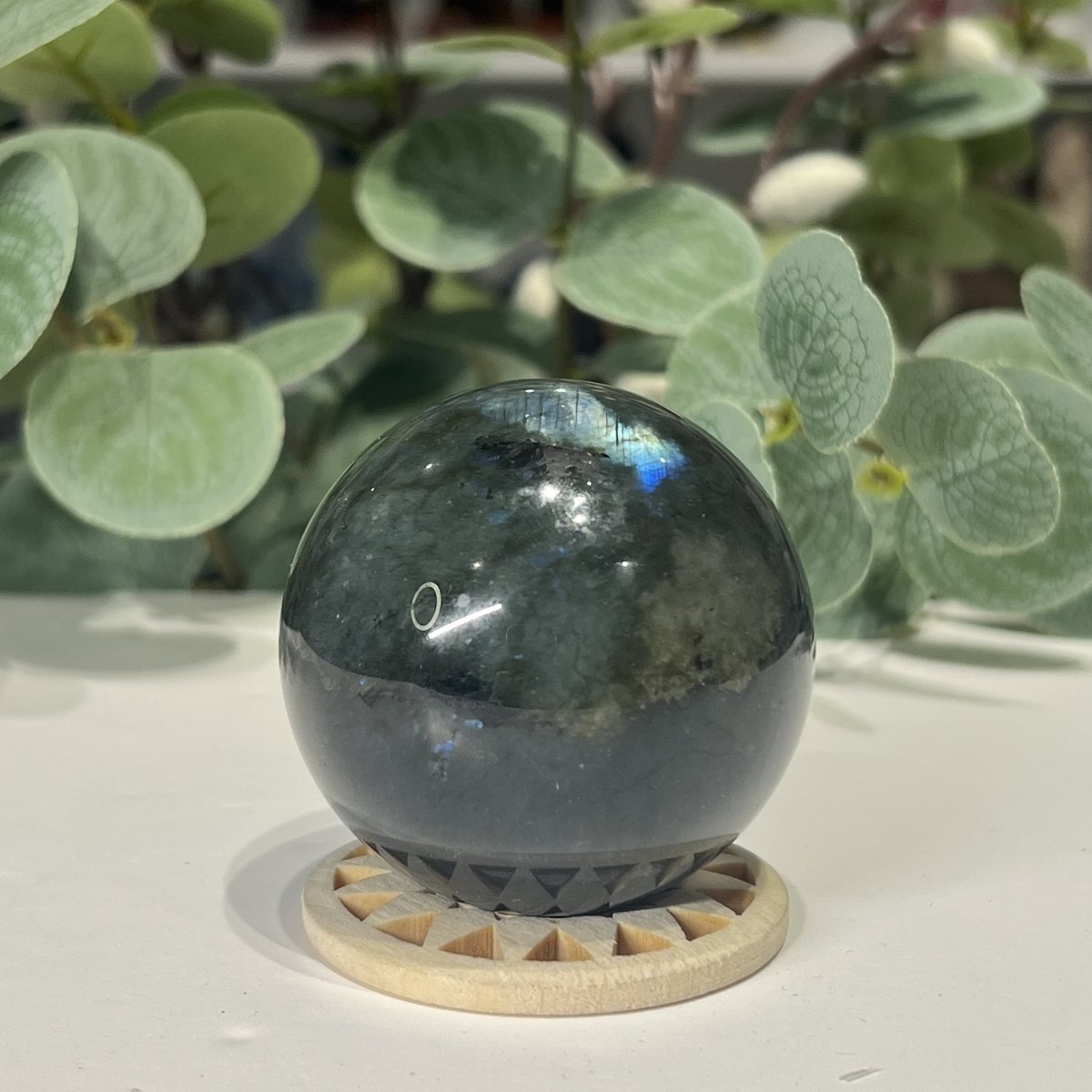
Labradorite meaning rests almost entirely on one thing: the flash. A piece of labradorite looks like a dull grey stone until it is turned to the right angle, and then blue, gold or green moves across the surface and it becomes something else. Everything traditionally said about the stone comes from that moment of hidden things becoming visible. This guide covers what labradorite is, why the flash appears and disappears, why Scott Cunningham left it out, and how to buy a piece that actually flashes.
Labradorite meaning and what the stone is
Labradorite is a feldspar, part of the plagioclase family, and it was named after Labrador in Canada where it was identified in the 1770s. Most of the material in shops now comes from Madagascar, with Finland producing the intensely coloured variety sold as spectrolite.
It sits at 6 to 6.5 on the Mohs scale, which is softer than quartz, and it has two good cleavage directions. That combination matters for handling and it matters for breakage, and both come up below. Mindat’s labradorite entry has the crystallography.
Why labradorite flashes, and why yours might not
The flash has a name, labradorescence, and it is not a colour in the stone at all. Labradorite grew as alternating microscopic layers of slightly different feldspar compositions. Light entering the stone bounces between those layers and interferes with itself, and certain wavelengths come back amplified. It is the same effect as oil on water or a soap bubble, which is why the colour changes as you move.
That explains the thing people are disappointed by. The layers lie in one plane, so the flash only appears when light, stone and eye line up with that plane. Turn the piece and it vanishes. A slab cut parallel to the layers flashes beautifully across its whole face. A slab cut across them barely flashes at all, and no amount of polishing will fix it, because the fault is in how the rough was oriented on the saw.
So if your labradorite does not flash, it is almost certainly a cutting decision rather than a bad stone. Blue is the most common colour, gold and green are frequent, and full spectrum material showing red and violet is genuinely scarcer and priced accordingly.
Is labradorite receptive or projective
Here the honest answer is that it depends which book you open, and one of them does not mention labradorite at all.
Scott Cunningham’s tables, which most modern crystal correspondence rests on, have no entry for labradorite. That is not an oversight about an obscure stone so much as a reflection of when he was writing, before labradorite became a shop staple. Rather than invent a line for him, it is better to say so.
Sandra Kynes does list it, as Yin, which is the same current Cunningham calls receptive. Her element is Water. The planets given are Neptune, Pluto and Uranus, the day is Saturday, the season is Winter, and the signs are Leo, Sagittarius and Scorpio. The chakras run brow, crown, heart, sacral and throat, which is an unusually wide spread and fits a stone associated with awareness rather than one particular job.
The traditional intentions she gives are awareness, clarity, courage, destiny, dream work, inspiration, intuition, magic, mindfulness, motivation, self work, inner strength, transformation, visions and wisdom. Read them together and they describe one idea: seeing what was already there. Which is what the stone does when you turn it.
As a receptive stone it belongs on the non dominant wrist. Our guide to which hand to wear a crystal bracelet goes into which wrist suits which stone. These are inherited associations, and they belong to practice rather than proof.
Can labradorite go in water
Briefly, and dry it properly afterwards. At 6 to 6.5 it is hard enough for a short rinse in cool water, and it is not soluble.
The reason to be careful is the cleavage. Water works into those planes, and a piece that has been soaked can develop a dull cloudy line along a cleavage direction that was invisible before. Avoid salt water entirely, because salt will etch the polish and labradorite with a dulled polish loses the flash, which is the whole point of the stone. Smoke, sound or moonlight are better choices.
What it means when labradorite breaks
Labradorite breaks cleanly and often, and the reason is structural. Those two cleavage directions meet at close to a right angle, so a knock sends a piece apart along a flat face rather than chipping. Palm stones and towers are the usual casualties. A freshly broken face often looks like it was cut, which unsettles people.
Traditionally a stone that breaks mid working has finished what it was asked for, and with labradorite the reading usually offered is that something hidden has come into view and the stone has done its part. Hold that gently. The flat break is a mineral property, not a message.
The pieces still flash, and a broken labradorite often flashes better than it did, because the break can expose a face closer to the layering than the polished one was.
We go into breakage properly in what it means when a crystal breaks.
Choosing a piece
Buy labradorite in person or from a photograph that shows it at more than one angle, because a single flattering shot taken at the perfect angle tells you nothing about how the piece looks on a shelf. A good seller shows both the flash and the stone at rest.
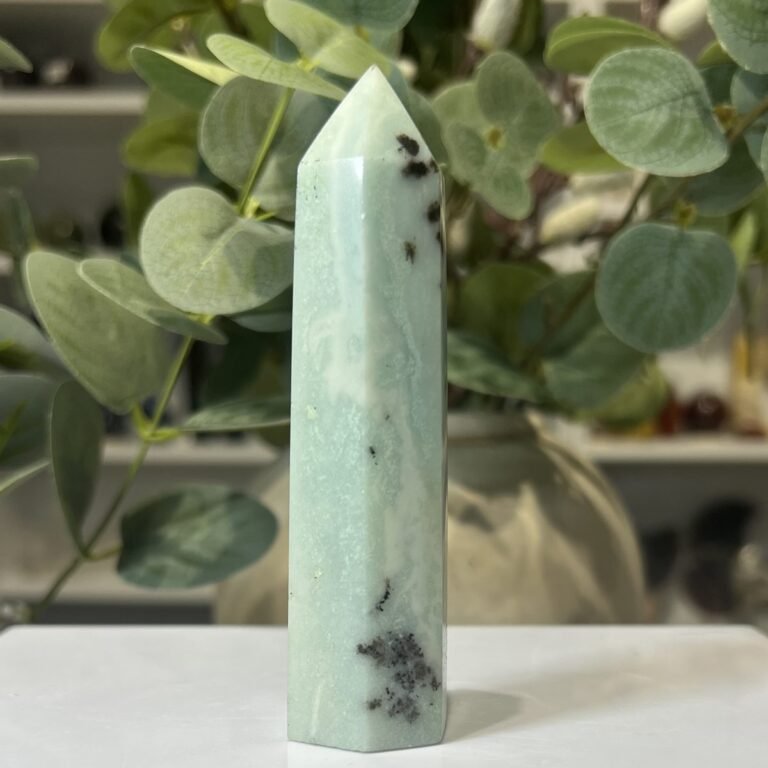
Palm stones and freeform slabs are the forms that show labradorescence best, because they give a broad flat face. Towers look striking but often flash on only one or two sides. Tumbles are the cheapest way in and the least reliable, since small pieces are cut from whatever orientation the rough allowed.
Grey base colour with strong blue is the common and affordable material. Dark base with gold, green, orange or violet costs more. Spectrolite, the Finnish material, costs more again and is worth it only if the full range of colour matters to you.
Labradorite to hold
Browse our labradorite, or go by form with tumblestones and crystal towers.
What tradition holds and what evidence shows are two different things. Nothing above replaces medical or professional advice.
Continue Your Journey
Lapis Lazuli Meaning · Blue Crystal Names · Which Hand To Wear A Crystal Bracelet


Leave a Reply