The golden glass of the Egyptian desert: where it comes from, what it means, and how to know yours is genuine
Libyan desert glass is a natural golden glass found in the Great Sand Sea of western Egypt, close to the Libyan border. It formed around 29 million years ago, when a meteorite strike melted the desert sand, and it is one of the purest natural glasses on Earth. A carved piece of it even sits at the heart of a jewel from the tomb of Tutankhamun.
This guide covers where Libyan desert glass comes from, its meaning in crystal practice, how to tell real from fake, and simple ways to work with it.
What is Libyan desert glass?
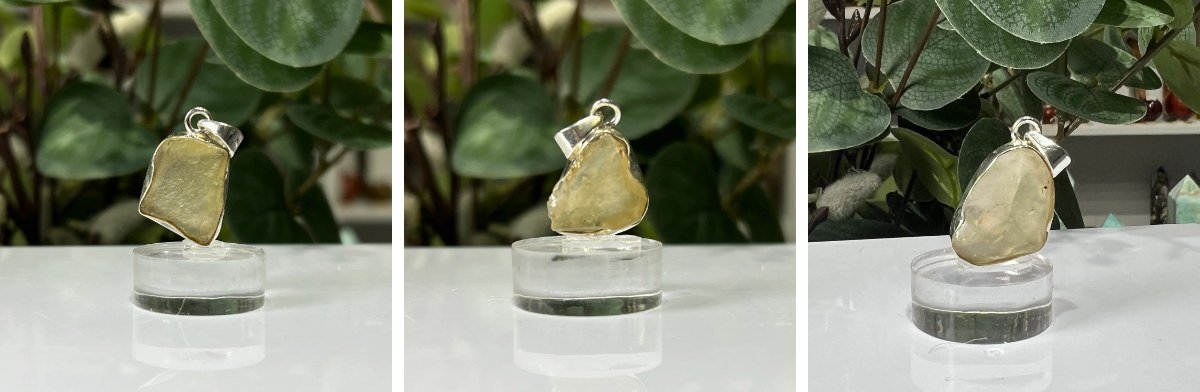
Libyan desert glass is almost pure silica, the same material as quartz sand, turned to glass by intense heat. It ranges from pale lemon and soft cream to warm honey gold. Some pieces are clear enough to glow when light passes through them, while others are cloudy, with milky veils, tiny bubbles and the odd dark streak.
The surface is usually frosted and pitted. Millions of years of wind and sand have worked it like sandpaper, so a raw piece feels soft and matt in the hand, and only shows its full colour when held to the light.
It is found scattered across the dunes of a remote area of the Sahara, and was only properly described by explorers in the 1930s, although people in the region had used it for tools since prehistoric times.
How did Libyan desert glass form?
For decades scientists argued over two ideas. One was that a meteorite exploded in the air above the desert, and the heat of the blast melted the sand below. The other was that a meteorite struck the ground itself.
In 2019 a team led by Curtin University in Australia found tiny crystals inside the glass that had changed into a mineral called reidite. Reidite only forms under the crushing pressure of a shock wave from an impact, which points strongly to a meteorite strike. No crater has been found yet, and it may simply be hidden beneath the sand.
Libyan desert glass is a moment of fire from 29 million years ago, held still in gold.
Is Libyan desert glass a tektite?
Not strictly. True tektites, such as moldavite, were thrown far from their crater through the air. Libyan desert glass formed close to where the strike happened, so it is called impact glass. You will still see it sold as Libyan gold tektite, and it sits naturally beside tektites in any collection. Our guide to tektites and which one is right for you explains the differences.
Tutankhamun and the scarab of desert glass
When Howard Carter opened the tomb of Tutankhamun in 1922, one of the pieces he found was a pectoral, a jewel worn on the chest. At its centre is a winged scarab carved from a pale yellow green stone. For years it was thought to be chalcedony. In the late 1990s it was identified as Libyan desert glass.
The scarab was a symbol of the rising sun and of rebirth in ancient Egypt. It is fitting that it was carved from a golden glass born of fire from the sky.
Libyan desert glass meaning
In modern crystal practice, Libyan desert glass is a stone of the Sun. Its golden colour links it with the solar plexus chakra, the centre of willpower, confidence and personal power. People choose it when they want to feel braver, to make a decision and stand by it, or to bring warmth and clarity to a plan.
It is also worked with for manifestation, because it carries the idea of something powerful taking solid form. Many people keep it close when starting a business, a creative project or a new chapter.
In correspondence traditions, Sunday is the day of the Sun, which makes it a natural day to begin working with your Libyan desert glass.
What people use Libyan desert glass for
- Confidence: carried or worn on days that ask more of you, such as interviews or difficult conversations.
- Willpower: kept on a desk or altar while working towards a goal.
- Manifestation: placed on a written intention during the new moon.
- Warmth through winter: a little sunshine to hold during the darker months.
Libyan desert glass and moldavite together
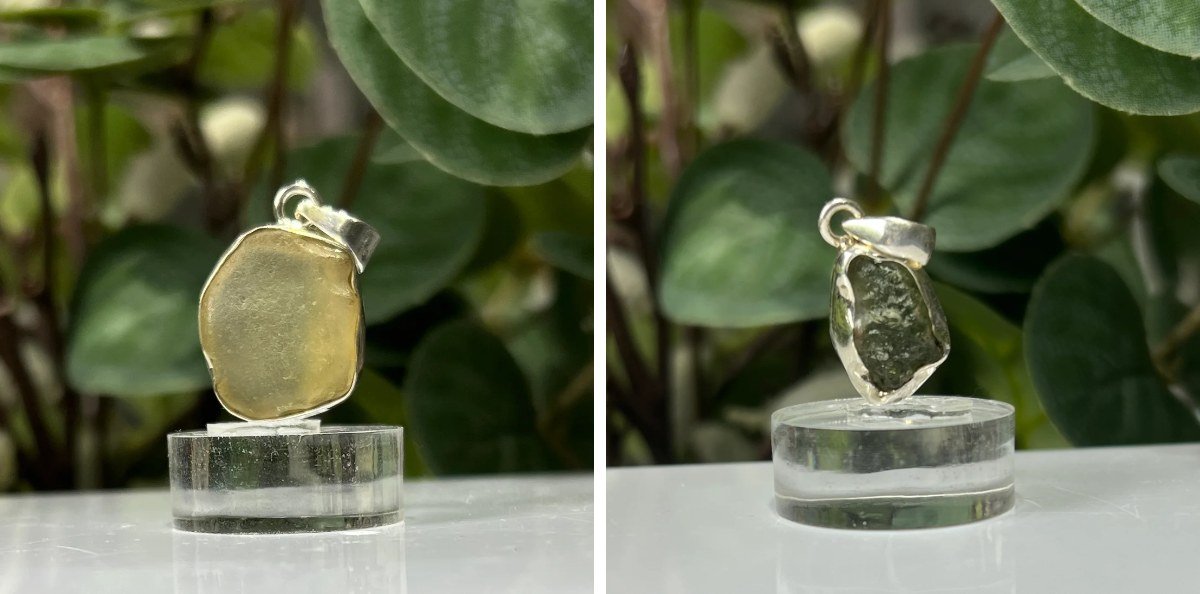
These two natural glasses are often worn as a pair. Moldavite is green and linked with transformation and the heart. Libyan desert glass is golden and linked with confidence and will. Together they suggest change, and the courage to follow it through.
Many people wear one as a pendant and the other as earrings, or place a piece of each side by side on their altar. If you are new to moldavite, our guide to what moldavite does is a good place to start.
How to tell if Libyan desert glass is real
Because it is valuable and popular, imitations are common. Most are made from yellow glass or dyed quartz. These signs help.
- The surface is frosted, not shiny. Raw Libyan desert glass has a matt, sandblasted skin with soft pits. A glossy surface all over suggests manufactured glass, unless the piece has been polished.
- The colour is natural and uneven. Real pieces vary from cream to gold, often within one stone. A bright, even lemon colour can point to an imitation.
- Look inside. Hold it to the light. Genuine pieces often show tiny bubbles, milky clouds, white specks or fine dark streaks.
- It feels light for its size. Natural glass is lighter than many crystals of the same size.
- Buy from a source you trust, where you can see clear photos of the exact piece you will receive.
A simple sunrise ritual with Libyan desert glass
On a Sunday morning, or any day you need courage, stand or sit by a window as the light comes in. Hold your Libyan desert glass up so the sun shines through it, and notice the colour glow. Place it over your solar plexus, just above your navel, and take three slow breaths. Say in one sentence what you are ready to do. Then wear it or carry it with you through the day.
Under a new moon, you can also place it on a written wish and leave the two together until the full moon.
Caring for Libyan desert glass. It is a natural glass of around six on the Mohs scale, so it can chip if dropped or knocked against harder stones. Store it wrapped or in its own pouch.
Cleanse it with incense smoke, sound or moonlight. Sunlight is fine for this stone, as its colour does not fade.
Shop Libyan desert glass
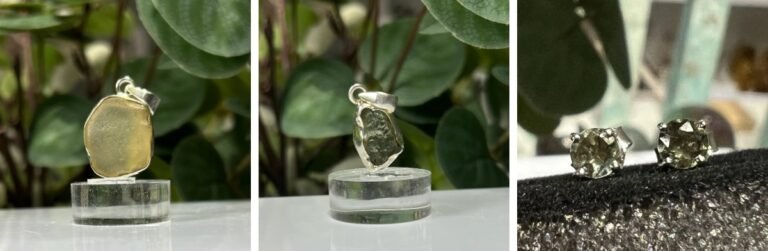
Every piece is shown exactly as you will receive it.
Sources: Mindat on Libyan desert glass, the 2019 Curtin University study.
Crystal correspondences are shared as part of traditional practice. They are not a substitute for medical or professional advice.
Leave a Reply