
Artemis, the Greek goddess of the hunt and the moonlit woods: who she is, her stories, her symbols, and how to honour the Artemis goddess at the Hunter’s Moon
Artemis is the huntress of the Greek hills, the twin sister of Apollo, the one who runs with her hounds through the cypress groves and keeps the wild places for herself. Here is who the Artemis goddess really is, how she came to be linked with the moon, and the crystals and simple practices people use to honour her at the Hunter’s Moon. She is the second goddess in our week of moon goddesses, from the full moon to Samhain.
Artemis at a glance
Say it: AR te miss, with the stress on the first syllable.
Tradition: Ancient Greek. Her Roman counterpart is Diana.
Family: daughter of Zeus and Leto, twin sister of Apollo.
Known for: hunting, wild animals, the wilderness, the protection of girls and young creatures, and help in childbirth.
Symbols: the bow and golden arrows, the quiver, the deer, the hound, the bear, the cypress, the torch and, in later art, the crescent moon.
Moon night this week: the Hunter’s Moon, full at 4.12am GMT on Monday 26th October 2026.
Who Is the Artemis Goddess?
Artemis is one of the twelve Olympian gods of ancient Greece. She is the goddess of the hunt and of everything that lives beyond the edge of the town: the mountains, the forests, the marshes and the animals that live there. Homer calls her the mistress of animals, and the Greeks pictured her as a young woman who never married, who ran with a pack of hounds and a band of nymphs, and who could bring down a deer with a single arrow.
The Greeks did not see her as a goddess of killing. The hunter who knows the woods is also the one who protects them, and Artemis looked after young animals, young girls and women giving birth.
She is very old. Her name has been read on clay tablets from the Mycenaean palace at Pylos, written more than three thousand years ago, and no one knows for certain what it means.
The Stories of Artemis
Born on an island
In the story, Leto was carrying twins by Zeus, and Hera, his jealous wife, made sure no land would let her rest. At last the small floating island of Delos took her in. Some tellings say Artemis was born first, on the nearby island of Ortygia, and then helped her mother deliver Apollo. That is one reason women in labour prayed to her.
A girl who asked for everything
The loveliest picture of young Artemis comes from the poet Callimachus, writing in Alexandria in the third century BC. In his Hymn to Artemis, the little goddess sits on her father’s knee and asks for her wishes. She wants to stay unmarried forever. She wants many names, so that her brother Apollo cannot outshine her. She wants a bow and arrows, a hunting tunic that falls only to the knee, a choir of nymphs and all the mountains of the world. Zeus laughs and gives her all of it, and more.
In the same poem the Cyclopes forge her bow, the god Pan gives her hunting dogs, and in Arcadia she catches four deer with golden horns on foot to draw her golden chariot.
She did not ask her father for a crown. She asked for the mountains, and the right to keep them wild.
Actaeon, Callisto and Orion
The stories also show her fierce side. The hunter Actaeon came upon her bathing, and she turned him into a stag, chased down by his own hounds. Her companion Callisto, after Zeus came to her, was turned into a bear and placed in the sky as the Great Bear.
The giant hunter Orion was her friend on the hunt. In one telling he boasted he would kill every creature on earth, the earth sent a scorpion against him, and Artemis set him among the stars. These are myths, told differently across the Greek world, and they read best as stories about respect for wild things rather than as history.

The Honest History of Artemis
It helps to know which parts of her picture are ancient and which came later.
What the ancient sources say
In Homer she is the archer and the mistress of animals. The short Homeric Hymn to Artemis opens with the line “I sing of Artemis, whose shafts are of gold”, and shows her hunting across the shadowy hills before she goes to her brother’s house at Delphi to lead the dancing.
Her worship was real and widespread. At Brauron, on the coast east of Athens, young Athenian girls served her as little bears, wearing saffron coloured dresses, a custom the playwright Aristophanes mentions in Lysistrata. At Sparta she was honoured as Artemis Orthia. At Ephesus, on the coast of what is now Türkiye, her great temple was counted among the Seven Wonders of the ancient world, and the site is now on the UNESCO World Heritage List. The goddess of Ephesus looked quite different from the slim huntress, a reminder that Artemis was worshipped in many forms.
Her most famous statue today is the Diana of Versailles in the Louvre, a Roman copy of a Greek bronze. She strides forward in a short tunic, reaching for an arrow.
How Artemis became a moon goddess
In Homer and the early hymns, Artemis is not the moon. The moon was Selene, a separate goddess who drove her own silver chariot across the night sky. Over time Greek writers began to treat Artemis and Selene as one, much as Apollo came to be linked with the sun, and by Roman times the huntress with a crescent on her brow was a familiar figure.
There were moonlit threads in her worship long before that. At the Mounichia festival in Athens, held on the sixteenth day of the spring month Mounichion, close to the full moon, people offered her round cakes set all around with small lit candles. Plutarch tells us the festival remembered the Greek victory over the Persians at Salamis, when, he says, the goddess shone with a full moon on the Greek fleet. So a candle on a round cake for Artemis is a genuinely ancient gesture.
What is modern
Calling Artemis the maiden of a triple moon goddess, alongside a mother and a crone, is a twentieth century idea, made popular by Robert Graves and then by modern witchcraft. The same goes for her crystals and her place in the zodiac. None of this is in the ancient texts. That does not make it less meaningful; the young huntress is old, the triple goddess is new, and you are free to love both.
Artemis Symbols and What They Mean
Ancient art gave Artemis a clear set of signs, so anyone could recognise her on a vase or a coin.
- The bow and arrows. Her most iconic symbols. Her arrows were said to be golden.
- The deer. Her sacred animal, from her golden horned chariot deer to the doe beside her in the Louvre.
- The hound. Her hunting companions, the gift from Pan.
- The bear. Linked with the girls of Brauron and with Callisto.
- The cypress. The tall dark tree of her sacred groves.
- The torch. She was sometimes called the light bringer, and torches were carried for her at night.
- The crescent moon. Worn as a diadem or a pendant in later art, once she had come to be seen as a moon goddess.
Callimachus has her ask for many names, and the Greeks gave them to her. Together they show how wide her care reached.
Artemis and the Hunter’s Moon
Her day in our series falls on Monday 26th October 2026, the morning of the Hunter’s Moon. The moon is full at 4.12am GMT, so the night to watch is Sunday 25th, when the moon rises low and golden in the east as the light fades. UK clocks go back that same weekend, at 2am on Sunday, so the evenings suddenly feel darker. Our guide to the Hunter’s Moon 2026 has the timings and the folklore of the name.
The sky adds its own echo of her story. The Sun is in Scorpio, the sign of the scorpion that brought Orion down, and on autumn nights Orion himself climbs into the late evening sky in the east. The full moon is in Taurus, the bull, and Artemis had a bull name too: the playwright Euripides calls her Tauropolos at her shrine at Halai, near Brauron. These are modern pairings, not ancient teaching, but they give the week a lovely shape.
From Monday the moon begins to wane, shrinking a little each night towards Samhain on the 31st. In modern moon work this is the time to finish, gather in and release. For Artemis that is the hunter’s rhythm: the chase is over, and now the catch comes home. It is a good week to look at one goal you have been chasing and decide what it needs from you now.
Crystals for Artemis
No ancient text gives Artemis a crystal. The stones below are modern correspondences, chosen for her story, and each one is in stock.
Moss agate, for the wild groves
Moss agate holds green, branching patterns that look like a tiny forest caught in stone. A moss agate tower on a windowsill brings a little of her grove indoors.
Clear quartz, for the arrow’s aim
A clear quartz point has a natural tip, like an arrowhead of light. A clear quartz point laid towards the moon is a simple way to set your aim for the coming month.
Tiger’s eye, for the hunter’s sight
Tiger’s eye has a golden band of light that moves as you turn it, like the eye of an animal in the dark. It speaks of sharp sight and patience, and its gold recalls her arrows. Try a tiger’s eye tower.
Howlite, for the white stag
Howlite is soft white with fine grey veins, the colour of the pale deer that so often walk beside her in art. It is a calming stone for quiet evenings. A howlite tower suits a bedside altar during the waning week.
Carnelian, for the swift stride
Warm orange carnelian is a stone of energy and courage, a good match for a goddess who caught golden horned deer on foot. A carnelian wand is lovely to hold while you speak your aim aloud.
Rainbow moonstone, for the crescent
Rainbow moonstone shows a blue sheen that seems to float under the surface, like moonlight through leaves. It stands for the crescent she wears in later art. Our rainbow moonstone tower makes a gentle centre for a small moon altar.
If you only have one stone, choose clear quartz and tell it plainly what you are aiming for. Any of these stones can also be bought as a single tumblestone from our choose your stone range.
A Simple Hunter’s Moon Practice for Artemis
This practice borrows a gesture from her ancient worship: a round cake and a small flame under the full moon. Do it on Sunday 25th as the moon rises, or on Monday 26th as it begins to wane. You need a white chime candle, a small round cake or biscuit, a pen and paper, and one of the stones above.
- Set your space. Place the cake on a plate with the candle beside it, and the stone in front.
- Light the candle. Say her name aloud three times: Artemis, Artemis, Artemis. You might add, “Lady of the wild places, huntress of the moon, I honour you tonight.”
- Name your aim. Write one clear goal on the paper, the thing you have been chasing this year. One line, as sharp as an arrow.
- Name what you are bringing home. Underneath, write one thing you have already achieved towards it.
- Make your offering. Break off a piece of the cake and set it aside for her. Later, leave it outside for the birds.
- Sit with the light. Hold the stone and watch the flame. Some people like to breathe slowly and count each breath, or step softly on the spot as if walking through the woods. Others simply sit quietly. Any of these is fine.
- Close. Thank Artemis, put out the candle, and keep the paper under the stone until Samhain.
If you enjoy making moon water, the Hunter’s Moon is a fine night for it, and our guide to moon water and lunar elixirs explains how.
Signs the Artemis Goddess May Be Calling You
- You feel most yourself outdoors, in woods, on hills or by wild water.
- Deer, dogs or bears keep appearing in your days or dreams.
- You guard your independence and your own space.
- You have a clear goal and the patience to follow it through.
If you are not sure, our guide to which goddess is calling you has some simple ways to find out, and lunar goddess archetypes and crystal grids shows how to build a grid around her.
Light a candle for Artemis
Our Manifest Magic chime candles come in ten colours. White suits the pale deer and the bright full moon of Sunday night, and green suits her woods and groves.
The Seven Moon Goddesses Film
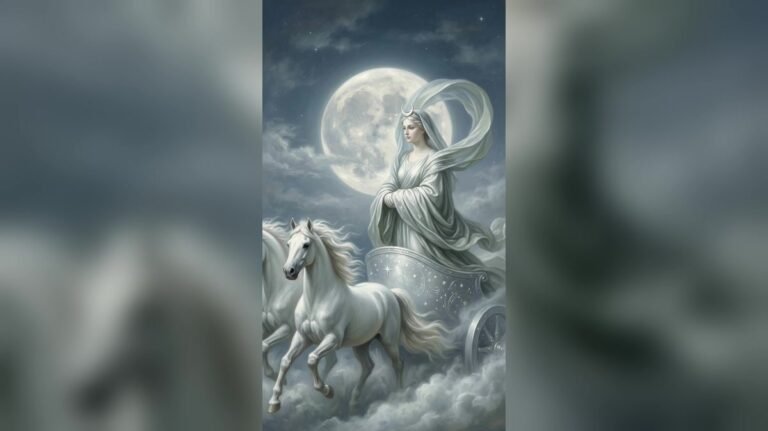
Artemis is one of seven goddesses in our short film for this week, which follows the moon from the Hunter’s Moon to Samhain night.
Questions People Ask About Artemis
What is Artemis the goddess of?
Artemis is the Greek goddess of the hunt, wild animals and the wilderness. She also protected young girls and helped women in childbirth, and in later times she became a goddess of the moon.
Is Artemis a moon goddess?
Not at first. In the earliest Greek sources the moon is Selene. Artemis came to be identified with Selene over time, and by the Roman period she was widely seen as a moon goddess. Most people who work with her today honour her at the crescent and full moon.
What are the symbols of Artemis?
The bow and arrows, the quiver, the deer, the hound, the bear, the cypress and the torch, with the crescent moon added in later art.
Who is Artemis’s twin?
Her twin brother is Apollo, god of music, prophecy and light. Their parents are Zeus and Leto, and they were born on or near the island of Delos.
What is the Roman name for Artemis?
The Romans honoured Diana, who came to be treated as the same goddess. You can read her own story, with the torchlit festival at Lake Nemi, in our post on Diana.
How do you pronounce Artemis?
Say AR te miss, with the stress on the first syllable.
Bring Artemis home
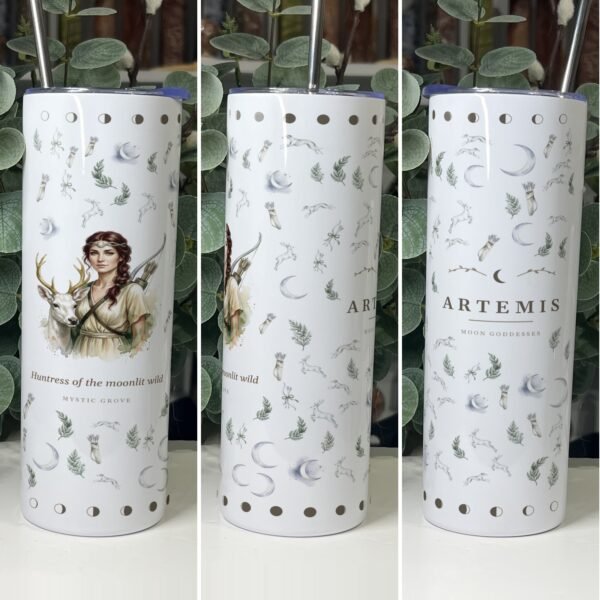
The Artemis artwork from this series now comes on a 13oz white ceramic mug and a 20oz skinny tumbler wrapped all the way round in bows, white deer and hounds. Each one comes with a printed card telling her story, so it is ready to keep or to give.


Leave a Reply