Luna, the Roman goddess of the moon: her silver chariot, her temples, her bond with Selene and Diana, and the months she ruled
Luna is the moon itself in Roman religion, the bright one who drove her chariot across the night and was said to rule the months. Here is who the Luna goddess is, what the Roman writers really tell us about her, how she differs from Selene, and the crystals and gentle practice people use to honour her in the waning light after the Hunter’s Moon. She is the fourth of our seven moon goddesses this week.
Luna at a glance
Say it: LOO nah. It is simply the Latin word for the moon.
Tradition: Roman, honoured in Rome from its earliest legends to the end of the empire.
Known for: being the moon in person, driving a two horse or two ox chariot, and ruling the months.
Temples: on the Aventine Hill, with its feast on 31 March, and on the Palatine as Luna Noctiluca, the one who shines by night.
Symbols: the crescent, the chariot called a biga, the torch, silver, and in modern practice cypress and poppies.
Her day: Monday, the Roman dies Lunae, still lundi in French and lunes in Spanish.
This week: Wednesday 28 October 2026, a waning moon in Gemini two nights after the full Hunter’s Moon.
Who Is the Luna Goddess?
Luna is the Roman goddess of the moon. Her name is the ordinary Latin word for the moon, and it comes from an old root meaning bright, the same root that gave Latin its word for light, lux. When a Roman looked up and said luna, there was no gap between the silver disc in the sky and the goddess who lived in it. She was not a goddess who looked after the moon. She was the moon.
That sets her apart from the other goddesses in this series. Diana, whom we met yesterday, was a huntress who became linked with the moon over time. Luna never had another job. She is the night light of Rome, paired with Sol, the sun, side by side in Roman art for centuries.
People come to the Luna goddess today for a sense of rhythm, the comfort of a steady light in the dark, and a simple way into moon work. Her gift is the month itself, the reliable turning from new to full and back again.
The Story of Luna and Her Silver Chariot
The chariot across the night
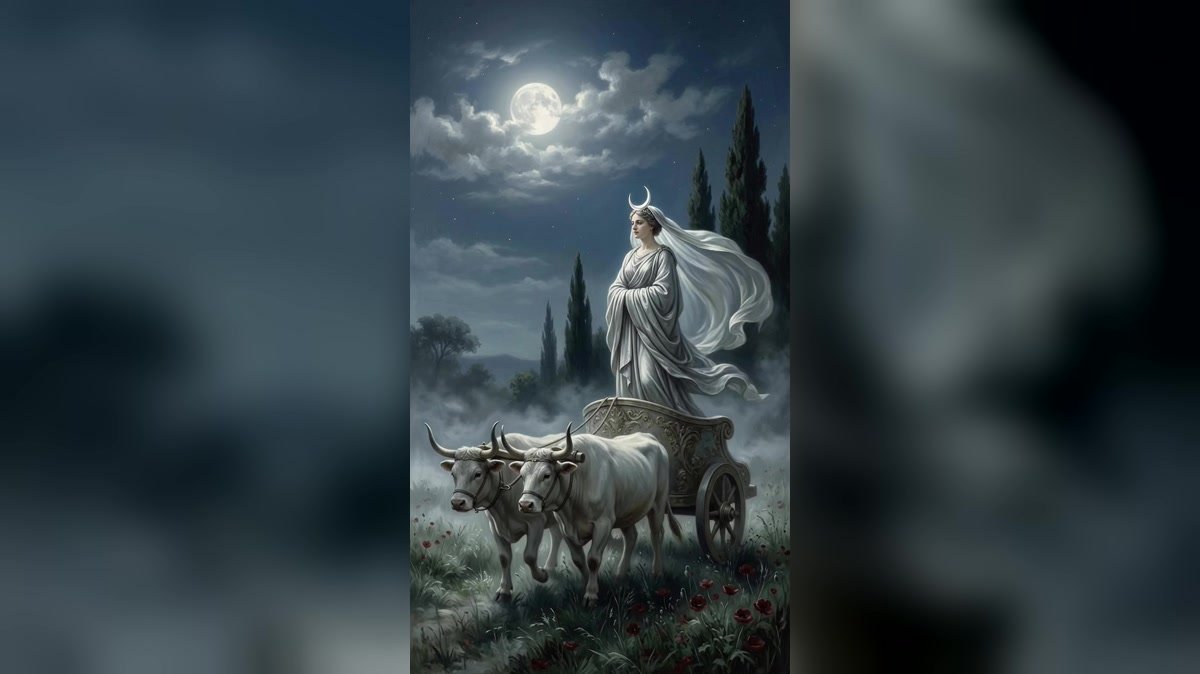
The Romans pictured Luna crossing the sky each night in a chariot. The sun drove four horses, the quadriga. Luna had a lighter two horse chariot, the biga. Isidore of Seville, writing in the seventh century, explained that the moon runs a twin path with the sun, seen both by night and by day, and that one of her horses was black and one white.
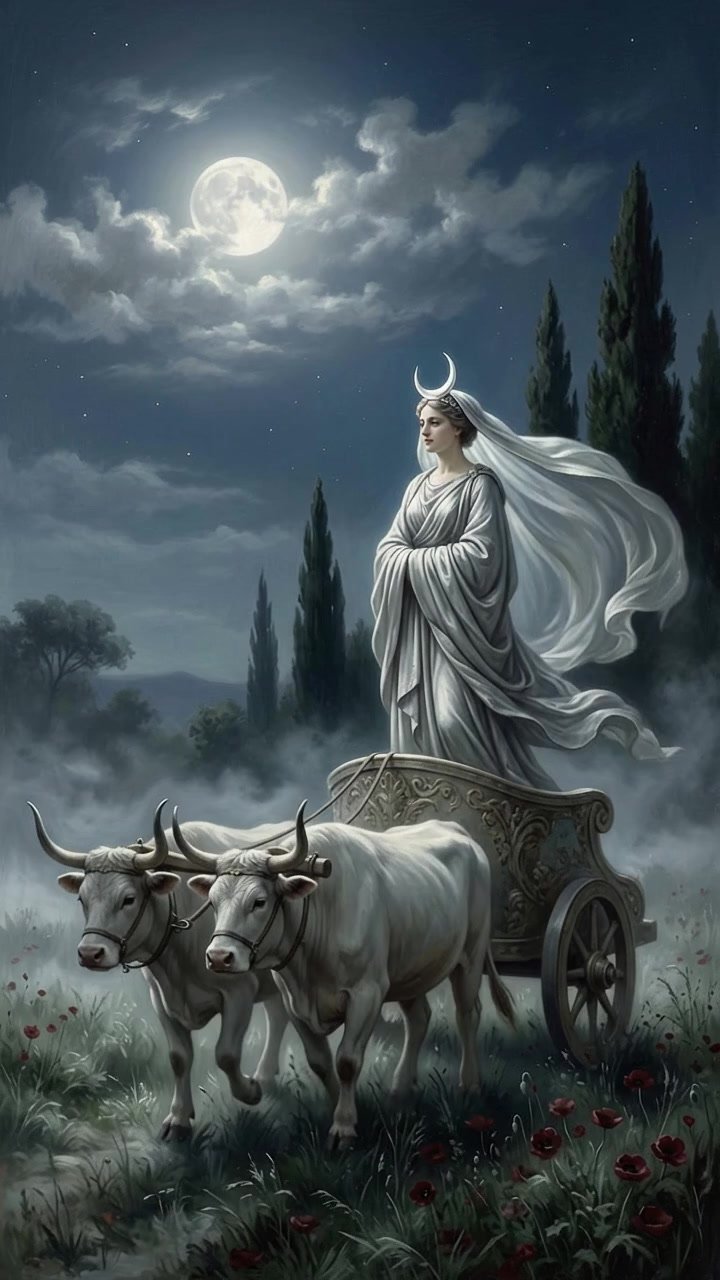
On Roman coins of the late third and early second centuries BC, Luna in her biga was one of the most common designs, often with a crescent above her head. In other art and in later poems the horses are sometimes swapped for a pair of white oxen or bulls. It is easy to see why: their curved horns echo the crescent moon.
Luna and Endymion
The best loved moon story in Rome was first told of Selene. The moon fell in love with Endymion, a shepherd, and visited him every night on Mount Latmus while he slept. In most versions he was given eternal sleep and eternal youth, so he would never grow old.
Roman writers knew the tale well. Cicero jokes in his Tusculan Disputations that Endymion has slept so long on Latmus he is surely not awake yet. Roman families chose the scene for their marble coffins, a gentle picture of death as a long and loving sleep. A beautiful example in the Metropolitan Museum shows the moon stepping down from her chariot, while a figure stands over Endymion holding a bunch of sleepy poppies.
She did not wake him. She simply kept coming back, which is exactly what the moon does.
This is a myth, told as a story rather than history, and Romans borrowed it from Greece along with much of Selene’s imagery. If you would like the Greek telling, our post on Selene covers it in full.
Luna, Diana and the goddess of three ways
Over time Roman poets blended Luna with Diana and with Hecate. In his hymn to Diana, the poet Catullus calls her Trivia, goddess of the crossroads, and Luna, named for her borrowed light, and says that her monthly journey measures out the year. Later the commentator Servius explained the three formed goddess as one power with three names: Luna in the sky, Diana on the earth and Proserpina below. That threefold idea runs straight on to Hecate, who closes our series on Samhain night.
The Honest History of Luna
What the old sources say
Roman tradition held that Luna was one of the gods brought to Rome by the Sabine king Titus Tatius, who ruled alongside Romulus. The scholar Varro, writing in the first century BC, lists her among the gods Tatius vowed altars to, and also names her among the twelve gods every farmer should call on, because the sun and moon decide the times for sowing and harvest.
Her main temple stood on the Aventine Hill, and Romans credited its founding to King Servius Tullius. Its feast fell on 31 March, and Ovid marks it in his calendar poem, the Fasti, with a lovely line: the moon rules the months, and so this month ends with her worship on the Aventine. Livy records that in 182 BC a storm tore off the temple doors and flung them against the temple of Ceres below, and Tacitus lists the shrine among the old buildings lost in the great fire of AD 64.
Varro also mentions a shrine on the Palatine to Luna Noctiluca, the Night Shiner, which he says glowed at night. Scholars still debate what he meant. In 17 BC, at the great Secular Games of Augustus, a choir of boys and girls sang the poet Horace’s hymn, in which the girls call on Luna, the two horned queen of the stars, to hear them.
What is modern
Beyond these lines, little is known about how Luna was worshipped. No ritual or list of offerings for her survives. The Victorian Dictionary of Greek and Roman Biography and Mythology put it plainly well over a century ago: further details of her worship are not known.
So anything you read about Luna’s crystals, colours or place as maiden, mother or crone comes from modern practice. Her link with cypress trees and poppies is also a modern reading, built on Roman art: poppies stood for sleep, as on the Endymion coffins, and the dark cypress was a Roman tree of mourning and the world below. The pairing of the moon with silver as a metal is best known from the medieval alchemists, who simply called silver luna. None of this makes modern practice less meaningful. It simply tells you which layer you are standing on.
Luna Symbols and What They Mean
The crescent
A crescent on her brow or behind her shoulders is the surest way to spot Luna in Roman art.
The biga and the white oxen
Her light two horse chariot says she is always moving and always on time. The oxen, horned like the young moon, suit a goddess of slow and steady cycles.
The torch
The light carried into the dark, which ties her to Diana Lucifera, the light bringer, and to Hecate’s torches.
Silver, cypress and poppy
Silver is the colour of moonlight. The cypress and poppy are a modern pairing, for stillness, sleep, dreams and remembrance.
Luna and the Roman Month
When Ovid said the moon rules the months, he meant it quite literally. The earliest Roman calendar followed the moon. On the first day of the month, the Kalends, a priest watched for the new crescent and then called out to the people how many days were left until the Nones. The Nones fell at the first quarter, and the Ides at the full moon. The days after the Ides were counted down towards the next Kalends. You can read how the dates worked in the Dickinson College Commentaries. The three names outlived the lunar calendar itself.
Her day, Monday, comes from the Roman seven day week, where each day belonged to a planet. The day of the moon was dies Lunae, still heard in lunedì, lundi and lunes.
Luna in the Week of the Hunter’s Moon
The Hunter’s Moon was full at 4.12am GMT on Monday 26 October, in Taurus with the Sun in Scorpio. That is Luna’s own day, which feels fitting. By Wednesday 28 October the moon is a waning gibbous, still more than nine tenths lit, and early that morning it moves into Gemini, the sign of the twins.
It is a gentle match. Luna’s two horses, one dark and one light, ran a twin path with the sun, and Gemini is the sign of pairs. The moon now rises a little later each evening and rides high through the night. In Roman terms we are past the Ides, in the waning days that count down towards the next new moon, with Samhain waiting at the end of the week.
The waning gibbous is a time for gratitude: a good night to look back over the month, notice what has come to fullness, and choose what you will let thin away. Many people also make moon water under these bright waning nights.
Crystals for Luna
No Roman text gives Luna a crystal. The stones below are modern correspondences, chosen for her story and symbols: the white oxen, the silver light, Endymion’s sleep, the poppies, the cypress groves and the torch carried into the dark. Each is one we stock.
Howlite, for the white oxen
Howlite is a soft white stone with fine grey veins, often kept by the bed for calm. Its quiet whiteness suits the patient oxen that pull Luna’s chariot. Try a howlite tower on a bedside table.
Amethyst and silver, for Endymion’s sleep
Amethyst is a favourite stone for sleep and dreams, and set in silver it carries the Endymion story beautifully. Our twisted silver wand with amethyst makes a lovely tool for opening a moon practice.
Almandine garnet, for the poppies
Deep red garnet holds the colour of the poppies at Luna’s feet. As remembrance poppies appear across Britain in the weeks before Remembrance Sunday, it also makes a thoughtful stone for honouring those we miss. See our almandine garnet sphere in matrix.
Moss agate, for the cypress groves
Moss agate carries green, branching patterns that look like tiny trees caught in stone. It brings the dark cypress groves into your space. A moss agate tower sits well beside a window.
Clear quartz, for the torch
The Romans believed rock crystal was ice frozen so hard it could never melt. A point that gathers and spreads light suits Luna Noctiluca, the Night Shiner, and her torch. A clear quartz point is also the easiest stone to begin with.
Agate moon, for her face on your altar
Agate forms slowly, layer upon layer, a fitting picture for a goddess who measures time. Our crazy lace agate moon on a stand gives you Luna’s crescent to keep in view all month.
If you only have one stone, choose clear quartz and say plainly what you are asking for. Any of these stones can also be bought as a single tumblestone, which is all you need for the practice below.
A Simple Practice for Luna’s Night
The Romans left no ritual for Luna, so this is a modern practice built from what the old sources do tell us: her month, her light and her name spoken aloud. It suits Wednesday 28 October or any waning night. You need a white chime candle, a pen and paper, and one of the stones above, ideally near a window.
- Set your space. Place the candle in front of you with the stone beside it.
- Light the candle. Say aloud, in Horace’s words or your own: Luna, two horned queen of the stars, hear me.
- Look back over the month. Write three short lines. What began at the new moon? What came to fullness at the Hunter’s Moon? What are you ready to let thin away before Samhain?
- Give thanks. Read the second line aloud and thank Luna for it. Gratitude is the old work of the waning gibbous.
- Sit with her light. Hold the stone and rest for a few minutes in the glow of the candle or the moon. If you like, breathe slowly and let a soft hum ride on each out breath. Silence works just as well.
- Close. Thank Luna, put out the candle, and keep your paper until the next new moon.
Light a candle for Luna
Our Manifest Magic chime candles come in ten colours. White carries Luna’s silver light, and light blue suits the calm of a waning moon night. Burn one on the evening of 28 October as the moon rises.
If you are not sure Luna is the goddess reaching for you, our guide to which goddess is calling you has some simple ways to find out.
The Seven Moon Goddesses Film
Luna is one of seven moon goddesses in our short film, which follows the moon from the Hunter’s Moon to Samhain night.
Questions People Ask About Luna
What is the Luna goddess known for?
Luna is the Roman goddess of the moon, known for driving her chariot across the night sky and for ruling the months. She was honoured at temples on the Aventine and Palatine hills in Rome.
Is Luna the same as Selene?
They are closely linked. Selene is the Greek moon goddess and Luna the Roman one. Rome borrowed Selene’s stories, including Endymion, but Luna had her own temples and festival.
Is Luna the same as Diana?
Not at first. Diana began as a goddess of woods and wild places, while Luna was the moon itself. Roman poets later blended them, and Diana was often called Luna.
What are the symbols of Luna?
The crescent, her two horse or two ox chariot, the torch and silver. In modern practice people also add cypress, poppies and moon stones.
What day is sacred to Luna?
Monday, the day of the moon, called dies Lunae in Latin. Her temple on the Aventine celebrated its birthday on 31 March.
How do you honour Luna?
No Roman ritual for her survives, so modern practice keeps it simple: a white candle, her name spoken aloud, a stone and a little time with the moon.
Bring Luna home
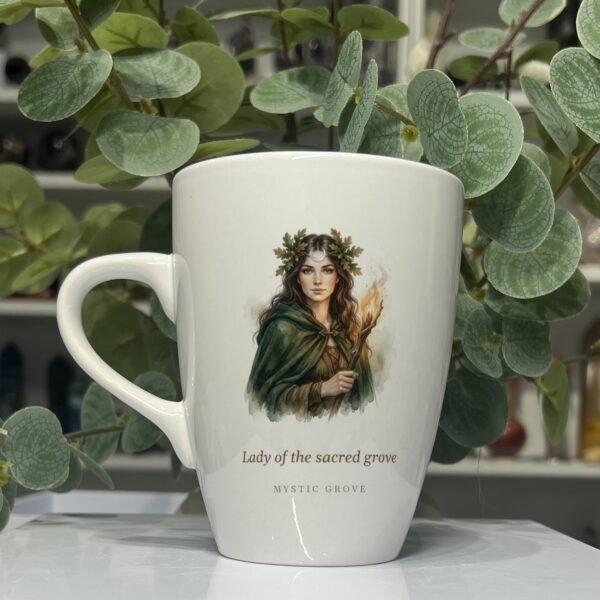
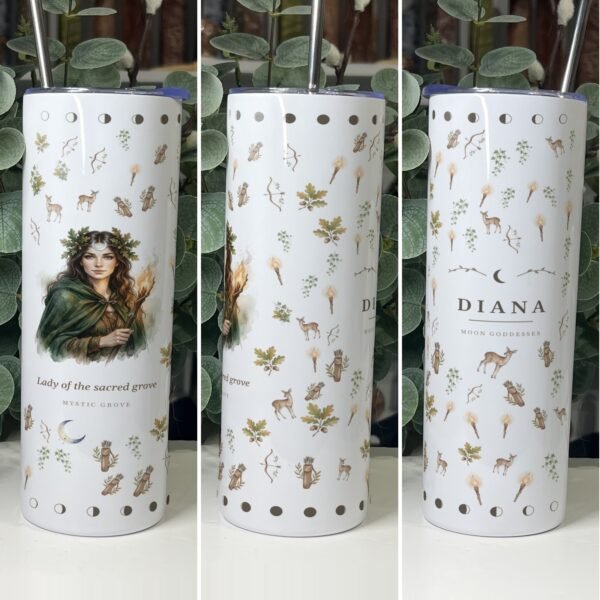
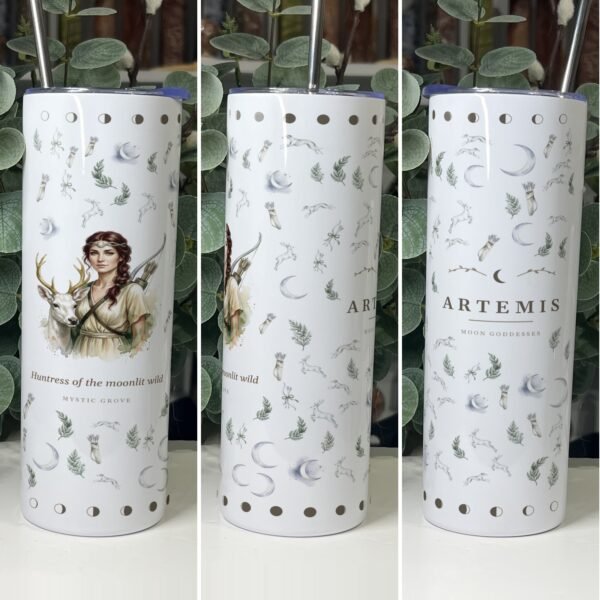
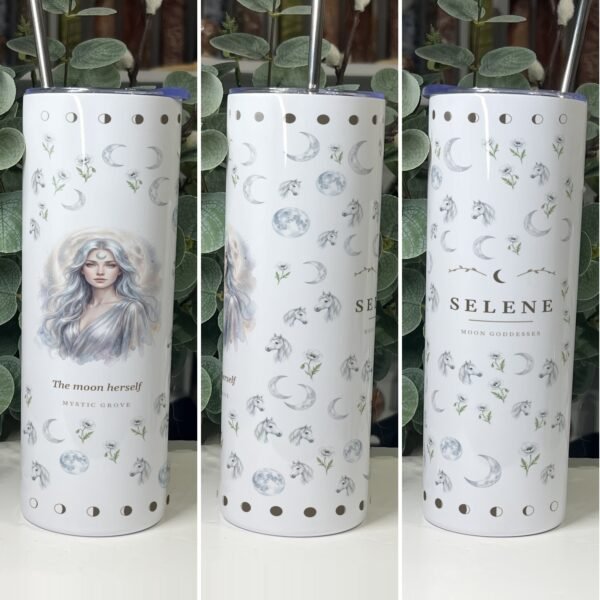
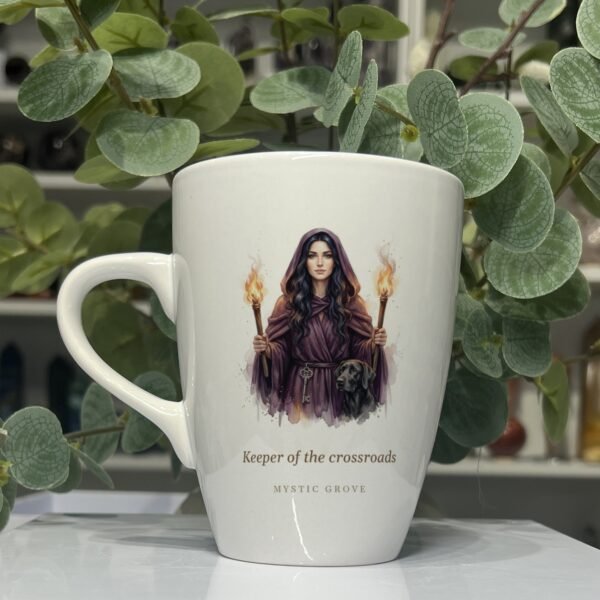
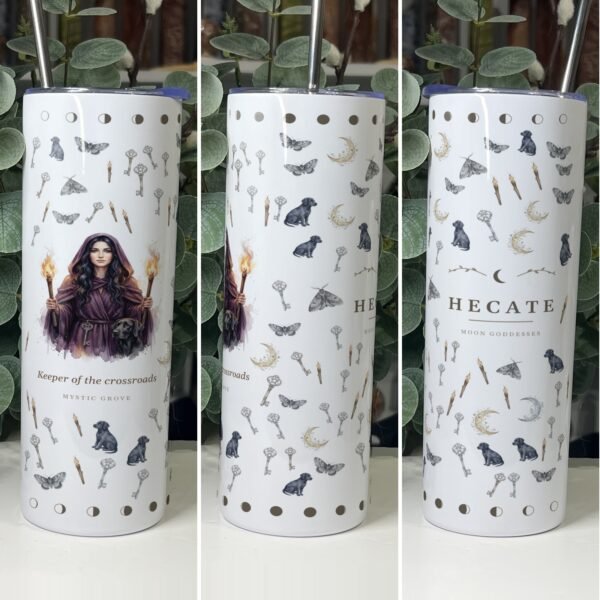
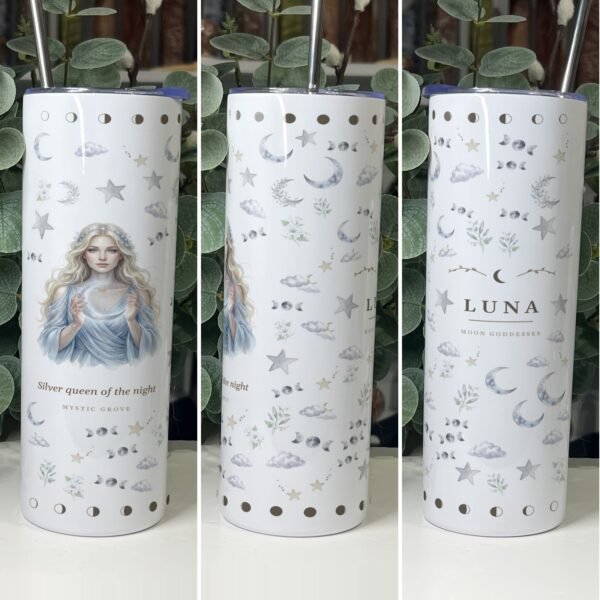
The Luna artwork from this series now comes on a 13oz white ceramic mug and a 20oz skinny tumbler wrapped all the way round in crescents, stars and moonflowers. Each one comes with a printed card telling her story, so it is ready to keep or to give.

Continue Your Journey
- Moon Goddesses: Names, Myths and Meanings
- Diana: Roman Goddess of the Hunt and the Moon
- Chang’e: the Moon Goddess of the Mid Autumn Festival
- Selene: Greek Goddess of the Moon
- Hecate: Goddess of the Crossroads
- The Hunter’s Moon 2026
- Lunar Goddess Archetypes and Crystal Grids
- Samhain Meaning and Traditions