

Selene, the Greek goddess of the moon: her silver chariot, her love for Endymion, her symbols and a simple practice for the eve of the Hunter’s Moon
Selene is the moon itself in Greek myth, the shining goddess who bathes in the Ocean at dusk, yokes her white horses and drives her chariot across the night sky. Here is who the Selene goddess is, what the oldest Greek sources really say, the story of Selene and Endymion, and the crystals and gentle practice people use to honour her today. She opens our week of moon goddesses, on the night before the Hunter’s Moon.
Selene at a glance
Say it: seh LEE nee. Her name is still the everyday Greek word for the moon.
Tradition: ancient Greek, from Hesiod and the Homeric Hymns.
Known for: driving the moon across the night sky, and her love for the sleeping Endymion.
Family: daughter of the Titans Hyperion and Theia, sister of Helios the sun and Eos the dawn.
Symbols: the silver chariot, two white horses, the crescent crown and the veil that arches over her head.
Roman name: Luna.
Her night this week: Sunday 25th October 2026, the eve of the Hunter’s Moon.
Who Is the Selene Goddess?
Selene is the Greek goddess of the moon, and in the oldest stories she is not simply linked with the moon, she is the moon. When the Greeks looked up at its light, they saw her face and her chariot. Her name comes from selas, an old Greek word for brightness or gleaming light, and it has never left the language: Greeks still call the moon selini today.
The poet Hesiod, writing around 700 BC, places her in a family of light. Her parents are the Titans Hyperion and Theia, and her brother and sister are Helios, the sun, and Eos, the dawn. The three of them share the sky. Helios drives his chariot across the day, Eos opens the gates of morning, and Selene takes the night.
Unlike the great Olympians, Selene had very few temples. She was honoured more as a living presence in the sky than as a goddess with priests and festivals. You do not need a temple to find her, only a clear night.
The Story of Selene and Endymion
The sleeper on Mount Latmos
The best known Selene story is a love story. On Mount Latmos, above what is now Lake Bafa in western Turkey, a beautiful young man named Endymion lay asleep in a cave. In most tellings he is a shepherd. Driving across the sky, Selene saw him sleeping in the moonlight and fell in love.
Night after night she stepped from her chariot and lay beside him while he slept. The poet Apollonius of Rhodes, writing in the third century BC, has her confess that she often slipped away to the Latmian cave to be with him.

The gift of endless sleep
Endymion was mortal, and mortals grow old. In the version told in the Library, a handbook of Greek myth from the Roman period, Zeus offered Endymion a wish and he chose to sleep forever, never ageing and never dying. Other tellers, among them the Roman writer Cicero, say the moon sent him to sleep herself, so that she could visit him undisturbed. Either way the ending is the same. He sleeps on Latmos still, and the moon still comes to him.
She could not stop him growing old. She could only stop the clock, and keep coming back.
The travel writer Pausanias, in the second century AD, adds that Selene bore Endymion fifty daughters. Some scholars suggest the fifty stand for the fifty lunar months between one Olympic festival and the next, which would make them the moon’s own months. It is a lovely idea, but a modern guess.
Selene’s other loves
She has two other partners in the stories. With Zeus she had a daughter, Pandia, whose name means all bright, and the poet Alcman names another daughter, Ersa, the dew. The Roman poet Virgil tells a stranger tale, that the woodland god Pan won the moon by tempting her with a snow white fleece. These are stories, told and retold by poets.
What the Selene Story Means
Read slowly, the Endymion tale is about faithfulness. The moon cannot stay. Every month she wanes away to nothing, yet she always comes back, and her love for Endymion is that rhythm turned into a story. It is also a story about rest, since sleep and night belong together. That is why so many people turn to Selene for calm evenings, peaceful sleep and dreams, and for a love that does not need to hold on tightly.
The Honest History of Selene
It helps to know which parts of Selene are ancient and which are recent.
What the old sources say
The most beautiful early picture of her is the short Homeric Hymn 32 to Selene, a poem of about twenty lines whose exact date no one knows, though it is usually counted among the later hymns in the collection. It describes her bathing her lovely skin in the waters of Ocean, putting on shining robes, yoking her bright horses and driving out in the evening in the middle of the month, when her great circle is full and her light is strongest. It calls her full moon a sure token and a sign to mortal men. That is the closest thing we have to an ancient description of Selene in her own right.
Pausanias saw a stone image of Selene at Elis with horns rising from her head. In Theocritus’s second Idyll, written in the third century BC, a young woman named Simaetha calls on Selene by moonlight as she works a love charm. The idea that witches could draw down the moon was familiar enough for Aristophanes to joke about it in his comedy The Clouds in 423 BC. You can read many of these passages gathered together at Theoi Greek Mythology.
Where you can still see her
Selene drives across some of the finest sculpture of the ancient world. On the east pediment of the Parthenon in Athens, carved between 438 and 432 BC, the sun’s horses rise at one corner and the moon’s horses sink at the other. One of those horse heads, its nostrils flared and its mouth open after a night of hard driving, is in the British Museum in London as the horse of Selene. The museum notes the driver may be Selene or Nyx, the night.
The Romans loved the Endymion story so much that they carved it on coffins. On these sarcophagi Selene steps down from her chariot towards the sleeping young man, her veil swelling in an arch above her head like a sail. The Metropolitan Museum’s Selene and Endymion sarcophagus from the early third century AD shows exactly this, with the sun rising in his chariot at one end and the moon sinking in hers at the other.
What is modern
Over time the Greeks blended their moon goddesses. By the Roman period Artemis, Hecate and Selene were often treated as faces of one lunar power, and Selene was matched with the Roman Luna. The triple goddess of maiden, mother and crone is newer still, popularised in the twentieth century by Robert Graves. Modern pagans often place Selene as the mother, the full moon. That is a meaningful modern layer, but it is not how the ancient Greeks arranged their gods.
Selene Goddess Symbols
Each Selene goddess symbol below comes from ancient poetry or art.
- The chariot. Her silver chariot carries the moon across the sky, just as her brother’s carries the sun. Later art often decorates it with stars.
- White horses. Usually a pair, pale as moonlight. Some poets give her oxen or bulls instead, and Pausanias mentions a mule.
- The crescent. Worn as a crown or diadem on her brow, or rising like horns from her head.
- The arching veil. A cloak or veil billowing over her head in a curve, which Roman artists used to show her drifting through the night.
- Silver and white. Her colours are the colours of moonlight itself.
Selene and the Hunter’s Moon
Selene’s day in our series is Sunday 25th October 2026, and the timing could hardly suit her better. It is the night the clocks go back. At 2am UK clocks fall from BST to GMT, and that evening the dark arrives an hour earlier than the night before. Sunday is named for the sun, her brother, so his day hands over to her night.
On Sunday evening the moon is a bright waxing gibbous, almost round, rising in the east around sunset. It slips into Taurus overnight and becomes the full Hunter’s Moon at 4.12am GMT on Monday 26th October, with the Sun in Scorpio opposite. Astrologers call the moon exalted in Taurus, the sign of the bull, a happy match for a goddess some poets gave a team of bulls. This is the full moon of the hymn.
For lovers of numbers, the digits of the 25th add up to seven, the number of goddesses in this series. From here the moon begins to wane, night by night, towards Samhain on Saturday 31st October, when Hecate closes the week.
Crystals for Selene
No ancient text gives Selene any crystal. The stones below are modern correspondences, chosen for her story: the moonlight, the white horses, the starry chariot, the sleeping Endymion and a love that keeps returning. Each is one we stock, and any of them can also be bought as a single tumblestone.
Selenite, the stone that carries her name
Selenite takes its name from the Greek for stone of the moon, after Selene herself, for its soft pearly glow. A selenite moon bowl makes a simple altar centre, and a selenite wand sits well beside a white candle.
Moonstone, for the full moon
Moonstone has a gentle sheen that seems to move across its surface, like moonlight on water. Our moonstone sphere echoes the round full moon itself.
Howlite, for the white horses
Howlite is white with soft grey veins, the colour of her pale horses. It is widely used as a calming stone before sleep, which ties it to the quiet hours she drives through. Try a howlite tower on a bedside table.
Amethyst, for Endymion’s dreams
Amethyst has long been a stone of rest and clear dreaming. With Selene it speaks to the sleeper on Latmos and the dreams the moon watches over. A dream amethyst sphere suits a dream journal kept by the bed.
Clear quartz, for the stars on the chariot
Clear quartz scatters light, much as the moon reflects her brother the sun, and stands for the stars on her chariot. A clear quartz cluster catches candlelight beautifully on a moon altar.
Rose quartz, for a faithful love
Rose quartz is the classic stone of tender love. With Selene it carries the side of her story that keeps coming back, a love that is patient and does not grasp. Hold a rose quartz palm stone while you think of someone you hold dear.
Keep selenite out of water. Selenite is a soft form of gypsum and it dissolves, clouds and pits when wet. If you are making moon water under the Hunter’s Moon, set the selenite beside the jar, never inside it. Moonstone and clear quartz are the safer stones to place near water.
A Simple Full Moon Practice for Selene
A gentle practice for the evening of Sunday 25th October, or any night near the full moon. You need a white chime candle, a small bowl of water, a pen and a journal, and one of the stones above. If you have a moon cycles charging plate, it makes a lovely base for your stone.
- Find the moon. Look for her rising in the east around sunset, or set your space by a window that faces her.
- Light the candle. Place the bowl of water in front of it, so the flame and the moonlight both catch on the surface. Say her name aloud three times: Selene, Selene, Selene.
- Speak to her. Say a few words of greeting in your own way. You might borrow the spirit of the old hymn: Hail, bright Selene, who drives the night. Thank you for your light.
- Write what you keep returning to. In your journal, write one thing in your life that is worth coming back to, again and again, like the moon to Endymion.
- Rest with the light. Hold your stone and sit quietly for a few minutes. Some people like to hum softly, or simply notice the slow rhythm of their breathing, as the night settles. Others sit in silence. Either is fine.
- Close. Thank Selene, put out the candle, and pour the water onto a plant or the earth outside. Keep your journal page private, just for you.
Light a candle for Selene
Our Manifest Magic chime candles come in ten colours. White is the colour of moonlight and of Selene’s horses, and a small chime candle burns down in a single evening, just right for the night before the Hunter’s Moon.
For a fuller altar, our guide to lunar goddess archetypes and crystal grids shows how to lay stones around a centre, with a crystal moon carving at its heart. Not sure Selene is the goddess for you? Our guide to which goddess is calling you may help.
The Seven Moon Goddesses Film
Selene is the first of seven moon goddesses in our short film, each painted in moonlight and following the moon from full to waning across the week of Samhain.
Questions People Ask About Selene
What is Selene the goddess of?
Selene is the Greek goddess of the moon. In the oldest sources she is the moon itself, driving it across the night sky in her chariot.
What is the story of Selene and Endymion?
Selene fell in love with Endymion, a young man who slept in a cave on Mount Latmos. He was granted endless sleep and eternal youth, and the moon visits him every night.
Is Selene the same as Artemis?
No, they began as separate goddesses. Selene was the moon itself, while Artemis was the goddess of the hunt. In later times Artemis took on moon symbolism and the two were often blended.
What is Selene’s Roman name?
The Romans called her Luna, and they told the Endymion story of Luna just as the Greeks told it of Selene.
Who are Selene’s parents?
Hesiod names the Titans Hyperion and Theia, which makes her the sister of Helios and Eos. One of the Homeric Hymns gives her father as Pallas instead.
What are Selene’s symbols?
Her chariot, her pair of white horses, the crescent crown, the arching veil, and the colours silver and white.
Bring Selene home
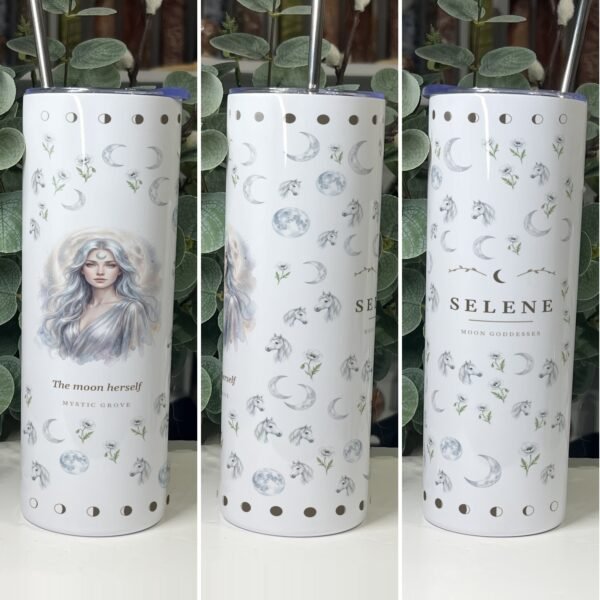
The Selene artwork from this series now comes on a 13oz white ceramic mug and a 20oz skinny tumbler wrapped all the way round in white horses, poppies and moons. Each one comes with a printed card telling her story, so it is ready to keep or to give.

Leave a Reply