Crystal Shop UK · Rooted in intention, curated with care

Tag: Celtic Mythology

  • The Morrígan: Celtic Goddess of Prophecy, Sovereignty and Fate

    The Morrígan: Celtic Goddess of Prophecy, Sovereignty and Fate

    The Great Queen of Irish myth: her three forms, the crow on the battlefield, her meeting with the Dagda at Samhain, and a quiet way to honour her as the dark half of the year begins

    Every October, as the nights draw in, the Morrígan seems to come closer. She is the crow on the battlefield, the woman washing armour at the river, the voice that speaks prophecy when the fighting is over. She can seem frightening at first. Spend a little time with her stories, though, and a different picture appears: a goddess of fate, of the land, and of seeing clearly what is coming. Here is who she is, where her stories come from, and a simple offering you can make at Samhain.

    The Morrígan at a Glance

    • Who: an Irish goddess of fate, prophecy, sovereignty, war and death, one of the Tuatha Dé Danann
    • How to say it: MOR·ree·gan, with the stress on the first part; often written Morrigan, without the accent
    • Her name: usually read as “Great Queen” or “Phantom Queen”
    • Her forms: the Morrígan herself, Badb and Macha; some tellings name Nemain
    • Known for: foretelling the outcome of battle, washing at the ford, her union with the Dagda at Samhain, testing the hero Cú Chulainn
    • Symbols: the crow and raven, the river ford, a red cloak, a grey spear, the chariot
    • Colours: black, red and white
    • Her festival: Samhain, Saturday 31 October 2026
    • Stones often linked with her: black obsidian, Whitby jet, bloodstone

    Who Is the Morrígan?

    The Morrígan belongs to the Tuatha Dé Danann, the divine people of Irish myth who were said to have ruled Ireland in the age before mortal kings. She is one of their greatest powers, and her loyalty in the old stories lies with them and with the land they held.

    She is often called a war goddess, but that is only half the story. She rarely fights the way a hero fights. Her power is over the outcome: she knows who will live and who will fall, and she speaks the prophecies that follow when the battle is done. She is less a goddess of fighting than a goddess of fate.

    Her Three Forms: Morrígan, Badb and Macha

    Like many Irish goddesses, the Morrígan is both one and three. The old texts speak of a group of sisters who share her work, and the names in that group shift from story to story. The best known trio is the Morrígan herself, Badb and Macha. Some tellings name Nemain instead.

    NameHow to say itWhat she is known for
    The MorríganMOR·ree·ganThe Great Queen herself: fate, prophecy, sovereignty and the shape shifter of the Táin
    BadbBAHVThe battle crow; her name is linked with the hooded crow, and she is often the one who washes at the ford
    MachaMAH·khaA queen of the land and the horse, remembered at Emain Macha in Ulster and in the curse she laid on the men of Ulster
    NemainNEV·inBattle frenzy and panic; named in some lists in place of one of the others

    Macha has her own famous tale. Forced to race against the king’s horses while heavily pregnant, she won the race, gave birth to twins at the finishing line, and cursed the men of Ulster to suffer the pains of labour at the very moment they most needed their strength. The great royal site of Emain Macha, near Armagh, carries her name, and Armagh itself is Ard Mhacha, Macha’s height. Her story ties the Morrígan’s family firmly to sovereignty: dishonour the goddess of the land, and the land will make you pay.

    Many people today link her three forms with the waxing, full and waning moon, a tradition many keep in their own practice, and it is a lovely way to sit with her through a lunar month.

    The Crow and the Washer at the Ford

    The crow is the Morrígan’s best known form. In the old tales the hooded crow or raven gathers over a battlefield, and a crow settling near a warrior is a sign that his fate is close. To this day, many people who feel drawn to her first notice it through crows and ravens: a bird that keeps turning up, landing close, calling at odd moments.

    Her other great image is the washer at the ford. A woman stands in a river, washing clothes or armour stained with blood, and whoever sees her is seeing their own fate. The washer appears across Gaelic folklore, and in the Scottish Highlands she lived on for centuries as the bean nighe, the washing woman of the streams. It is a stark picture, but the ford is also a crossing place, where one thing ends and the next begins.

    The Morrígan and the Dagda at Samhain

    One of the oldest and most important stories about her comes from the tale of the Second Battle of Mag Tuired, when the Tuatha Dé Danann faced their great enemies, the Fomorians.

    Shortly before the battle, at Samhain, the Dagda, the great father god of the Tuatha Dé Danann, went to a river in Connacht, the Unshin (written Unius in older spellings). There he found the Morrígan washing, with one foot on each bank of the river and her hair loosened. They came together there, and the place was afterwards known as the Bed of the Couple. She then told him where the Fomorians would land, and promised to take the strength from their king.

    This is not a romance in the modern sense but a joining of two great powers, abundance and fate, on the night the year turns. The old teaching held that their union at Samhain helped secure a good year to come for the fields, the herds and the people. Some traditions say a son, Aengus, the god of love and youth, was born of their meeting.

    When the battle was won, the Morrígan spoke two prophecies: a song of peace reaching up to the sky and plenty across the land, and a darker vision of a far future when summers would have no flowers and cattle no milk. She sees the good and the bad, and says both aloud. You can read more about the wider festival in our guide to the meaning of Samhain, and more about her partner in our post on the Dagda.

    The Morrígan and Cú Chulainn

    The Morrígan’s most famous human encounter is with Cú Chulainn, the young champion of Ulster, in the great Irish epic the Táin Bó Cúailnge, the Cattle Raid of Cooley.

    Medb, queen of Connacht, marches her army out to seize the Brown Bull of Cooley. The men of Ulster are laid low by Macha’s curse, and Cú Chulainn must hold back the invading army almost alone, fighting one champion after another at the fords. The Morrígan watches him closely. She comes to him as a young woman and offers him her love and her help. He turns her away, and she warns him that she will come against him when he is fighting.

    She keeps her word. During a hard fight at the ford she comes as an eel that wraps around his legs, as a grey wolf that drives cattle at him, and as a heifer leading a stampede. He wounds her in each form. Afterwards she appears as an old woman milking a cow, and offers him milk. With each drink he blesses her, and the wounds between them are healed. In other moments she comes as a crow and perches on his shoulder, bringing him omens and warnings of what lies ahead.

    In a later tale, the dying Cú Chulainn ties himself to a standing stone so he can face his enemies on his feet, and they only dare come near when a crow settles on his shoulder. Read together, the stories show the Morrígan as a tester of heroes, the one who keeps the appointment with fate.

    Sovereignty: The Queen and the Land

    In early Irish thought, the right to rule was a relationship with the land, and the land was understood as a goddess. A good king was, in a sense, married to her. If he ruled well, the land was fruitful; if badly, the crops failed.

    The Morrígan carries this idea in her very name. She is the Great Queen, fierce in defence of the land and those who belong to it, which is why she can be both terrifying and protective. For many people today, that is exactly her appeal.

    Samhain, the Moon and the Season of the Crow

    The Morrígan’s festival is Samhain, the old Celtic new year, kept on 31 October by people of many paths. The bright half of the year closes here and the start of the dark, a time when the veil between the worlds was said to be thin. In 2026 it falls on Saturday 31 October.

    The sky fits her well this year. The Sun is in Scorpio at Samhain, the sign of depth, endings and what lies beneath the surface. The Hunter’s Moon is full in Taurus early on Monday 26 October, so by Samhain the moon is waning, the phase traditionally used for letting go and clearing away. It is a fitting time to ask her what needs to end in your own life before winter.

    The Honest History

    Everything we know about the Morrígan comes from Irish stories that were written down by Christian monks, mostly from around the eleventh and twelfth centuries, in great manuscript collections such as the Book of the Dun Cow, the Book of Leinster and the Yellow Book of Lecan. Some of the material in them is clearly much older, carried in oral tradition for generations before anyone wrote it down. But the monks were not writing as worshippers, and we cannot be sure how much they changed, softened or left out.

    We have no temples or carved inscriptions that name her, and we do not know exactly how she was honoured before Christianity reached Ireland. What we have are her stories.

    The Morrígan as many people meet her today, a goddess of personal power, boundaries and empowerment, especially for women, is a modern understanding. It grew from the twentieth century onwards as people came back to the old tales and found something in her that spoke to their own lives. That does not make it false. It simply means it is new, built with care on old foundations, and it is worth knowing the difference.

    Crystals for the Morrígan

    These stones are often chosen for her altar or to carry when working with her:

    • Black obsidian: a dark, glassy stone of protection and honest reflection, long linked with her
    • Whitby jet: a traditional stone of mourning and remembrance, fitting for Samhain and her care for the dead
    • Bloodstone: deep green flecked with red, a warrior’s stone traditionally linked with courage
    • Snowflake obsidian: black with soft grey marks, a gentle companion for facing endings with a clear head
    • Red jasper: grounding and steady, in one of her three sacred colours

    Trees and plants traditionally linked with her include rowan, willow and yew.

    A Simple Samhain Offering to the Morrígan

    This is a gentle, traditional style offering for Samhain night, Saturday 31 October 2026, or any evening in the waning days around it.

    1. Prepare a small space. Lay a black or red cloth on a shelf or table. Place a black or red candle in the centre; a white candle can stand in for any colour. Add your stones, a dish for the offering, and a crow or raven image if you have one, or a feather you have found naturally on a walk.
    2. Choose your offering. Offerings often given to her today include a small dish of red beans, a piece of meat from your Samhain meal, a little red wine, milk, or bread.
    3. Light the candle and speak to her. Breathe slowly for a moment, then say aloud, in your own words or these: “Great Queen, Morrígan, I honour you on this night of turning. I bring this gift with respect. Help me see clearly what is ending and what is worth defending.”
    4. Sit with her. Close your eyes and picture a river ford at dusk, with a crow on a branch above the water. Notice what comes: a sound, a feeling, a word. If nothing comes, that is fine too. Simply sit for a few minutes in the quiet.
    5. Write it down. In a journal, answer two questions: What in my life has run its course? What am I willing to stand up for in the year ahead?
    6. Close with thanks. Thank her, then snuff the candle rather than blowing it out.
    7. Return the offering. The next morning, pour any liquid onto the earth and place food outside on soil or in the garden, away from paths, if it is safe for wildlife. Otherwise, bury it or compost it with thanks.

    If you are drawn to honour the dead as well, our Samhain guide includes a simple ancestor practice that sits beautifully alongside this one.

    Signs the Morrígan May Be Calling You

    People who feel drawn to her often describe a few of the same things:

    • Crows or ravens turning up again and again, landing close or calling at you
    • Dreams of rivers, fords, battles or a tall woman in red or black
    • A strong pull towards her name or image, especially in autumn
    • A season of life where you need to find your courage, speak up or protect something you love
    • A growing interest in prophecy, divination and seeing things as they really are

    You do not need a sign to begin learning about her. If you are not sure which goddess is reaching for you, our gentle guide Which Goddess Is Calling You? may help.

    Questions People Ask

    What is the Morrígan the goddess of?

    She is an Irish goddess of fate, prophecy, sovereignty, war and death. In the old stories she decides the outcome of battles rather than fighting in them, and she is closely tied to the land and the right to rule it.

    Is the Morrígan evil?

    No. She can be fierce and frightening in the stories, but she is not evil. She protects her people and her land, she tests heroes, and she speaks the truth about what is coming, whether it is welcome or not.

    Is the Morrígan a crow or a raven?

    Both appear in the tradition. Her sister Badb is closely linked with the hooded crow, and the Morrígan herself takes crow form in the Táin. Many people today honour her through ravens and crows alike.

    What is the Morrígan’s connection to Samhain?

    In the tale of the Second Battle of Mag Tuired, she meets the Dagda at a river on Samhain, before the battle against the Fomorians. Their union at the turning of the year was traditionally linked with the fertility of the land. You can read more in our post on the Dagda.

    How is the Morrígan different from Hecate?

    Both are goddesses many people turn to as the nights draw in. Hecate is Greek, a goddess of crossroads, keys and the dark moon, while the Morrígan is Irish and tied to fate, sovereignty and the land. Our post on Hecate tells her story.

    The Morrígan is said to take the form of a wolf in the old tales, and many people keep a crystal wolf head carving on their altar for her. A black obsidian mini goddess body carving is another fitting focus for this goddess of the darker half of the year.

    Bring the Morrígan home

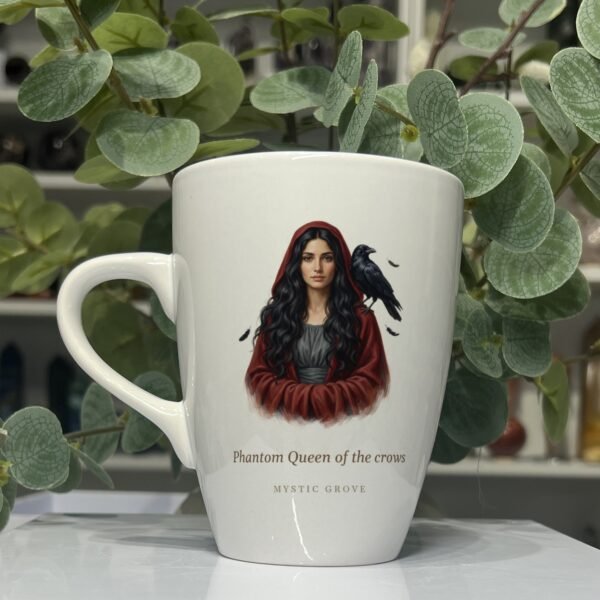
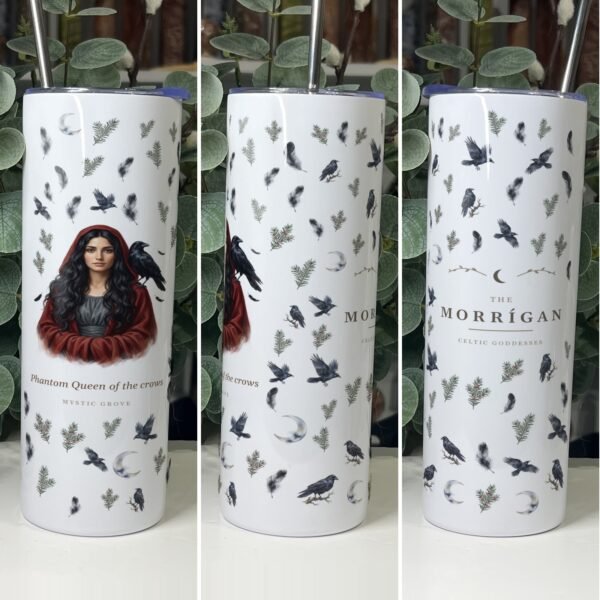
    The Morrígan artwork from this series now comes on a 13oz white ceramic mug and a 20oz skinny tumbler wrapped all the way round in crows, feathers and yew. Each one comes with a printed card telling her story, so it is ready to keep or to give.
    See all the goddess tumblers

    Keep reading: The Dagda, the Good God of Ireland · The Cailleach, the Celtic Winter Goddess · Samhain Meaning · Which Goddess Is Calling You? · Hecate, Goddess of the Crossroads
  • Celtic Circles and Ancient Crystal Magic

    Celtic Circles and Ancient Crystal Magic

    The first crystal grids: Celtic stone circles, Egyptian lapis and the obsidian mirrors of Mesoamerica, and how to bring their magic home

    Crystals are everywhere at the moment, on yoga mats, in necklaces and all over social media. It is lovely that so many people are drawn to them, but it can make crystal work look like a new trend. It is not. People have been arranging stones with intention for thousands of years, and this guide looks at a few of the oldest examples.

    We are here to tell you that working with stones is not a modern trend. It is one of the oldest human practices on earth. Long before we had apps to track the moon or digital calendars to tell us when the seasons were changing, our ancestors were using stones as highly advanced technology. They did not just think rocks were pretty. They understood that minerals held a steady, grounding power that could help them navigate a very chaotic world.

    Before we start building our own beautiful grids on our coffee tables, we need to understand exactly whose footsteps we are walking in. Today, we are travelling back in time to look at the huge, original crystal grids of the ancient world. From the misty fields of the Celtic Druids to the golden temples of Egypt, let us explore the profound history of earth magic.

    The Original Grids The Celtic Stone Circles

    When we think of a crystal grid today, we usually picture a small geometric pattern of polished stones that fits neatly on a bedside table. But the very first crystal grids were absolutely huge. They were the great stone circles built by the ancient Celtic and pre Celtic peoples across the British Isles and Europe.

    Think of famous sites like Stonehenge or the Avebury ring. Modern historians often call these giant stone circles primitive calendars. Yes, they were built to track the movement of the sun and the stars, telling the people exactly when to plant their crops and when to prepare for winter. But to the Druids and the ancient wise people who used them, they were so much more than a clock.

    These circles were constructed using very specific types of rock. The giant stones at Stonehenge, known as bluestones, were dragged for hundreds of miles from Wales. Why would ancient people work so incredibly hard to move heavy rocks from so far away? Because those specific stones were rich in quartz. They understood that quartz is an amplifier. By placing these quartz rich stones in a huge circular circuit, they were building a giant energy generator.

    Imagine standing in the centre of a huge stone circle at dawn on the Winter Solstice. The air is freezing, but as the sun crests over the horizon, its light hits the central altar stone perfectly. The circle of giant quartz rich rocks acts exactly like a modern crystal grid. It catches the energy of the sun, amplifies it, and broadcasts it outward into the frozen earth to wake up the soil and promise the return of spring. They were not just watching the seasons change; they were actively using the stones to help the earth turn.

    Egyptian Magic Lapis Lazuli Conduits

    While the Celts were building huge outdoor earth grids, the ancient Egyptians were using stones in a deeply personal, incredibly precise way. If you look at the tomb goods of the Pharaohs, you will see they are absolutely covered in specific gemstones. But the Egyptians did not just wear jewellery to look wealthy. To them, stones were spiritual tools with exact jobs to do.

    The Egyptians were master alchemists. They believed that certain stones were literally the flesh of the gods. One of their most sacred tools was Lapis Lazuli. This deep blue stone, flecked with golden pyrite, looked exactly like the night sky. The high priests and priestesses used Lapis Lazuli as a conduit. They placed it on the centre of their foreheads, right over the third eye, to open their minds and receive direct messages from the spiritual realm.

    They also used Carnelian, a fiery orange stone, to protect the soul as it travelled to the afterlife, and Malachite, a rich green stone, to protect the physical body from illness. When we place a Lapis Lazuli stone at the centre of our modern crystal grids to boost our intuition, we are doing exactly what the Egyptian high priests did thousands of years ago.

    The Obsidian Mirrors of Mesoamerica

    If we travel across the world to ancient Mesoamerica, we find the Aztecs and the Mayans using stones for deep shadow work and spiritual protection. Their stone of choice was Obsidian. Obsidian is born from raw volcanic glass. It is created when molten lava cools so incredibly fast that it forms a smooth, dark, glass like stone.

    The ancient priests polished Obsidian until it was completely reflective, creating dark mirrors. But they did not use these mirrors to check their reflection. They used them for a practice called scrying. They believed that the dark, perfectly smooth surface of the Obsidian acted as a portal. By staring into the stone, they could peer into the shadow world, communicate with their ancestors, and see visions of the future.

    Obsidian was also known as the ultimate energetic vacuum. The Aztecs knew that this dark volcanic glass could absorb heavy, negative energy. Today, when we place Black Obsidian at the four corners of our crystal grid to protect our home from bad vibes, we are tapping straight into this ancient volcanic wisdom.

    Bringing the Ancient Magic Home

    When you look at the huge stone circles of the Celts, the intuitive lapis conduits of the Egyptians, and the protective obsidian mirrors of the Aztecs, you realise something incredible. Our ancestors were all doing the exact same thing. They were taking the stable, quiet power of the earth and using it to bring balance to their human lives.

    In Crystal Grid Alchemy, we are simply taking this ancient, global knowledge and scaling it down. You do not need to drag a huge boulder across a field to harness the power of a stone circle. You can create that exact same circular circuit on your kitchen table using small quartz points. You do not need to be an Egyptian Pharaoh to open your intuition; you just need a single piece of Lapis Lazuli.

    By building crystal grids, we are keeping this ancient earth magic alive. We are stepping into the role of the architect, using the very same tools our ancestors used to protect their homes, heal their bodies, and connect with the stars.

    Your Ancient History Toolkit

    If you want to feel a direct connection to these ancient cultures, you can start by adding their favourite foundational stones to your own collection. These are the classic tools of the ancient architects.

    • The Celtic Amplifier: Clear Quartz points. These are your modern equivalent to the giant standing stones. Use them to build the outer circles of your grids to amplify and direct your energy.
    • The Egyptian Conduit: A piece of Lapis Lazuli. Place this royal blue stone in the centre of your grid when you want to quiet your busy mind, meditate deeply, and tap into your intuition.
    • The Mesoamerican Shield: Black Obsidian. Keep a piece of this dark volcanic glass near your front door, or use it as the anchor stones in your grid, to absorb stress and protect your home from outside chaos.

    You can find these beautiful, historically rich stones in our Mystic Grove Crystal Category.

    Knowing where the practice comes from makes it richer. If you would like to understand why stones are thought to steady us, our guide to the science of entrainment looks at the physics, and how to build and wire a crystal grid shows you how to lay your own.

    Shop the stones in this guide

    Obsidian · Lapis Lazuli · Quartz · Carnelian · Crystal Towers and Points · Tumble Stones

  • Samhain Meaning: History, How to Say It and a Home Ritual

    Samhain Meaning: History, How to Say It and a Home Ritual

    Samhain meaning, honest history and a gentle home ritual for 31 October

    Samhain is the old turning point between the light half of the year and the dark. Here is the Samhain meaning as the records actually tell it, how to say the word, what is folklore and what is fact, and a simple ritual you can keep at home with a candle, a bell and a few stones.

    Samhain at a Glance

    • When: the evening of 31 October, running into 1 November, every year
    • Say it: SOW in (rhymes with cow) or SAH win
    • Astronomical Samhain: when the Sun reaches 15 degrees of Scorpio, usually around 6 to 8 November
    • What it marks: the turn from the light half of the year into the dark, and a time to remember those who came before
    • Altar stones: black obsidian, smoky quartz, Whitby jet, black tourmaline, labradorite, carnelian and red jasper
    • This year: dates, Moon times and a fortnight ritual in our Samhain 2026 guide

    Samhain meaning: what the word really says

    Samhain is the Irish name for the festival at the start of November. In Modern Irish it is Samhain, in Scottish Gaelic Samhainn, and in Old Irish Samain. The night itself is Oíche Shamhna in Irish, Samhain eve.

    You will often read that the word means “summer’s end”. That is the popular explanation, but linguists now lean another way. The most widely accepted root is a Celtic word meaning reunion or assembly, the same family as the Old Norse saman, “together”. That fits the medieval Irish stories well, because Samhain in those tales is above all a gathering: the great assemblies of the year, the feasts, the meetings of kings.

    So the truest Samhain meaning may simply be this: the night everyone comes together as the dark half of the year begins. Kin, community and, in later folklore, the ones who have gone before.

    Samhain was first a gathering. The thinning veil came later in the story, and both are worth keeping.

    The honest history of Samhain

    A lot of what is written about Samhain online is confident and very little of it is sourced. Here is what the evidence actually supports, and where it runs out.

    The oldest written trace

    The earliest hint comes from Gaul, not Ireland. The Coligny calendar, a bronze calendar from around the second century found in eastern France, names a month called SAMON. One of its entries reads TRINOX SAMONI, often translated as the three nights of Samon. Scholars still debate exactly when that fell in the year, but it shows a festival with a related name was being marked in the Celtic world long before anyone in Ireland wrote it down.

    Caesar, writing about the Gauls, also noted that they counted time by nights rather than days, with each day beginning at sunset. That is why Samhain is kept on the eve, 31 October, and runs into 1 November.

    Samhain in the Irish stories

    Samhain appears in Irish writing from around the ninth century onward. The tale known as Tochmarc Emire, the Wooing of Emer, lists Samhain as the first of the four seasonal festivals of the year, alongside Imbolc, Beltaine and Lughnasadh. Other stories place the great Feast of Tara at Samhain, and a remarkable number of the old sagas set their most dramatic moments on this night: battles, meetings with the people of the sídhe (the otherworld mounds), and doorways opening between worlds.

    These are literature, written down by Christian monks, so they are not a diary of pre Christian practice. But they show clearly that Samhain was understood as the hinge of the year and a time when the ordinary rules could slip.

    The fire on the Hill of Ward

    The Hill of Ward in County Meath, known in Irish tradition as Tlachtga, is said to have been the site of a great Samhain fire. Excavations led by Stephen Davis of University College Dublin from 2014 found evidence of large scale feasting, intense burning and activity across phases running from the Bronze Age to around AD 400 to 520. The excavators were careful to say that tying the burning directly to Samhain is tempting but cannot be proven, since it could equally come from metalworking. It is a fair example of how this history works: strong tradition, real archaeology, and an honest gap between them.

    Is Samhain the Celtic new year?

    You will see this claim everywhere. It mostly traces back to nineteenth century scholars, John Rhys and James Frazer, and historians such as Ronald Hutton have pointed out that the medieval records do not prove it. What we can say is that Samhain opened the dark half of the year and was the first festival in the Irish list. Many people today treat it as their new year, and that is a lovely modern practice. It is just worth knowing it is a modern reading rather than an ancient certainty.

    THE WHEEL OF THE YEAR the light half the dark half Yule Imbolc Ostara Beltane Litha Lughnasadh Mabon S Samhain How to read the wheel The year turns clockwise. The dashed line splits the year. The bold arc, from Samhain round to Beltane, is the dark half. Samhain opens it. Imbolc, Beltaine, Lughnasadh and Samhain are the four old Irish festivals. The solstices and equinoxes complete the modern eight point wheel. MYSTIC GROVE THE WHEEL OF THE YEAR light half dark half Yule Imbolc Ostara Beltane Litha Lughnasadh Mabon S Samhain How to read the wheel The year turns clockwise. The bold arc, from Samhain round to Beltane, is the dark half of the year. Samhain opens it. Imbolc, Beltaine, Lughnasadh and Samhain are the four old Irish festivals. MYSTIC GROVE
    Samhain on the Wheel of the Year, turning clockwise. The bold arc from Samhain round to Beltane is the dark half of the year.

    Samhain and Halloween: how one became the other

    Halloween is All Hallows’ Eve, the night before the Christian feast of All Saints on 1 November. Churches in Ireland were already keeping All Saints on that date by around AD 800, and in 835 it became the official date across the Frankish Empire, with All Souls following on 2 November by the eleventh century. Whether the church chose the date because of Samhain is still argued over, but the two seasons ran side by side and the customs blended.

    Many things people think of as American Halloween are older customs from these islands:

    • Guising: going door to door in disguise, offering a song, rhyme or verse in exchange for food, recorded in Ireland and Scotland long before trick or treating.
    • Turnip lanterns: turnips and mangel wurzels carved with faces and lit from inside. Pumpkins only took over once the custom crossed the Atlantic.
    • Apples and hazelnuts: used in divination games about love and the year ahead.
    • Bonfires on high ground: lit across Ireland and Scotland at Samhain.

    The custom is alive closer to home too. On the Isle of Man, Hop tu Naa is still celebrated on 31 October, with children carrying carved turnips and singing traditional songs. In Wales the start of winter is Calan Gaeaf, the calends of winter, and the night before, Nos Galan Gaeaf, was traditionally a night to be home before dark.

    How to pronounce Samhain

    The word is not said the way it is spelled, which is why “how to pronounce Samhain” is searched almost as often as the festival itself. The Irish pronunciation is close to SOW in, rhyming with cow. In Scottish Gaelic, Samhainn is closer to SAH win. Both are right. The one to avoid is saying it as written, “sam hane”.

    Seven goddesses of the Celtic world, from the silver stars to the Samhain fire, in one short film: Arianrhod, the Morrígan, Cerridwen, Danu, Blodeuwedd, the Cailleach and Brigid.

    Seven Celtic Goddesses: a one minute film, from the standing stones to the Samhain fire

    The Samhain meaning for us now

    For many people today, of many paths, Samhain is a time to honour those who have gone before, to look back over the year and to let go of what is finished. You do not have to follow any one tradition to keep it. A lit candle, a name said aloud and a quiet half hour is a full Samhain.

    The sky around Samhain changes from year to year: where the Moon sits, when the clocks go back and the day the Sun reaches the astronomical midpoint. We gather those details each autumn in a short seasonal guide. For this year, read Samhain 2026: the date, the sky and a gentle fortnight ritual.

    Crystals for Samhain and your altar

    These are the stones that carry the Samhain season best. All are in stock as tumblestones or rough pieces, so a full altar set costs very little.

    The Samhain crystal set. Our Samhain crystal set gathers seven of these stones in one velvet pouch: obsidian at the centre, with black tourmaline, smoky quartz, labradorite, moonstone, carnelian and red jasper. It comes with a Samhain grid card showing where each stone sits, so the grid and the ritual below are ready to go.

    Black obsidian: for clearing and endings

    Volcanic glass, formed when lava cools too quickly to crystallise. Traditionally used for protection, cutting cords and seeing a situation as it really is. The heart of most Samhain altars. Find it as a black obsidian tumblestone or a black obsidian tower.

    Whitby jet: the British mourning stone

    Jet is fossilised wood, and the finest comes from the Yorkshire coast at Whitby. It has been worn in Britain since the Bronze Age, and it became the mourning stone of the Victorian era after Queen Victoria wore it for Prince Albert. Few stones carry remembrance so honestly. Hold a Whitby jet tumble while you speak the names of your loved ones.

    Smoky quartz: for grounding the grief

    Quartz darkened by natural radiation in the earth. Smoky quartz is a gentle, steadying stone for the heavier feelings this season can bring. Choose rough smoky quartz for the altar or a smoky quartz tower as a centrepiece.

    Black tourmaline: for protecting the threshold

    Traditionally placed by doors and windows. On a night when the old stories say the boundaries thin, a piece of rough black tourmaline by the front door feels exactly right.

    Labradorite: for the space between

    Grey until the light catches it, then flashing blue and gold. Labradorite is the stone of thresholds and intuition. Try a blue labradorite tumblestone for the altar.

    Carnelian and red jasper: for warmth and life

    Samhain honours endings, but the hearth fire was always lit. Carnelian and red jasper bring that warmth and vitality back to the altar so it does not become all shadow. A red jasper tumblestone or a carnelian palm stone balances the darker stones.

    The raven: messenger between worlds

    Ravens appear throughout Irish and British lore as messengers and as birds of the battlefield goddess. A raven skull crystal carving in obsidian or labradorite makes a quiet guardian for the season. Crystal skulls, too, have long been kept as reminders of the cycle of life, and a crystal skull carving suits an ancestor shelf.

    Short of stones? One black obsidian and one red jasper are enough. Dark for what you release, warm for what you keep. If all you have is clear quartz, use that and say aloud what you would like it to hold.

    A simple Samhain ritual for home

    This ritual draws on the old Samhain customs of remembering: candlelight, a place laid for those who have gone, and their names spoken aloud. It takes about half an hour and is best kept after dark on 31 October, though any evening in the days that follow, before the next New Moon, is fine.

    What you will need

    • A candle in a holder, ideally black or white, and a safe place to burn it
    • A bell, a singing bowl or a glass you can ring with a spoon
    • Your altar stones, at least one dark and one warm
    • A journal and pen
    • Something for each person you wish to honour: a photo, a keepsake, or simply their name written on paper
    • Incense or a cleansing stick, if you like scent

    The ritual

    1. Open the space with sound

    Ring the bell once and listen until the sound has completely gone. That silence after the sound is your doorway. Say, out loud or under your breath: “It is Samhain. The year turns and I am here.”

    2. Light the candle

    Feel the warmth on your hands as you hold them near the flame. Say: “This light is for the ones who came before me.”

    3. Speak the names

    Hold the Whitby jet or black obsidian in your hand. Say each name aloud, slowly. After each one, take one full breath in and out before the next. If a memory comes, say it too. If you are honouring a pet, an old friend or a part of your own life that has ended, that belongs here as well.

    4. Let go

    Write down what this year is ending for you: a habit, a worry, a role you have outgrown. Read it aloud. Place your hand flat on the paper and breathe out slowly through the mouth three times, as if setting a weight down. Fold the paper and set the dark stone on top.

    5. Keep what is good

    Now hold the red jasper or carnelian. Say three things from this year you want to carry into the dark months: people, lessons, small joys. Feel the stone warm in your palm.

    6. Close

    Ring the bell once more and listen to the silence. Thank the ones you named. Snuff the candle rather than blowing it out, and leave the stones on the altar until the next New Moon. The folded paper can be safely burned in a cauldron or simply torn and recycled.

    Say the names out loud. A name spoken in a quiet room is one of the oldest offerings there is.

    Samhain journal prompts

    • What has this year taught me that I do not want to forget?
    • Who shaped me, and what do I still carry from them?
    • What am I ready to stop carrying?
    • What do I want the dark months to give me: rest, study, healing, quiet?
    • If this Samhain is my new year, what is the first true sentence of it?

    Your Samhain altar, ready by 31 October

    Everything for a home Samhain is in the shop now: the Samhain crystal set with its grid card, black obsidian, Whitby jet, smoky quartz and red jasper stones, raven skull carvings, ritual candles, the Book of Shadows journal with its black obsidian pen, and cast iron cauldrons for the release paper. Order by the third week of October for Samhain eve.

    Shop the Samhain crystal set

    More for the altar

    Sources for the history in this post: the Archaeology magazine report on the Hill of Ward excavations. For this year’s dates and Moon times, see our Samhain 2026 guide.

    Shop the stones in this guide

    Obsidian · Quartz · Jasper · Smoky Quartz · Samhain · Spell Candles

  • Imbolc Meaning: History, Traditions and How to Celebrate on 1 February

    Imbolc Meaning: History, Traditions and How to Celebrate on 1 February

    What Imbolc means, how to say it, where it comes from, and simple ways to welcome the first light of spring on Monday 1 February 2027

    Imbolc arrives when winter still has a firm hold. The mornings are dark, the ground is cold, and yet something has changed. The days are a little longer, snowdrops are out under the hedges, and on the hill farms the first lambs are on their way. For centuries people in Ireland and across the Celtic lands marked this moment on 1 February with rushes, candles and a welcome for Brigid. Here is what Imbolc means, what is old and what is new, and how you can keep it at home.

    Imbolc at a Glance

    • What: an old Irish festival of early spring, one of the four fire festivals of the Celtic year
    • When: 1 February, beginning on the evening of 31 January. In 2027 Imbolc falls on Monday 1 February
    • How to say it: IM·bolk or IM·bulg. Both are heard and both are fine
    • Meaning: usually explained as “in the belly”, linked with ewes coming into milk before lambing
    • Who it honours: Brigid, the Irish goddess of fire, poetry and healing, and Saint Brigid of Kildare, whose feast day is the same day
    • Symbols: Brigid’s cross woven from rushes, candles, snowdrops, milk, a white cloth, a small bed for Brigid
    • Colours: white, green and red
    • Next day: Candlemas, 2 February

    What Does Imbolc Mean?

    The name is old Irish. Most writers trace it to i mbolg, “in the belly”, and connect it with the ewes, heavy with lambs, beginning to make milk. In a farming year that had very little fresh food in the depths of winter, the return of milk mattered. It meant the hungry months were nearly over.

    An older explanation comes from Cormac’s Glossary, written in Ireland around the year 900. It links the festival with oimelc, “ewe’s milk”. The two ideas sit happily together. Both point to the same picture: animals in the field carrying new life, and a household that knows spring is coming even if it cannot yet see it.

    Imbolc is also remembered as a feast of purification, a time to clear out the old and make a clean, bright start. You will often see both meanings in modern books, the belly and the cleansing, and they are both part of how the festival is kept today.

    How to pronounce Imbolc

    You will hear it said IM·bolk, with a hard k at the end, and IM·bulg, closer to the old spelling Imbolg. The stress falls on the first syllable either way. There is no single correct version, because Irish itself has changed over the centuries and different regions say it differently.

    A Fire Festival in the Cold

    The old Irish year turned on four great festivals: Samhain on 1 November, Imbolc on 1 February, Beltane on 1 May and Lughnasadh on 1 August. These are often called the fire festivals, because fire was at the heart of each one. At Samhain there were bonfires. At Beltane cattle were driven between two fires. At Imbolc the fire came indoors, as candles in the window and a well tended hearth.

    Imbolc sits halfway between the winter solstice and the spring equinox. It is the quickening of the year, the first stirring. Nothing much shows yet above ground, but under it, seeds and roots are waking. Many people find it a gentle festival, quieter and more domestic than the others, a time for the home rather than the hilltop.

    Some people now keep Imbolc on the date the sun reaches the true midpoint between solstice and equinox, which falls a few days later in early February. Most keep the traditional date of 1 February. Either is a lovely way to mark it.

    Brigid and St Brigid’s Day

    Imbolc belongs to Brigid. In Irish mythology she is a daughter of the Dagda, the great father of the gods, and a goddess of the three fires: the fire of poetry, the fire of the forge and the fire of healing. Stories tell that a tower of flame rose above her head on the morning she was born, and that healing springs welled up wherever she walked.

    Saint Brigid of Kildare, one of the patron saints of Ireland, shares her name and her feast day. The saint founded a great church at Kildare, where a flame was kept burning for centuries. A tradition many keep holds that the goddess and the saint are two faces of one beloved figure, and that the people of Ireland simply carried Brigid with them when the new faith arrived. Since 2023 St Brigid’s Day has been a public holiday in Ireland, held on the first Monday of February, or on 1 February itself when it falls on a Friday. In 2027 the two land on the same day.

    You can read her full story, the three Brigids and the flame at Kildare, in our guide to Brigid, the Celtic goddess of fire, poetry and healing.

    Brigid and the Cailleach

    In Scottish and Irish folklore, Imbolc is also a meeting point between Brigid and the Cailleach, the old woman of winter. The Cailleach rules the dark half of the year with her staff and her frost. Brigid brings the spring. Each year they meet, and the story of how winter finally gives way is told in many versions. One well known piece of weather lore says that if Imbolc is bright and dry, the Cailleach is out gathering firewood for a long winter still to come. A wet, grey Imbolc means she is asleep, and spring will be early. You can find more about her in our post on the Cailleach.

    Imbolc Traditions

    Most of the customs we know come from Irish and Scottish homes over the last few hundred years, recorded by folklorists who spoke to farming families. Many are still kept.

    Brigid’s cross

    The best known Imbolc symbol is Brigid’s cross, a small four armed cross woven from rushes or straw. Rushes were pulled by hand on the eve of the feast, never cut, and the crosses were made by the fire in the evening. A new cross was hung over the door or in the rafters to keep the home and its people safe through the year, and the old one was often burned or tucked into the thatch. The four arms are equal, which gives the cross the look of a turning wheel or a little sun. Our Brigid guide has step by step instructions for making one.

    Brigid’s bed and the brídeóg

    On the eve of the feast, families made a small bed for Brigid near the hearth, sometimes a basket lined with cloth, so that she would feel welcome when she passed through the house in the night. In many places a doll called a brídeóg, said BREE·jogue, was made from straw or rushes and dressed in white. Young people carried it from door to door, and each household offered a coin, a little food or a pin in her honour. In Scotland the same idea is recorded, with Bride placed in her bed and a call that she is welcome.

    The brat Bríde

    A piece of cloth or a ribbon, the brat Bríde or Brigid’s mantle, was left outside on a bush or windowsill overnight. Brigid was believed to touch it as she passed. In the morning it was brought back in and kept safely through the year as a token of her blessing and protection.

    Candles and the hearth

    Light is at the centre of Imbolc. Homes were lit with candles, the hearth was cleaned and the fire kept bright. In the modern practice of many people, every candle in the house is lit at sunset on Imbolc eve, even for a few minutes, to welcome back the strengthening sun.

    Spring cleaning

    Long before it had a name, spring cleaning was part of Imbolc. The house was swept, the hearth cleared of ash and everything made ready for Brigid’s visit. Today many people give one room, their altar or their front door a proper clean and a fresh start at Imbolc. It is simple, practical and it feels good.

    Holy wells

    Brigid has many wells across Ireland, and visiting them around her feast day is a living tradition. People walk around the well, say prayers, and sometimes leave a ribbon or a strip of cloth tied to a nearby tree.

    Imbolc and Candlemas

    The day after Imbolc, 2 February, is Candlemas, the Christian feast when candles for the coming year were blessed in church. In Wales it is called Gŵyl Fair y Canhwyllau, Mary’s festival of the candles. The two feasts sit side by side and share the same heart: light returning to the world as the days lengthen. Old British weather sayings cluster around Candlemas too, and many of them say the same thing as the Cailleach story, that a fair day now means more winter to come.

    The Honest History

    Imbolc is genuinely old. It is named as one of the four great festivals in early Irish literature, written down in the medieval period from older tradition, and it is tied there to the season of ewes’ milk. Much of what we know about how it was kept, the crosses, the beds, the brídeóg and the cloth left out, comes from folklore collected in the eighteenth, nineteenth and twentieth centuries.

    The Wheel of the Year as many people know it today, with eight festivals evenly spaced through the year, is a modern arrangement. It was shaped in the middle of the twentieth century, mainly by Gerald Gardner and Ross Nichols, who joined the four old fire festivals to the solstices and equinoxes. That does not make it any less meaningful. It simply helps to know which parts are ancient and which are new. Imbolc is one of the old ones. Today it is kept by people of many paths, from churchgoers on St Brigid’s Day to those who follow the modern Wheel.

    How to Celebrate Imbolc

    Imbolc does not need anything grand. A clean space, a candle and a few quiet minutes are enough. Here are some simple ideas.

    • Make a Brigid’s cross from rushes, or from paper straws if rushes are hard to find
    • Give your home, or one corner of it, a proper clean
    • Light a white candle at sunset on 31 January or 1 February
    • Leave a ribbon or cloth outside overnight as a brat Bríde
    • Set out a small dish of milk or a little bread as an offering
    • Bring snowdrops or the first spring flowers indoors
    • Write a poem, a page in your journal, or a list of hopes for the growing year
    • Walk somewhere you can see the land waking up, and notice what is changing

    Crystals for Imbolc

    If you like to work with crystals, a few stones fit the season well. Howlite, white and soft looking, echoes snowdrops and the first milk. Red jasper brings the warmth of Brigid’s fire. Chevron amethyst, with its bands of purple and white, is a calm stone for clearing and fresh starts. Snowflake obsidian, black flecked with white, suits the meeting of winter and spring. For a full layout, see our Imbolc crystal grid.

    A Simple Imbolc Ritual at Home

    This is a gentle home ritual for the evening of 31 January or for Imbolc day itself. You will need a white candle, a small dish of milk or water, a ribbon or strip of cloth, and something to write with.

    1. Clean the space. Sweep or tidy the place where you will sit. Open a window for a moment to let fresh air through.
    2. Light the candle. As you light it, say something simple, such as “Brigid, you are welcome in this house.”
    3. Breathe and settle. Take a few slow breaths. Listen to the room. Let yourself arrive.
    4. Bless the cloth. Hold the ribbon or cloth in your hands and think of what you would like to carry into spring: rest, courage, a new idea.
    5. Make an offering. Set the dish of milk or water beside the candle as a thank you for the turning of the year.
    6. Write. Note down one thing you are letting go of with winter and one thing you would like to grow. Read them aloud if you wish.
    7. Close. Snuff the candle rather than blowing it out. Hang the cloth outside overnight, then bring it in the next morning and keep it somewhere safe.
    8. Return the offering. The next day, pour the milk or water onto the earth, at the foot of a tree or in the garden.

    An Imbolc blessing you can say

    If you would like words to speak as you light your candle, you could use these, or write your own:

    Brigid of the bright flame, welcome to this house.
    Bless the hearth and those who gather by it.
    As the light grows, may we grow with it.
    Winter is turning. Spring is on its way.

    Numbers have a part here too. Imbolc falls on the first day of the month, and in numerology one is the number of beginnings. It is a fitting day to start something small and let it grow with the light.

    Questions People Ask

    What is Imbolc?

    Imbolc is an old Irish festival held on 1 February to welcome the first signs of spring. It is linked with lambing, the return of light and the goddess and saint Brigid, and it is one of the four fire festivals of the Celtic year.

    What is Imbolc in Christianity?

    The same day is St Brigid’s Day, the feast of Saint Brigid of Kildare, and the next day, 2 February, is Candlemas, when candles were traditionally blessed in church. Many of the old Imbolc customs live on through these two feasts.

    How do you pronounce Imbolc?

    Say IM·bolk, or IM·bulg. Both are heard in Ireland and both are accepted. The stress falls on the first syllable.

    What are the symbols of Imbolc?

    The main symbols are Brigid’s cross, candles, snowdrops, milk, a white cloth left out overnight and a little bed or doll for Brigid. White, green and red are the colours most often used.

    Is Imbolc a pagan holiday?

    Imbolc has roots in Ireland older than Christianity, but today it is kept by people of many paths. Some honour Brigid the goddess, some Saint Brigid, and many simply enjoy marking the turn towards spring. You can read about the wider cycle in our post on Samhain, which begins the Celtic year.

    Why is Imbolc on 1 February?

    The old Irish calendar began each season on the first day of a month, so spring began on 1 February. It also lines up with the time ewes came into milk. Some people today mark it on the astronomical midpoint a few days later.

    Keep reading: Brigid, Goddess and Saint · The Cailleach, Old Woman of Winter · Wheel of the Year Crystal Grid for Imbolc · Candle Colour Meanings

  • Lughnasadh Meaning: The Celtic Harvest Festival of Lugh on 1 August

    Lughnasadh Meaning: The Celtic Harvest Festival of Lugh on 1 August

    What Lughnasadh means, how to say it, the story of Lugh and his foster mother Tailtiu, how it relates to Lammas, and a simple bread and gratitude ritual for 1 August

    By the start of August the fields have turned gold. The first grain is ready, the hedgerows are heavy with fruit, and the long evenings are just beginning to draw in. In Ireland this turning was marked with Lughnasadh, the festival of the god Lugh, with games, gatherings on the hills and the first bread of the new harvest. In England the same day became Lammas, the loaf mass. Here is what Lughnasadh means, where its customs come from, and a gentle way to give thanks at home.

    Lughnasadh at a Glance

    • What: the Celtic festival of the first harvest, one of the four fire festivals of the old Irish year
    • When: 1 August, beginning on the evening of 31 July
    • How to say it: LOO·nah·sah. The gh and dh are silent. Modern Irish spells it Lúnasa, which is also the Irish name for August
    • Meaning: “the assembly of Lugh”
    • Who it honours: Lugh, the many skilled god of light and craft, and his foster mother Tailtiu
    • Other names: Lammas in England, Gŵyl Awst in Wales
    • Symbols: the first loaf, the last sheaf, grain, bilberries, hilltops, games and fairs, Lugh’s spear
    • Season: the sun in Leo, at the height of late summer

    What Does Lughnasadh Mean?

    Lughnasadh is usually explained as “the assembly of Lugh” or “the gathering of Lugh”. It names the great fairs and games held in his honour at the start of the harvest. In the old Irish calendar it was one of four great festivals, along with Samhain, Imbolc and Beltane, and it opened the harvest season.

    This was a farming festival, a celebration of crops and grain rather than of herds. August days are still warm, but they are noticeably shorter than at midsummer. People knew the harvest ahead would decide whether the winter was comfortable or hungry, so Lughnasadh carried both joy and a quiet seriousness. It was a time to give thanks for what the land had given, and to ask that the rest of the harvest would come in safely.

    How to pronounce Lughnasadh

    Say LOO·nah·sah, with the stress on the first syllable. The letters gh and dh are silent in Irish, which is why the spelling looks so different from the sound. You may also see Lúnasa, the modern Irish spelling, and Lughnasa, used by the playwright Brian Friel in Dancing at Lughnasa.

    Who Is Lugh?

    Lugh is one of the most celebrated figures in Irish mythology. He is a bright, young god of light, skill and kingship, known as Lugh Lámhfhada, Lugh of the Long Arm, and Lugh Samildánach, Lugh of the many skills. His father was Cian of the Tuatha Dé Danann and his mother was Ethniu, sometimes described as a goddess and sometimes as a Fomorian princess. He was raised in fosterage, a common custom in early Ireland, and the stories give him more than one foster parent. The sea god Manannán mac Lir taught him many of his skills.

    The god of every skill

    The best known story about Lugh tells of his arrival at Tara, the royal seat of the gods. The doorkeeper would only let in someone who brought a skill the court did not already have. Lugh said he was a smith. They had a smith. A warrior? They had a warrior. A harper, a poet, a healer, a craftsman? They had all of these. Then Lugh asked whether anyone at the court had every one of those skills at once. No one did, and Lugh was welcomed in.

    He went on to lead the Tuatha Dé Danann against the Fomorians at the second battle of Mag Tuired, with his famous spear and his gift for strategy. He is also linked with kingship, justice and the fertility of the land. His name is shared with the Welsh Lleu and the Gaulish Lugus, and in some seasonal calendars he is honoured as the sun god of high summer, from midsummer into the harvest.

    Tailtiu and the Funeral Games

    At the heart of Lughnasadh is a story about love and loss. Lugh’s foster mother was Tailtiu. In the old telling she cleared the great plains of Ireland of forest so that they could be farmed, and the work was so hard that it cost her life. As she was dying she asked that games be held every year in her memory.

    Lugh honoured her wish. He established funeral games at the place named for her, Tailtiu, now Teltown in County Meath, and they became one of the great gatherings of early Ireland, with races, contests of skill, music, trading and matchmaking. So Lughnasadh is a festival of the first harvest and also a remembering. The food on the table rests on the labour of someone who gave everything to the land.

    The memory of those games was strong enough that Ireland revived them as the Tailteann Games in 1924, with further games in 1928 and 1932.

    Lammas: The Loaf Mass

    In England, 1 August was Lammas, from the Old English hlāfmæsse, the loaf mass. Bread baked from the first wheat of the harvest was taken to church to be blessed, and in some places the blessed loaf was then broken and its crumbs scattered in the corners of the barn to protect the grain stored there. Some English towns still have Lammas lands, fields once opened for common grazing after the hay had been gathered on Lammas Day.

    Lammas and Lughnasadh come from different traditions, one Christian and English, one Irish and older, but they mark the same moment and share the same heart: the first bread of the new harvest. In the modern Wheel of the Year the two names are often used for the same festival, and it is kept by people of many paths.

    In Wales the time is Gŵyl Awst, the August festival. Welsh harvest custom included the cutting of the last sheaf, plaited into a harvest mare, which the reaper would try to carry into the farmhouse without being caught and soaked with water by the household.

    Lughnasadh Traditions

    Climbing the hills

    One of the strongest Lughnasadh customs in Ireland was the gathering on hilltops on a Sunday at the end of July or the start of August. Families climbed together, picked bilberries, shared food, danced, held races and courted. The day had many local names, among them Garland Sunday, Bilberry Sunday and Fraughan Sunday, after fraochán, the Irish word for the bilberry. The folklorist Máire MacNeill gathered memories of these gatherings from all over Ireland in her book The Festival of Lughnasa, published in 1962.

    The best known hill climb today is the pilgrimage up Croagh Patrick in County Mayo on Reek Sunday, the last Sunday in July. Thousands still climb it each year. It is a Christian pilgrimage, and many historians see in it the older pattern of gathering on the heights at harvest time.

    Puck Fair

    Every August the town of Killorglin in County Kerry holds Puck Fair, one of the oldest fairs in Ireland. A wild mountain goat is brought down from the hills and crowned King Puck, and for three days the town fills with music, horse trading and celebration. Its exact origins are unknown, but many see it as one of the last great Lughnasadh fairs still running.

    The first bread

    Bread is the true symbol of Lughnasadh. The first grain of the harvest was ground and baked into a special loaf, which was shared by the household and the community. It stood for the gifts of the land and the turning of life and death in the field, as the grain is cut so that people can eat.

    Games and gatherings

    Following Lugh’s funeral games for Tailtiu, Lughnasadh became a time for contests of strength and skill, races, fairs and matchmaking. It was a festival of community, of coming together after the long work of summer.

    The Honest History

    Lughnasadh is one of the genuinely old festivals. It appears among the four great feasts of the year in early Irish literature, written down in the medieval period from older tradition, and the story of Lugh and Tailtiu explains its origin. The fair at Tailtiu is recorded in the Irish annals. Much of what we know about how ordinary people kept the season, the hill climbs, bilberry picking and the harvest fairs, comes from folklore collected in the nineteenth and twentieth centuries.

    Lammas is a separate English Christian festival, with records going back to Anglo Saxon times. The eight festival Wheel of the Year that joins Lughnasadh, Lammas and the solstices and equinoxes into one cycle was shaped in the middle of the twentieth century. It is a lovely framework, and it helps to know which parts are ancient and which are new.

    Crystals for Lughnasadh

    • Tiger’s eye: gold and brown like ripe grain, a classic harvest stone
    • Black obsidian: obsidian is one of Lugh’s traditional stones, a grounding stone for the start of the darker half
    • Goldstone: made in fire and flecked with copper, a fitting stone for the god of every craft
    • Mookaite: warm earth tones for the land and its gifts

    For a full layout, see our Lammas crystal grid. If you like to work with the moon as well, our post on the full moon before Lughnasadh looks at how the two fit together.

    A Simple Bread and Gratitude Ritual

    This ritual can be done on the evening of 31 July or on 1 August. You will need a loaf of bread, homemade if you can or a good bakery loaf if not, a yellow, orange or white candle, a small plate and a pen and paper.

    1. Set the table. Place the bread on the plate in the centre, with the candle beside it. Add a few ears of wheat, late summer flowers or a handful of berries if you have them.
    2. Light the candle. As you light it, say: “Lugh of the many skills, Tailtiu who cleared the land, I give thanks for this harvest.”
    3. Breathe. Take a few slow breaths and notice the smell of the bread and the warmth of the flame.
    4. Write your harvest. List what has grown for you this year: work finished, skills learned, people who helped you, small things that went well.
    5. Speak your thanks. Read the list aloud. Add a word of thanks for anyone whose hard work stands behind what you have, as Tailtiu’s stood behind the harvest.
    6. Break the bread. Tear off the first piece and set it aside as an offering. Then share the rest with your household, or eat a piece yourself.
    7. Close. Snuff the candle. Later, crumble the first piece onto the earth, under a tree or for the birds.

    If you have a skill you have been meaning to practise, Lughnasadh is a good day to begin. Lugh honoured every craft, and many people dedicate a new piece of work to him at this time.

    Questions People Ask

    What is Lughnasadh?

    Lughnasadh is the Celtic festival of the first harvest, held on 1 August. It is named after the god Lugh and remembers the games he held for his foster mother Tailtiu. It is one of the four fire festivals of the old Irish year.

    How do you pronounce Lughnasadh?

    Say LOO·nah·sah, with the stress on the first syllable. The gh and dh are silent.

    Is Lughnasadh the same as Lammas?

    They fall on the same day and both celebrate the first harvest, but they come from different traditions. Lughnasadh is Irish and named after Lugh. Lammas, the loaf mass, is English and Christian. Today many people use the names side by side.

    What do you eat at Lughnasadh?

    Bread made from the new grain is the main food of the festival. Bilberries, blackberries, new potatoes, apples and honey are also traditional, along with anything fresh from the garden or local farms.

    Who was Tailtiu?

    Tailtiu was Lugh’s foster mother. In the old story she cleared the plains of Ireland for farming and died from the effort, and Lugh founded the games at Teltown in County Meath in her memory.

    What comes after Lughnasadh on the Wheel of the Year?

    The autumn equinox in September, often called Mabon in the modern Wheel, follows Lughnasadh as the second harvest. See our guide to how to celebrate Mabon.

    Keep reading: The Full Moon Before Lughnasadh · Wheel of the Year Crystal Grid for Lammas · Celtic Gods and Goddesses · Imbolc Meaning and Traditions