
Coyolxauhqui, the Mexica moon goddess of the golden bells: her story at Coatepec, the great stone found in Mexico City, and a gentle waning moon practice
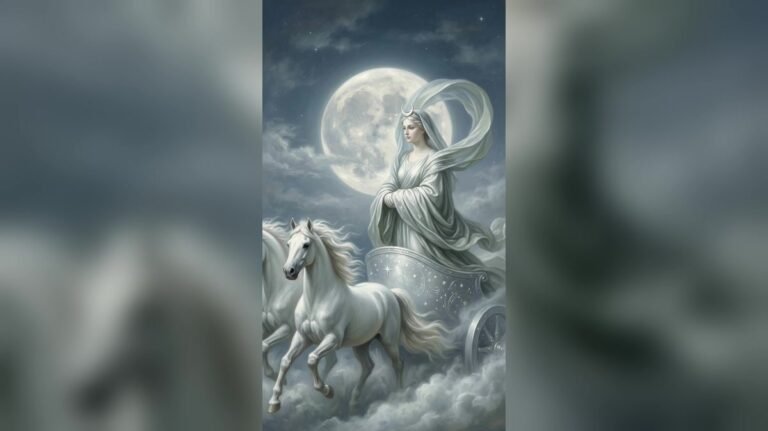
Coyolxauhqui is the moon goddess of the golden bells, the sister who fell from the Hill of Serpents and, in the best known telling, rose again as the moon. Here is who Coyolxauhqui is, where her story really comes from, what her famous stone shows, and a quiet way to honour the waning moon in her week. She is part of our moon goddesses series, from the Hunter’s Moon to Samhain.
Coyolxauhqui at a glance
Say it: koy ol SHAUW kee. The x sounds like sh, and the stress falls on the third syllable.
Name: usually translated as painted with bells, or she of the bells on her cheeks.
Tradition: Mexica (often called Aztec), from the Valley of Mexico in the fifteenth and sixteenth centuries.
Known for: leading her four hundred brothers against their mother, her fall from Coatepec, and the great carved stone found in Mexico City in 1978.
Family: daughter of the earth goddess Coatlicue, sister of Huitzilopochtli and the Centzon Huitznahua.
Symbols: golden bells, white down feathers, the serpent hill, the moon.
Moon: honoured today with the waning moon.
Who Is Coyolxauhqui?
Coyolxauhqui is a goddess of the Mexica, the people who built the great city of Tenochtitlan on an island in Lake Texcoco, where Mexico City stands today. You will often see her called the Aztec moon goddess. The Mexica did not call themselves Aztecs; that name became popular with European writers in the nineteenth century, and many museums in Mexico now prefer Mexica.
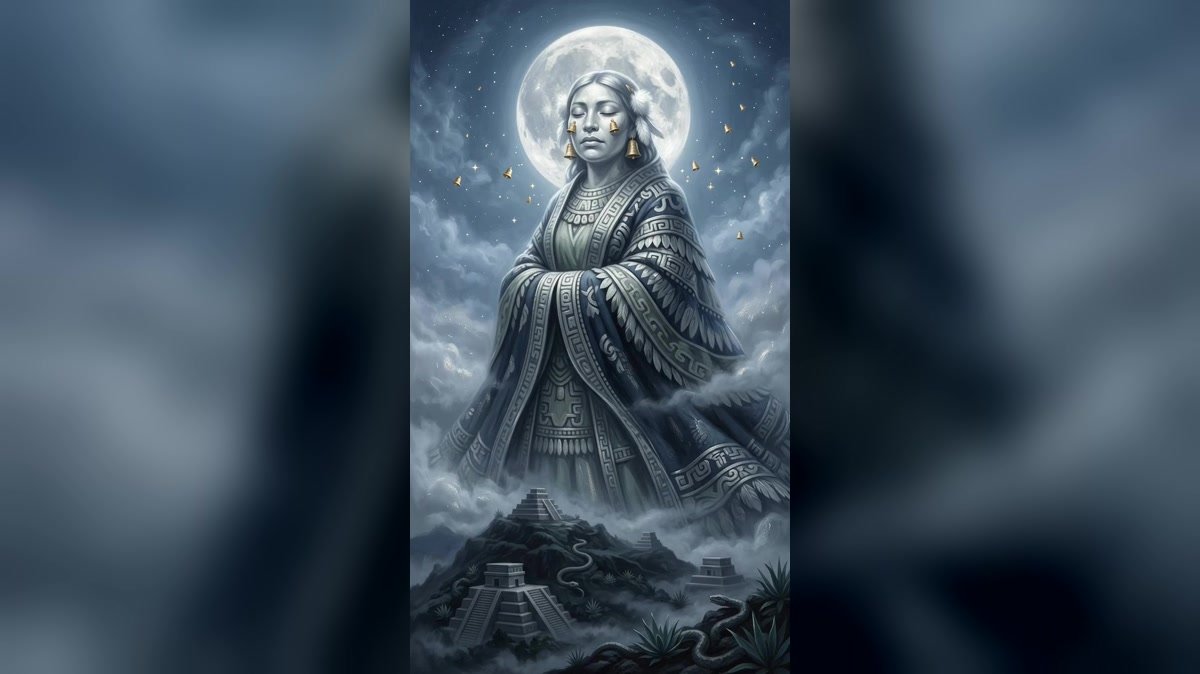
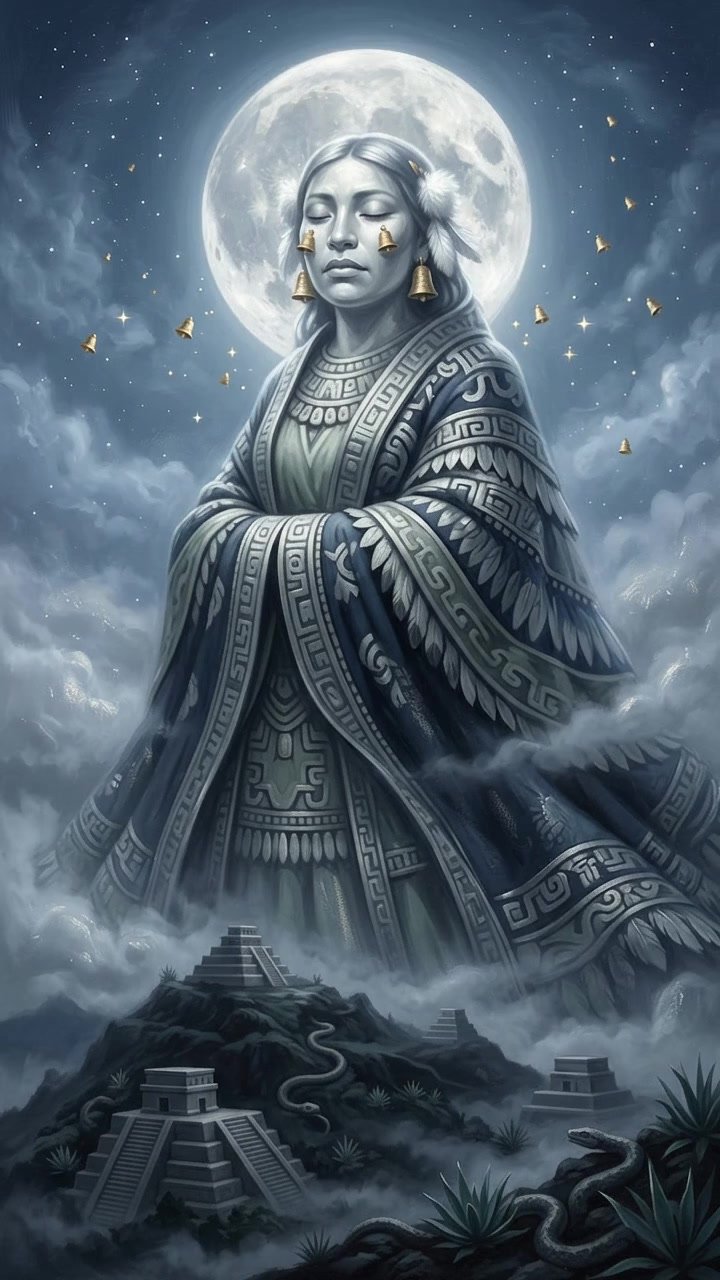
She is known first by her face. On her cheeks she wears small round bells, and her name is usually read as painted with bells. In her hair sit soft balls of white down feathers. Bells of copper and gold were cast across ancient Mexico and worn on the body, so she is a goddess you might hear as well as see.
In her story she is a warrior, the proud eldest sister of four hundred brothers. Today many people see in her the moon, loss and the work of putting yourself back together.
She is the moon that breaks into pieces every month and still comes back whole.
The Story of Coyolxauhqui at Coatepec
What follows is myth, told as story. It comes mainly from one account, set down in the sixteenth century, and there are other versions.
A ball of feathers
On Coatepec, the Hill of Serpents near Tula, the goddess Coatlicue kept a shrine, and every day she swept it as an act of devotion. One day, as she swept, a ball of fine feathers drifted down from the sky. She picked it up and tucked it into the cloth over her breast. When her sweeping was done she looked for the feathers and they were gone. From that moment she was carrying a child.
The sister who led the four hundred
Coatlicue already had a daughter, Coyolxauhqui, and four hundred sons, the Centzon Huitznahua, whose name means the four hundred southerners. When they saw their mother was with child, they were ashamed and angry. Coyolxauhqui urged her brothers on, and together they decided their mother must die. They dressed for war and set off up the hill, with Coyolxauhqui at their head.
The fall from the hill
The child in Coatlicue’s womb was Huitzilopochtli, who would become the great god of the sun and of war for the Mexica. One of the brothers secretly warned him as the army climbed. As they reached the top, Huitzilopochtli was born, fully grown and armed with a weapon called the fire serpent. He struck down his sister, and Coyolxauhqui fell from the summit, broken apart as she tumbled to the foot of the hill. Then he chased the four hundred brothers around the mountain and scattered them.
In a later and much loved telling, her head was cast up into the sky and became the moon, so that her mother could see her shining every night, while her brothers became the stars of the southern sky. It is a beautiful ending, but it is hard to trace in the earliest sources, so hold it as a later layer.
What the Coyolxauhqui Story Means
Many scholars read the Coatepec story as a picture of the sky. The sun rises each morning and the moon and stars fade before it. Seen that way, Huitzilopochtli is the sun, his sister the moon, and the four hundred brothers the stars, scattered by every dawn.
It was also about their city. The Templo Mayor at the heart of Tenochtitlan was built as Coatepec, with the shrine of Huitzilopochtli at the top and the figure of his fallen sister at the foot of its stairs, exactly where the story says she came to rest.
The Coyolxauhqui Stone
On 21st February 1978, workers from the Mexico City electricity company were digging beneath a street corner in the historic centre when they struck a great carved stone. It turned out to be a round disc of volcanic andesite about three and a quarter metres across and roughly eight tonnes in weight, showing Coyolxauhqui after her fall.
The find proved that the Templo Mayor lay under the colonial streets, and the archaeologist Eduardo Matos Moctezuma went on to lead years of excavation there. The stone itself is displayed in the Museo del Templo Mayor, with a replica at the spot where it was found.
The carving shows her fallen and broken apart, her arms and legs separated from her body, which is exactly how the story describes her at the foot of Coatepec. She still wears a bell on her cheek, bells and balls of down in her hair, a feathered headdress and a serpent belt. Traces of paint show it was once bright with yellow, red and blue.
A second famous portrait is a large greenstone head with bells on her cheeks and a calm, heavy lidded face, now in the National Museum of Anthropology in Mexico City. It is the serene face many people picture when they think of her.
The Honest History of Coyolxauhqui
What the old sources say
The full story of Coatepec comes from the Florentine Codex, the great encyclopedia of Nahua life made by the friar Bernardino de Sahagún with Nahua scholars and artists, and completed in 1577. It is written in Nahuatl and Spanish side by side, and you can explore it in the Digital Florentine Codex from the Getty Research Institute. The tale of her fall is in Book Three, on the origin of the gods. A shorter version of the same episode appears in an account of the Mexica migration by the chronicler Alvarado Tezozómoc.
The stone and the greenstone head are older, carved in the fifteenth century, which shows the story of the fallen sister mattered long before the Spanish arrived in 1519.
Was she really a moon goddess?
This is where honesty matters. Many writers, and Mexico’s own national institute of anthropology and history, describe her as a lunar goddess. But the old sources never quite say it. The idea that her head became the moon is hard to find in the sixteenth century texts, and some scholars link her instead with the Milky Way or with the stars. The World History Encyclopedia gives a clear summary of both views.
The Mexica had another moon figure too. In the story of the Fifth Sun, also in the Florentine Codex, the proud god Tecciztecatl becomes the moon, and the gods throw a rabbit at his face to dim his light, which is why people in Mexico see a rabbit in the moon. If you read our post on Chang’e, you will know the moon has a rabbit in China too.
What is modern
From the 1970s, Chicana writers and artists in the United States took up Coyolxauhqui as a symbol of women and of healing. The writer Gloria Anzaldúa spoke of the Coyolxauhqui imperative, the deep urge to gather up the scattered pieces of yourself and become whole again, in her book Light in the Dark. That reading is new, and it is genuinely meaningful to a great many people.
Coyolxauhqui belongs to the living heritage of Mexico and of Mexican and Indigenous communities today. Mystic Grove does not offer any Mexica ritual. The practice below is our own simple moon practice, inspired by what her story has come to mean, not a copy of anything the Mexica did.
Coyolxauhqui in the Week of the Hunter’s Moon
The Hunter’s Moon is full at 4.12am GMT on Monday 26th October 2026, in Taurus, with the Sun in Scorpio. UK clocks go back to GMT at 2am on Sunday 25th October, so the evenings draw in an hour earlier and the moon has a long dark sky to cross. By Friday 30th, Coyolxauhqui’s day, the moon is waning gibbous, about three quarters lit, rising in the mid evening and riding high in the small hours. By Friday evening it has moved into Cancer, the sign traditionally ruled by the moon, a gentle sign for home, family and feeling.
Her day sits just right. The moon is losing its light a little each night, as she broke apart on the hill, and it reaches last quarter on Sunday 1st November. The waning moon is the traditional time for letting go and taking stock, and the next night is Samhain, when Hecate closes our week at the crossroads.
Our guide to the Hunter’s Moon 2026 has the full timings, and lunar shadow work and the dark moon follows the cycle on into the darkest nights.
Crystals for Coyolxauhqui
No Mexica source links Coyolxauhqui with any crystal. The stones below are modern correspondences, chosen for her story and her symbols: the golden bells, the white down, the greenstone head, the volcanic stone of her valley and the waning moon. Each is one we stock.
Pyrite, for the golden bells
Pyrite shines like polished metal and catches the light the way her bells would have done. It is a stone of confidence, which suits a sister who led four hundred brothers up a mountain. Our pyrite heart on a stand sits beautifully on a moon altar.
Black obsidian, for the volcanic valley
Obsidian is natural volcanic glass, and the Valley of Mexico is ringed with volcanoes. The Mexica worked it into blades and mirrors, and it is a traditional stone for the waning moon and Samhain. Try a black obsidian tower.
Green moonstone, for the greenstone head
Greenstone was precious to the Mexica, worth more than gold, and her serene head was carved from it. A green moonstone palm stone brings together that green and the soft sheen of the moon, and it fits comfortably in the hand.
Howlite, for the white down
Soft white down crowns her hair, on the great stone and in the paintings of her. Calm, chalky white howlite echoes it, and many people keep it by the bed for quieter sleep. Our howlite tower suits a bedside or a windowsill under the moon.
Smoky quartz, for the waning moon
Smoky quartz is clear quartz darkened slowly in the earth. It is the classic grounding stone for the waning moon, for setting something down and letting it rest. A smoky quartz tower is a good companion for this week.
Carnelian, for the painted stone
Her great stone was once painted in warm red and yellow. Carnelian carries those colours and is linked with energy and a brave heart. A carnelian wand works well held in the hand while you speak your words aloud.
If you only have one stone, choose clear quartz and tell it plainly what you are asking for. Any of these stones can also be chosen as a single tumblestone.
A Gentle Waning Moon Practice for Coyolxauhqui
This is our own simple practice for the evening of Friday 30th October, or any waning moon night. It borrows nothing from Mexica ritual. Its theme is the one many people find in her story: gathering yourself back together. You need a white chime candle, a pen and paper, a small dish and one of the stones above.
- Set your space. Place the candle in its holder with the dish beside it and your stone in your hand. Face the moon if you can.
- Light the candle. Say aloud: Coyolxauhqui, lady of the golden bells, I honour you on this waning moon.
- Write the scattered pieces. On the paper, write the parts of your life that feel pulled in different directions this autumn. Keep it private.
- Gather them in. Fold the paper towards you, once for each piece, and place it in the dish with the stone on top.
- Sit a while. Watch the flame, or simply breathe slowly. If you have a small bell, you might ring it once and listen to the sound fade, like the moon losing its light. Silence is just as good.
- Close. Thank her, put out the candle, and leave the dish where it is until the new moon, then recycle or bury the paper.
Light a candle for Coyolxauhqui
Our Manifest Magic chime candles come in ten colours. White is the colour of the moon and of the down in her hair, and yellow echoes the golden bells on her cheeks, ready for Friday 30th October.
The Seven Moon Goddesses Film
Coyolxauhqui is the sixth of our seven moon goddesses. Watch all seven together in our short film.
Questions People Ask About Coyolxauhqui
What is Coyolxauhqui the goddess of?
Coyolxauhqui is the Mexica goddess usually described as the goddess of the moon. In her story she is a warrior who leads her brothers against their mother. Some scholars link her with the Milky Way or the stars rather than the moon.
How do you pronounce Coyolxauhqui?
Say koy ol SHAUW kee. In Nahuatl the x is pronounced like sh, and the stress usually falls on the third syllable.
What does the name Coyolxauhqui mean?
It is usually translated as painted with bells, from the Nahuatl word coyolli, a bell. That is why she is shown with bells on her cheeks and is often called the goddess of the golden bells.
What is the Coyolxauhqui Stone?
A round carved stone about three and a quarter metres across, showing the goddess after her fall. Electricity workers found it in Mexico City on 21st February 1978, and it is now in the Museo del Templo Mayor.
Who killed Coyolxauhqui?
In the story, her brother Huitzilopochtli, who was born fully armed on the hill of Coatepec just as she and the four hundred brothers arrived to attack their mother, Coatlicue.
Is Coyolxauhqui the Aztec moon goddess?
She is the best known. The Mexica also told of the moon god Tecciztecatl, and her own link with the moon is much loved but less certain in the oldest sources.
Bring Coyolxauhqui home
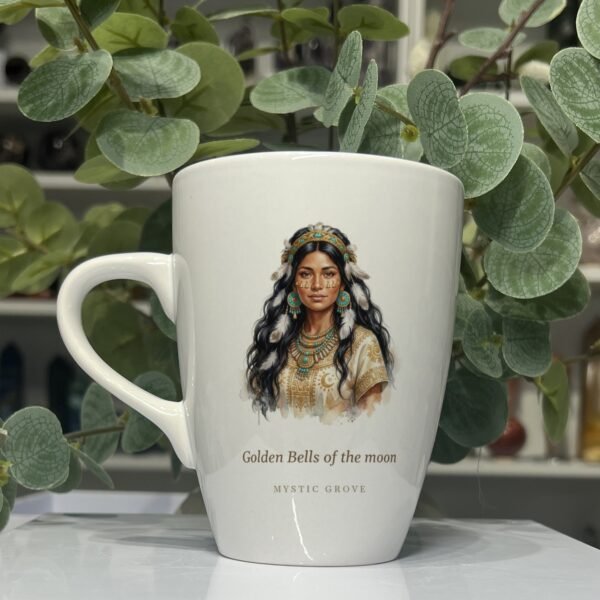
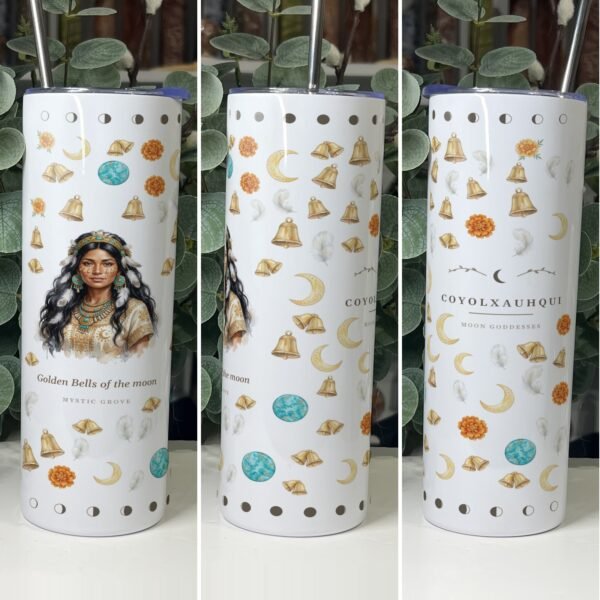
The Coyolxauhqui artwork from this series now comes on a 13oz white ceramic mug and a 20oz skinny tumbler wrapped all the way round in golden bells, feathers and marigolds. Each one comes with a printed card telling her story, so it is ready to keep or to give.

Leave a Reply